
 Worksheets
Energy Study Guide/ Extra Credit
Total questions: 75
Worksheet time: 3hrs 41mins
Which method of heat transfer occurs through direct contact?
Radiation
Convection
Conduction
Evaporation
Which of the following is an example of convection?
A) A spoon heating up in hot soup
B) The sun warming your skin
C) Warm air rising in a room
D) A metal rod getting hot at one end
Radiation differs from conduction and convection because it:
Requires a medium
Transfers energy through particles
Can occur in a vacuum
Only happens in solids
Which surface would absorb the most radiant energy?
Shiny white
Dull black
Shiny silver
Transparent glass
Which of the following is the best conductor of heat?
Copper
Wood
Plastic
Glass
What causes warm air to rise?
It is heavier
It is less dense
It reflects radiation
It conducts better
Which is an example of radiation?
Boiling water
A microwave heating food
A metal rod heating up
A fan blowing warm air
Which material is a good insulator?
Aluminum
Water
Styrofoam
Steel
In which state of matter does convection occur most easily?
Solid
Liquid
Gas
Which of the following is NOT a method of heat transfer?
Conduction
Convection
Radiation
Compression
What type of energy is stored in a stretched rubber band?
Kinetic
Thermal
Potential
Chemical
Which of the following has the most kinetic energy?
A parked car
A rolling ball
A compressed spring
A battery
Kinetic energy depends on:
Mass and height
Mass and speed
Speed and temperature
Height and temperature
Potential energy increases when:
An object is moving faster
An object is lifted higher
An object is cooled
An object is compressed
What is the formula for gravitational potential energy?
KE = ½mv²
PE = mgh
PE = ½kx²
E = mc²
What is the kinetic energy of a 2 kg object moving at 3 m/s?
3 J
6 J
9 J
18 J
A 5 kg object is lifted to a height of 10 m. What is its potential energy? (g = 9.8 m/s²)
50 J
98 J
490 J
980 J
Which of the following is an example of energy transformation?
What is specific heat?
Heat needed to melt a substance
Heat needed to raise 1 kg of a substance by 1°C
Heat needed to boil water
Heat needed to change state
What is the formula for heat energy?
Q = mcΔT
Q = mv²
Q = mgh
Q = P × t
How much heat is needed to raise the temperature of 2 kg of water by 5°C? (c = 4186 J/kg°C)
4186 J
8372 J
If 1000 J of heat raises the temperature of 0.5 kg of a substance by 10°C, what is its specific heat?
20 J/kg°C
100 J/kg°C
200 J/kg°C
500 J/kg°C
Which factor does NOT affect the amount of heat absorbed?
A) Mass
B) Temperature change
C) Specific heat
D) Color
Why does water heat up more slowly than metal?
It has a lower density
It has a higher specific heat
It reflects heat
It conducts heat better
Energy is transferred from hot to cold objects by:
Gravity
Magnetism
Heat
Which is an example of energy transfer by conduction?
Sunlight warming your face
A pot heating on a stove
Warm air rising
A microwave oven
Which of the following is a pathway for energy transfer in a power plant?
Chemical → Thermal → Mechanical → Electrical
Electrical → Mechanical → Thermal
Mechanical → Chemical → Electrical
Thermal → Electrical → Chemical
Which of the following best describes energy conservation?
Energy is destroyed in reactions
Energy is created from nothing
Energy changes form but is not lost
Energy disappears after use
Which of the following is an example of potential energy?
A stretched bow
A moving bicycle
Sunlight
Boiling water
What is the main method of heat transfer in liquids?
Conduction
Convection
Radiation
Absorption
Which factor increases the kinetic energy of an object?
Decreasing its mass
Lowering its height
Increasing its speed
Cooling it down
Which material would make the best insulator?
rubber
steel
copper
aluminum

At what point does the biker have the greatest Kinetic Energy?
Point A
Point B
Point C
Point D
At what point does the biker have the greatest Potential Energy?
Point A
Point B
Point C
Point D
At what point does Potential Energy transform into Kinetic Energy?
Point A
Point B
Point C
Point D
Choose which things might spin a generator to produce electricity. (Check all that apply)
wind
water
animals

Which will heat up faster?
copper
granite
iron
basalt
Which of the following best explains why the sand at the beach is hotter than the water?
Sand has a higher specific heat than water.
Sand has a lower specific heat than water.
There is more water than sand at the beach.
There is more sand than water at the beach.
The amount of energy required to raise the temperature 1ºC for every gram is called____?
Thermal Energy
Specific Heat
Temperature
Kinetic Energy
The specific heat of platinum is 0.133 J/g°C. How much heat(Q) is released when a 10 g piece of platinum cools from 100°C to 50°C?
66.5 J
665 J
0.0266 J
0.665 J


The SI units J/g°C measures
Specific heat
mass
temperature
heat energy
Heat lost or gains = ?
C = 4.18 J/g.c
M = 508 g
Change in Temp = 100 c and 120 c
42,468.8 J/g.c
42,468.8 J
11,000 J
12,456.3 J
Heat lost or gains = ?
C = 4.18 J/g.c
M = 508 g
Change in Temp = 100 c and 120 c
42,468.8 J/g.c
42,468.8 J
11,000 J
12,456.3 J

The heating curve below represents a sample of a substance starting as a solid below its melting point and being heated over a period of time. Which statement describes the energy of the particles in this sample during interval DE?
Both potential energy and average kinetic energy increase.
Both potential energy and average kinetic energy decrease.
Potential energy increases and average kinetic energy remains the same.
Potential energy remains the same and average kinetic energy increases.
Heat is added to a sample of liquid water, starting at 80.°C, until the entire sample is a gas at 120.°C. This process, occurring at standard pressure, is represented by the balanced equation below.
H2O(l) + heat → H2O(g)
Which diagram correctly represents the heating curve for this physical change?


Based on the graph and information shown in Figure 2, what phase change is occurring between minutes 2-6?
fusion
solidification
vaporization
condensation

Fill in the blank: The graph in Figure 2 shows that the compound is in the ______ phase at 15°C.
Solid
Liquid
Gas

Given the diagram shown representing a heating curve for a substance: During which time interval is the average kinetic energy of the particles of the substance constant while the potential energy of the particles increases?
AC
BC
CD
DF

Is a metal cookie sheet a conductor or an insulator?
Conductor
Insulator

Is a potholder a conductor or an insulator?
Conductor
Insulator
Which of the following is an insulator for thermal energy?
A coat
A glass window
A metal pan
A car is traveling down a flat road. Its velocity increases. What happens to its kinetic energy?
it increases
it is constant
it decreases
A car is traveling down a flat road. It has its cruise control on. What happens to its kinetic energy?
it increases
it is constant
it decreases

The kinetic energy is 15 Joules. The mass is increased by a factor of 3. What is the new kinetic energy?
5 Joules
45 Joules
1.7 Joules
135 Joules

Gravitational potential energy depends on the ________ and ________ of the object.
Height and mass
Friction and movement
Mass and Movement
Height and Friction

What is the potential energy of a person flying down from a height of 1000 m that has a mass of 70 kg?
1070 J
700,000 J
686,000 J
9800 J

What is the potential energy of a piece of paper falling off your desk from a height of 1 meter, if it has a mass of 0.05kg
4.9 J
9.8 J
0.5 J
0.49 J

What is the energy of a 1325 kg mass that is rolling at a speed of 1.5 m/sec?
19.4775 J
19477.5 J
1490.625 J
1.497 J

What is the KE of a football which has a mass of 0.8 kg and is kicked at a velocity of 10m/s.
80 J
3.2 J
160 J
40 J

You serve a volley ball with a mass of 2.1 kg. The ball leaves your hand with a speed of 30m/s. The ball has ____ kinetic energy. Calculate it.
1890 J
3780 J
945 J
31.5 J
What is the force that is pulling a skydiver towards the Earth?
Elastic Force
Electrical Force
Magnetic Force
Gravitational Force
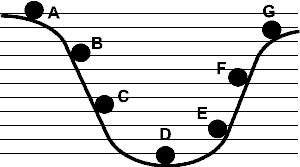
At which point does the ball has the greatest gravitational potential energy (GPE)?
A
G
D
C
G
How could you increase the gravitational potential energy of an object without changing its mass and gravity?
Make the object larger
Lower the object towards the ground
Raise the object farther off the ground
Allow the object to roll on the ground

