
Font size
S
M
L
XL
 Worksheets
8th Grade Science STAAR Review: Reporting Category 3 (Part 2)
Total questions: 47
Worksheet time: 24mins
Name
Class
Date
1.
What scientist first formally proposed that the Earth’s landmasses were once joined together as one giant supercontinent that had since drifted apart?
a)
Harry Hess
b)
Albert Einstein
c)
Isaac Newton
d)
Alfred Wegener
2.
The name given to the super-continent was: (a)
3.
Why was the idea of Pangaea not accepted by the scientific community when it was first proposed by Wegener?
a)
Wegener was not liked in the scientific community
b)
Wegener was not a creditable scientist
c)
Wegener stole the idea from another scientist named Hess
d)
Wegener could not explain HOW the continents moved
4.
What are 3 pieces of evidence used to support the Continental Drift Theory? Select four correct answers.
a)
fossil evidence
b)
South America and Africa fit like a puzzle
c)
glacial clues
d)
volcanic eruptions
5.
Harry Hess’ discovery of seafloor spreading provided the mechanism to explain how continental drift could work. The two hypotheses were merged into what is now known as the _____________ Theory. It proposes that the lithosphere is broken into plates that float on top of the asthenosphere.
a)
Continental Drift
b)
Pangaea
c)
Plate Tectonics
d)
Earth's Shift
6.
According to Alfred Wegener's Theory of Continental Drift, the continents were once joined together as one giant landmass called Pangaea. What major forms of evidence did Wegener use to support his theory?
Select TWO correct answers.
a)
The same species of bird is currently found on 2 or more continents.
b)
Similar rock and fossil evidence have been found on the coastlines of tow or more continents
c)
Magnetic striping found in seafloor spreading shows a pattern of Earth's magnetic field reversal over time.
d)
Glacier deposits have been found on two or more continents near the equator.
e)
Convection currents in the mantle move the Earth's crustal plates, causing plate boundaries to collide, separate, or slide against one another.
7.
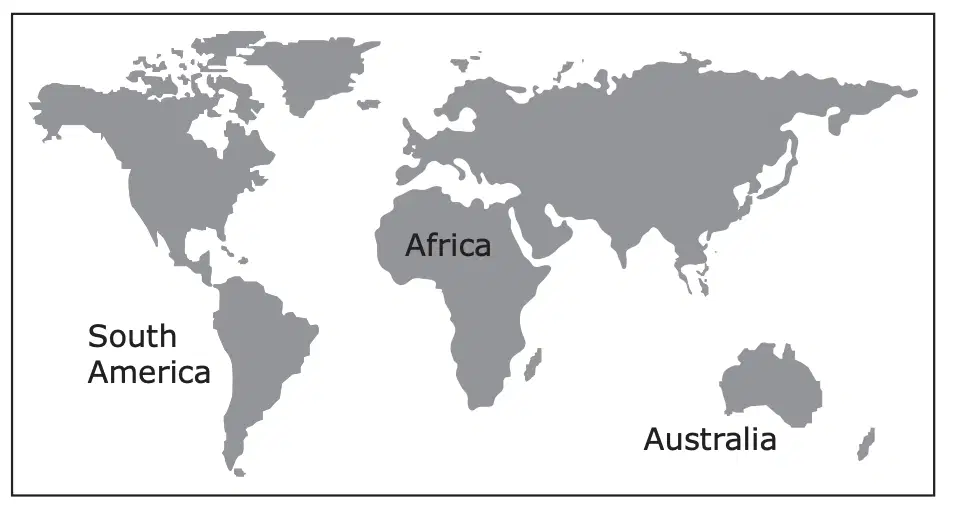
STAAR QUESTION: Alfred Wegener noticed fossils of similar non-aquatic animals had been found in Africa, South America, and Australia. What conclusion did Alfred Wegener make?
a)
The animals were carried on boats as people moved to new areas.
b)
The animals migrated across the ocean in search of food.
c)
The continents were once connected.
d)
There were no oceans during the time these animals lived.
8.
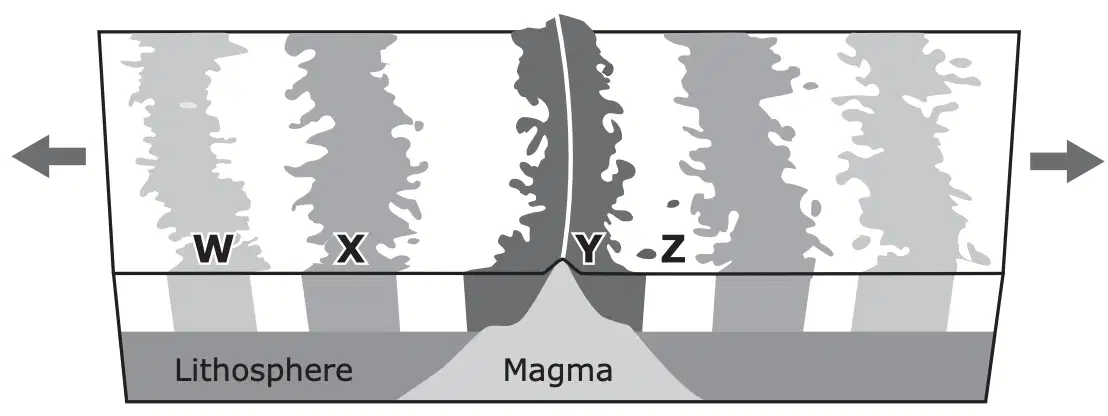
STAAR QUESTION: It was not until the 1950s that scientists navigated along the ocean floor of the Atlantic Ocean and discovered an underwater mountain range. The diagram below shows rock being formed at a mid-ocean ridge.
At which position is the rock the oldest?
a)
W
b)
X
c)
Y
d)
Z
9.
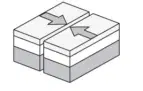
Example of a (a) boundary.
10.
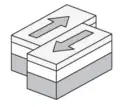
Example of a (a) boundary.
11.
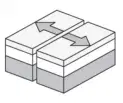
Example of a (a) boundary.
12.

What type of boundary is this?
a)
Convergent - Ocean to Continent - Subduction
b)
Convergent - Continent to Continent
c)
Convergent - Ocean to Ocean - Subduction
d)
Transform
e)
Divergent
13.

What type of boundary is this?
a)
Convergent - Ocean to Continent - Subduction
b)
Convergent - Continent to Continent
c)
Convergent - Ocean to Ocean - Subduction
d)
Transform
e)
Divergent
14.

What type of boundary is this?
a)
Convergent - Ocean to Continent - Subduction
b)
Convergent - Continent to Continent
c)
Convergent - Ocean to Ocean - Subduction
d)
Transform
e)
Divergent
15.
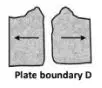
What type of boundary is this?
a)
Convergent - Ocean to Continent - Subduction
b)
Convergent - Continent to Continent
c)
Convergent - Ocean to Ocean - Subduction
d)
Transform
e)
Divergent
16.
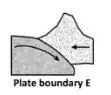
What type of boundary is this?
a)
Convergent - Ocean to Continent - Subduction
b)
Convergent - Continent to Continent
c)
Convergent - Ocean to Ocean - Subduction
d)
Transform
e)
Divergent
17.
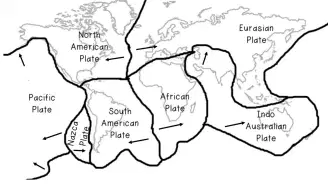
Look at the plate boundary located off the western coast of South America. This is most likely an area of -
a)
sea-floor spreading because the plates are spreading apart.
b)
folded mountains because the plates are colliding.
c)
subduction because the plates are colliding.
d)
mid-ocean ridges because the plates are pulling apart.
18.
Which features form at plate tectonic boundaries?
Select THREE correct choices.
a)
A ridge can form when two plates move apart.
b)
A mountain range can form when two plates collide.
c)
A valley can form when two plates are pushed upward.
d)
New crust can form when two plates slide past each other.
e)
A trench can form when one plate moves beneath another.
19.

STAAR QUESTION: The Mariana Trench is the deepest part of Earth's ocean. It is located where the Pacific Plate subducts beneath the Mariana Plate.
Which statement best describes the movement of plates forming the Mariana Trench?
a)
The Pacific Plate moves west while the Mariana Plate moves east forming the Mariana Trench.
b)
The Pacific and Mariana Plates both move east forming the Mariana Trench.
c)
The Pacific Plate moves east while the Mariana Plate moves west forming the Mariana Trench.
d)
The Pacific and Mariana Plates both move west.
20.
STAAR QUESTION: A group of students models crustal movement to understand stress caused by plate movement. The students demonstrate compression by squeezing a piece of aluminum foil with equal pressure from both hands. What type of crustal feature is the group MOST LIKELY forming?
a)
A divergent boundary that forms an ocean ridge
b)
A convergent boundary that forms a volcano
c)
A transform boundary that forms a fault line
d)
A divergent boundary that forms a volcano
21.
Which of best fills in the blanks: The process of ___________, the transfer of thermal energy in liquids and gases, causes wind because __________ air rises and ________ air sinks.
a)
conduction/hot/cool
b)
convection/cool/hot
c)
conduction/cool/hot
d)
convection/hot/cool
22.
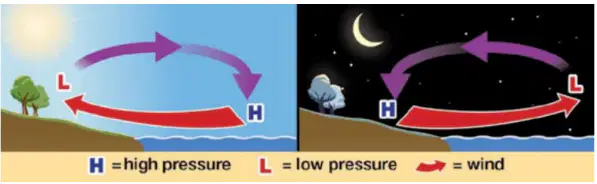
Use the diagram to answer the four parts. Part A: Sea breezes blow from the ocean to the shore because-
a)
as the Earth rotate on its axis, breezes are created.
b)
ocean currents cause large waves which makes wind blow toward shore.
c)
the Sun heats up the water more quickly.
d)
the Sun heats up the land more quickly.
23.
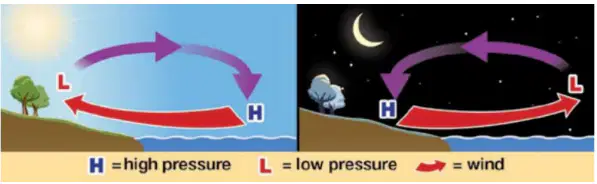
Part B: What does the illustration on the right panel show?
a)
a sea breeze
b)
a land breeze
c)
the Coriolis effect
d)
cold fronts
24.
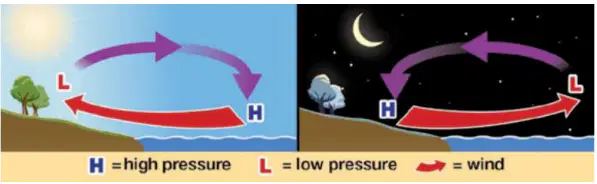
Part C: What is the name of the process that causes the events shown in the illustrations above?
a)
radiation
b)
conduction
c)
convection
d)
weathering
25.
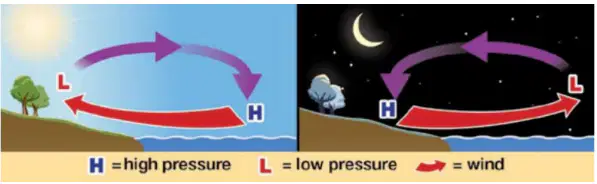
Part D: These diagrams illustrate the fact that-
a)
water vapor in the atmosphere condenses to form clouds.
b)
winds are produced by the uneven heating of the land by the Sun.
c)
water vapor evaporates more quickly when temperatures are warmer.
d)
weather conditions mainly occur in the Earth’s lower atmosphere.
26.
When visiting the beach, Felicity observed that a breeze blew in from the ocean during the day and out toward the ocean at night. Which factor is MOST responsible for the direction of land and sea breezes in coastal regions?
a)
the revolution of Earth around the Sun
b)
the uneven heating between the land and water
c)
the gravitational pull of Earth on the atmosphere
d)
the daily rise and fall of tides in a regular pattern
27.

Select three correct answers associated with the image shown.
a)
cold front
b)
warmer temperatures and more humid
c)
rain, possible violent storms
d)
warm front
e)
light to moderate rain
28.

Select three correct answers associated with the image shown.
a)
cold front
b)
warm front
c)
light to moderate rain
d)
rain, possible violent storms
e)
cooler temperatures and drier
29.

Select two correct answers associated with the image shown.
a)
stationary front
b)
occluded front
c)
usually light rain or other precipitation
d)
often brings many days of almost continuous precipitation
30.

Select three correct answers associated with the image shown.
a)
stationary front
b)
occluded front
c)
usually light rain or other precipitation
d)
often brings many days of almost continuous precipitation
31.
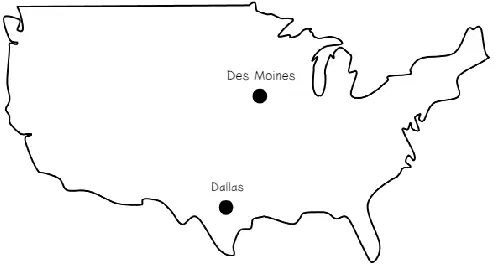
Dallas has been experiencing several days of light drizzle with very little change in temperature. What the type of front is present in the Dallas area.
a)
Option 1
b)
Option 2
c)
Option 3
d)
Option 4
32.
Which weather map shows a cold front headed through Des Moines moving southeast.
a)
A
b)
B
c)
C
d)
D
33.
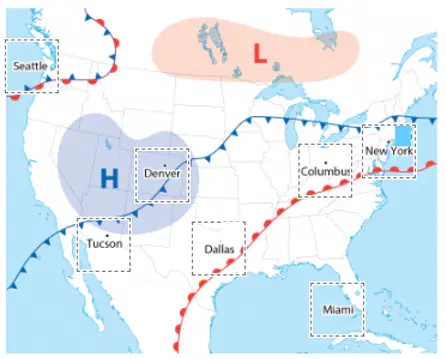
Which cities will be experiencing a increasing temperatures within the next 24 hours?
Select THREE correct answers.
a)
Dallas
b)
Columbus
c)
New York
d)
Seattle
e)
Tucson
34.
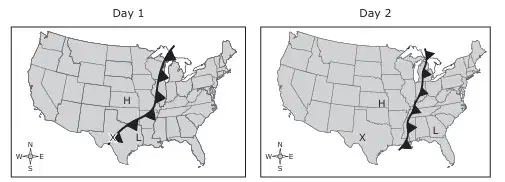
Maps of predicted weather conditions are shown.
Which answer choice best describes the weather at location X on Day 1 and Day 2?
a)
Day 1: warm and rainy Day 2: cool with more rain
b)
Day 1: warm and windy Day 2: clear skies and cold
c)
Day 1: clear and cool Day 2: warm and rainy
d)
Day 1: clear and cool Day 2: warm and rainy
35.

The weather map shows the weather conditions for one day across the United States.
Based on the weather map, which city will most likely experience decreasing temperatures during the next 24 hours?
a)
Denver, because it is raining there
b)
Minneapolis, because a cold fron is appoaching
c)
Atlanta, because a warm front is approaching
d)
Houston, because it is in a high pressure area
36.
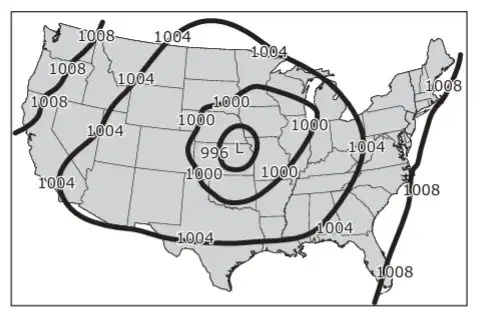
The weather map shows air pressures in millibars.
Which set of conditions best describes the weather at the area of lowest air pressure?
a)
Bright sun with no wind
b)
Partly cloudy with no wind
c)
Mostly sunny with light winds
d)
Overcast skies with strong winds
37.
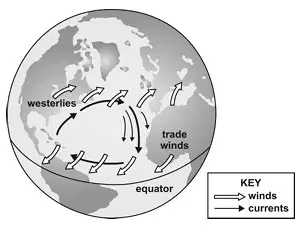
Analyze the diagram of winds and currents on Earth.
Which occurrence is the source of energy does not driving these winds and currents?
a)
the Coriolis effect
b)
the rotation of Earth
c)
. the gravitational pull of the moon
d)
the uneven heating of Earth by the sun
38.
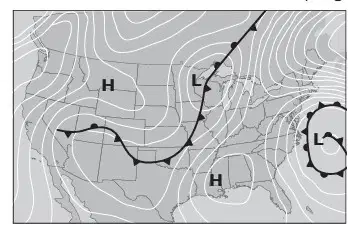
The weather map provides the current weather conditions across the United States on a spring day.
What weather conditions will MOST LIKELY occur in the southern part of the United States one day after the front passes through?
a)
Warmer temperature with clouds and rain
b)
Cooler temperatures and clea skies
c)
Warmer temperatures with clear skies
d)
Cool temperature and cloudy skies
39.
How does the jet stream influence weather?
a)
The jet stream causes warm fronts to move from south to north
b)
The jet stream causes cold fronts to move from south to north
c)
The jet stream causes warm fronts to move from north to south
d)
The jet stream causes cold fronts to move from east to west
40.
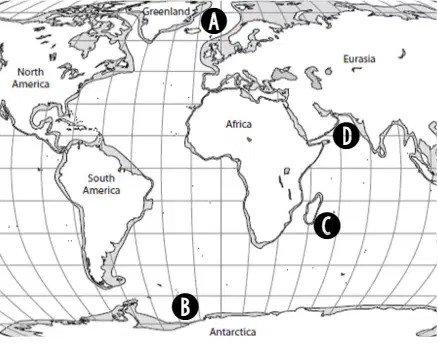
Hurricanes begin over oceans. Which location below most likely produced the most violent storms?
(a)
41.
The ocean surface current that runs along the west coast of the U.S. bringing cool water from the polar region is called the ___________Current. Along the east coast, the _____________Current brings warmer water from the tropical region.
a)
US Current, Florida
b)
Florida, California
c)
California, Gulf Stream
d)
Gulf Stream, US Current
42.
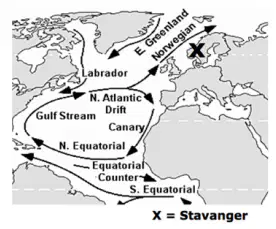
Stavanger, Norway has a warmer climate than the rest of Norway. What could cause this?
a)
Stavanger is the southernmost city.
b)
The Gulf Stream current carries warm water to the Stavanger area.
c)
The Arctic Current carries cold water toward Norway
d)
There is no sea ice in the region to create the cold, deep ocean currents.
43.
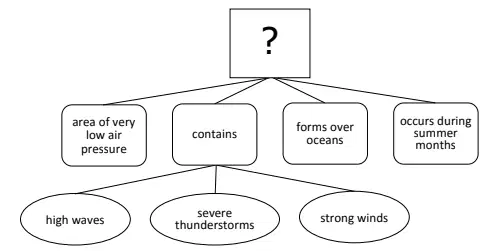
Which of the following best describes the conditions found above and should replace the question mark?
a)
Hurricane
b)
Tsunami
c)
Tornado
d)
Water spout
44.
How do oceans contribute to the formation of hurricanes?
a)
Earthquakes on the ocean floor cause large waves.
b)
Fast-moving ocean currents increase the speed of wind.
c)
Warm ocean water supplies the energy for storms to grow.
d)
Cold ocean water directly cools and condenses into rain.
45.
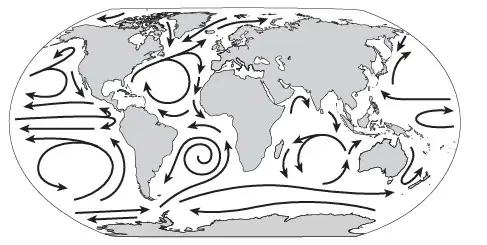
Major surface currents of the ocean are shown in the diagram.
Ocean currents affect weather patterns by —
a)
regulating when tides occur in coastal areas
b)
trapping heat at the equator to regulate the global climate
c)
distributing heat from the uneven absorption of solar energy
d)
increasing the rate of evaporation to transport water to areas experiencing droughts
46.
Which of the following increases the gravitational attraction between two objects? Select two correct answers.
a)
Increase the mass of the objects
b)
Decrease the distance between the objects
c)
Increase the distance between the objects
d)
Change the color of the objects from light to dark
e)
Increase the orbital path of at least one of the objects
47.
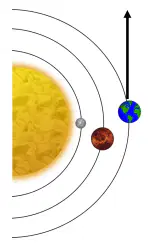
What keeps the Earth from traveling in an elliptical orbit around the Sun instead of traveling in a straight line ( as shown with the arrow)?
a)
The gravitational attraction between Earth and Venus.
b)
The electromagnetic force between the surrounding planets.
c)
The centripetal force of the Earth's moon.
d)
The gravitational attraction between the Sun and the Earth.
Reset

