
 Worksheets
AP HuG Semester Final
Total questions: 50
Worksheet time: 58mins
Match the following
Decline
movement of industries out of a city
Ecumene
permanently inhabitated earth's surface
Urban
high # of people
suburbs
residential areas
rural
low # of people
Match the following
Settlement
permanent human population
urbanization
developing towns/cities, causes & effect
percent urban
proportion of urban pop : rural pop
suburbanization
people --> suburbs
reurbanization
suburbs --> urban
Match the following
hexagon
because it's the fairest shape
threshold
pop. required 4 a business to stay alive
range
how far are you willing to go 4 somethin
megacity
world's biggest cities (10 mil. people+)
world/global cities
country influence expands beyond borders
Match the following
central place
location where people go for goods
hamlet
tiny community
Match the following
time-space compression
it's a small world after all!
pedestrian cities
cities where people can walk
streetcar suburbs
communities w/ rail lines
urban system
interdependent set of cities in a region
gravity model
places that are closer communicate more
Match the following
exurbanization
--> rural
satellite city
town near big city becomes independent
city-states
urban center + nearby territory + ag 🏙
urban hearths
river valleys
social heterogeneity
population diversity
ag surplus
rise in social stratification/leadership class
job specialization
economic expansion
purchasing power increase
car-centered life
new highways from gov
mortgage loans
racial tension
"white flight"
legally
metropolitan: adj. cities where population is high + continuous
MSA - nodal region - cities w/ 10,000<50,000 people
epochs
sail wagon
iron horse
steel vail
auto-air amenity

The images show examples of agricultural technology developed during different time periods. Which of the following statements is best supported by the images?
Image 2 shows an innovation that occurred in the Second Agricultural Revolution, reducing the amount of labor needed and increasing crop yields.
Image 2 shows an innovation that occurred late in the First Agricultural Revolution, increasing farmers' profits.
Image 1 shows an innovation that occurred early in the Second Agricultural Revolution resulting in more sustainable livestock production.
Image 2 shows an innovation that occurred in the Third Agricultural Revolution, resulting in a diffusion of agricultural practices to less developed countries.
Image 1 shows an innovation that occurred early in the Third Agricultural Revolution, improving the standard of living for small farmer families.
Which of the following best explains the significance of similarities between the farming practices for apple orchards and grape vineyards?
Both farming practices occur in the same climate region, which is found in places such as Italy and South Africa.
Both farming practices require considerable labor input because the fruit is picked by hand, making it a product of intensive agriculture.
Both farming practices are used for tropical plantation crops grown on large estates with hired labor who plant and harvest crops.
According to von Thünen, both farming practices occur in the outermost areas of agricultural land.
According to land-rent theory, both farming practices are found on small farms and must be located close to markets.

Using the data shown, which of the following best explains the spatial variations of rural women’s roles in food production and food preparation?
In less developed countries, females tend to participate more than males in harvesting and less in preparation tasks.
In more developed countries, females and males tend to participate equally in food-production tasks.
In less developed countries, females and males tend to participate equally in food-production tasks.
In more developed countries, females tend to participate more than males in harvesting and less in preparation tasks.
In less developed countries, females and males tend to participate equally in harvesting and preparation tasks.
Sheep production in New Zealand and poultry production in Arkansas produce food animals for human consumption. Which of the following best describes the differences in the agricultural practices and land use for these products?
Sheep production is an example of intensive agriculture requiring large amounts of fertilizer, whereas poultry production is an example of extensive agriculture practiced mainly in more developed countries.
Sheep production and poultry production are both examples of extensive agriculture practiced on large areas of land, but requiring different climates.
Sheep production is an example of extensive agriculture requiring large pastures, whereas poultry production is an example of intensive agriculture often practiced indoors.
Sheep production and poultry production are both examples of intensive agriculture practiced on small areas of land but requiring different amounts of labor and capital.
Sheep production is an example of extensive agriculture that is declining because of an insufficient supply of open land, whereas poultry production continues to be practiced on small areas of land.
Which of the following is an explanation for the similar impact of large-scale commercial agriculture in developed countries and plantation agriculture in developing countries?
Both farming practices stimulate local economies with the influx of profits from export-oriented crops.
Both farming practices involve the consolidation of family farms and displacement of rural communities.
Both farming practices provide an increased standard of living in rural communities from the many jobs created to run these large farms.
Both farming practices enable local farmers to remain on their land rather than migrating to jobs in urban areas.
Both farming practices guarantee that long-term sustainable farming methods will be incorporated in their production processes.
Which of the following explains an impact of globalized agricultural commodity chains on consumers as compared to producers?
Drought and depletion of groundwater sources in developing countries cause a rise in global grain prices and associated higher costs for food.
The shift from subsistence farming to value-added agriculture by small farmers in developed countries causes a drop in profits for global agribusiness corporations.
The imposition of government-imposed tariffs on specialty crops in order to protect domestic farmers causes a worldwide decrease in all farm products.
Farmers in developing countries who are unable to gain access to global food markets to sell their goods protest, leading to global unrest.
Agricultural production with a focus on monocropping cash crops creates more vulnerability in a country’s exports if consumer preferences shift to a different commodity.

Compare the two maps and examine the data for Africa, the Middle East, and South Asia. Which of the following statements is supported by the comparison of the two maps?
There is less food produced in these regions and therefore fewer women working in agriculture.
Many women in these regions work on farms and grow food for their families, but not all are paid to do this work.
Agriculture is considered a prestigious field in these regions, and they have the highest percentage of women working in agriculture.
There is a strong correlation between countries with a large percentage of women in the paid workforce and women working in agriculture.
Typically women in these regions work for agribusiness in the formal paid workforce.
Which of the following is the most often cited environmental benefit of the eat-local movement?
Less fossil fuel is used in transporting food to market.
Fewer pesticides are used by farmers.
Less topsoil is lost to wind and water erosion.
There is less demand for chemical fertilizers.
It helps local and regional economies.

The chickens shown in the image are an example of value-added agriculture used by small family-run farms to compete with large agribusiness poultry and egg farms. Which of the following types of value-added products best describes the kind of agriculture shown in the image?
Local-food movement
Free-range
Nongenetically modified
Fair-trade
Community-supported
Isolated farmsteads in the United States evolved as a result of all of the following EXCEPT
political stability
colonization by individual pioneer families
agricultural private enterprise
government land policy
physical barriers preventing communal farm practices
Labor-intensive intertillage is often practiced in
The Canadian Wheat Belt
Southeast Asia
The Turkish Highlands
The English Countryside
New Zealand
Which of the following is a characteristic of shifting cultivation?
Dependency on irrigation
Sharecropping
Production of cash crops for export
Demand for wage laborers
Multicropping
The clearing of tropical rain forest for agriculture frequently results in
long-term productive farmland
a shift to animal raising
an increase in the size of the ozone hole
better-managed commercial forests
large-scale immigration
All of the following statements about the geography of meat production in the United States and Canada are true EXCEPT
Industrial farmers are raising ever-increasing numbers of animals on their farms
Animal slaughtering and meat-processing activities are dominated by a few large corporations
The development of the poultry industry has made chicken the least expensive kind of meat consumed in the United States and Canada
Fast-food restaurants have created a demand for increased standardization and homogeneity of animals raised for meat
Consumer demand for organic foods has significantly decreased the amount of meat produced by most agribusiness firms
Why is the traditional classification of agriculture as a primary economic activity a problem when considering the geography of agriculture?
Modern farmers are engaged in production, research, marketing, and some manufacturing of their products.
Agricultural employment is such a small fraction of the labor force in the industrialized countries that agriculture can no longer be thought of as a primary economic activity.
Unlike mining, forestry, and other primary activities, agriculture has not been affected by industrialization.
Traditional patterns of farming are disappearing.
Modern farmers use machinery.
During the first half of the twentieth century, which of the following facilitated the transportation of beef over long distances to global markets?
Commercial canning
Irradiation of food
Refrigerated ships
Airplanes
High-speed railroads
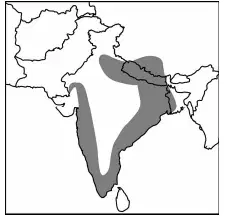
On the map above, the shaded area is most associated with which of the following types of agriculture?
Truck farming
Plantation agriculture
Slash-and-burn cultivation
Rice cultivation
Dairy farming
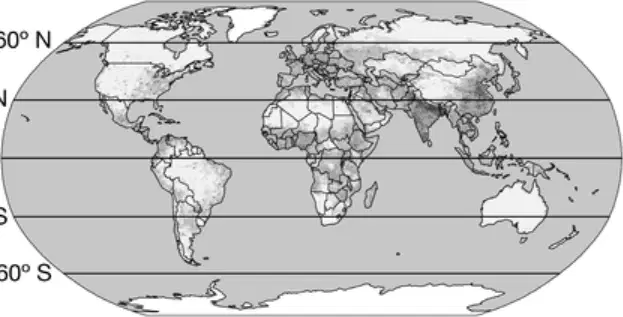
The map shows global population density shaded from low to high. Which type of data is shown by the number of people per unit of land?
Agricultural density
Physiological density
Arithmetic Density
Urban density
Suburban density
Physiological population density is viewed as a superior measure of population density for which reason?
It best reflects the percentage of a country’s population that is urbanized.
It yields the average population density.
It is more reflective of the world’s largest population concentrations.
It measures the average by dividing total land area by total number of people.
It is more reflective of population pressure on arable land.
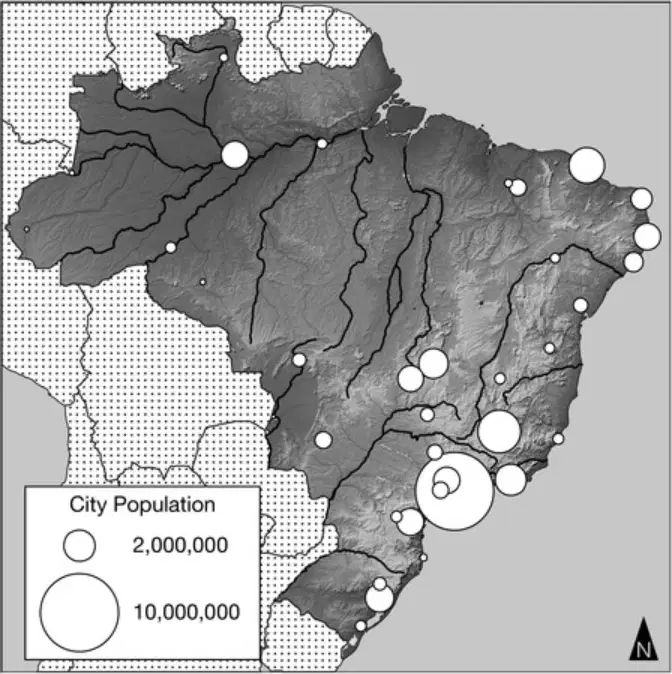
Which of the following describes information a geographer could identify from the map of urban populations in Brazil?
Urban areas most at risk for overpopulation
Distribution of high and low incomes
Areas with negative population growth
Patterns of arithmetic density within specific regions
Urban areas with rapid population growth
What term describes the maximum number of individuals that an environment can support without being degraded?
population density
growth rate
carrying capacity
resource allocation
ecological footprint
Which of the following factors most contributes to the growth of urban populations in highly developed countries?
a critical need for workers in the primary economic sector
Availability of diverse employment options and advanced infrastructure
Large expanses of undeveloped rural land
Preference for rural lifestyles and open spaces
Lack of access to modern healthcare and education
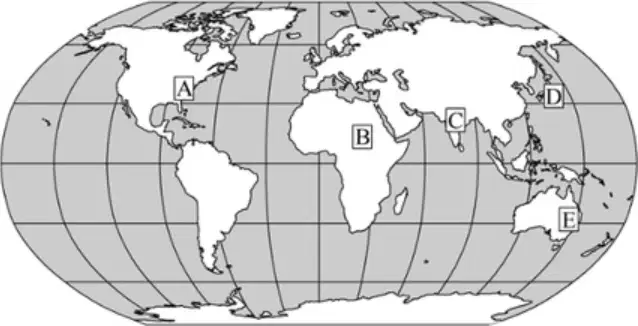
On the world map with labeled boxes A, B, C, D, and E, which box is in a region where the population density is low and the level of economic development is high?
A
B
C
D
E
The demographic indicator that represents the average number of children a woman is expected to have during her reproductive years is known as the
gross reproduction rate
general fertility rate
crude birth rate
age-specific birth rate
total fertility rate
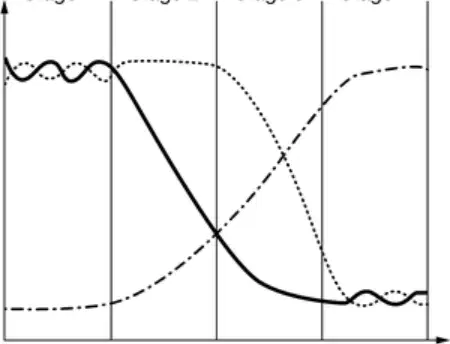
Which factor most contributes to the stabilization of population growth in stage 4 of the demographic transition model?
High infant mortality rates and limited access to healthcare
Increased urbanization and widespread access to family planning
Predominantly agricultural economy and low literacy rates
Traditional gender roles and early marriage
Rapid industrialization and high birth rates
Which of the following demographic trends in Europe, Canada, and the United States since the 1970s is most closely linked to changes in women’s participation in the workforce and evolving social roles?
Declining birth rates
Rising birth rates
Increasing average household size
Decreasing life expectancy
Rising infant mortality rates
Which of the following best describes the characteristics of stage 2 in the demographic transition model?
High birth rates and high death rates.
Declining birth rates and low death rates.
High birth rates and rapidly falling death rates.
Low birth rates and high death rates.
Low birth rates and low death rates.
Olivia is studying different countries for her geography class. She wants to identify which characteristic is most likely to be found in more-developed countries. Which of the following characteristics applies to more-developed countries?
Early stages of epidemiological transition
Rapid population growth
High total fertility rates
Long life expectancies
Early stages of the demographic transition
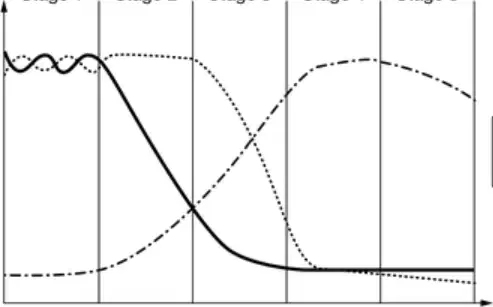
Based on the Demographic Transition Model diagram, which of the following is most likely to be a major health concern for a country in stage 2 of the demographic transition model?
Degenerative diseases such as heart disease and cancer
Diseases related to aging populations
Long life expectancies
Health issues caused by overnutrition and sedentary lifestyles
Genetic disorders due to increased life expectancy
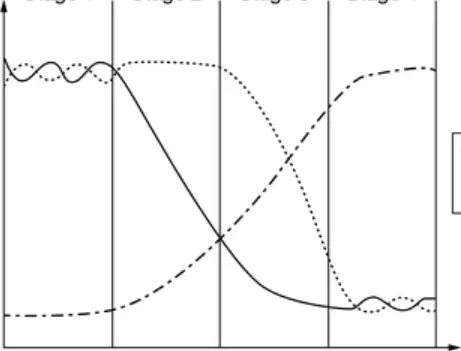
According to the Demographic Transition Model diagram, which of the following is most likely to occur as a country progresses from stage 3 to stage 4?
Birth rate falls below death rate
Rapid increase in total population
High infant mortality rate
Decreasing access to healthcare
Rising agricultural employment
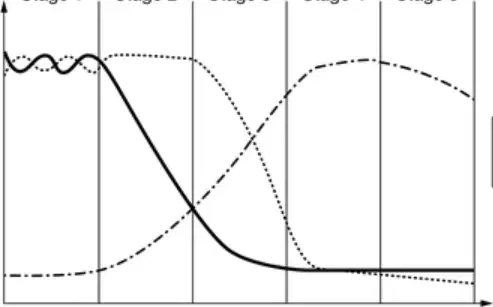
Based on the Demographic Transition Model diagram, which of the following best explains the relationship between declining death rates and the changes in total population during the transition from stage 1 to stage 2?
Declining death rates in stage 2 are primarily due to a sudden drop in birth rates, leading to a decrease in total population.
Declining death rates in stage 2 result from advances in medicine and public health, causing the total population to increase rapidly.
Declining death rates in stage 2 are caused by increased migration, which stabilizes the total population.
Declining death rates in stage 2 are due to economic decline, resulting in a lower total population.
Declining death rates in stage 2 are unrelated to changes in total population.
Thomas Malthus predicted that population growth would outpace food production, leading to widespread famine. However, this did not occur in 19th-century Europe. Which of the following best explains why?
Religious reforms encouraged people to consume less food
European countries implemented strict population control policies that limited family size.
Large-scale emigration from Europe reduced the population and food demand.
Colonial expansion provided unlimited access to new food resources.
Technological advancements in agriculture and changes in family structure led to increased food production and slower population growth.
Which of the following statements best summarizes Thomas Malthus’s view on the relationship between population growth and food supply in the late eighteenth and early nineteenth centuries?
Malthus believed that government intervention was unnecessary because population growth would naturally slow down overtime.
Malthus believed that technological advances would always ensure food production kept up with population growth.
Malthus believed that population growth would outpace food production unless checked by natural limits such as famine and disease.
Malthus believed that increased population would automatically lead to increased agricultural innovation and food supply.
Malthus believed that overpopulation could only be prevented by mandatory family planning policies.

Based on the data shown, which of the following describes the most likely population context for the countries listed?
High youth dependency ratio and a lack of economic resources to provide for large families
Rapid population growth in cities as people migrate from rural to urban areas for industrial jobs
Shortage of arable land on which to raise crops and other food products to support the population
Unstable food supply due to a rapidly growing population
Stage five of the demographic transition model due to very low birth rates

The characteristics of this population pyramid reflect the demographics of
A country in Stage 1 of the DTM
A country in Stage 2 of the DTM
A country in Stage 3 of the DTM
A country in Stage 4 of the DTM

