
 Worksheets
Biology Final Exam /First Semester/2025/2026
Total questions: 64
Worksheet time: 32mins
Name
Class
Date
1.
Write Your Name
4 lines
2.
Write Your Section
4 lines
3.
1- How many chromosomes are typically found in human somatic cells?
a)
A) 23
b)
B) 46
c)
C) 22
d)
D) 44
e)
E) 48
4.
2- Which of the following best describe the term “crossing over”?
a)
a. An exchange of information between two homologous chromosomes
b)
b. A molecular interaction between two sister chromatids
c)
c. A molecular interaction between two non-sister chromatids
d)
d. A separation of two sister chromatids
5.
3- A cell with 24 chromosomes undergoes meiosis, the sex cells produced will each have ________________ chromosomes.
a)
a. 6
b)
b. 12
c)
c. 24
d)
d. 48
6.
4- Chromosomes are doubled during _____________.
a)
a. interphase
b)
b. prophase
c)
c. metaphase
d)
d. anaphase
7.
5- During _____________ in mitosis, double-stranded chromosomes separate and go to opposite ends of the cell.
a)
a. Interphase
b)
b. metaphase
c)
c. prophase
d)
d. anaphase
8.
6-During ________ stage in mitosis, the nuclear membrane disappears.
a)
a. interphase
b)
b. metaphase
c)
c. prophase
d)
d. anaphase
9.
7- A laboratory technician examined cells during their division. He observed chromosomes occupying the middle of the cell. The corresponding phase is:
a)
A. Prophase
b)
B. Metaphase
c)
C. Anaphase
d)
D. Telophase
e)
E. Interphase
10.
8- In Metaphase I, what are homologous pairs of chromosomes held by?
a)
A) Centromere
b)
B) Chromatid
c)
C) Histones
d)
D) Chiasmata
e)
E) Telomeres
11.
9- In eukaryotic cells, which protein do chromosomes coil around during cell division?
a)
A) DNA polymerase
b)
B) RNA polymerase
c)
C) Histones
d)
D) Ribosomes
e)
E) Polymerase II
12.
10- What is the main difference between mitosis and meiosis?
a)
A) Mitosis produces diploid cells, while meiosis produces haploid cells.
b)
B) Meiosis produces diploid cells, while mitosis produces haploid cells.
c)
C) Mitosis involves two rounds of cell division, while meiosis involves one round.
d)
D) Meiosis involves the synthesis of DNA, while mitosis does not.
e)
E) Mitosis occurs in somatic cells, while meiosis occurs in germ cells.
13.
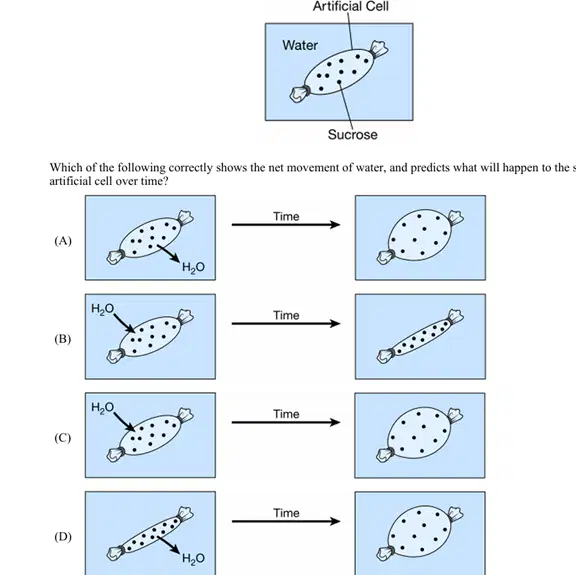
11- In order to model osmosis, students created an artificial cell using dialysis tubing (a thin membrane that water can pass through but that sucrose cannot) and a solution made of sucrose (a type of sugar) dissolved in water. The students filled the dialysis tubing with the sucrose solution, tied the open ends of the tube, and placed the artificial cell in a beaker containing distilled water as shown in the figure.
a)
A
b)
B
c)
C
d)
D
14.
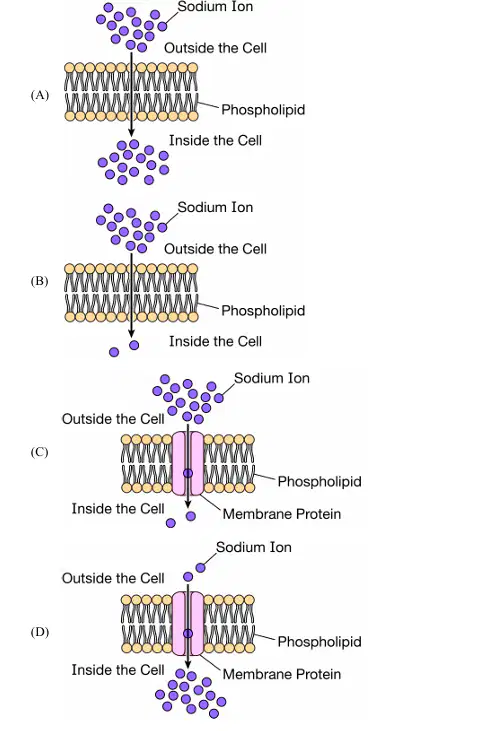
12- Which of the following models best represents the movement of sodium ions into cells by facilitated diffusion?
a)
A
b)
B
c)
C
d)
D
15.
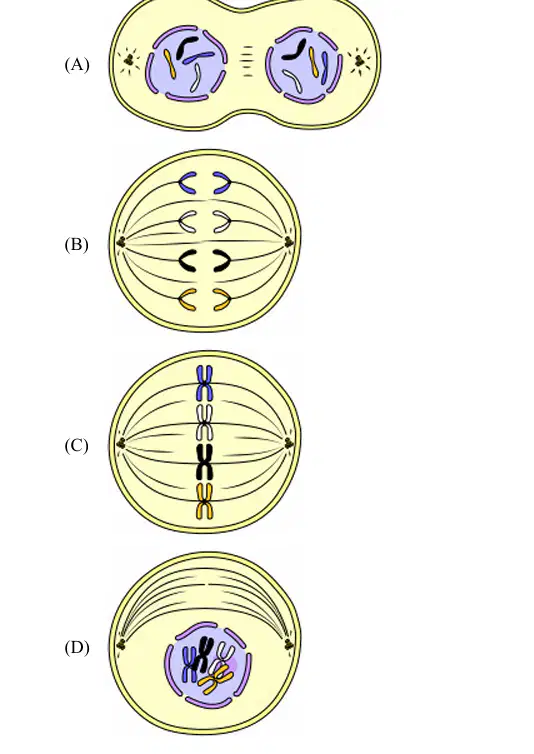
13- During cell division, the spindle checkpoint ensures that spindle fibers have attached to each of the chromosomes. Which of the following models represents the stage of mitosis that would occur immediately AFTER the cell passes through this checkpoint?
a)
A
b)
B
c)
C
d)
D
16.
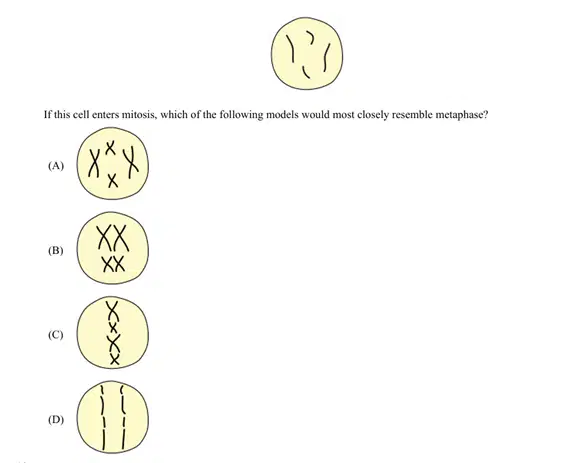
14- A model of a cell with two pairs of chromosomes is shown below. If this cell enters mitosis, which of the following models would most closely resemble metaphase?
a)
A
b)
B
c)
C
d)
D
17.
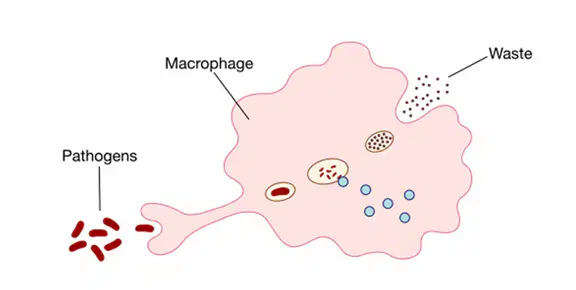
15- Macrophages are cells that have an important role in the human immune system. The following diagram illustrates how macrophages function. When a pathogen is detected, macrophages engulf and destroy the pathogen.
Which of the following statements most reasonably explains how the cellular structures that are found in macrophages help them to destroy pathogens?
a)
A) Macrophages have an abundance of chloroplasts because chloroplasts are needed to provide energy to the cells to destroy pathogens.
b)
(B) Macrophages have an abundance of lysosomes because lysosomes contain the enzymes needed to destroy the pathogens.
c)
(C) Macrophages have an abundance of nuclei because nuclei contain the genetic information necessary to identify and destroy pathogens.
d)
(D) Macrophages have an abundance of vacuoles because vacuoles store the waste products after pathogens are destroyed.
18.
16- Which macromolecule is responsible for the formation of a cell's membrane?
a)
A- nucleic acids
b)
B- carbohydrates
c)
C- proteins
d)
D- lipids
19.
17- The hydrogen, oxygen, and carbon atoms in a glucose molecule are held together by:
a)
A- Hydrogen bonds
b)
B- Covalent bond
c)
C- Ionic bond
d)
D- Van der Waals
20.
18- Which of the following is not a property of water?
a)
It is adhesive.
b)
It is cohesive.
c)
It combusts.
d)
It is a good solvent.
21.
19- A substance that hates, or “fears” water is called
a)
polar
b)
Ionic
c)
Non polar
d)
reactant
22.
20- Circle the letter of each sentence that is true about water's specific heat.
a)
a. It is due to the many attractions among water molecules.
b)
b. It makes large bodies of water heat up more quickly than nearby land.
c)
c. It makes large bodies of water cool off more slowly than nearby land.
d)
d. It leads to warmer air over land than over water on summer days.
23.
22- Which of the following polymers contain nitrogen?
a)
Carbohydrates
b)
proteins
c)
lipids
d)
cellulose
24.
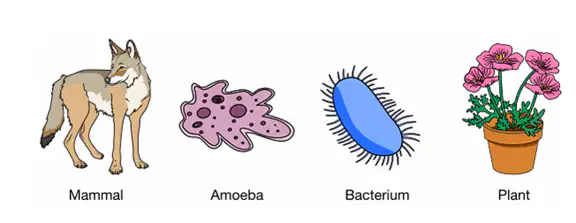
23- Which THREE of the following cellular structures are found in all four organisms shown above?
a)
Plasma membrane
b)
B Nucleus
c)
C Ribosome
d)
D Cell wall
e)
E Cytoplasm
25.
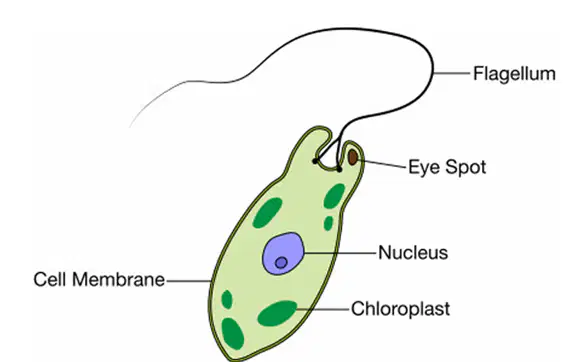
24- Students observed a sample of pond water using a microscope as shown below. Mateo claims that the organism in the sample is a prokaryote. Nia claims that the organism is a eukaryote. Which student’s classification of the organism is correct?
a)
(A) Mateo's claim is correct because only prokaryotes have flagella.
b)
(B) Mateo's claim is correct because only prokaryotes have chloroplasts.
c)
(C) Nia's claim is correct because only eukaryotes have a cell membrane.
d)
(D) Nia's claim is correct because only eukaryotes have a membrane-bound nucleus.
26.
25- Which of the following most reasonably explains how the cell membrane helps cells maintain homeostasis while the cells are performing aerobic cellular respiration?
a)
(A) Oxygen diffuses across the cell membrane into the cell to be used during aerobic cellular respiration.
b)
(B) The cell membrane is impermeable to oxygen, which enables increased rates of aerobic cellular respiration.
c)
(C) Carbon dioxide diffuses across the cell membrane into the cell to be used during aerobic cellular respiration.
d)
(D) The cell membrane is impermeable to carbon dioxide, which enables increased rates of aerobic cellular respiration.
27.
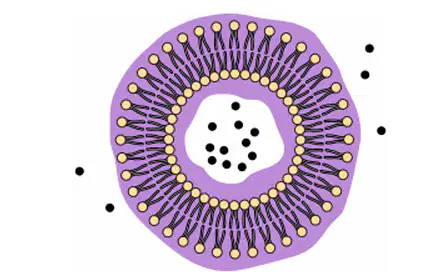
26- The following is a simplified model of a cell in a solution. The solvent in the solution is water. The solute is represented by the small black circles and can diffuse into and out of the cell. Based on the figure, which of the following best predicts the net movement of solutes?
a)
A) There will be a net movement of solutes into the cell until there are no longer solutes outside the cell.
b)
(B) There will be a net movement of solutes into the cell until the cell has approximately the same concentration of solutes as the solution.
c)
(C) There will be a net movement of solutes out of the cell until there are no longer solutes inside the cell.
d)
(D) There will be a net movement of solutes out of the cell until the cell has approximately the same concentration of solutes as the solution.
28.
27- How can apoptosis be defined?
a)
cell death
b)
incomplete mitosis
c)
complete mitosis
d)
cell growth
29.
28- Which of the following is the number of chromosomes in a haploid cell?
a)
4n
b)
1n
c)
3n
d)
2n
30.
29- which organelle is responsible for protein synthesis?
a)
chloroplast
b)
mitochondria
c)
lysosomes
d)
Endoplasmic Reticulum
31.
30- Protein pumps are used for
a)
A. Moving Ions from low concentration to high concentration using energy (ATP)
b)
B. Transporting substances down their concentration gradient without energy
c)
C. Allowing water to diffuse freely across the membrane
d)
D. Breaking down large molecules into smaller ones
32.
31- B-lymphocytes differentiate into plasma cells that produce and secrete antibodies. Microscopic observations showed that plasma cells have more ribosomes, RER, Golgi bodies, and mitochondria in comparison to B-lymphocytes. How can you explain these observations?
a)
A. Ribosomes, RER, and Golgi bodies are important for cell division, while mitochondria are important for supplying the cell with energy.
b)
B. Ribosomes, RER, and Golgi bodies are important for DNA replication, while mitochondria are important for supplying the cell with energy.
c)
C. Ribosomes and RER are important for DNA replication, while mitochondria and Golgi bodies are important for supplying the cell with energy.
d)
D. Ribosomes and RER are important for the synthesis of antibodies, while mitochondria and Golgi bodies are important for supplying the cell with energy.
e)
E. Ribosomes, RER, and Golgi bodies are important for the synthesis of antibodies, while
33.
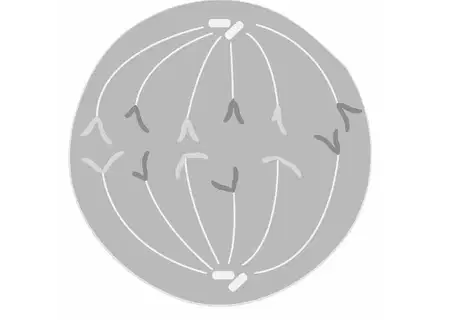
32- Referring to the below figure, how many chromosomes did the initial cell have before it started the division?
a)
A. 3 chromosomes
b)
B. 6 chromosomes
c)
C. 23 chromosomes
d)
D. 46 chromosomes
e)
E. 12 chromosomes
34.
33- ____________is the movement of solutes along a concentration gradient without the need for energy.
a)
A. Osmosis
b)
B. Exocytosis
c)
C. Active transport
d)
D. Diffusion
e)
E. Endocytosis
35.
34- A living cell is placed in a beaker containing a solution with a concentration of 5 mmol/L. The intracellular concentration is 10 mmol/L. The membrane of the cell is impermeable to the particles of the solute. What do you think might happen after a few hours?
a)
A. Osmosis of water from intracellular to extracellular medium will occur, and the cell will shrink.
b)
B. Osmosis of water from intracellular to extracellular medium will occur, and the cell will swell.
c)
C. Osmosis of water from extracellular to intracellular medium will occur, and the cell will shrink.
d)
D. Osmosis of water from extracellular to intracellular medium will occur, and the cell will swell.
e)
E. Diffusion of solute particles from extracellular to intracellular medium, and the cell
36.
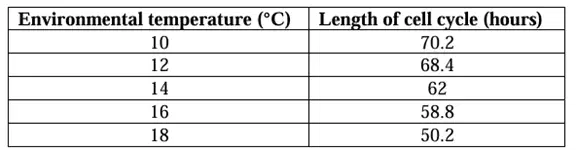
35- The table below shows the length of the cell cycle of a plant cell at different environmental temperatures.
What conclusion can be drawn concerning the length of the life cycle of the plant cell?
a)
A. The cell cycle is fastest when the environmental temperature is 10°C.
b)
B. The cell cycle is fastest when the environmental temperature ranges between 10°C and 12°C.
c)
C. The cell cycle becomes slower as the temperature increases.
d)
D. The cell cycle becomes faster as the temperature increases.
e)
E. Environmental temperature has no effect on the duration of the cell cycle.
37.
36- What is the amount of energy provided by a meal containing 7 g of fat, 10 g of protein, and 12 g of carbohydrates? Given that 1 g of carbohydrate provides 4 kcal, 1 g of protein provides 4 kcal, and 1 g of fat provides 9 kcal.
a)
A. 29 kcal
b)
B. 22 kcal
c)
C. 151 kcal
d)
D. 111 kcal
e)
E. 63 kcal
38.
37- During an infection, the individual suffers from fever where the body temperature may reach 40°C. Based on your knowledge, what would happen to the enzymes if the body temperature remained abnormally high?
a)
A. The enzymes’ function will improve.
b)
B. The high body temperature will not affect the function of the enzymes.
c)
C. The enzymes will be inactive but conserve their structure.
d)
D. The enzymes efficiency will improve at first, then they will become inactive.
e)
E. The enzymes’ structure will be destroyed, and thus they will be unable to function.
39.

38- The table below shows the size of some eukaryotic and prokaryotic living cells. What can you conclude?
a)
A. Eukaryotic cells are larger than prokaryotic cells.
b)
B. Prokaryotic cells are larger than eukaryotic cells.
c)
C. All eukaryotic cells are approximately the same size.
d)
D. Only human cells are eukaryotic cells, which are larger than prokaryotic cells.
e)
E. Prokaryotic cells are only larger than human cells.
40.
39- The number of mitotic divisions needed to obtain 128 cells from a single cell is:
a)
A. 7
b)
B. 14
c)
C. 16
d)
D. 32
e)
E. 64
41.
40- Which statement about eukaryotic cells is not true?
a)
A. Eukaryotic cells have their genetic information enclosed inside the nucleus.
b)
B. Eukaryotic cells have membrane bound organelles.
c)
C. Eukaryotic cells are smaller in size than prokaryotic cells.
d)
D. Eukaryotic cells are more complex and have a larger quantity of DNA than prokaryotic
e)
E. Plant cells, animal cells, and fungi are examples of eukaryotic cells
42.
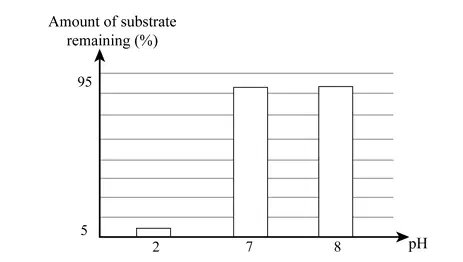
The activity of the enzyme varies under different conditions. An experiment was done where a digestive enzyme X was added to 3 test tubes containing the same convenient substrate. Chemical substances were added to create different pH values in these tubes. The activity of the enzyme was measured by measuring the amount of substrate remaining in each tube. The results are represented in the following bar graph.
41- Deduce the dependent and the independent variables in the above experiment.
a)
A. The amount of the enzyme is the dependent variable, while pH is the independent variable.
b)
B. The activity of the enzyme is the dependent variable, while pH is the independent variable.
c)
C. The activity of the enzyme is the independent variable, while pH is the dependent variable.
d)
D. The activity of the enzyme is the dependent variable, while the amount of substrate is the independent variable.
e)
E. The activity of the enzyme is the independent variable, while the amount of substrate the independent variable.
43.
42- What can you conclude from the results presented in the above bar graph?(in question 41)
a)
A. Enzme X is very active at pH 7 and pH 8, and its activity stops at pH 2.
b)
B. Enzme X is very active at pH 2, and its activity stops at pH 7 and pH 8.
c)
C. As pH increases, the activity of enzyme X increases.
d)
D. As pH decreases, the activity of enzyme X increases, and the optimum pH is 8.
e)
E. The activity of enzyme X is not affected by pH.
44.
43- To enter or leave a cell, substances must pass through
a)
a. a microtubule.
b)
b. the Golgi apparatus.
c)
c. a ribosome.
d)
d. the nucleus.
e)
e. the plasma membrane.
45.
44- Bacterial cell are prokaryotic; in comparison to a typical eukaryotic cell they would
a)
a. be smaller.
b)
b. have a smaller nucleus.
c)
c. lack a plasma membrane.
d)
d. have fewer internal membranous compartments.
e)
e. have a greater variety of organelles.
46.
45- Which of the following correctly matches an organelle with its function?
a)
a. mitochondrion . . . photosynthesis
b)
b. nucleus . . . cellular respiration
c)
c. ribosome . . . manufacture of lipids
d)
d. lysosome . . . movement
e)
e. central vacuole . . . storage
47.
46- The electron microscope has been particularly useful in studying bacteria, because
a)
a. electrons can penetrate tough bacterial cell walls.
b)
b. bacteria are so small.
c)
c. bacteria move so quickly they are hard to photograph.
d)
d. with few organelles present, bacteria are distinguished by differences in individual macromolecules.
e)
e. their organelles are small and tightly packed together
48.
47- The jelly-like fluid substance present in cells is called
a)
(a) protoplasm
b)
(c) chloroplast
c)
(b) chromosome
d)
(d) cytoplasm
49.
48- Which of the following feature will help you in distinguishing a plant cell from an animal cell?
a)
(a) cell wall
b)
(c) mitochondria
c)
(b) cell membrane
d)
(d) nucleus
50.
49- The longest stage in the cell cycle is
a)
a. Interphase
b)
b. Anaphase
c)
c. Metaphase
d)
d. cytokinesis
e)
e. None of the above
51.
50- The _______ state implies the exit of cells from the cell cycle (rest stage)
a)
a. S
b)
b. G1
c)
c. G2
d)
d. G0
e)
e. M
52.
51- Which of the following is a characteristic of lipids?
a)
a) They are composed of nitrogenous chains.
b)
b) They are polar molecules.
c)
c) They are either fats or oils.
d)
d) They are soluble in water
53.
52- Which of the following bonds are formed between the amino acids?
a)
a) Glycosidic linkages
b)
b) Hydrogen bonds
c)
c) Ester linkage
d)
d) Peptide bonds
54.
53- Which of the following macromolecules contains C, H, O, N and P?
a)
a) Amino acids
b)
b) Hormones
c)
c) Nucleic acids
d)
d) Carbohydrates
55.
54- Which of the following statements concerning unsaturated fats is true?
a)
a-They are more common in animals than in plants.
b)
b• They have double bonds in the carbon chains of their fatty acids.
c)
c• They generally solidify at room temperature.
d)
d• They contain more hydrogen than saturated fats having the same number of carbon atoms.
e)
e• They have fewer fatty acid molecules per fat molecule.
56.
55- One difference between a cancer cell and a normal cell is that
a)
a-the cancer cell is unable to synthesize DNA.
b)
b• the cell cycle of the cancer cell is arrested at the S phase.
c)
c• cancer cells continue to divide even when they are tightly packed together.
d)
d• cancer cells cannot function properly because they suffer from density-dependent inhibition.
e)
e• cancer cells are always in the M phase of the cell cycle.
57.
56- A human cell containing 22 autosomes and a Y chromosome is
a)
a• a somatic cell of a male.
b)
b• a zygote.
c)
c• a somatic cell of a female.
d)
d• a sperm cell.
e)
e• an ovum.
58.
57- Crossing over usually contributes to genetic variation by exchanging chromosomal segments between
a)
a.sister chromatids of a chromosome.
b)
b• chromatids of nonhomologues.
c)
c• nonsister chromatids of homologues.
d)
d• nonhomologous loci of the genome.
e)
e• autosomes and sex chromosomes.
59.
58- Which of these is a difference between a DNA and an RNA molecule? (Activity: DNA and RNA Structure)
a)
DNA contains uracil, whereas RNA contains thymine.
b)
• DNA is a polymer composed of nucleotides, whereas RNA is a polymer composed of nucleic acids.
c)
• DNA is double-stranded, whereas RNA is single-stranded.
d)
• DNA contains five-carbon sugars, whereas RNA contains six-carbon sugars.
e)
• DNA contains nitrogenous bases, whereas RNA contains phosphate groups.
60.
59- Explain how crossing over occurs during meiosis and describe its importance .
4 lines
61.
60- Describe is the difference between Passive and active cellular transport ?
4 lines
62.
61- which organelle is responsible for producing sugars in plants?
4 lines
63.
62- Which type of solution causes the animal cell to burst?
4 lines
64.
63- Describe the stages of interphase , write what happens during each stage
4 lines
100 %

