
 Worksheets
math class 11 (dipson gajurel)
Total questions: 91
Worksheet time: 2hrs 53mins

4
5
6
Does not exist

1
2
3
non of the above

1/2
1/3
1/4
1
If LHL ≠ RHL, then the limit:
Exists
Is zero
Is infinite
Does not exist
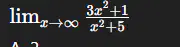
1
2
3
∞

0
-1
-2
1/2

x
2x
3x
4x
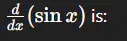
−sin x
cosx
sinx
tanx
Derivative of a constant is:
0
0.999999
1
16

ex
e
e2x
1/2
Derivative of tan x is:
sec x
sec2x
tan x
cosec x

Linear
Constant
Quadratic
Exponential
A set is a:
Collection of objects
Formula
. Relation
Function
Empty set is denoted by:
{0}
{ }
∅
{∅}
Union of sets A and B is:
A ∩ B
A ∪ B
A - B
~A
Let x→−2limf(x)=16 . Find x→−2limf(x)
4
-2
2
16
Let x→8limf(x)=3 and x→8limg(x)=10. Find x→8limg(x)f(x).
8
10/3
-7
3/10
Find x→14lim2 .
14
2
2
14
Find x→21lim4x(x−41) .
21
1
81
23
Find x→0limx−2x3−6x+8 .
0
4
-4
DNE
Find x→0lim3x+4+22 .
DNE
1
2
21
Find x→0limx1+x−1 .
21
41
DNE
0
Find x→4limx−4x2+3x−28 .
11
0
DNE
3
Find x→2limx+4x+2x−2 .
4
-4
41
−41
Find x→2limx−2x1−21 .
DNE
41
21
−41
What type of set is denoted as either { } or ∅?
Superset
Disjointed Set
Empty (or Null) Set
Subset
Find n(A) when
A = {14, 16, 18, 20, 22, 24}
6
4
12
even numbers
A = {x : x is a letter in the word SEAT}
B = {x : x is a letter in the word TASTE}
Determine if these two sets are equal or equivalent.
Not equal because seat has 4 letters and taste has 5 letters.
Equivalent because they have the same letters
Equal because each set has the same cardinality and the same letters.
If A = {1, 3, 5, 7, 9} and B = {2, 3, 5, 7}, what is A ∪ B?
{3, 5, 7}
{2, 3, 5, 7}
{2, 3, 5, 7, 9}
{1, 2, 3, 5, 7, 9}
If A = {1, 3, 5, 7, 9} and B = {2, 3, 5, 7}, what is A ∩ B?
{3, 5, 7}
{2, 3, 5, 7}
{2, 3, 5, 7, 9}
{1, 2, 3, 5, 7, 9}
The Universal Set = { -4, -3, -2, -1, 0, 1, 2, 3 ,4} and A = {0}.
What is the complement of A?
{-4, -3, -2, -1, 0, 1, 2, 3}
{-3, -2, -1, 1, 2, 3}
{-4, -3, -2, -1, 1, 2, 3, 4}
{-4, -3, -2, -1, 1, 2, 3}
If
P = {0, 1, 2, 3, 4}, Q = {4, 6, 8}
R = {6, 12, 18} Then what is (P ∩ Q) ∪ (Q ∩ R)?
{4}
{4, 6}
{4, 6, 8}
{1, 2, 3, 4, 6, 8}
If
P = {0, 1, 2, 3, 4}, Q = {4, 5, 6, 7}
R = {3, 6, 9}, and S = {6, 12, 18}
Then what is (P ∪ Q) ∩ (S ∪ R)?
{6}
{3, 6}
{4, 6}
{1, 2, 3, 4, 5, 6, 7, 9, 12, 18}
If
A = {1, 3, 5, 15},
B = {2, 3, 5, 7}
C = {2, 4, 6, 8}
then what is (A U B) ∩ C ?
{1,3,5}
{1,2,3}
{2,3,5}
{2}
If
U (the universal set) = {1, 3, 5, 7, 9, 11, 13, 15, 17} and W = {5, 7, 9, 11}, then W' = . . ..
{1, 3, 13, 15, 17}
{1, 3}
{2, 4, 6, 8, 10, 12, 14, 16}
{1, 3, 5, 7, 9, 11, 13, 15, 17}
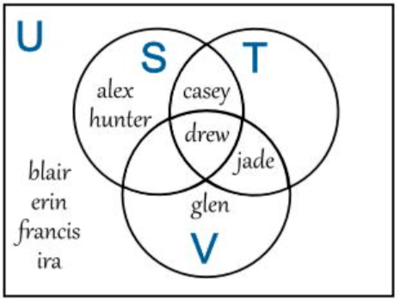
From the above Venn diagram, what is the set S ∩ T?
{casey, drew, jade, glen}
{alex, casey, drew,hunter}
{casey, drew}
{drew, jade}

From the above Venn diagram, what is the set (S ∪ T) ∩ V?
{casey, drew, jade, glen}
{alex, glen, hunter, jade}
{casey, drew, glen}
{drew, jade}

From the above Venn diagram, what is the set S' ? Look at ALL of the Universal set called "U."
{casey, drew}
{blair, erin, francis, glen, jade, ira}
{blair, erin, francis, ira}
{jade, glen, blair, erin, francis, ira}

The image represents which of the following?
intersection, "and"
intersection, "or"
union, "and"
union, "or"
Let A={1, 3, 4} and B={x|x is an even whole number less than 9}. Find A U B
{1, 3, 4}
{1, 2, 3, 4, 6,8}
{1, 2, 3, 4, 5, 6, 7, 8}
{1, 2, 3, 4, 5, 6, 7}
Let A={1, 3, 4} and B={x|x is an even whole number less than 9}. Find A ∩ B
{1, 3, 4}
{1, 2, 3, 4, 6,8}
{4}
{2, 4}

Which of the following represents the shaded region?
A union B
A intersect B
A ⊂ B
B ⊂ A
This symbol, ∧, means?
and
or
not
if, then
This symbol, ∨, means?
and
or
not
if, then
This symbol,→ , means?
and
or
not
if, then
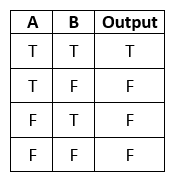
What type of logic is this table showing:
AND
OR
IF, THEN
Let p represent: Brent works this summer.
Let q represent: Brent takes a vacation.
What is the symbolic representation of this statement?
Therefore, Brent does not work this summer.
∴~p
∴~q
~p
~q
If Brent works this summer, he will have extra money. If Brent has extra money, then he can go on vacation. Therefore if Brent works this summer, he can go on vacation.
Which of the following is a premise in the argument above?
If Brent works this summer, he will have extra money
Therefore, if Brent works this summer, he can go on vacation
Brent works this summer
Brent can go on vacation
If Brent works this summer, he will have extra money. If Brent has extra money, then he can go on vacation. Therefore if Brent works this summer, he can go on vacation.
Which of the following is the conclusion of the argument above?
If Brent works this summer, he will have extra money
Therefore, if Brent works this summer, he can go on vacation
Brent works this summer
Brent can go on vacation
If Brent works this summer, he will have extra money. If Brent has extra money, then he can go on vacation. Therefore if Brent works this summer, he can go on vacation.
Which of the following is a variable in the argument above?
If Brent works this summer, he will have extra money
Therefore, if Brent works this summer, he can go on vacation
Brent works this summer
If Brent has extra money, then he can go on vacation

Is the argument represented in this truth table valid or invalid?
Valid
Invalid

Is the argument represented in this truth table valid or invalid?
Valid
Invalid
∫2x+4dx
x2 + 4x + c
2
x2 + 4x
2x2 + 4x + c
∫cos(4x+5)dx
-¼sin(4x + 5) + C
4sin(4x + 5) + C
¼sin(4x + 5) + C
4cos(4x + 5) + C

62
64/11
56/3
50/3


Which of the following is the anti-derivative of ∫2x dx
x2
2x2+c
2x
None of the choices
Which of the following is the anti-derivative of ∫(3x5−x54+3x2)dx
833x8+x41+x3+c
833x8−x41+x3+c
833x8+x41−x3+c
833x8+x31+x4+c
The process of finding the anti-derivative of a function
Anti-differentiation
Differentiation
Limit of a function
Anti-integration

a. 43
b. 130/3
c. 40
d. 19/3
If F(x) is an anti-derivative of f(x), then for every anti-derivative is in the form of ?
F(x)
F(x)−C
F(x)+c
F(x+c)
Which of the following is the anti-derivative of ∫(x−3) dx
32x3−3x
32x3−3x+c
23x3−3x+c
23x3+3x+c
Which of the following is the anti-derivative of ∫(−3x5+2x) dx
−21x6+x2+c
−21x6+x3+c
−2x6+x2+c
−2x6+2x2+c


Which of the following is the anti-derivative of ∫(−23x4−x3+5x2−2) dx
−103x5−4x4+35x3−2x+c
−103x5−4x4+35x3−2x
−103x5+4x4+35x3−2x+c
+103x5−4x4+35x3−2x+c



A
B
C
D
Find the derivative of: f(x) = 4x4-3x3-9
16x4-9x3
16x4-9x3-0
16x3-9x2-9
16x3-9x2
Find the derivative of: f(x) = x
21x2
2x1
x1
2x21
Find the derivative of f(x) = x51
5x4
−5x6
−x65
5x61
Find the derivative of f(x) = 2x1
−4x31
−x31
−x2
−4x2
f(x) = x3 + x2 + 3
Find the derivative of f(x) = (3 − x)(3 − x)
9−6x−x
−x3−1
−3x1−1
−3x1−1

Find the derivative of the following:
a
b
c
d

Find the derivative of:
a
b
c
d

Find the derivative of:
a
b
c
d
If f(x)=−3x2+6x−4 , determine f′(x).
−3x+6
−6x+2
−6x2+6
−6x+6
f(x)=(2x+3)2
Calculate the derivative of f(x).
4x2+9
8x
8x+12
4x2+12x+9
If f(x)=x23 , calculate f′(x) .
−x36
x36
x6
−x6
What is the derivative of y = 2π?
0
2
-2
None of the above
Differentiate y = x2x2+x−3
y = 2x + 1 - 3x-1
y' = 4x + 1 - 1x-2
y' = 2 + 3x-2
y' = 4x + 1 - 3x-2
Find the derivative of f(x) = e3x+1
3ex
3e3x+1
3x+1e3x+1
0

