wayground logo

Free Printable Worksheets

Font size

S
M
L
XL
Worksheets

MIDTERM REVIEW

Total questions: 76

Worksheet time: 4hrs 53mins

Name
Class
Date
1.
∠1 and ∠3 can best be described as -
a)
complementary angles
b)
supplementary angles
c)
vertical angles
d)
adjacent angles
2.
Identify the type of angle shown.
a)
Complementary
b)
Supplementary
3.
State the angle relationship and find the measure of angle 1
a)
Corresponding
110
b)
Alternate Exterior
110
c)
Corresponding
70
d)
Alternate Exterior
70
4.
State the angle relationship and find the measure of angle 1
a)
Alternate Interior
37
b)
Alternate Interior
143
c)
Corresponding
143
d)
Corresponding
37
5.
What word describes line Z?
a)
Transversal
b)
Parallel
c)
Corresponding
d)
Same side interior
6.
Name the angle relationship.
a)
Alternate Interior
b)
Alternate Exterior
c)
Corresponding
d)
Vertical Angles
7.
Find C 
a)
∠C=116°
b)
∠C=64°
c)
∠C=180°
d)
∠C=26°
8.

What is the correct EQUATION to find the value of x AND what is the value of x?

a)

X=12

b)

8X - 17 + 5X +19 = 180

c)

8X - 17 = 5X +19

d)

X= -12

9.

Solve for x.

a)

A

b)

B

c)

C

d)

D

10.
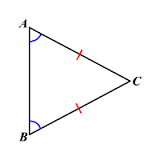
Which segment is the base?
a)
Segment AB
b)
Segment BC
c)
Segment AC
11.
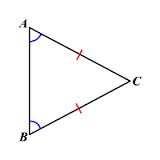
Which angle is the vertex angle?
a)
<C
b)
<A
c)
<B
12.

If an isosceles triangle has a base angle measuring 40°, then what measure is the VERTEX angle?

a)

120°

b)

100°

c)

40°

d)

80°

13.

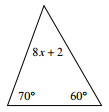
Solve for x

a)

49

b)

58

c)

70

d)

94

14.

Solve for x

a)

105

b)

78

c)

110

d)

25

15.
Find the measure of the indicated angle. 
a)
95
b)
85
c)
35
d)
45
16.
State if the two triangles are congruent.  If they are, state how you know.
a)
A
b)
B
c)
C
d)
D
17.
State if the two triangles are congruent.  If they are, state how you know.
a)
A
b)
B
c)
C
d)
D
18.
What postulate would prove triangle ∆NYQ is congruent to ∆PYQ?
a)
ASA
b)
SAS
c)
SSS
d)
HL
19.

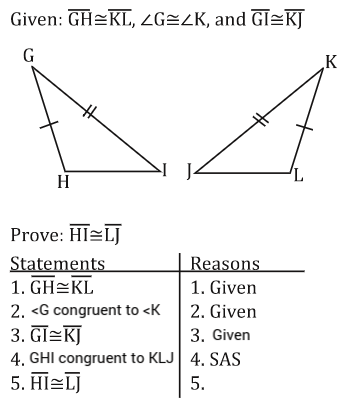
What is the correct choice for Reason 5?

a)

SAS

b)

Definition of Congruence

c)

Prove

d)

CPCTC

20.
What equation can be used to solve for x?
a)
Sin(40°)= x/40 
b)
Sin(40º)=x/19
c)
Cos(40º)=x/19
d)
Tan(40°)=19/x
21.
Find x round to the nearest tenth.
a)
46.1
b)
4.9
c)
16.4
d)
26.9
22.
Solve for x. Round to the nearest tenth.
a)
9.8
b)
0.1
c)
0.038
d)
9.9
23.
Susan is flying a kite, which gets caught in the top of a tree.  Use the diagram to estimate the height of the tree. 
a)
63 ft
b)
65 ft
c)
74 ft
d)
87 ft
24.
A yacht is anchored 90 feet offshore from the base of a lighthouse.  The angle of elevation from the boat to the top of the lighthouse is 26 degrees.  The distance between the yacht and the top of the lighthouse is about 100 feet.  Which of these is nearest to the height of the lighthouse? 
a)
25 feet
b)
45 feet 
c)
110 feet 
d)
135 feet 
25.
Solve for the missing angle
a)
50
b)
0.053
c)
36.9
d)
95
26.
Solve for the missing angle
a)
50.2
b)
93.1
c)
12.6
d)
42.2
27.

Level 1

The Pythagorean Theorem ONLY works on which triangle?

a)

obtuse

b)

scalene

c)

isosceles

d)

right

28.

Level 2

Solve for the value of y

a)

13

b)

5

c)

23

d)

10

29.

Find a.

a)

5

b)

√2

c)

5√2

d)

2

30.

Find a.

a)

4

b)

2

c)

4√2

d)

2√4

31.

Find a.

a)

2√6

b)

2√3

c)

3

d)

6

32.

Find a and b.

a)

a = 5, b = 5

b)

a = 10, b = 10√2

c)

a = 10√2, b = 10√2

d)

a = 5√2, b = 5√2

33.

If you are given the SHORT LEG of a 30-60-90 triangle, how do you find the LONG LEG?

a)

Multiply by 2

b)

Divide by 2

c)

Multiply by √3

d)

Divide by √3

34.
Find x.
a)
10
b)
10√3
c)
10√2
d)
20
35.
What is the length of u and v in this 30-60-90 triangle?
a)
u = 8 v = 4√3
b)
u = 4√2 v = 8
c)
u = 16 v = 8
d)
u = 4√3 v = 8
36.
Where is the function increasing?
a)
(4, ∞)
b)
(−4, ∞)
c)
(6, ∞)
d)
4 < x < 6
37.

What is the domain?

a)

x = 2

b)

(−∞ , ∞)

c)

y = 2

d)

none of these

38.

What is the domain of the graph?

a)

[-7 , 5)

b)

[-3 , 1)

c)

(-3 , 1)

d)

[-7 , 5]

39.
List the types of intervals that the graph demonstrates in order.
a)
decreasing, constant, increasing, constant
b)
increasing, decreasing, constant
c)
increasing, constant, increasing, constant
d)
increasing, constant, decreasing, constant
40.

Write the interval that represents the negative portion of the function?

a)

(-2,1)

b)

(-0.5,-3.5)

c)

(,2); (1,)\left(-\infty,-2\right);\ \left(1,\infty\right)

d)

(-3,0)

41.

Where is the function positive?

a)

Nowhere

b)

(0.5, 2)

c)

(-3, 0.5); (2, 5]

d)

(,0.5) and (2,)\left(-\infty,0.5\right)\ and\ \left(2,\infty\right)

42.

Where is the function positive?

a)

(-∞,5]

b)

(0, 5]\left(0,\ 5\right]

c)

(-∞,2]

d)

(-∞,0)

43.
Describe the end behavior of the graph.
a)
x →∞, y→∞ and x→∞, y→⁻∞
b)
x →∞, y→∞ and x→⁻∞, y→∞
c)
x →∞, y→∞ and x→⁻∞, y→0
d)
x →∞,y→0 and x→∞, y→⁻∞
44.
Describe the end behavior of the graph.
a)
x → ∞, y→ ∞ and
x→ ∞, y→⁻∞
b)
x → ∞, y→ ∞ and
x→⁻∞, y→∞
c)
None of these
d)
x →∞,y→⁻∞ and
x→∞, y→⁻∞
45.
Describe the end behavior of the graph.
a)
x → ∞, y→ ∞ and x→∞, y→⁻∞
b)
x → ∞, y→ ∞ and x→⁻∞, y→∞
c)
x → ∞, y→ ∞ and x→⁻∞, y→ 0
d)
x → ∞,y→ ∞and x→ ⁻∞, y→ ⁻∞
46.
If the blue function is f(x)=x2, then the red function must be
a)
g(x)=x2-5
b)
g(x)=x2+5
c)
g(x)=(x-5)2
d)
g(x)=(x+5)2
47.
g(x)=f(x-1)-5
Describe the transformation to f(x) that results in g(x).
a)
f(x) has been translated to the left one and down five.
b)
f(x) has been translated to the right one and down five.
c)
f(x) has been translated to the left one and up five.
d)
f(x) has been translated to the right one and up five.
48.
Which transformation transforms the graph of
f(x) = x2 to the graph of g(x) = (x + 4)2?
a)
a vertical translation 4 units up
b)
a vertical translation 4 units down
c)
a horizontal translation 4 units to the left
d)
a horizontal translation 4 units to the right
49.

Describe the transformation that occurred

k(x) = f(x) - 9

a)

vertical compression

b)

Down 9 units

c)

Left 9 units

d)

Right 9 Units

50.

Describe the transformation that occurred

g(x) =2f(x)

a)

Up 2 units

b)

vertical compression

c)

vertical stretch

d)

Right 2 Units

51.

Describe the transformation that occurred

h(x) = 1/5f(x)

a)

Up 5 Units

b)

vertical compression

c)

vertical stretch

d)

Down 5 Units

52.

reflection over y-axis, shift right 1

a)

f(-x - 1)

b)

-f(x + 1)

c)

-f(x) - 1

d)

-f(x - 1)

53.

vertical reflection, horizontal stretch

a)

g(x) = ½f(-x)

b)

g(x) = -f(¼x)

c)

g(x) = -3f(x)

d)

g(x) = -f(4x)

54.
Multiply
x2(2x+3)
a)
x2+2x+3
b)
2x+3
c)
2x2+3x
d)
2x3+3x2
55.
(8y+5)2
a)

64x2+36

b)

64x^2+80y+25

c)
64y2+25
d)
16y+10
56.
Find the sum.
(3y2 + y3 - 5) + (4y2 -4y + 2y3 + 8)
a)
3y+ 7y- 4y + 3
b)
4y2 + 3y3 - y + 3
c)
-y4 + 2y-y - 4
d)
4y+ 3y-3y + 1
57.
Find the difference. 
(3- 2x + 2x2) - (4x -5 +3x2)
a)
x2 + 6x + 8
b)
2x+ 5x - 7
c)
-x2 -6x + 8
d)
-2x2 + 11x - 4
58.
What is an example of a pair of complementary angles?
a)
13° and 45°
b)
10° and 170°
c)
81° and 9°
d)
90° and 3°
59.
Solve for x.
a)
16
b)
11
c)
50
d)
6
60.
What is reason 3?
a)
Addition Property of Equality
b)
Subtraction Property of Equality
c)
Multiplication Property of Equality
d)
Division Property of Equality
61.

What is the correct reason for line 5 and 6?

a)

5.Transitive Property of equality 6. Substitution

b)

5.Algebra 6.Definition of ≅

c)

5.Substitution 6.Definition of ≅

d)

5.Angle addition postulate 6.Substitution

62.
What is the reason?
a)
Definition of vertical angles
b)
Angle addition postulate
c)
Definition of angle bisectors
d)
Vertical angles are congruent
63.

(5x215y3)5\frac{\left(5x^2-15y^3\right)}{5}  

a)

x23y3x^2-3y^3  

b)

x215y3x^2-15y^3  

c)

10x220y310x^2-20y^3  

d)

5x23y35x^2-3y^3  

64.

(14d321d8)÷ 7d2\left(14d^3-21d^8\right)\div\ 7d^2  

a)

7d21d67d-21d^6  

b)

7d1.514d47d^{1.5}-14d^4  

c)

2d3d62d-3d^6  

d)

2d1.53d42d^{1.5}-3d^4  

65.

Simplify the following radical: 32\sqrt[]{32}

a)

323\sqrt[]{2}

b)

484\sqrt[]{8}

c)

16216\sqrt[]{2}

d)

424\sqrt[]{2}

66.

Simplify the following radical: 28\sqrt[]{28}

a)

272\sqrt[]{7}

b)

727\sqrt[]{2}

c)

747\sqrt[]{4}

d)

474\sqrt[]{7}

67.

Rationalize the denominator:
523\frac{\sqrt{5}}{2\sqrt{3}}  

a)

156\frac{\sqrt{15}}{6}  

b)

1518\frac{\sqrt{15}}{18}  

c)

536\frac{5\sqrt{3}}{6}  

d)

5318\frac{5\sqrt{3}}{18}  

68.

Rationalize the denominator:
2812\frac{2\sqrt{8}}{\sqrt{12}}  

a)

966\frac{\sqrt{96}}{6}  

b)

263\frac{2\sqrt{6}}{3}  

c)

29612\frac{2\sqrt{96}}{12}  

d)

4223\frac{4\sqrt{2}}{2\sqrt{3}}  

69.

Rationalize the denominator:
4121\frac{\sqrt{4}}{\sqrt{121}}  

a)

411\frac{4}{11}  

b)

484121\frac{\sqrt{484}}{121}  

c)

211\frac{2}{11}  

d)

2121121\frac{2\sqrt{121}}{121}  

70.

Polynomial with 1 term

a)

monomial

b)

binomial

c)

trinomial

d)

constant

71.

Polynomial with 2 terms

a)

monomial

b)

binomial

c)

trinomial

d)

quadratic

72.

Polynomial with 3 terms

a)

monomial

b)

binomial

c)

trinomial

d)

cubic

73.
What are the five ways to prove triangles congruent?
a)
SSS, ASA, AAS, SAS, HL
b)
SSS, SSA, HL, AAS, SAS
c)
SAS, SSA, HL, AAS, SSS
d)
HL, SAS, SSA, SSS, ASA
74.
What does CPCTC stand for?
a)
Congruent parts of congruent triangles are congruent
b)
Corresponding parts of congruent triangles are congruent
c)
Corresponding parts of corresponding triangles are corresponding
d)
Corresponding parts of congruent triangles are Canadian.
75.
If ∆LMK ≅ ∆LMT, then
∠K ≅ ____
a)
T
b)
∠T
c)
∠M
d)
∠L
76.

If ΔDEF ≅ ΔRST, then we can conclude that DE = what?

a)
ST
b)
RS
c)
DF
d)
RT