
 Worksheets
Ch. 5 Test The American Revolution
Total questions: 20
Worksheet time: 10mins
What was the significance of the fighting at Lexington and Concord in 1775?
The British plan to divide the colonies into two at Lexington and Concord failed.
General Washington and his troops endured great hardships from hunger.
The fighting at Lexington and Concord marked the outbreak of the American Revolution.
Right after these battles, British leaders recognized the independence of the United States.
The passage below is from the Declaration of Independence, signed on July 4th, 1776. That to secure these rights, Governments are instituted {created} among Men, deriving, {obtaining} their just powers from the consent of the government, that whenever any form of Government becomes destructive of these ends, it is the Right of the People to alter or to abolish it and to institute new Government, laying out its foundations on such principles and organizing its powers in such as form, as to them shall seem most likely to affect their Safety and Happiness. Which theory of government led directly to the views expressed in this passage?
The Mayflower Compact
The Divine Right of Kings
John Locke’s social contract
Baron Montequieu’s separation of powers
What was the main purpose for writing the Declaration of Independence?
to create framework for a new democratic government in America
to explain the colonists’ reasons for separating from Great Britain
to offer King George III a compromise that would end the conflict
to persuade the Loyalists to move to Canada
Which argument is found in the Declaration of Independence?
The British government has failed to respect the rights of the Native Americans.
The colonists have a right to change their government because it has violated the very rights it is supposed to protect.
The colonists have the right to declare independence because the British government is too far away to govern effectively.
The colonists should be able to elect their own representatives to Parliament before the British government imposes any more taxes.
The passage below is from The Crisis, written by Thomas Paine in 1776. These are the times that try men's souls. The summer soldier and the sunshine patriot will, in this crisis, shrink from the service of his country; but he that stands it now deserves the love and thanks of man and women. What effect did Thomas Paine intend this passage to have on his readers?
persuade Loyalists to desert the British cause
explain to colonists why they were fighting against the British
encourage soldiers of the Continental Army to keep on fighting
help colonists understand the reasons for recent British victories
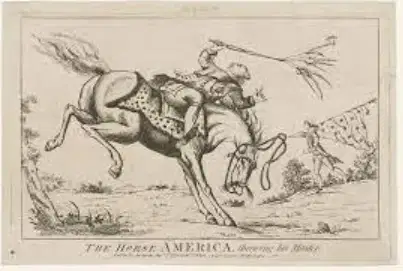
In this picture, who does the person on the horse most likely represent?
Thomas Paine
King George III
George Washington
Members of the Continental Congress
What was the significance of the Battle of Saratoga in 1777?
The Continental Army ended the British threat in the South.
The British decided to grant the colonists their independence.
The British were able to divide the colonies into two separate parts.
The French were persuaded to enter the war as an ally of the colonists.
How did Thomas Jefferson contribute to the outcome of the American Revolution?
By serving as a U.S. Senator from Virginia
By writing the Declaration of Independence
By being elected as President of the United States
By serving as a general in the Continental Army.
The passage below is from a diary entry by a leader in the American Revolution. I served my country as the Commander of the Continental Army during the American Revolution. I retired to Virginia but was called back to serve my country as its chief executive under the new United States Constitution. Which leader was the author of this passage?
John Adams
James Madison
Thomas Jefferson
George Washington
Which factor most contributed to the American victory in the Battle of Yorktown (1781)?
The support of the French navy and of the French troops
George Washington’s victory at the Battle of Trenton
The orders of King George III, which confused General Cornwallis
Support from the German mercenaries who surrendered at Trenton
Why did so many Native American tribes support the British during the American Revolution?
They felt a sense of loyalty to King George III.
They feared the colonists would take away their lands.
They felt regret for supporting the French in the French and Indian War.
They didn’t believe in the equality promised by the Declaration of Independence.
The information below provides details about the American Revolution. - The American colonies were fighting on home soil. - The Americans were more determined - British generals didn’t always pursue their opportunities. - The French alliance played a crucial role. - British public opinion was divided. What do these details have in common?
They tell the ways in which the American Loyalists influenced the war’s outcome.
They describe the effects of geographic factors on the American Revolutionary War.
They identify the reasons why the British army was defeated in the American Revolution.
They explain why the French and the Spanish decided to support the American Revolution.
How was the signing of The Treaty of Paris in 1783 a victory for the United States?
Great Britain was forced to form an alliance with France.
Great Britain recognized the United States as an independent nation.
The French and Indian War was over and colonists could move west.
American Patriots signed an alliance with France to help them win the American Revolution.

Two individuals are described in the chart below. Person A: I didn’t want to leave the British Empire. I hope King George III would change his policies. Person B: I opposed British rule. I believe that the American colonies should declare independence from British rule and they should govern themselves. Which pair of individuals is described in the chart?
Anti-Federalists and Federalists
Loyalists and Patriots
Native Americans and the French
Hessians and The Spanish
In Thomas Paine's pamphlet "Common Sense," what key argument did he make that had a significant impact on the American Revolution?
The need for reconciliation and peaceful negotiations with the British Crown.
The importance of maintaining a strong monarchy in the American colonies.
The idea that American independence was not only necessary but also morally justifiable.
The call for greater British control over colonial governance.
During the harsh winter at Valley Forge, from 1777 to 1778, General George Washington's Continental Army faced extreme hardships. Which of the following best describes the conditions they endured?
mild temperatures and ample supplies.
severe cold, food shortages, and disease.
full support and cooperation from the British.
a comfortable and well-fortified camp.
Benedict Arnold, a prominent figure in the American Revolutionary War, is known for his actions during the conflict. Which of the following statements about Benedict Arnold is accurate?
He was a loyal patriot who played a significant role in the capture of Fort Ticonderoga.
He is remembered as a hero for his contributions to the Battle of Saratoga, a turning point in the war.
He later switched his allegiance to the British and became a symbol of betrayal in American history.
He was the primary author of the Declaration of Independence.
During the drafting of the Declaration of Independence, several important groups of people were initially left out of the political process. Which of the following groups was notably absent?
Women
African Americans
Native Americans
All of the above
During the First Continental Congress in 1774, American colonies gathered to address their grievances with Great Britain. How did they intend to resolve these grievances?
Through an immediate declaration of independence from Great Britain.
By seeking peaceful negotiations with King George III.
By forming a centralized colonial government with the authority to govern independently.
Through a call for military action against the British forces.
The "Shot Heard 'Round the World" is a phrase associated with which significant event in American history?
The signing of the Declaration of Independence.
The Boston Tea Party.
The Battles of Lexington and Concord.
The ratification of the United States Constitution.

