
 Worksheets
U3: Human Geography
Total questions: 70
Worksheet time: 35mins
Determine whether the following is a religion or an ethnic group: Buddhist.
Ethnicity
Religion
What alphabet do East Slavic languages such as Russian and Ukrainian use?
Greek alphabet
Cyrillic alphabet
Hebrew alphabet
Roman alphabet
Hakim lives in Iraq and shares the majority ethnicity and religion there. Which statement best describes Hakim?
Persian ethnicity, follows Judaism
Arabic ethnicity, follows Christianity
Arabic ethnicity, follows Sunni Islam
Arabic ethnicity, follows Shia Islam
Which individual is considered to be the founder of Judaism?
Abraham
Muhammad
Buddha
Jesus
Identify the primary branch of Islam associated with Iran’s majority population.
Ibadi Islam
Sunni Islam
Shia Islam
Sufi Islam
Classify Russian under the following language families.
Slavic family
Romance family
Germanic family
Semitic family
If a country officially adopts the Cyrillic script, what is a likely implication for its language community?
Closer ties to Slavic linguistic traditions
Immediate conversion to Roman Catholicism
Replacement of all local dialects by Greek
Loss of native vocabulary overnight
A student confuses ethnic group with religion. Which statement corrects the misunderstanding?
Ethnicity describes cultural ancestry, religion describes belief systems
Ethnicity only refers to language choice
Both ethnicity and religion describe the same thing
Religion always determines a person’s ethnicity
Which region most commonly uses the Roman alphabet today?
East Slavic countries
Much of Western and Central Europe
Middle Eastern nations
Traditional East Asian states
Two neighboring countries share Arabic as a major ethnicity but different Islamic branches. What is the most likely social outcome?
Elimination of cultural holidays everywhere
End of ethnic identity in both countries
Potential differences in rituals and leadership structures
Identical religious practices in both countries
Which religions are the most widely practiced in modern Africa?
Christianity and Judaism
Buddhism and Hinduism
Judaism and Buddhism
Islam and Christianity
Which statement about religious and ethnic groups is correct?
Two individuals may belong to the same religious group and still be from different ethnic groups.
All individuals of a religious group belong to the same ethnic group.
Individuals in a particular ethnic group typically all belong to different religious groups.
All members of particular ethnic or religious groups live in the same area.
Which statement describes a person's religion?
Lee is Korean
Hu is Chinese
Indira is Hindu
Thao is Vietnamese
Anu was born and raised in India. It is MOST LIKELY that Anu practices which religion?
Judaism
Shintoism
Confucianism
Hinduism
Identify the key difference between an ethnic group and a religious group.
Ethnic group is nationality; religious group is language.
Ethnic group shares culture; religious group shares beliefs.
Ethnic group is profession; religious group is family.
Ethnic group is political party; religious group is region.
If two classmates share the same ethnic heritage but attend different places of worship, what does this show?
Ethnicity always determines religion.
Religious groups are smaller than ethnic groups.
Religion and ethnicity can be independent.
Ethnic groups require identical beliefs.
Which pair correctly matches a region with a commonly practiced religion?
North Africa – Islam
Middle East – Shintoism
India – Buddhism
Japan – Hinduism
A student assumes everyone in Africa practices the same religion. What is the best correction to this misconception?
Africa has no major religions.
Africa includes both Islam and Christianity.
Africa is entirely Hindu.
Africa is entirely Buddhist.
Which example best illustrates a religious identity rather than an ethnic identity?
Chen is Chinese.
Maria is Spanish.
Ahmed is Muslim.
Ava is American.
Which statement supports the idea that religion can be practiced by people of many ethnic backgrounds?
Ethnicity is chosen like religion.
Religious beliefs spread across cultures.
Religious groups are limited to one region.
Religions are tied to one nationality.
What is the MOST widely practiced religion in Europe today?
Judaism
Hinduism
Christianity
Islam
Mahari lives in Zimbabwe, is Muslim, has Christian friends, and neighbors who practice animism. Many languages are spoken nearby. Which ethnic group does Mahari MOST LIKELY belong to?
Swahili people
Bantu people
Ashanti people
Arab people
In Hinduism, the moral law of the universe that directs the cycle of rebirth is called:
Karma
Bhakti
Kami
Dharma
Which characteristic is typically shared by all members of the same religious group?
Shared ancestry
Common beliefs
Same profession
Identical language
Which belief system includes kami as spiritual beings associated with natural elements?
Shinto
Sikhism
Buddhism
Taoism
Which African ethnic group is primarily associated with the Akan-speaking peoples of Ghana?
Tuareg
Ashanti
Berber
Zulu
If a region has many different languages spoken, which challenge is MOST likely for everyday communication?
Simpler laws
Misunderstandings
Faster learning
Uniform messages
Which term best describes a belief that spirits inhabit natural objects like trees and rivers?
Polytheism
Atheism
Monotheism
Animism
Which religion emphasizes the concept of karma affecting future rebirths?
Islam
Hinduism
Judaism
Christianity
In East African coastal regions, which group historically formed through a mix of Bantu and Arab cultures?
Amhara
Maasai
Swahili
Yoruba
Which factor most often unites a culture across regions?
a common belief system
a common physical appearance
a common language
a common ancestry
What religion spread from China to Korea and then to Japan, shaping elements of Shinto practice?
Confucianism
Buddhism
Taoism
Sikhism
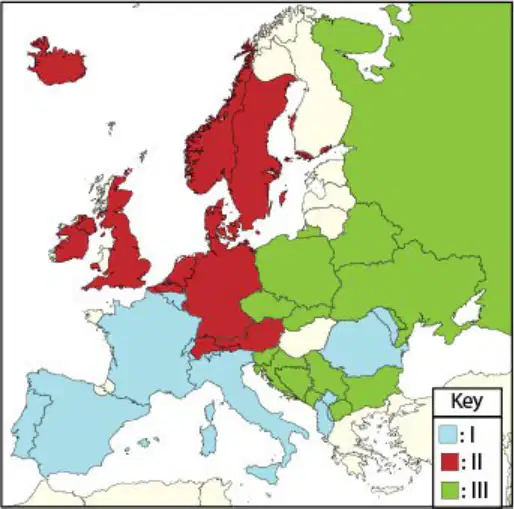
On the European language map, which numeral represents the Germanic language group?
IV in yellow on the map
III in green on the map
I in blue on the map
II in red on the map
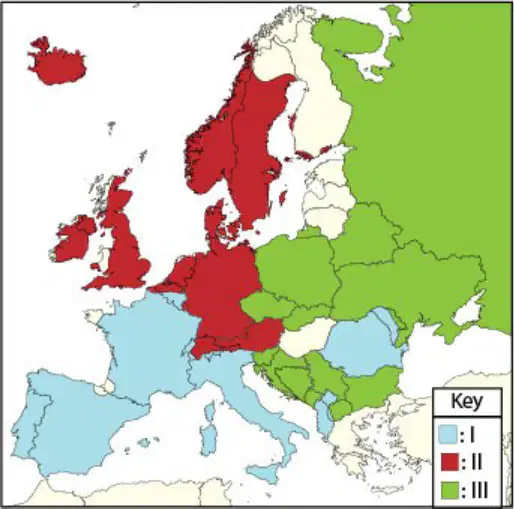
Match each numeral in the map key to its language family: I, II, III.
I: Slavic; II: Romance; III: Germanic
I: Romance; II: Germanic; III: Slavic
I: Germanic; II: Slavic; III: Romance
I: Germanic; II: Romance; III: Slavic
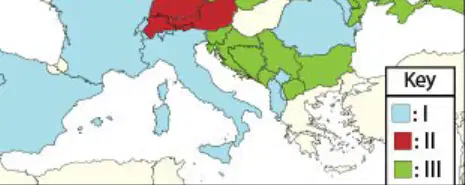
Which of these countries is most likely in the Romance language area shown in green on the map?
Portugal on the Iberian Peninsula
Sweden in Scandinavia
Poland in Eastern Europe
Germany in Central Europe
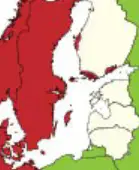
Using the map, what language group predominates in Scandinavia?
Romance languages
Germanic languages
Slavic languages
Celtic languages

Which region on the map is most associated with Slavic languages?
Scandinavia and Iceland
Eastern Europe and Balkans
British Isles and Low Countries
Iberian Peninsula and Italy
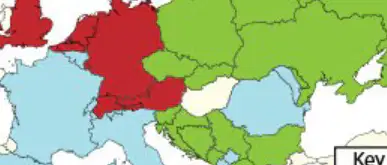
If a city lies where the map shows red (II), which alphabet or scripts are students most likely to encounter historically?
Cyrillic and Latin scripts
Arabic script exclusively
Latin-centered scripts only
Chinese logographic script
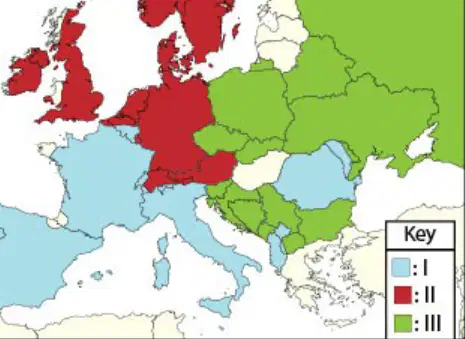
A traveler wants to visit countries where Romance languages are common. Based on the map, which route best fits this goal?
Berlin to Hamburg to Munich
Lisbon to Madrid to Rome
Stockholm to Oslo to Copenhagen
Warsaw to Kiev to Belgrade
Why might language families cluster in contiguous regions on the map?
Uniform climate everywhere
Identical government policies
Shared migration histories
Random settlement patterns
Read the article: Over the past 2,000 years, the Bantu have been migrating across Africa from the Sahel region. As they met new people on the continent and settled in different areas, their language, culture, and religion adapted to their new homes. Many Bantu who stayed in the north of Africa converted to Islam. Those that settled in Christian areas converted or combined traditional and Christian beliefs. Even still others follow traditional African beliefs such as animism. What is the BEST title for this article?
Differences between ethnic groups and religions
How desertification shaped the Sahel migrations
Religious change among migrating Bantu peoples
The founding of major religions by ethnic groups
Which languages are NOT Romance languages?
Italian and French
Spanish and Italian
Russian and English
French and Spanish
What does monotheistic mean?
Belief in spirits of nature
Belief in many gods
Belief in one God
Belief in no gods
Consider the migration described in the article. Which outcome best explains religious diversity among Bantu communities today?
Exclusive adoption of animism in all regions
Uniform conversion to Christianity everywhere
Mixture of Islam, Christianity, and traditional beliefs
Complete abandonment of traditional practices
Match the language families I–III to their correct labels. I, II, III are placeholders for Slavic, Romance, and Germanic. Which pairing best fits?
I: Romance; II: Germanic; III: Slavic
I: Germanic; II: Slavic; III: Romance
I: Slavic; II: Germanic; III: Romance
I: Slavic; II: Romance; III: Germanic
Which statement best describes animism as referenced in the article?
Belief that natural objects have spirits
Belief in one supreme deity
Belief in strict church hierarchy
Belief based solely on written scriptures
Why might Bantu groups in northern Africa have converted to Islam?
Isolation from other cultures
Government laws banning Christianity
Climate making travel impossible
Contact with Muslim communities in the region
Which pair lists a Slavic language and a Germanic language?
Italian and Spanish
Russian and English
Spanish and French
French and Italian
If a Bantu community combines Christian beliefs with traditional practices, what term describes this blend?
Secularization process
Language assimilation
Syncretism of religions
Polytheistic conversion
Which conclusion is most supported by the article about Bantu migration and religion?
Migration always replaces traditional beliefs
Migration prevents contact with new ideas
Migration can lead to uniform culture
Migration fosters adaptation to local religions
The image shows a red octagonal sign with bold white text. What message does this sign convey to a traveler?
Bridge is out ahead
Proceed with caution ahead
You have reached the end
Detour to the left lane
Slow down and merge
On the page, a short line reads "C. No religion." In a data table of cultural traits, what would this entry most likely represent?
A climate zone label
A political party category
A transportation route type
A population religion category
A land use classification
What is the primary purpose of a "Stop" sign in map-based fieldwork or navigation?
Announce upcoming tolls
Mark a rest area stop
Suggest a scenic viewpoint
Require a complete halt
Indicate a border crossing
If a worksheet page ends with a stop symbol and the line "You have reached the end of this section," what should a student do next in a multi-section assignment?
Begin the next section or page
Continue answering on same page
Return to the introduction section
Skip to the final summary
Erase previous answers and redo
Which statement best describes how "No religion" might be mapped in a population thematic map legend?
As a land elevation contour
As a river drainage basin
As a road network symbol
As a wind speed isopleth
As a categorical legend class
In a survey of cultural geography, the label "No religion" most likely indicates which kind of data?
Quantitative temperature values
Qualitative belief affiliation
Topographic slope degrees
Economic export tonnage
Latitude-longitude coordinates
When interpreting a document that uses a stop sign to end a section, what is the safest assumption about additional instructions on that page?
Hidden items are on the margin
Only diagrams remain to view
The section’s tasks are complete
Notes must be copied by hand
More tasks continue below
A classroom map legend includes items A, B, and C, where C is labeled "No religion." What kind of variable type is C within the legend?
Ordinal ranked variable
Binary seasonal variable
Continuous numerical variable
Nominal categorical variable
Interval ratio variable
If a population pie chart includes a slice labeled "No religion," what does that slice represent?
Households with no electricity
Workers without formal education
Individuals without religious affiliation
Residents without transportation
People with no climate data
On a field survey form, a checkbox labeled "No religion" appears under cultural traits. Which response best matches the meaning of checking this box?
Temporary visitor status only
Preference for historic landmarks
No stated religious affiliation
Belief in regional weather patterns
Affiliation with multiple faiths
Which latitude line is closest to the geographic center of most world maps that use the Equator-centered projection?
Prime Meridian at 0° longitude
Equator at 0° latitude
Tropic of Cancer around 23.5° N
Arctic Circle near 66.5° N
Which statement best describes longitude?
Semicircles running pole to pole
Imaginary lines parallel to the Equator
Lines measuring north–south distances
Circles defining the polar regions
What is the main purpose of a scale on a map?
Indicate relative time zones
Show the map’s orientation
Convert map distance to real distance
Explain symbols in the legend
Which feature helps you determine direction on a map without using latitude and longitude?
Grid reference letter–number
Inset map detail box
Compass rose with cardinal points
Relief shading for elevation
Which of the following best explains why different map projections distort areas or shapes?
Earth is a perfect sphere
Flattening a curved surface onto a plane
Maps always use the same scale
Latitude lines are equal in length
A city is located at 35° N, 140° E. Which hemisphere is it in?
Northern and Western hemispheres
Northern and Eastern hemispheres
Southern and Eastern hemispheres
Southern and Western hemispheres
If one centimeter on a map represents fifty kilometers on the ground, what distance does three centimeters represent?
100 kilometers total distance
300 kilometers total distance
150 kilometers total distance
200 kilometers total distance
Which natural feature is most likely shown with contour lines on a physical map?
Climatic seasons of an area
Time zones dividing regions
Elevation changes across terrain
Political boundaries between states
Two towns share the same latitude but different longitudes. Which statement is true about daylight length on a given date?
Daylight length depends only on altitude
Daylight length depends on longitude
Daylight length will be identical
Daylight length depends on latitude
Which tool or feature would you use to estimate the area of a country from a map most effectively?
A compass rose for direction
An equal-area projection map
A graticule of latitude–longitude
The legend explaining symbols

