
Font size
 Worksheets
Ancient India Ultimate review
Total questions: 41
Worksheet time: 22mins
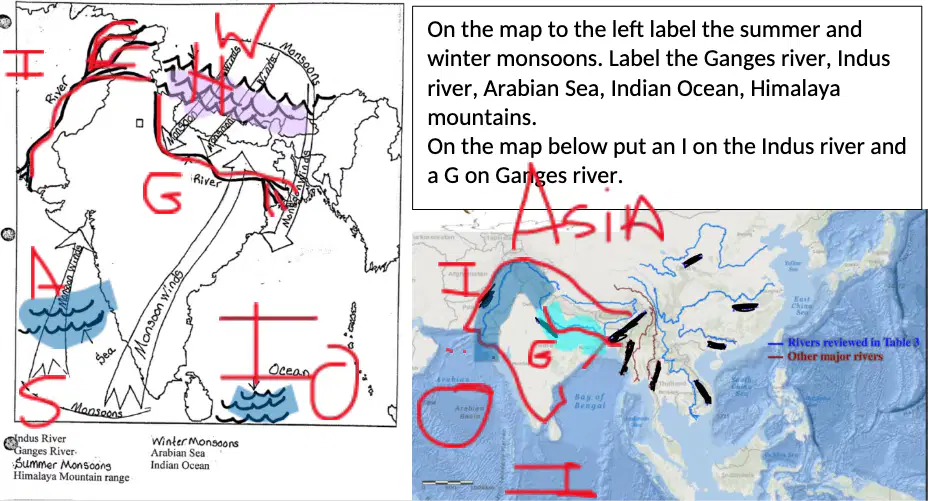
Which river flows across the northern part of the Indian subcontinent and is often highlighted on maps of ancient India?
Indus River across western plains
Ganges River across northern plains
Narmada River across central plains
Brahmaputra River across eastern plains
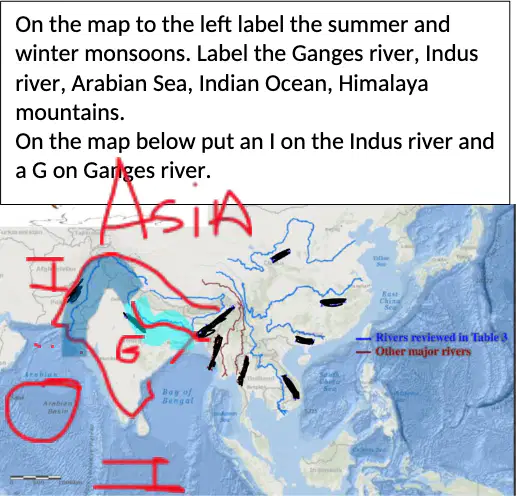
On a labeled map of ancient India, where would the Indus River most likely be placed?
Eastern India near Bangladesh
Western India into modern Pakistan
Southern tip near Sri Lanka
Central plateau near Deccan
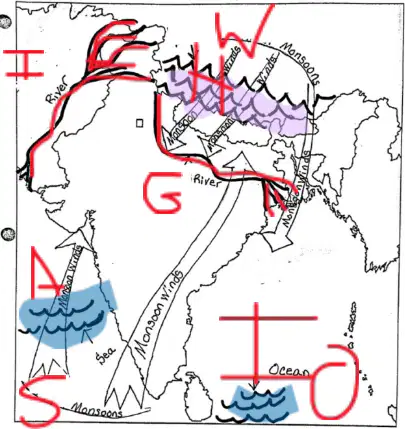
Which mountain range forms a natural barrier to the north of the Indian subcontinent?
Himalayan Mountains along northern border
Vindhya Mountains across central plateau
Aravalli Range near Rajasthan
Western Ghats along Arabian coast
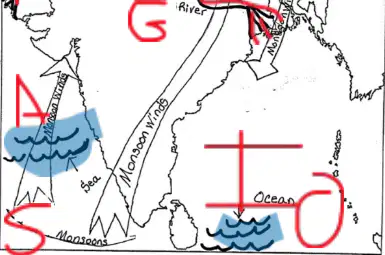
If you were labeling surrounding waters on an ancient India map, which two bodies of water border India to the south and west?
Bay of Bengal and Red Sea
Arabian Sea and Indian Ocean
South China Sea and Pacific Ocean
Caspian Sea and Persian Gulf
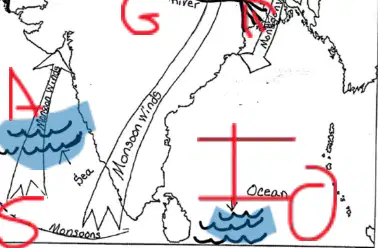
Monsoon winds are seasonal winds. On a map key showing arrows for summer and winter monsoons, what pattern best matches their direction?
Summer from land to sea, winter from sea to land
Summer from sea to land, winter from land to sea
Both seasons from north to south only
Both seasons from east to west only
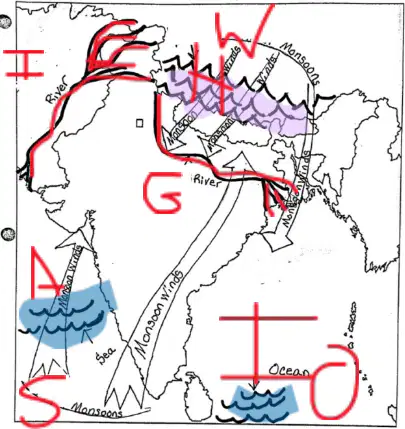
Which statement best explains how the Himalayan Mountains affected ancient Indian civilizations shown on the map?
They blocked all trade with western empires
They caused year-round flooding of the Indus
They created deserts across southern India
They provided protection and a northern boundary
Which factor most directly explains why Harappan cities could grow large in the Indus River Valley?
Trade was banned to limit population movement
Mountain barriers forced small isolated villages
Frequent river flooding prevented settlement growth
Abundant fertile land supported successful farming
What building material was commonly used to construct Harappan architecture?
Metal structures of bronze sheets
Baked Bricks
Wooden timber frames with thatch
Stone blocks carved from quarries
Harappan streets were arranged using which urban design feature?
Circular lanes around central temples
Single main road with small alleys
Random winding paths following houses
A planned grid of straight intersecting roads
Which achievement best shows Harappan attention to public health?
Tall watchtowers for city defense
Royal palaces with private gardens
Decorative statues in city plazas
Sanitation with sewer systems and baths
Why would brick baking in ovens be an important technological improvement for Harappan builders?
It reduced the need for clay and sand resources
It made bricks stronger for multi‑story buildings
It allowed buildings to be moved after construction
It kept streets cooler during summer monsoons
Which combination best summarizes key Harappan achievements?
Wooden huts, footpaths, open ditches
Military forts, chariots, mountain passes
Nomadic herding, rock art, cave shelters
Brick architecture, grid roads, sanitation systems
Which group traditionally performed priestly and scholarly roles at the top of the caste hierarchy?
Shudra
Vaishya
Kshatriya
Brahmin
What belief explains that actions in this life influence one’s future rebirth?
Karma
Moksha
Dharma
Vedas
Which statement best describes social mobility within the traditional caste system?
People could switch castes by marriage
Mobility was limited during a lifetime
Jobs were chosen freely across castes
Movement between castes was common
Where are the earliest traditions that shaped Hinduism often traced?
Roman Mediterranean coast
Chinese Yellow River valley
Aryan cultures of Central Asia
Egyptian Delta region
What is the role of the Vedas in Hinduism?
Maps of ancient migrations
Lists of caste occupations
Collections of sacred texts
Codes for city building
Which belief in Hinduism refers to fulfilling duty and living by rules?
Karma
Reincarnation
Moksha
Dharma
How did the caste system influence everyday life such as marriage and socializing?
It encouraged mixing of groups
It rewarded travel across regions
It banned contact across castes
It required trade with outsiders
In Hindu thought, what is moksha?
A merchant’s fair exchange
A warrior’s heroic code
Release from the cycle of rebirth
A priestly ceremony
Which pair correctly matches caste with typical role?
Vaishya—ruling and warfare
Kshatriya—rituals and teaching
Shudra—manual labor and service
Brahmin—trading and farming
Which person is recognized as the founder of Buddhism?
Confucius
Siddhartha Gautama
Mahavira
Ashoka
What is the sacred text most closely associated with Buddhism?
Rig Veda
Torah
Tripitaka
Quran
Which idea in Buddhism describes ending suffering by following a path of right actions and thoughts?
Eightfold Path
Ten Commandments
Five Pillars
Four Vedas
What is the goal of Buddhism that represents release from suffering and perfect peace?
Valhalla
Nirvana
Heaven
Moksha
Siddhartha Gautama taught the Four Noble Truths after a long period of meditation. What problem do these truths aim to explain and solve?
Trade routes and resources
Suffering and its causes
Creation of the universe
Political conflict in kingdoms
Buddhism differs from many religions because Buddhists generally do not worship a supreme creator deity. Which feature highlights this difference?
Focus on a code of laws
Emphasis on meditation practice
Ritual animal sacrifice
Belief in one personal god
What did Ancient Indians use to fix torn earlobes and broken noses?
Plastic surgery on skin and facial features
Cataract surgery for cloudy eye lenses
Herbal remedies for common illnesses
Building hospitals to train future doctors
What medical procedure did ancient Indians perform to improve vision?
Treating fevers with herbal drinks
Stitching wounds with plant fibers
Cataract surgery to clear eye lenses
Setting broken bones with splints
Why were hospitals important in ancient India?
They stored grain for the villages
They trained students in medical knowledge
They served only traveling merchants
They replaced family care at home
Which numerical system from India is widely used today?
Roman numerals
Hindu-Arabic numerals
Babylonian numerals
Mayan numerals
What concept in mathematics did ancient Indians help develop?
Negative numbers in calculus
Zero as a number and placeholder
Pi for measuring circles
Infinity symbol in geometry
How did recording medical findings help future generations?
It shared knowledge for later learners
It kept trade routes organized
It prevented wars between kingdoms
It increased taxes for hospitals

A major world religion that developed in India from the Vedas
Hinduism
Buddhism
Islam
Christianity
Monsoon
seasonal wind, especially in the Indian Ocean and southern Asia
Currency
something, such as coins or paper money, that is used as a medium of exchange
Hinduism
a major religion that developed in ancient India and believes in many gods
Buddhism
a religion founded in ancient India by the religious teacher the Buddha
Nirvana
a state of perfect happiness and peace
What is reincarnation?
The rebirth of a soul into a new body
A magic trick
A type of flower used at the altar
The head dress that kings wore
The meaning of Karma
A type of tea in India
A dream that the Buddha had
The effect of a person's actions
The rules ancient Hindus follow
Dharma refers to one's ________________________________
family status
personal duty
nirvana
prayer life
Where is the Indus River Valley?
Pick the subcontinent
The Indian subcontinent is part of the continent of
Africa
Asia
Europe
South America

