
Font size
 Worksheets
Reconstruction Era Worksheet
Total questions: 67
Worksheet time: 34mins
What was the name given to the U.S. program designed to rebuild the South after the Civil War?
Reconstruction
Rebuilding Period
Reformation
President during the Civil War
Woodrow Wilson
Abraham Lincoln
William McKinley
Who replaced Abraham Lincoln as president after his death?
Andrew Johnson
Robert E. Lee
Ulysses S. Grant
What does it mean to "impeach" someone?
To praise someone for their achievements
To formally accuse a public official of misconduct
To promote someone to a higher position
What was the name for laws created in the South that limited the civil rights of African Americans?
White Codes
White Laws
Black Codes
From “Match the following amendments to their changes in the Constitution”: Which amendment officially abolished slavery in the US?
13th
14th
15th
From “Match the following amendments to their changes in the Constitution”: Which amendment officially made African Americans US citizens?
13th
14th
15th
From “Match the following amendments to their changes in the Constitution”: Which amendment gave voting rights to all men, regardless of color?
13th
14th
15th
What is an example of a group that rose up in the South to try to secure white power by using violence and terror?
Southern Democrats
Confederates
Klu Klux Klan (KKK)
Towns that experienced an increase in population in the west were known as?
Rural Towns
Boom Towns
Bust Towns
The west has always represented to Americans a sense of adventure and ________
Freedom
Power
Loss
What event first drew people out west to mine for gold?
Homestead Act
California Gold Rush
Civil War
A vast area of grassland that the federal government owned was known as the ________
Great Plains
Midwest
Open Range
What event caused the cattle industry to boom?
Civil War
California Gold Rush
Ranching
What was the purpose of the Homestead Act?
Encourage settlement out West
Move Native Americans to reservations
Remove Native Americans from reservations
What invention put an end to the open range ranching industry?
The Plow
Barbed Wire
Reaper
What challenges did people face on the Great Plains?
Tsunamis
Floods
Droughts
What book was written by Helen Hunt that brought to light the mistreatment of Native Americans in the US?
Pride and Prejudice
What They've Done to Us
A Century of Dishonor
Match the inventor to his invention: Alexander Graham Bell.
Incandescent lightbulb
Telephone
Match the inventor to his invention: Thomas Edison.
Incandescent lightbulb
Telephone
What does Gross National Product (GNP) measure?
The total value of goods and services produced within a country’s borders in a year.
The amount of money spent by a government on public services in a year.
The total number of goods exported by a country in a year.
How did the following titan make their fortunes? Andrew Carnegie.
Railroads
Steel
Oil
How did the following titan make their fortunes? John D Rockefeller.
Railroads
Steel
Oil
How did the following titan make their fortunes? Cornelius Vanderbilt.
Railroads
Steel
Oil

Match the economic systems to their correct definition: Select the correct definition of Communism.
Free market economy
system allows for property to be publicly owned and run by the government; each person works and is paid according to their abilities and needs

Match the economic systems to their correct definition: Select the correct definition of Capitalism.
Free market economy
system allows for property to be publicly owned and run by the government; each person works and is paid according to their abilities and needs
What was organized to increase wages, improve working conditions, and advocate for healthcare?
Governments
Labor Parties
Unions
What does the term laissez-faire mean?
Practice of government staying out of business and the economy; a "hands off" approach to government
A system where the government controls production
Placing rules and regulations on factories
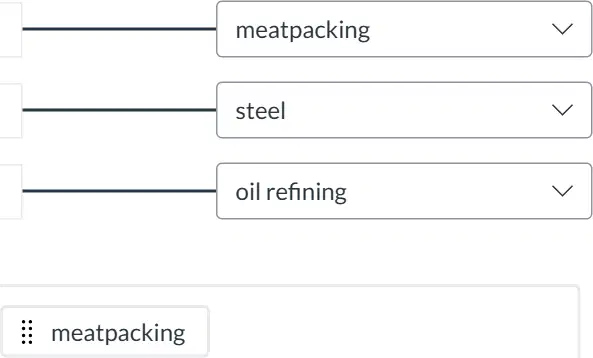
List the industry that each city was known for: Which industry was Chicago known for?
oil refining
steel
meatpacking

List the industry that each city was known for: Which industry was Pittsburg known for?
oil refining
steel
meatpacking

List the industry that each city was known for: Which industry was Cleveland known for?
oil refining
steel
meatpacking
Multiple Choice — 1 point: What was the purpose of Jim Crow laws in the southern United States?
To ensure equal rights for African Americans and whites
To separate African Americans and whites in public places like schools and restaurants
To promote integration and diversity in public spaces
Multiple Choice — 1 point: By 1900, what percentage of the American people lived in cities?
40%
10%
80%
Categorization — 6 points: Place the correct Push or Pull factors in their correct categories. In migration, is religious oppression a Push factor or a Pull factor?
Push factor
Pull factor
Categorization — 6 points: Place the correct Push or Pull factors in their correct categories. In migration, is war a Push factor or a Pull factor?
Push factor
Pull factor
Categorization — 6 points: Place the correct Push or Pull factors in their correct categories. In migration, is poverty a Push factor or a Pull factor?
Push factor
Pull factor
Categorization — 6 points: Place the correct Push or Pull factors in their correct categories. In migration, is opportunity a Push factor or a Pull factor?
Push factor
Pull factor
Categorization — 6 points: Place the correct Push or Pull factors in their correct categories. In migration, is land a Push factor or a Pull factor?
Push factor
Pull factor
Categorization — 6 points: Place the correct Push or Pull factors in their correct categories. In migration, are better jobs a Push factor or a Pull factor?
Push factor
Pull factor
Multiple Choice — 1 point: What is the term for a poorly maintained, overcrowded apartment building where low-income families lived in cities during the 19th and early 20th centuries?
Skyscraper
Tenement
Townhouse
Why did the Spanish-American war happen?
Americans wanted to help the people of Cuba and the Philippines
Americans wanted to avoid involvement in foreign conflicts
Spain wanted to gain control of American colonies
The U.S. and Spain had a conflict over what island?
Puerto Rico
Cuba
Hawaii
What ship exploded off the coast of Cuba?
USS Explorer
USS Arnold
USS Maine
What was the name of the group Theodore Roosevelt formed to fight in the Spanish-American War?
Rough Riders
Boxers
Roosevelt Rebels
What was the trade policy that allowed all countries to trade fairly with China?
Pacific Trade Policy
China-America trade Policy
Open Door Policy
Which statement best shows yellow journalism in the newspaper’s report about the explosion of the USS Maine?
Facts were reported
Spain was blamed without proof
China was blamed without proof
Who was president during the Spanish-American War?
Abraham Lincoln
William Mckinley
Grover Cleveland
What is propaganda, and how was it used during World War I?
Propaganda is a form of entertainment, and it was used to raise money for soldiers.
Propaganda is the spread of biased or misleading information, and it was used to influence public opinion and gain support for the war.
Propaganda is a type of military strategy, and it was used to fight battles.
Which of the following terms best describes an intense loyalty and devotion to your nation?
Americanization
Propaganda
Nationalism
What was the Zimmerman Telegram, and why was it significant during World War I?
A secret message from Germany to Mexico asking for help against the United States
A letter from the United States to Germany asking for peace
A public message saying World War I was over
How did the draft impact World War I?
It caused many soldiers to leave the army and return home.
It stopped the war by making countries talk to each other.
It helped the U.S. get more soldiers to fight in the war.
Which of the following events brought the United States to declare war on Germany?
The Zimmerman Telegram
The Blitzkrieg
Sinking of the USS Maine
What new naval technology did Germany develop for World War I?
Flame thrower
Machine gun
Unterseaboot (U boat)
Which description best matches Militarism as a cause of World War I?
Countries build up their military forces
Countries sign treaties promising to defend one another
Strong countries take control of weaker countries
Intense loyalty and devotion to your nation
Which description best matches Alliances as a cause of World War I?
Countries build up their military forces
Countries sign treaties promising to defend one another
Strong countries take control of weaker countries
Intense loyalty and devotion to your nation
Which description best matches Imperialism as a cause of World War I?
Countries build up their military forces
Countries sign treaties promising to defend one another
Strong countries take control of weaker countries
Intense loyalty and devotion to your nation
Which description best matches Nationalism as a cause of World War I?
Countries build up their military forces
Countries sign treaties promising to defend one another
Strong countries take control of weaker countries
Intense loyalty and devotion to your nation
Which of the following are examples of civil liberties being restricted in America during World War I? Select all that apply.
The government allowing citizens to protest the war in public spaces
The Espionage Act, which made it illegal to speak out against the war
The government giving people more freedom to speak out against the draft
The government arresting people for speaking against the war or draft
The Sedition Act, which made it illegal to criticize the government or the military
Which statement best describes working conditions in factories, as called for in the writing prompt?
Long hours with unsafe machinery and low pay
Short shifts with abundant safety equipment and high wages
Mostly at-home work with flexible schedules
Outdoor work with few machines and frequent breaks
Which description best explains trench warfare, as requested in the writing prompt?
Armies fight from dug trenches, leading to stalemate, harsh living conditions, and constant danger
Armies move quickly across open fields with few defenses and rapid victories
Navies battle exclusively at sea using submarines and battleships
Air forces dominate battles with frequent dogfights and minimal ground combat
What is trench warfare? Choose the most accurate description.
Opposing armies dig defensive trenches and fight from them, facing mud, rats, disease, and long stalemates
A fast-moving style of battle focused on cavalry charges and open maneuver
A naval strategy using submarines to attack merchant ships
A secret campaign of spying and propaganda without open combat
Which alliance did Germany belong to leading up to World War I?
Triple Alliance
Triple Entente
Which alliance did Italy belong to leading up to World War I?
Triple Alliance
Triple Entente
Which alliance did Austria-Hungary belong to leading up to World War I?
Triple Alliance
Triple Entente
Which alliance did Great Britain belong to leading up to World War I?
Triple Alliance
Triple Entente
Which alliance did France belong to leading up to World War I?
Triple Alliance
Triple Entente
Which alliance did Russia belong to leading up to World War I?
Triple Alliance
Triple Entente

