
 Worksheets
Heart Anatomy and Conditions
Total questions: 97
Worksheet time: 49mins
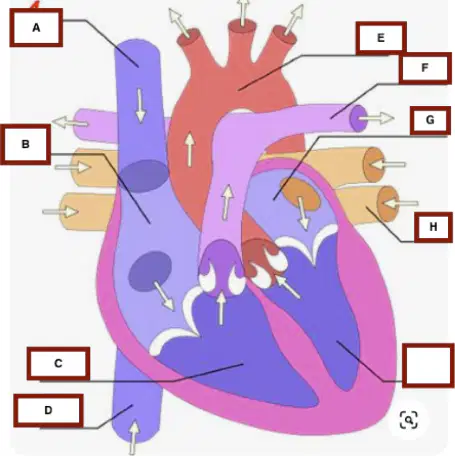
Which labeled structure carries oxygen-poor blood from the upper body into the right atrium?
Superior vena cava
Inferior vena cava
Pulmonary artery
Pulmonary vein
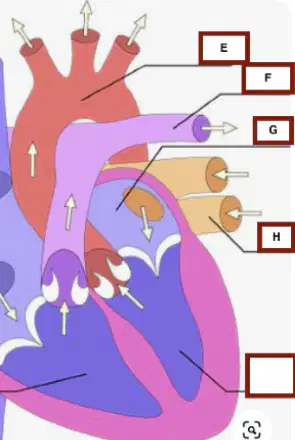
Which chamber receives oxygen-rich blood returning from the lungs?
Right atrium
Left atrium
Right ventricle
Left ventricle
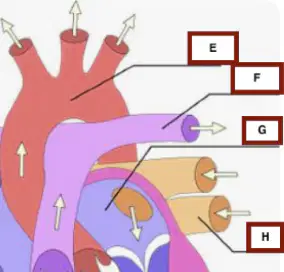
Which labeled structure is the main artery that distributes blood from the left ventricle to the body?
Pulmonary artery
Aorta
Inferior vena cava
Superior vena cava
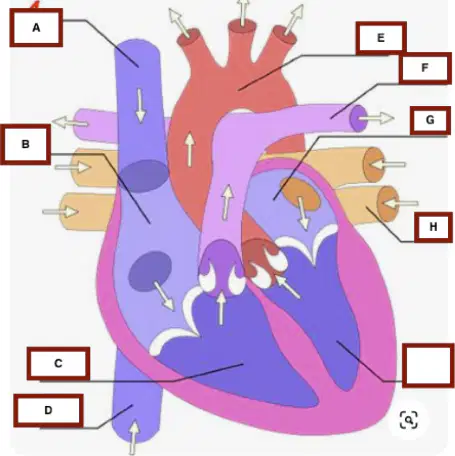
Which structure pumps oxygen-poor blood to the lungs?
Right atrium
Right ventricle
Left atrium
Left ventricle
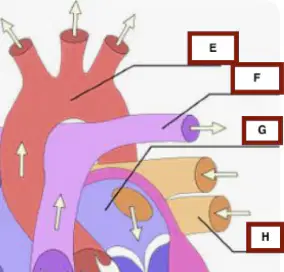
Which labeled vessel returns oxygen-rich blood from the lungs to the heart?
Inferior vena cava
Aorta
Pulmonary artery
Pulmonary vein
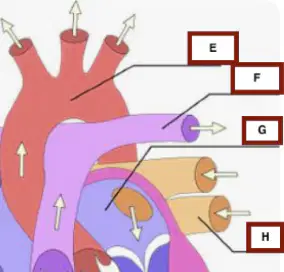
Blood leaves the left ventricle through which valve and vessel pathway?
Aortic valve to aorta
Pulmonary valve to inferior vena cava
Mitral valve to pulmonary vein
Tricuspid valve to pulmonary artery
Which condition is defined as the heart not pumping enough blood to meet the body’s needs?
Congestive heart failure
Aortic valve stenosis
Patent foramen ovale
Myocardial infarction
What best describes a myocardial infarction?
Death of heart muscle from blocked blood flow
Gradual plaque buildup in artery walls
An opening between atria persists after birth
Valve narrowing obstructing blood flow
Aortic valve stenosis primarily causes which effect on blood flow?
Increased venous return to right atrium
Improved oxygen exchange in lungs
Backflow into the venae cavae
Narrowed outflow from the left ventricle
Which term refers to a persistent opening between the right and left atria after birth?
Mitral regurgitation
Coronary occlusion
Patent foramen ovale
Pulmonary stenosis
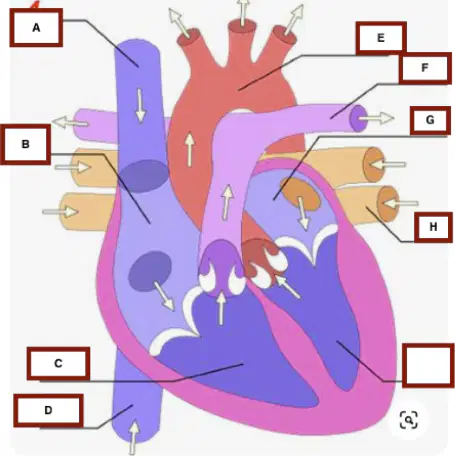
Which labeled structure is the vessel carrying oxygen-poor blood from the lower body to the heart?
Aorta
Pulmonary vein
Inferior vena cava
Superior vena cava
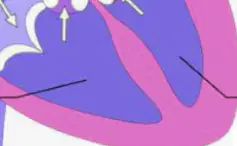
Which chamber has the thickest muscular wall for pumping blood throughout the body?
Right atrium
Right ventricle
Left atrium
Left ventricle
What is the correct sequence of blood flow starting at the right atrium?
Right atrium → Aorta → Body
Right atrium → Left atrium → Lungs
Right atrium → Left ventricle → Body
Right atrium → Right ventricle → Lungs
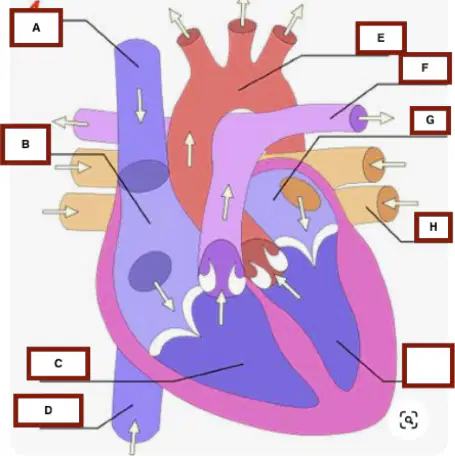
Which labeled vessel carries blood away from the right ventricle toward the lungs?
Aorta
Pulmonary artery
Superior vena cava
Pulmonary vein
Which finding would most likely be present in congestive heart failure?
Open foramen ovale improving mixing
Widened aortic valve improving outflow
Fluid buildup causing leg or lung swelling
Increased ejection fraction and strong pulses
Which lobe of the cerebrum is primarily responsible for planning, organizing, behavior, and emotions?
Frontal lobe functions include planning and emotions
Parietal lobe manages balance and coordination
Temporal lobe integrates sensory and visual information
Occipital lobe handles language and long-term memory
Which brain region primarily handles balance and coordination for movement?
Cerebellum controls balance and coordination
Brain stem controls conscious thought and memory
Occipital lobe controls hearing and emotion
Cerebrum controls balance and coordination
What is the main function of the brain stem as described?
Planning and organizing complex behaviors
Integrating sensory and visual information
Automated life functions using smooth muscle
Processing language into long-term memory
Which lobe receives and processes sensory nerve impulses from the eyes?
Temporal lobe receives visual nerve impulses
Occipital lobe receives visual nerve impulses
Parietal lobe receives visual nerve impulses
Frontal lobe receives visual nerve impulses
Identify the correct sequence of blood flow starting at the Vena Cava and ending at the body.
Vena Cava → Aorta → Left Ventricle → Mitral Valve → Left Atrium → Pulmonary Valve → Lungs → Right Atrium → Tricuspid Valve → Body
Vena Cava → Right Atrium → Tricuspid Valve → Right Ventricle → Pulmonary Valve → Pulmonary Artery → Lungs → Pulmonary Vein → Left Atrium → Bicuspid/Mitral Valve → Left Ventricle → Aortic Valve → Aorta → Body
Vena Cava → Left Atrium → Mitral Valve → Left Ventricle → Pulmonary Artery → Lungs → Right Atrium → Tricuspid Valve → Right Ventricle → Aorta → Body
Vena Cava → Right Ventricle → Tricuspid Valve → Right Atrium → Pulmonary Vein → Lungs → Left Atrium → Aortic Valve → Left Ventricle → Body
Which statement best describes angina?
Valve narrowing limiting outflow from the left ventricle
Blood and oxygen supply to the heart is reduced
Abnormal hole present between the two atria
Chest pain due to reduced blood flow to the heart
Atherosclerosis primarily causes which problem?
Irregular electrical impulses in the ventricles
Chest pain due to reduced blood flow to the heart
Abnormal hole present between the two atria
Blood and oxygen supply to the heart is reduced
Aortic valve stenosis most directly limits blood leaving which chamber?
Left atrium during diastole
Left ventricle during systole
Right ventricle during systole
Right atrium during diastole
Which set lists the four primary tissue types and a basic function for each?
Muscular language, Nervous visual memory, Connective filtration, Epithelial hearing
Muscular balance, Nervous circulation, Connective contraction, Epithelial neural control
Muscular movement, Nervous sensing world, Connective support, Epithelial lining body and organs
Muscular digestion, Nervous memory storage, Connective oxygenation, Epithelial hormone release
Which lobe processes language and helps store information in long-term memory?
Frontal lobe processes language and memory
Parietal lobe processes language and memory
Occipital lobe processes language and memory
Temporal lobe processes language and memory
If blood flow is blocked before reaching the pulmonary artery, which valve problem could be the cause?
Mitral valve failing to open properly
Tricuspid valve failing to open properly
Pulmonary valve failing to open properly
Aortic valve failing to open properly
Which pairing of lobe and function is correct?
Parietal—receives sensory nerve impulses from the eyes
Frontal—integrating sensory and visual information
Occipital—planning, organizing, behavior, and emotions
Temporal—balance and coordination for movement
Which statement best distinguishes eukaryotic cells from prokaryotic cells?
Eukaryotes have a nucleus; prokaryotes lack one
Eukaryotes are bacteria; prokaryotes are animals
Eukaryotes only live in blood; prokaryotes only in hair
Eukaryotes lack organelles; prokaryotes have many
When creating a DNA profile from blood, which cells provide nuclear DNA?
Red blood cells in the sample
Platelets in the plasma
White blood cells in the sample
Bacterial cells in the blood
Why should DNA from noncoding regions be used for profiling?
Noncoding regions code identical proteins
Noncoding regions are only found in bacteria
Noncoding regions vary between individuals
Noncoding regions cannot be copied by PCR
What is the primary purpose of PCR in DNA analysis?
To measure protein expression levels
To cut DNA at specific sequences
To separate DNA by fragment size
To make billions of target DNA copies
Restriction enzymes are best described as which of the following?
Antibodies that bind proteins
Nuclear pores that move DNA
Human enzymes that copy RNA
Bacterial proteins that cut DNA
RFLPs are defined as which of the following?
Fragments left after restriction cuts
Whole chromosomes in a ladder
PCR primers used to start copying
Proteins that run through the gel
Which gel electrophoresis principle explains fragment movement toward a specific electrode?
DNA is negatively charged
DNA is positively charged
Fragments are neutral in charge
Gel is magnetic and polar
During gel electrophoresis, which fragments travel faster through the gel matrix?
Circular plasmid fragments
Larger, heavier DNA fragments
Uncut whole genomic DNA
Smaller, shorter DNA fragments
Write the complementary DNA strand for: ATGGCCGCCTTAAGCATGGCGGAATG
TACCGGCGGAACTCGTACCGGCTTAC
TAGCGGCGGAATTAGTACCGCCTTAC
TACCAGCGGAATTCGTATCGCCTTAC
TACCGGCGGAATTCGTACCGCCTTAC
If HaeIII cuts between bases GG|CC, how many restriction fragments form from the strand ATGGCCGCCTTAAGCATGGCGGAATG?
Three fragments are produced
Two fragments are produced
Only one fragment remains
Four fragments are produced
Which step order correctly builds a DNA profile using the methods listed?
PCR copies DNA, gel separates, enzymes cut
Enzymes cut DNA, gel separates, PCR copies
Gel separates DNA, PCR copies, enzymes cut
PCR copies DNA, enzymes cut, gel separates
Which sample source should be avoided for profiling to prevent identical protein-coding sequences?
DNA from coding gene regions
DNA from hair root cells
DNA from white blood cells
DNA from cheek epithelial cells
Which statement about the DNA ladder in a gel is correct?
It provides size markers
It makes DNA fragments negative
It acts as restriction enzyme
It supplies PCR primers
In a standard gel image, where are the smallest fragments typically found after a run?
Centered at the loading wells
Evenly spaced throughout
Near the negative end
Near the positive end
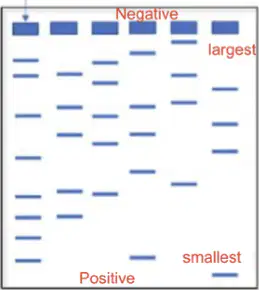
In the gel diagram, what label corresponds to the top of the gel near the wells?
Positive electrode side
Smallest fragment zone
Middle ladder region
Negative electrode side
Which statement best defines an antigen in the context of blood type?
Sugars on red blood cells recognized as self
Proteins on pathogen surfaces recognized as not self
Enzymes in white blood cells recognized as defense
Lipids floating in plasma recognized as nutrients
Which antigens are found on the red blood cells of type A individuals?
A antigens on the cell surface
No antigens on the surface
B antigens on the cell surface
A and B antigens together
Which antigens are present on type B red blood cells?
A antigens only on cells
B antigens only on cells
A and B antigens on cells
No antigens on cells
Which antigens are present on type AB red blood cells?
Both A and B antigens
Only B antigens on cells
Only A antigens on cells
No antigens at all
Which antigens are present on type O red blood cells?
Only A antigens present
Only B antigens present
No A or B antigens
Both A and B antigens
How does increased drop height affect blood spatter patterns?
Greater height makes oval drops only
Greater height increases drop diameter
Greater height eliminates satellite drops
Greater height decreases drop diameter
How does a steeper impact angle generally affect blood spatter?
Steeper angle widens the drop diameter
Steeper angle narrows the drop diameter
Steeper angle makes circular drops only
Steeper angle stops spatter formation
Which are the three components of a nucleotide?
Phosphate group, peptide, ribose sugar
Deoxyribose sugar, amino acid, phosphate
Ribose sugar, fatty acid, nitrogen base
Deoxyribose sugar, phosphate group, nitrogen base
Which base pairing rule is correct for DNA?
A pairs with T via two H bonds
G pairs with T via one H bond
A pairs with G via two H bonds
C pairs with T via three H bonds
Which DNA bases are purines?
Adenine and guanine are purines
Cytosine and thymine are purines
Thymine and adenine are purines
Guanine and cytosine are purines
How many hydrogen bonds connect cytosine to guanine?
Two hydrogen bonds connect them
Three hydrogen bonds connect them
One hydrogen bond connects them
Four hydrogen bonds connect them
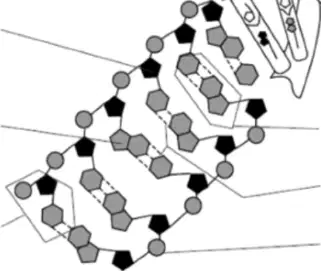
Which label correctly identifies the sugar in a DNA nucleotide in a diagram?
Hydrogen bonds labeled at the backbone
Phosphate group labeled at the base
Nitrogen base labeled at the backbone
Deoxyribose sugar labeled at the backbone
Which description best defines a gene?
All chromosomes packaged during mitosis
Amount of DNA that codes for a particular protein
Entire genome stored in one cell nucleus
Segment of RNA used to make ribosomes
What is a chromosome?
Coiled DNA around histone proteins, packaged for mitosis
Single uncoiled DNA strand floating in cytoplasm
Protein-only structure that carries traits
RNA coil used to code for proteins
Which statement correctly describes the relationship among DNA, genes, and chromosomes?
Genes are chromosomes; DNA is a protein
Chromosomes contain proteins; DNA makes genes
DNA contains genes; chromosomes are made of DNA
Genes contain DNA; chromosomes make proteins
A crime scene shows larger-diameter blood drops near a ledge. Which inference aligns with blood spatter principles?
Drops formed without gravity effects
Drops formed by low-angle swipe
Drops likely fell from lesser height
Drops likely fell from greater height
Which term describes the medical examination of a body to determine why a person died?
Imaging
Autopsy
Therapy
Biopsy
Which statement best defines cause of death?
The circumstances under which death occurred
The physiological failure that results in death
The legal classification of the death event
The specific injury or disease leading to death
Which option describes manner of death?
Exsanguination following liver laceration
Cessation of respiration from brain failure
Cardiac arrest due to blocked artery
Natural, accident, suicide, homicide, undetermined
What is mechanism of death?
The medical specialty performing the exam
The physiological derangement resulting in death
The setting or circumstances of the death
The timeline from injury to discovery
Livor mortis primarily indicates which postmortem change?
Drying of the outer epidermis
Stiffening of muscles and joints
Cooling of core body temperature
Pooling of blood causing purplish skin
Rigor mortis is best described as
Pooling of blood in dependent areas
Drop in body temperature after death
Gas formation within body cavities
Stiffening of muscles after death
Algor mortis refers to
Purple discoloration from blood pooling
Postmortem muscle stiffening
Change in body temperature after death
Insect colonization of remains
Which body system includes the heart and veins?
Digestive system
Respiratory system
Urinary system
Cardiovascular system
Which organ belongs to the respiratory system?
Lungs
Pancreas
Kidneys
Spleen
Which organ is part of the urinary system?
Gallbladder
Spleen
Small intestine
Bladder
Which structure is correctly matched to the digestive system?
Urethra
Thymus
Trachea
Small intestine
Which organ is associated with the endocrine system?
Pituitary
Trachea
Spleen
Urethra
Which organs are part of the nervous system?
Heart and vein
Brain and eye
Spleen and thymus
Pancreas and gallbladder
Which organs are components of the immune/lymphatic system?
Pancreas and pituitary
Lungs and trachea
Kidneys and urethra
Spleen and thymus
Which organ belongs to the reproductive system?
Testes
Pancreas
Spleen
Eye
Which structure carries air to the lungs as part of the respiratory system?
Urethra
Vein
Gallbladder
Trachea
Which term sequence correctly orders levels of biological organization from smallest to largest?
Organism, organ system, organ, tissue, cell
Cell, organ, tissue, organism, organ system
Tissue, cell, organ, organism, organ system
Cell, tissue, organ, organ system, organism
Which example correctly matches level and system: epithelial stomach tissue belongs to the
Digestive system
Respiratory system
Urinary system
Endocrine system
Which piece of evidence would most help estimate time since death at 10 hours?
Increased heart contraction force
Moderate rigor in jaw and neck
High blood pressure readings
Elevated respiratory rate
A body shows purplish discoloration on its back but not on its chest. What inference is most reasonable?
The body died from respiratory disease
The body is in early rigor mortis
The body was lying face up after death
The body has high core temperature
Which physiological response is commonly measured during a polygraph test?
Respiration rate changes over time
Bone density variations
Pupil dilation under dim light
Reflex speed after a tap
Why are baselines established before running a polygraph test?
To increase device voltage
To identify fingerprint patterns
To reduce subject fatigue
To provide a comparison control
Are polygraph results considered fully reliable for all cases?
No, they are not 100% reliable
Yes, always accurate and precise
Only reliable for athletes
Reliable only with fingerprints
Which statement best describes the legal status of polygraph tests in court?
Admissible only for minors
Often not admissible in court
Never used by investigators
Always accepted as evidence
Select the correct if-then format for a testable hypothesis.
If control is absent, then results are certain
If data are missing, then experiment is valid
If results are random, then hypothesis is true
If independent variable changes, then dependent variable responds
Which option correctly differentiates independent and dependent variables?
Independent is constant; dependent is random
Independent is data; dependent is hypothesis
Independent is manipulated; dependent is measured
Independent is observed; dependent is controlled
What is the role of a control in an experiment?
Eliminates all bias
Measures the dependent variable
Guarantees perfect accuracy
Provides a basis for comparison
Where in hair is DNA typically found for analysis?
Oil residue outside hair
Cells in the root region
Pigment along the shaft
Keratin at the tip end
Which fingerprint pattern is shown by ridges entering one side and exiting the other without deltas?
Arch pattern with simple flow
Loop pattern with one delta
Composite pattern with four deltas
Whorl pattern with two deltas
Define fingerprint minutiae most accurately.
Hand size and shape
Ink quality on the card
Overall ridge flow type
Small unique ridge details
How many matching minutiae are typically required to declare two fingerprints identical?
Seven matching points
Twelve matching points
Three matching points
Twenty-five matching points
Which blood component is primarily involved in clotting?
Plasma proteins
Leukocytes only
Erythrocyte membranes
Platelets (thrombocytes)
Which blood cell type delivers oxygen to body tissues?
Red blood cells (erythrocytes)
White blood cells
Platelets alone
Stem cells only
Which blood component transports water, hormones, and nutrients like glucose?
Plasma fluid matrix
Red cell nuclei
Leukocyte enzymes
Platelet granules
During an immune response, which cells are most active?
Keratinocytes in skin
Platelets with fibrin
Erythrocytes in plasma
Leukocytes (white cells)
Which statement best compares presumptive and confirmatory tests?
Presumptive is definitive; confirmatory is tentative
Presumptive is expensive; confirmatory is free
Presumptive is slower; confirmatory is faster
Presumptive suggests presence; confirmatory gives absolute answer
A positive presumptive test for blood indicates which conclusion?
It is definitely human blood
It might be blood; more testing needed
It is not blood at all
It proves the suspect is guilty
Which variable should remain unchanged across groups to serve as the control condition?
Random participant assignment
Measured dependent outcome
Manipulated independent factor
Baseline comparison setting
In designing a fingerprint analysis experiment, what should be the dependent variable?
Number of matching minutiae
Room temperature setting
Time of day recorded
Type of ink pad used

