
 Worksheets
Semester 1 Midterm Review
Total questions: 54
Worksheet time: 27mins
In which revolution did Simon Bolivar help bring about changes associated with the new political ideas of the Enlightenment?
American
Haitian
French
Latin American
Which revolution included: the use of the guillotine for execution, unfair treatment of the 3rd estate, and the Tennis Court Oath?
American
French
British
German
Which statement is true about women in the Industrial Revolution?
They became more dependent on men since they could not work
They were forced to work in order to support their families as the men worked in the factories
They stayed home since the men made more money
They became more independent as they entered the work force, rather than be at home
10 months of accusations and executions via the guillotine led by The Jacobin's & Robespierre is known as?
The Berlin Fear
Congress of Vienna
Reign of Terror
Napoleonic Code
____________________ are cloths or fabrics.
Textiles
Metals
Liquids
Plastics
Which of the following was an immediate result of Commodore Matthew Perry's visit to Japan in 1854?
the continued isolationist policy of Japan
an alliance between Japan and Russia to ensure peace
a war between Japan and the U.S. based on the usage of opium
the development of trade between Japan and the U.S.
Thomas Hobbes believed that all men were born evil, and strong government was needed to keep order.
True
False
John Locke believed in which theory?
Men and women are equal
A person has no right to the product of their labor
The government's role is to protect the rights of the people
Labor is the least important part of property
Which term describes the idea that royals were given their power from God, so therefore no one should question him/her?
Laissez-Faire
Divine Right
Social Contract
Absolutism

On which side was Great Britain during World War I?
Triple Entente
Triple Alliance
Central Powers
Axis Powers
One of the main reasons that Europeans countries met for the Congress of Vienna (1814-1815) was to:
restore the power of the Holy Roman Empire
promote independence movements in Europe
establish a balance of power in Europe after the defeat of Napoleon
keep the German territories gained by Otto von Bismarck
How does the policy of Mercantilism contribute to Imperialism?
The lack of needed resources forced the factories to close down.
The colonies of Africa used the policy to defeat the European nations.
The need for new military advancements forced the nations to spy on each other.
The need for raw materials forced European nations to look for new resources.
What is the term used to describe a policy of glorifying the armed forces and keeping an army prepared for war?
militarism
Nationalism
imperialism
patriotism
A major cause of World War I was:
a decline in the policy of imperialism
the existence of opposing alliances
an increase in acts of aggression by England
the spread of communism throughout Europe
What event in Sarajevo ignited the Great War (WWI)?
Russia's mobilization of troops along the Austrian border
The assassination of Archduke Franz Ferdinand and his wife Sofia
Napoleon's rise to power after being exiled to Elba
The uncovering of events that occurred in the Congo by journalists
The race to divide up African land between European colonizing nations.
Congress of Vienna
The Scramble for Africa
Treaty of Nanking
none of the above
Japan resisted modernization as it practiced isolationism. What motivated Japan to modernize beginning in the 1800s?
The Japanese people developed a need for Western goods.
China threatened to attack Japan, so modern weapons were required for their defense.
The Japanese leadership feared that if it did not modernize, it might be controlled by Western nations like China had been.
Japanese military leaders admired the design of Commodore Perry's fleet of steamships.
Who/Whom tried to prevent changes caused by the Scientific Revolution and Age of Enlightenment since they didn't agree with those beliefs?
Martin Luther
English Civil War
Catholic Church
Spanish Inquisition
Many countries were colonized during the Imperial era. Of the following list, which WERE NOT?
India
China
Ethiopia
South Africa
Which of the following 3 countries were not invited to the Berlin Conference?
South Africa
Namibia
Great Britain
Congo
France
Which of the following correctly summarizes the impact of imperialism?
Colonial markets were closed to manufactured goods from the colonizing power.
Land was distributed equally among the main social classes.
Colonial economies became devoted to manufacturing goods using the raw materials from the colonial power.
The wealth of the colonizing powers often increased at the expense of their colonies.
The Industrial Revolution led to imperialism because:
Industrialists wanted to use their wealth to protect African and Asian cultures.
Europeans expected to sell to the United States.
Europeans planned to set up manufacturing centers in Asia.
It created a need for raw materials used in manufacturing.
The treaty of Nanking is an example of an unequal treaty because it:
Gave more privileges to some European nations than others.
Benefited China and hurt European nations.
Forced the British to be tried in Chinese courts.
Benefited Europeans at the expense of the Chinese.
Which of the following was a result of the Sepoy Mutiny, or rebellion in 1857?
The British government ended the rule of the British East India Company
India declared its independence
India adapted Christianity
The British East India company raised taxes
The Boxer Rebellion of the early 20th century was an attempt to
remove foreign influences from China
bring Western-style democracy to China
restore trade between China and European countries
introduce communism
What was something that was a result of the Congress of Vienna?
restored monarchies again
promote the European free-trade zone
encourage nationalist movements
spread the idea of democracy
What term describes people leaving farms to live and work in cities?
suburbanization
emigration
rural to urban migration
immigration
Otto von Bismarck organized the Berlin conference in 1884-85 to:
work with the Africans to seek trade agreements
establish rules for dividing up Africa among the European countries
prevent Belgium from taking over the Congo
limit Russian expansion on the continent
Which of the following statements is NOT true about the industrial revolution?
New energy sources were developed to power the new machinery
Decline in factory based manufacturing
Increased use of metals and minerals
Machines were invented which replaced human labor
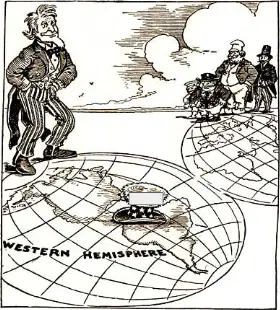
What policy is being shown here?
Monroe Doctrine
Trans-Columbian Trade
Mercantilism
Encomienda
Which of the following was a cause of the French Revolution?
outrage over the use of the guillotine by the Committee of Public Safety
nationalization of the Church
the demand of the Third Estate for more political power
ineffective rule of Napoleon Bonaparte
The American and French Revolutions were turning points in history because their results:
marked the end of European influence in the West
led to the abolition of slavery
demonstrated the need for international peace keeping organizations
inspired other people seeking democracy and independence
Before the French Revolution, the people of France were divided into three estates based mainly on their:
geographic location
education level
religious beliefs
social class
Why did the 3rd Estate take action against King Louis & Marie Antoinette?
Believed a king should rule by divine right, rather than by will of the people
Had fewer rights, owned less land, and paid more taxes than wealthier members of the French population
Supported the tax system set up by King Louis XIV
Disagreed with the ideas behind the Declaration of the Rights of Man and of the Citizen
What was the significance of the Printing Press?
with easier access to books, more people learned to read and more books were printed.
until guilds were created, craftspeople were unable to control the goods they produced.
coupled with a large pool of unemployed workers, it led to early industrialization in parts of Central Europe.
with oil paints, Renaissance artists could paint much more detail than they could with watercolors.
The name of the room where the rich would gather to discuss topics such as politics & during the Enlightenment era is called:
Barber shop
Living Room
University
Salon
Which form of government was ruled by a leader that had total control over their nation and didn't have to follow their own laws?
Absolute monarchy
Oligarchy
Constitutional Monarchy
Democracy
The period when philosophers focused on reason is called the:
Age of Truth
Age of Enlightenment
Scientific Revolution
Human Condition
Which of the following countries were NOT invited to the Berlin Conference?
Britain
Ethiopia
Namibia
France
France, Russia and Great Britain made up the:
Triple Alliance
Eastern Block
Central Powers
Triple Entente

Which claim is best supported by the evidence included in this map?
In 1913, European countries controlled most of the territory in Africa.
In 1913, European countries controlled all of the territory in Africa.
By 1913, European countries built extensive railroad systems in sub-Saharan Africa.
In 1913, European countries ruled territory in Africa with the consent of the Africans who lived there

Which force best describes the motive behind Gavrilo Princip's assassination of the Archduke Franz Ferdinand and his wife, Sophie?
Alliances
Militarism
Nationalism
Imperialism
How does the "White Man's Burden" relate to imperialism?
The belief that Europeans had a moral obligation to civilize primitive cultures
The financial cost of maintaining colonies
The responsibility of white men to resist imperialism
The burden of developing new technologies for colonized lands
What was a main reason for European colonization in Africa during during the 1800s?
To promote democracy
To access natural resources and new markets
To establish educational institutions
To encourage cultural exchanges
In Rousseau's The Social Contract, he expressed his belief that
a child was a small adult with all the same abilities and obligations.
the individual's will is the most important.
government was necessary to protect the rights of its citizens, but may be overthrown.
government was an evil that should be totally eliminated.
What was one of the key impacts of the Scientific Revolution on the Enlightenment?
It reinforced the belief in traditional religious explanations
It discouraged the use of reason and scientific inquiry
It provided a model for using reason and observation to understand the world
It led to the rejection of all scientific methods
What was the primary goal of the Enlightenment thinkers?
To maintain the status quo
To challenge traditional authority and promote knowledge through reason
To establish a new religious order
To expand colonial empires
What did John Locke believe about government?
It should be absolute and unquestionable
It should protect the natural rights of life, liberty, and property
It should be based on religious authority
It should be led by a monarch
How did the Enlightenment influence the French Revolution?
By supporting the continuation of the monarchy
By inspiring revolutionary ideas about liberty, equality, and fraternity
By advocating for colonial expansion
By promoting religious wars
The Boxer Rebellion tried to...
Free China from the United States
teach people self defense with karate
Burning & disposing all of the opium in China
get rid of foreign influence
What happened shortly after the Sepoy Mutiny?
The British ended the rule of the British East India Company
The Enfield rifles were banned in India
The British started to hire Africans instead of Indians as soldiers in India
India was split apart by various different countries in the Berlin Conference
Laissez-faire is an economic philosophy that proposes that businesses work best with a "hands off" government approach
True
False
Which scientist created the investigative scientific method?
Rene Descartes
Isaac Newton
Francis Bacon
Copernicus

