
 Worksheets
American History Sem. 1 Final
Total questions: 25
Worksheet time: 12mins
Name
Class
Date
1.
Choose THREE amendments that are considered to be part of the "Reconstruction Amendments" which provided for greater rights to more individuals; including but not limited to African Americans; after the Civil War.
a)
12th - Separating the President and Vice President onto two different ballots.
b)
14th - Provides citizenship, due process, and equal protection.
c)
13th - Abolishes slavery.
d)
15th - Grants black men the right to vote.
e)
16th - Provides for Federal Income tax.
2.
By the end of the Reconstruction era, most African-Americans in the United States
a)
found themselves increasingly left out of the political process because of poll taxes and literacy tests.
b)
had made tremendous economic and social gains in the South as a result of constitutional amendments.
c)
began to migrate in massive numbers to the rural South to pursue farming jobs.
d)
found themselves owners of the land their ancestors had worked on as slaves.
3.
What was one long term consequence of the sharecropping system in the Southern states?
a)
agricultural workers organized labor unions
b)
many former slaves became trapped in a cycle of debt
c)
many agricultural workers moved to cities for new opportunities
d)
land owners sold property to pay wages to former slaves
4.
Read and study the source about the Reconstruction era.
Freedmen's Bureau Documents (1867)
These excerpts are from documents issued by local offices of the Freedmen's Bureau in Virginia and Kentucky during the Reconstruction era.
Office of the Freedmen's Bureau In Richmond, Virginia (1867)
Officers and Agents of this Bureau will take care that the Freedmen are familiar with their rights under the Reconstruction Act of Congress.
These actions will inform all Freedmen entitled to be registered to vote, of the necessity for voting, and the time and place of registration, and of the time and place of voting. They will also be instructed that they will be protected from violence due to exercising their right of suffrage. They should ignore all threats.
Any case in which the rights of a Freedman are withheld or interfered with will be promptly reported.
Office of the Assistant Commissioner of the Kentucky Freedmen's Bureau (1867)
The Negro, though free in theory, is practically held in a state of slavery. If a Negro does anything that offends, for instance if he refuses to work, differs with his employer, gives a social party, or does any acts considered wrong, he is attacked by an armed and disguised mob. So great is the terror that the Freedmen do not report these acts because they fear that revenge will be visited upon them.
Based on this source, which statements best explain how freedmen were often treated in the South during the Reconstruction era?
Select the two correct answers.
a)
Freedmen were encouraged by white southerners to run for local and state offices.
b)
Freedmen were often threatened with violence by white southerners.
c)
Freedmen were jailed by Union soldiers for refusing to cooperate with federal officials.
d)
Freedmen were prohibited by Union officials from pursuing educational activities.
e)
Freedmen were informed of their rights by the Freedman's Bureau.
5.
During Reconstruction, the "Black Codes"
a)
were laws passed by mainly Southern states to keep African Americans in a system of virtual slavery by denying them their Constitutional rights.
b)
forced Congress to do the bidding of former Confederate politicians by intimidating Radical Republicans through KKK violence.
c)
were enacted by the Radical Republicans to prevent racial discrimination in the South.
d)
protected the Constitutional rights and liberties of freed slaves.
6.
As railroads expanded westward across the United States in the late-1800s, Native Americans were increasingly unable to hunt across the formerly open landscape of the Great Plains.
In addition to the problems stated here, what other issue contributed to the problems faced by Native Americans on the Great Plains at the end of the 19th century?
Responses
a)
Railroads brought an increase in population, leading to controversies over land usage.
b)
The discovery of oil got companies involved in issues of property ownership.
c)
Timber land was harvested, robbing Native Americans of a valuable resource.
d)
European wars wiped out a substantial portion of the Sioux population.
7.
The purpose of the Homestead Act of 1862 was to
a)
provide people with economic incentives to settle in the territory of Florida.
b)
encourage people to populate U.S. western territories, especially on Great Plains
c)
provide free blacks with “40 acres and a mule” in former Confederate states.
d)
offer former Confederate officers a place to live in return for their loyalty to the U.S.
8.

The completion of which period in United States History is BEST associated with this image?
a)
Reconstruction
b)
Manifest Destiny
c)
Social Darwinism
d)
Second Great Awakening
9.
Based on your knowledge of Westward Expansion, which of these would have been the BIGGEST obstacle to completing that period of history?
a)
lack of religious unity
b)
transportation
c)
Southern states
d)
slavery
10.
Dawes Severalty Act, 1887
An act to provide for the allotment of lands in severalty to Indians on the various reservations, and to extend the protection of the laws of the United States and the Territories over the Indians, and for other purposes.
Based on this excerpt from the Dawes Severalty Act, United States domestic policy toward Native Americans in the late 1800s made an attempt to
a)
increase the land holdings of western tribes by setting aside Oklahoma territory as Indian land forever.
b)
grant them full citizenship and due process.
c)
give their tribal groups authority over their own governmental affairs.
d)
force Native American Indians to give up their traditional cultures and settle on reservations
11.
The most important reason for the growth of labor unions in the latter half of the 19th century was
a)
the creation of the Interstate Commerce Commission.
b)
the forceful leadership of the newly arriving immigrants.
c)
the way the workers were treated by big business and big industry.
d)
the passage of the Sherman Anti-trust Act.
12.
How did immigration during the Industrial Revolution allow big U.S. companies to make even bigger profits?
a)
Businesses in other nations were shutting down because their workers were immigrating to the U.S.
b)
Immigrants were able to get deals from their home countries on raw materials.
c)
Immigrants were coming from poor conditions abroad and were willing to work for low wages.
d)
As more wealthy immigrants came to the U.S., sales increased for many companies.
13.
What positive outcomes happened as a result of low wages, poor working conditions, and long hours that stemmed from industrialization?
a)
These issues caused businesses to hire more immigrants.
b)
These issues caused an increase in the number of immigrants coming to America.
c)
These issues caused a reform movement that included the passage of laws and regulations for businesses.
d)
These issues caused more businesses to move their factories to other countries.
14.
What changes resulted from industrialization in the United States in the late 19th and early 20th centuries?
Select all the correct answers.
a)
shift from predominance of agricultural workers to a predominance of factory workers
b)
decreased immigration from other countries
c)
increased number of people of living in urban areas
d)
less crowded and cleaner cities
15.
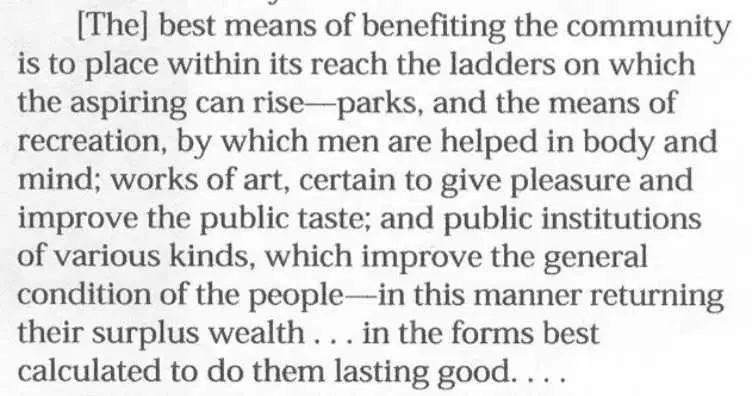
The excerpt comes from "The Gospel of Wealth" by Andrew Carnegie.
Based on the reading and your content knowledge, which of the following would Andrew Carnegie see as a proper use of wealth?
a)
Giving small amounts of money to poor individuals to use as they see fit
b)
Building libraries, schools, and arts centers during your lifetime to benefit all people.
c)
Leaving your whole estate (money and possessions) to your family
d)
Making a will that specifies giving millions of dollars to charities upon your death
16.
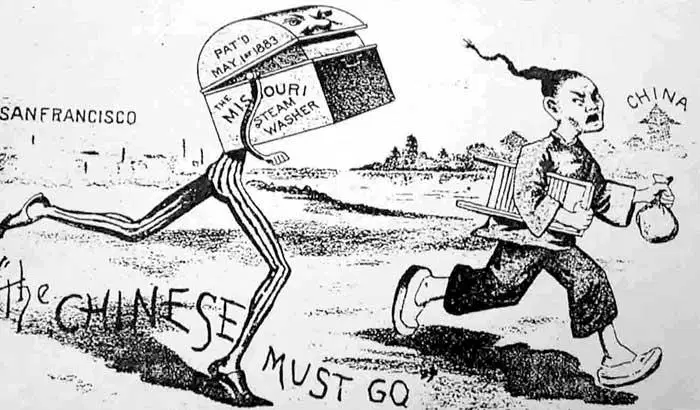
The political cartoon was published and relates to
a)
passage of the Pendleton Act
b)
the end of Reconstruction in the South
c)
the Chinese Exclusion Act
d)
the implementation of Jim Crow laws
17.
Upton Sinclair’s novel The Jungle uncovered the unhealthy conditions inside a meat packing plant. The publication helped fuel demands for reforms in industrial America.
Select all of the legislative actions that occurred in response to the publication of Upton The Jungle.
a)
The Seventeenth Amendment was ratified to establish the use of popular elections.
b)
The Pure Food and Drug Act required improved food handling processes and procedures.
c)
The Supreme Court declared the Standard Oil Company’s monopoly and ordered it to be dissolved.
d)
The Meat Inspection Act required the inspection of the meat processed and the sanitary practices used.
e)
A Grand Jury investigation recommended a budget increase to the New York City Department of Public Charities and Corrections
18.
This work-place disaster in 1911 helped to bring about better safety laws in factories and safety for public buildings across America.
a)
Winecroft Fire
b)
Triangle Shirtwaist Factory Fire
c)
Pullman Strike
d)
Haymarket Riot
e)
the Johnstown Flood
19.
What was the 19th Amendment?
a)
granted women the right to vote
b)
started income taxes
c)
ended slavery
d)
banned alcoholic beverages
20.
Which of the following was not a requirement of the Homestead Act?
a)
had to be a US citizen
b)
had to serve in the Civil War
c)
had to pay a small fee for the 160 acres
d)
had to improve the land for 5 years
21.
What time of government involvement represents the French term Laissez-Faire?
a)
very strict government approach
b)
very well regulated government approach
c)
Dictatorship
d)
hands off government approach
22.
Select 2 pull factors for immigrants choosing to come to America during the Industrial Era?
a)
an abundance of jobs in factories
b)
an abundance of land to live on
c)
bad living conditions in their home country
d)
lack of freedom in their home country
23.
What was the 18th Amendment?
a)
banned alcoholic beverages in the US, known as "prohibition"
b)
ended slavery
c)
Granted women the right to vote
d)
ended the civil war
24.
When someone was recorded as "do not hire" and shared amongst other company owners the were
a)
fired
b)
unionized
c)
blacklisted
d)
denied due process
25.
Click on the example of assimilation.
A
B
C
100 %

