
 Worksheets
Biology Semester Guide
Total questions: 91
Worksheet time: 48mins
Competition between two species occurs when:
Mold grows on a tree that has fallen in the forest
Chipmunks and squirrels eat sunflower seeds in a garden
A crow feeds on the remains of a rabbit killed on the road
A lion stalks, kills and eats an antelope
Which statement represents a characteristic of an ecosystem that is not likely to sustain itself?
The sun provides the needed energy.
Energy is transferred from plants to animals.
There are more consumers than producers.
There are interactions between biotic and abiotic factors.
When an environment has reached its carrying capacity for a certain population, which of the following is true?
Growth and immigration rate is equal to death and emigration rate.
Growth and immigration rate is greater than death and emigration rate.
Growth and immigration rate is less than death and emigration rate.
Growth rate is exponential.
The common brushtail possum is a marsupial native to Australia. This possum was introduced to New Zealand where it had no natural predators and had an abundant food supply. Which of these likely occurred a few years after the introduction of this possum to New Zealand?
The possums became extinct.
The possums developed shorter life spans.
The possum population grew to a larger size.
The possum population evolved into a different species.
Angel was trying to explain carrying capacity to her mother. Which of the following descriptions is accurate? Carrying capacity is:
the maximum number of individuals that an ecosystem can sustain.
the ability of an environment to accommodate a growing population.
the number of predators that an area can sustain over the long term.
the maximum number of species that can co-exist in an area.
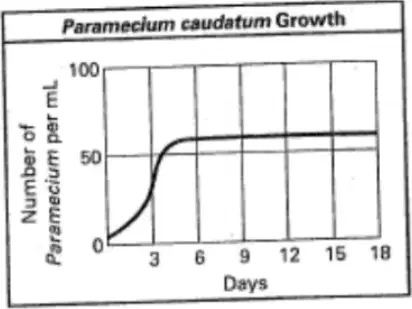
According to the diagram, what is the carrying capacity of the test-tube environment as long as food is added?
about 10 paramecia
about 50 paramecia
about 60 paramecia
about 100 paramecia
Jenn is studying a population of fish found in a pond that has a decreasing carrying capacity. Which of the following factors would not decrease the carrying capacity of the pond?
drought
flooding
food shortages
a freeze
An animal population decreases from 800 individuals to 600 individuals. Which of the following could explain this change in population size?
The population size of the animal’s predator increased.
The emigration rate of the animals from the population decreased.
The number of breeding pairs in the animal’s population increased.
The number of species competing with the animal for food decreased.
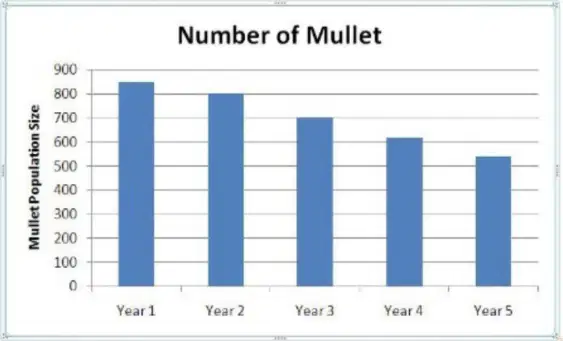
Mullet are local estuarine fish that move in schools and feed on plankton and plant matter. Natural predators of the mullet include spotted sea trout, sharks, pelicans and dolphins. The graph below shows how the number of mullet in an area has changed over time. Based on the data, one student concludes that a new predator was introduced into the area during this time period. Which of the following is a likely alternate explanation for the change in the mullet population?
mullet prey increased in the area
mullet parasites decreased in the area
the temperature of the area increased
the amount of aquatic plants in the area decreased
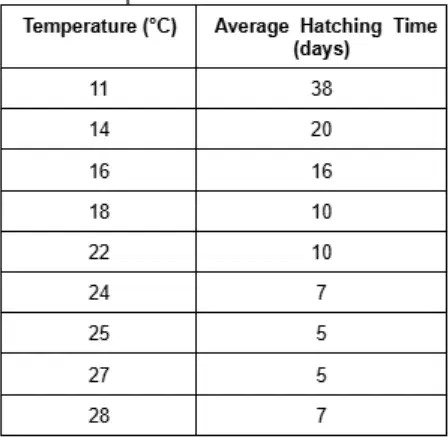
Based on the data, which of the following conditions would promote the highest population growth rate in pea weevils?
cold springs with temperatures from 11°C to 16°C
moderate summers with temperatures from 25°C to 27°C
heat waves in which the temperature is sustained well above 28°C
overnight frosts after which the temperature warms from 0°C to 11°C
On remote islands, immigration and emigration usually do not have a large effect on population sizes. A bird population on a remote island remains at a relatively constant size year after year. Which of the following most likely describes the birthrate and the death rate for this population?
Birthrate and death rate are both zero
Birthrate and death rate are close to equal.
Birthrate is significantly less than death rate.
Birthrate is significantly greater than death rate.
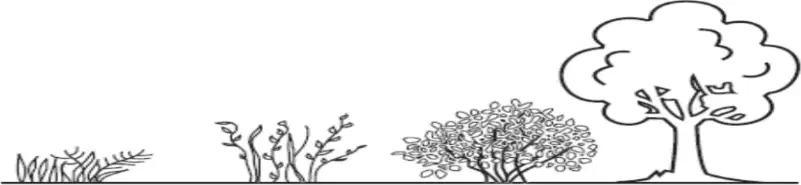
Changes in an ecosystem over a long period of time are shown in the diagram below. These changes will most likely lead to a:
A. stable ecosystem that can last for many years
B. loss of heterotrophs that cannot be recovered
C. long-term rise in environmental temperatures
D. forest consisting of only producers and decomposers
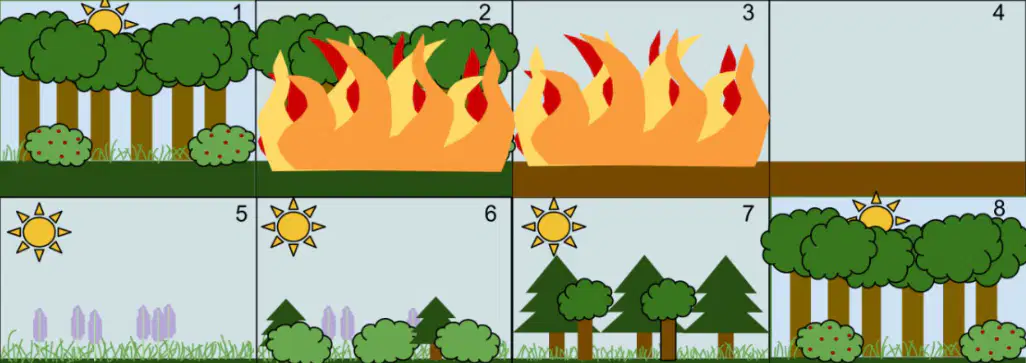
What process is illustrated by the diagram in boxes 4-8 after the forest fire?
A. pioneer speciation
B. primary succession
C. secondary succession
D. ecosystem boundaries
A biologist compares how different ecosystems undergo succession. She divides the series of events that happen during primary and secondary succession into three different stages. Which feature might be used to distinguish secondary succession from primary succession?
the lack of pioneer species in the second stage
the presence of pioneer species in the final stage
the presence of trees and large plants in the final stage
the presence of soil and organic matter in the first stage.
After a volcano erupts and destroys an ecosystem, a few organisms are able to begin growing from the decaying organic matter left behind. What do we call those first organisms that are able to grow in little or no soil that first appear?
adaptors
pioneer species
non-vascular plants
decomposers
Based on Jill’s observations, the most reasonable conclusion is:
Jill observed a pattern in the data.
Jill ignored the evidence presented.
Jill made a random guess.
Jill was unable to draw any conclusion.
Which of the following statements does NOT describe a factor that influences the distribution of life in aquatic systems?
A. Geography – determines the location of different aquatic ecosystems like oceans, rivers, and lakes.
B. Light – the availability of sunlight in the water affects photosynthesis and the types of organisms that can survive at various depths.
C. Salinity – the concentration of salts in water determines whether organisms are adapted to freshwater or marine environments.
D. Color of the Water – influences metabolic rates and the types of species that can thrive in different water temperatures.
One way humans can promote the survival of organisms in an ecosystem is to:
decrease diversity in plant habitats
introduce new consumers to control autotrophs
release extra CO2 into the atmosphere to help autotrophs
learn about the interactions of population
New fuels are being produced by converting corn and grasses into compounds containing alcohols that can be broken down for energy in various engines. The purpose of this research is to
reduce the use of nonrenewable resources.
increase the rate of air pollution.
reduce the rate of homeostasis in organisms.
cause a loss of biodiversity in the rain forests.
Whaling was a very profitable profession until whale populations crashed. The global community came together to enact a ban on whaling. However, Japan and Norway have not agreed to stop whaling. Which of the following is the most likely consequence of their decision?
The whale populations are bouncing back very successfully and are unaffected by Japan and Norway continuing to whale.
The whale populations are not rebounding as quickly as they might if all of the countries agreed not to hunt whales.
The whale populations have mutated into new kinds of organisms.
The whales are getting better at avoiding capture.
What is the relationship between proteins and nucleic acids?
Nucleic acids use proteins for energy
Nucleic acids are a subset of proteins
Proteins are long polymers of nucleic acids
Nucleic acids contain the information to make proteins
Organisms in the intertidal zone must be able to withstand very cold water. There are no producers in the benthic zone that rely on photosynthesis. Organisms in the benthic zone must be able to tolerate large amounts of oxygen. The warm water and abundant sunlight in the neritic zone limits the plankton population.
Organisms in the intertidal zone must be able to withstand very cold water.
There are no producers in the benthic zone that rely on photosynthesis.
Organisms in the benthic zone must be able to tolerate large amounts of oxygen.
The warm water and abundant sunlight in the neritic zone limits the plankton population.
Resistance to antibiotics results from variations in the genetic code of Streptococcus pneumoniae. Which type of molecule encodes genetic information in Streptococcus pneumoniae?
carbohydrate
fatty acid
nucleic acid
protein.
Which of the following diagrams below is an example of a carbohydrate?
1
2
3
4
In living organisms, lipids function mainly as:
Sources of stored energy and transmitters of genetic information
Sources of stored energy and components of cellular membranes
Transmitters of genetic information and catalysts of chemical reactions
Catalysts of chemical reactions and components of cellular membranes
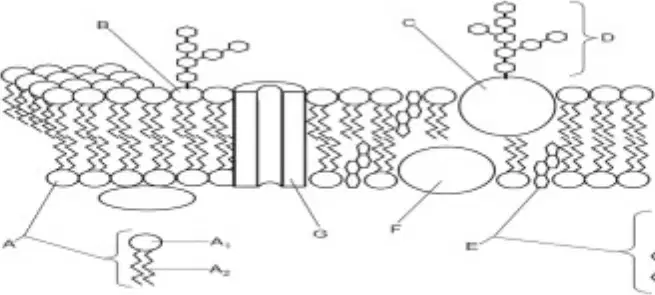
What is the building block of structure G?
nucleotide
chains of fatty acids
amino acids
monosaccharides
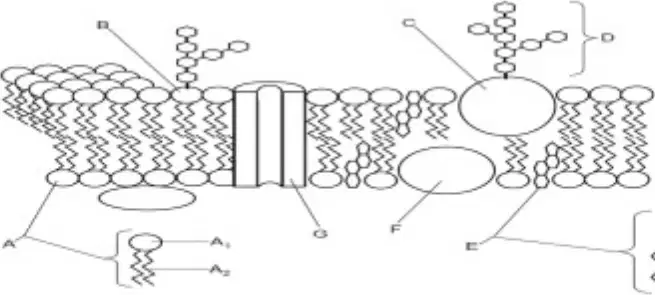
Which macromolecule makes up the majority of the cell membrane?
(a)
Which of the following macromolecules is not identified on the cell membrane above?
nucleotide
lipid
protein
carbohydrate
Baby food manufacturers sometimes use proteases in their products. Proteases catalyze the breakdown of the proteins in these foods, making digestion easier for infants. Proteases are which of the following types of molecules?
enzyme
fatty acid
carbohydrate
nucleic acid.
Ovalbumin is a protein found in eggs. Which of the following best describes the molecular structure of ovalbumin?
a group of six carbon atoms joined in a ring.
a chain of amino acids folded and twisted into a molecule
a set of three fatty acids attached to a molecule of glycerol
a sequence of nitrogenous bases attached to a sugar phosphate backbone
Many plants have waxy coatings on some surfaces. This coating reduces water loss because it is not water-permeable. This waxy coating is which of the following types of organic molecule?
protein
carbohydrate
nucleic acid
lipid
Like complex carbohydrates, proteins are macromolecules that serve many functions and can be chemically broken down and restructured. Both proteins and complex carbohydrates are which of the following?
polymers of smaller subunits
sequence of sugars
lipids of large molecules
nucleotides of DNA

What is the function of the macromolecule subunit to the right?
energy
catalyst
stores genetic information
composes the majority of the cell membrane
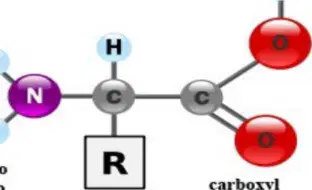
The diagram to the right shows a monomer of a macromolecule. Which of the following macromolecules contains these monomers?
carbohydrates
proteins
nucleic acid
lipid
Some bacteria live in hot springs. Their cells contain enzymes that function best at temperatures of 70 °C or higher. At the temperature of 50 °C, how will the enzymes in these bacterial cells most likely be affected?
The enzymes will be destroyed by lysosomes.
The enzymes will lose their bond structure and fall apart.
The enzymes will require less energy to function than at 70 °C.
The enzymes will not increase the rate of reactions as much as they would at 70 °C.
Many of the proteins in the human body are enzymes that catalyze chemical reactions. What is the relationship between enzymes and activation energy?
When an enzyme catalyzes a reaction, it increases the activation energy of the reaction.
When an enzyme catalyzes a reaction, it increases the activation energy of the product.
When an enzyme catalyzes a reaction, it decreases the activation energy of the reaction.
When an enzyme catalyzes a reaction, it does not affect the activation energy of the reaction.
Meat tenderizer contains an enzyme that breaks down meat. If meat is coated with tenderizer and then placed in a refrigerator, predict how the enzyme might be affected?
It would break down the meat more slowly.
It would disintegrate the meat.
It would break down the meat more quickly.
It would change the shape of the meat.
As food travels through the digestive system, it is exposed to a variety of pH levels. The stomach has a pH of 2 due to the presence of hydrochloric acid (HCl), and the small intestine has a pH ranging from 7 to 9. HCl converts pepsinogen into pepsin, an enzyme that digests proteins in the stomach. Which of the following most likely happens to pepsin as it enters the small intestine?
It becomes inactive.
It begins to replicate.
Its shape changes to engulf large proteins.
Its activity increases to digest more proteins.
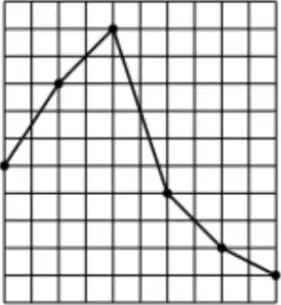
The graph to the right shows how the activity of an enzyme changes over a range of pH values. According to the graph, at which pH does the enzyme show maximum activity?
pH 2
pH 4
pH 6
pH 8
Which of the following conclusions can be drawn from this graph?
The optimum pH of the enzyme is 6.6.
The optimum pH of the enzyme is 5.8
The enzyme’s activity continually increases as pH increases from 5.0 to 9.0
The enzyme’s activity is greater around pH of 8.0 than around pH of 5.0.
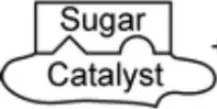
What is another name for the substance labeled "catalyst"?
A. Enzyme
B. inorganic compound
C. Hormone
D. Antibody
The human body maintains a temperature of around 98.6 degrees at all times. Enzymes are involved in almost every chemical reaction in the body. Which of the following describes the connection between these two statements?
Enzymes function best at a specific temperature.
The body needs to be warm to prevent hypothermia.
The body is kept relatively warm to prevent too much enzyme action.
There is no connection between the two statements.
Which of the following best explains why enzymes are necessary for many cellular reactions?
Enzymes supply the oxygen necessary for the reactions.
Enzymes change reactants from solid to liquids during the reactions.
The reactions take up too much space in the cell if the enzymes are missing.
The reactions are too slow to meet the needs of the cell if enzymes are missing.
A student is investigating how reaction rate changes over a range of enzyme concentrations. The student uses excess reactants. Which of the following best represents the relationship between enzyme concentration and reaction rate?
Reaction rate increases linearly with enzyme concentration.
Reaction rate increases with enzyme concentration, then levels off.
Reaction rate decreases with enzyme concentration.
There is no relationship between enzyme concentration and reaction rate.
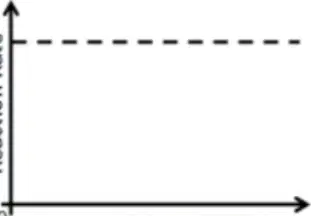
Which of the following graphs (A, B, C, or D) best represents the relationship between enzyme concentration and reaction rate?
A. (Graph showing a horizontal line)
B. (Graph showing a bell-shaped curve)
C. (Graph showing a curve that rises and then plateaus)
D. (Graph showing a straight line with positive slope)
Which gas is removed from the atmosphere during photosynthesis?
hydrogen
oxygen
nitrogen
carbon dioxide
A potted plant is placed inside a clear, sealed vacuum container that has water pumped into it on a regular basis. The container is placed in the sun and the plant’s growth is monitored. Which statement best describes what will most likely happen to the plant over time?
The plant will grow faster because it is sheltered from the wind.
The plant will die because it does not have oxygen for photosynthesis.
The plant will die because it does not have carbon dioxide for photosynthesis
The plant will grow at a slower rate because it requires more water.
Mike has four aquatic plants of the same size and the same species. He submerges the plants in a separate beaker filled with 200 ml of water. He then sets each beaker under a different intensity of light. Mike observes that, of the four plants, the plant in the beaker under the most intense light gives off the most gas bubbles in a 20 minute period. Which of the following statements best explains Mike’s observations?
Cells decompose most quickly under the most intense light.
Water evaporates from plants faster under the most intense light.
Photosynthesis occurs at the highest rate under the most intense light.
Gases in the leaves of plants expand most under the most intense light.
Which of the following are the reactants of photosynthesis?
water and glucose
glucose and carbon dioxide
carbon dioxide and water
oxygen and water
If a plant died from lack of food, which structure is most likely missing or damaged?
flower
root
stem
leaves
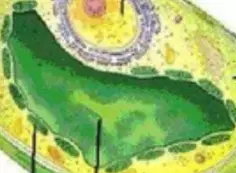
Which of the following structures is where photosynthesis occurs in the cell below?
nucleus
chloroplast
mitochondria
endoplasmic reticulum
Which process takes place in the presence of oxygen and produces nearly 20 times as much ATP as glycolysis alone?
photosynthesis
lactic acid fermentation
aerobic respiration
alcoholic fermentation
Two different species of bacteria are examined. Scientists find that species X always produces CO₂ and H₂O during cellular respiration. Species Y always produces ethyl alcohol and CO₂. Which conclusion can be made from these observations?
Only species Y is aerobic.
Only species Y is anaerobic.
Both species X and Y are aerobic.
Both species X and Y are anaerobic.
A weightlifter is using heavy weights in short bursts for a competition. Because his muscle cells are not able to take in enough oxygen to make very much ATP the weightlifter begins to get fatigue in his muscles. Which of the following processes is most likely going on in the muscles of the weightlifter as he competes in his event?
As the cells run out of oxygen they switch to anaerobic respiration, which allows the cell to make small amounts of ATP in the absence of oxygen.
As the cells run out of oxygen, they die off gradually and the weightlifter's muscles have fewer contracting muscle cells.
The cells will never run out of oxygen if the weightlifter is breathing.
As the cells run out of oxygen, they will continue to make the same amount of ATP, since oxygen is not required to make ATP.
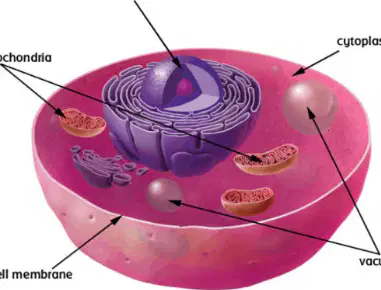
Which of the following structures is where cellular respiration occurs in the cell below?
nucleus
cytoplasm
mitochondria
vacuoles
What function does ATP carry out in living things?
aids in protein folding and coiling
used to capture and transfer energy
identifies DNA start sequences for transcription
helps maintain the fluidity of cell membranes
Which process do animals use to convert energy from food into ATP?
cellular respiration
osmosis
photosynthesis
transcription
How are cellular respiration and photosynthesis related, in terms of energy?
The energy captured in photosynthesis is used to power cellular respiration.
The energy transformed in cellular respiration is used to power photosynthesis.
Photosynthesis and respiration perform the same task in terms of energy transformation.
Energy is not involved in either photosynthesis or cellular respiration.
In which way are photosynthesis and cellular respiration different?
Cellular respiration stores ATP, while photosynthesis releases ATP.
Cellular respiration produces oxygen, while photosynthesis uses oxygen.
Photosynthesis releases energy, while cellular respiration stores energy.
Photosynthesis uses carbon dioxide, while cellular respiration produces carbon dioxide.
Which statement describes how photosynthesis and cellular respiration are interrelated?
Oxygen is produced during cellular respiration and stored during photosynthesis.
Carbon dioxide and water released by cellular respiration are used in photosynthesis.
Photosynthesis releases the energy that is stored during the process of cellular respiration.
Glucose is used during cellular respiration to produce food that is broken down during photosynthesis.
A diagram representing the relationship between photosynthesis and cellular respiration is shown below. The numbered boxes in the diagram represent which of the following?
1 - water; 2 - nitrogen
1 - nitrogen; 2 - oxygen
1 - oxygen; 2 - carbon dioxide
1 - carbon dioxide; 2 – water
Two test tubes were filled with a solution of bromthymol blue. A student exhaled through a straw into each tube, and the bromthymol blue turned yellow. An aquatic green plant was placed into each tube, and the tubes were corked. One tube was placed in the dark, and one was placed in direct sunlight. The yellow solution in the tube in sunlight turned blue, while the one in the dark remained yellow. Which statement best explains why the solution in the tube placed in sunlight returned to a blue color?
Oxygen was produced by photosynthesis.
Carbon dioxide was removed by photosynthesis.
Carbon dioxide was produced by respiration.
Oxygen was removed by respiration.
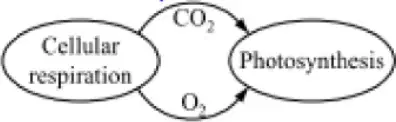
Which of the following diagrams to the right accurately represents the use of gases in both cellular respiration and photosynthesis?
Cellular respiration → CO₂ → Photosynthesis → O₂ → Cellular respiration
Cellular respiration → CO₂ → Photosynthesis → O₂
Cellular respiration → O₂ → Photosynthesis → CO₂
Cellular respiration → O₂ → Photosynthesis → CO₂ → Cellular respiration
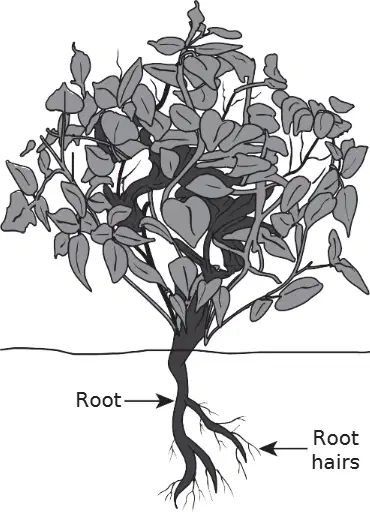
Plant roots have extensions called root hairs. These root hairs are important in the homeostasis of the plant. Which statement best explains the importance of the root hairs to the stems and leaves of the plant?
Root hairs convert minerals into glucose for immediate use by cells.
Root hairs decrease the need for osmosis and diffusion in vascular tissue.
Root hairs prevent water loss in leaves through transpiration and gas exchange.
Root hairs increase the surface area of the roots for nutrient and water absorption.
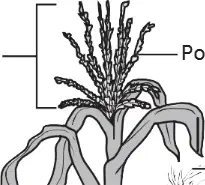
The role of silks in corn reproduction is to:
capture pollen for fertilization
protect the corn kernels from pests
support the corn cob structurally
store nutrients for the developing kernels
Which of these must happen for corn seeds to develop on the ear?
More tassels than silks need to be present on the same plant.
Pollen grains must fall from tassels and land on the silks of the ear.
Pollen must be transported from the tassel to the silk through the phloem.
The tassels must come into direct contact with the silks of the ear.
Fruits grown in hot climates are usually less sweet than those grown in cooler temperatures. The high temperatures increase the rate of respiration in the plants, thus reducing the sugar content in some fruits. Why does increased respiration in the leaves and stems reduce the sugar content in the fruits of a plant?
Chloroplasts move from the fruits to the leaves and stems to provide energy for respiration.
The flow of nutrients shifts from the phloem to the xylem, moving nutrients away from the fruits.
Sugars are moved from the fruits to the roots for storage.
Sugars produced in the leaves are used as an energy source instead of being stored in fruits.
Food and water are carried throughout your body in blood vessels. In a plant, the transportation of food and water is the main function of two types of vascular tissue. Which tissue in a stem conducts water upward?
Dermal tissue
Ground tissue
Phloem
Xylem
The leaves of a plant are the main organs where photosynthesis occurs. Which of the following best describes how their structure is related to this function?
Most leaves are broad and flat to absorb maximum sunlight.
Leaves are covered by a waxy cuticle that prevents water loss.
Most leaves contain all the structures that the plant requires to reproduce.
The leaves are covered with tiny hairs that allow for more water absorption.
Vascular tissue carries out a physiological function in plants. The vascular tissues of a plant are arranged in a structure called a vascular bundle. Which two tissues make up a vascular bundle in a plant?
Cortex and pith
Pith and mesophyll
Phloem and dermis
Xylem and phloem
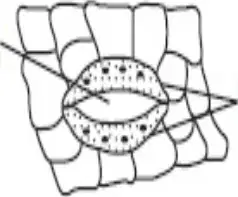
The diagram below represents specialized cells in the surface of the leaf of a green plant.
The main function of these cells is to
Change the size of the stomate to regulate water loss
Close the stomate to keep dust and dirt out of the leaf
Directly provide leaf cells with the water involved in photosynthesis
Allow newly formed glucose to be released from the leaf
Dermal tissue covers all parts of a plant’s body. What function does dermal tissue provide?
Transport
Protection
Reproduction
Osmosis
The flat structure of a leaf blade enables its function as a photosynthetic organ by
Decreasing the loss of oxygen into the atmosphere.
Increasing the absorption of nutrients from soil.
Protecting the rest of the plant from water loss due to evaporation.
Exposing a greater surface area to capture energy from sunlight.
Flowers with brightly colored petals are generally pollinated by insects. The insects transfer pollen grains from one plant to another. The pollen is captured from the insect at the
Anther.
Style.
Stigma.
Ovary.
Much of a plant’s body is made of ground tissue. What function does the ground tissue in a stem provide?
Absorption
Reproduction
Support
Protection
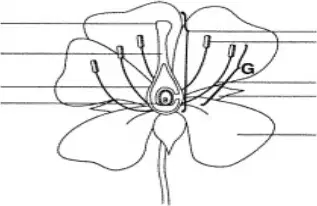
What is the name of the flower part labeled B?
Ovary
Stigma
Anther
Filament
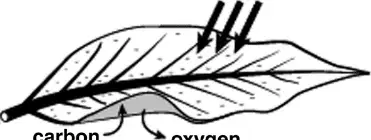
Which structure or part enables the leaf to transport water and sugar as shown in this illustration?
A. Stomate
B. Cuticle
C. Chloroplasts
D. Vascular tissue
Most plants have either a taproot or fibrous root system. A taproot system includes a large central root with smaller branches. A fibrous root system includes a root system that is highly branched. What do both types of root systems provide for the plant?
Enable it to anchor in the ground
Provide more tissue for photosynthesis
Transport materials to the leaves
Offer support in shallow soils where nutrients are scarce
Jason took a celery stalk, cut off both ends, and then placed the stalk in a jar of water. He added a few drops of food coloring. A few days later, he removed the celery stalk and cut it in half from top to bottom. He noticed that the food coloring had moved through the stem. Through which tissue did the food coloring move through the celery stalk?
Epidermal
Ground
Spongy
Vascular
The loss of water by a plant is called transpiration. If a plant loses too much water through transpiration, it will wilt. Through which structure can a plant lose too much water?
Leaf
Pith
Root
Stem
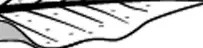
The structure marked X contributes to the survival of the plant by:
Storing water for drought conditions
Producing flowers for reproduction
Absorbing sunlight for photosynthesis
Anchoring the plant in the soil
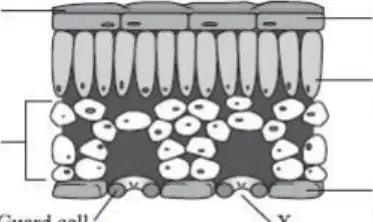
What is the function of the structure labeled X?
It allows the intake of gases necessary for photosynthesis.
It allows the intake of minerals necessary for plant growth.
It allows the intake of sunlight necessary for ATP production.
It allows the intake of sugars necessary for plant reproduction.
If the xylem in a young tree is damaged, which process is first affected?
Performing photosynthesis
Transporting sugar to the roots
Transporting water to the leaves
Absorbing water from the soil
Terrestrial plants have stomata on the surface of their leaves. A single stoma is surrounded by two guard cells that change shape in response to environmental factors and open or close the stoma. Which of the following best explains how the structure of the leaf is used in processes that occur in the plant?
Water enters the plant through the surface of the leaf for transpiration.
Gases for photosynthesis are exchanged through the surface of the leaf.
Energy for cellular reproduction is absorbed through the surface of the leaf.
Carbon dioxide enters the plant through the surface of the leaf for cellular respiration.
The leaves of a plant are the main organs where photosynthesis occurs. Which of the following best describes how their structure is related to this function?
Most leaves are broad and flat to absorb maximum sunlight.
Leaves are covered by a waxy cuticle that prevents water loss.
Most leaves contain all the structures that the plant requires to reproduce.
The leaves are covered with tiny hairs that allow for more water absorption.
If some of the xylem of a young oak tree were destroyed, it would most likely interfere with the tree’s ability to
Conduct sugars to the roots.
Absorb sunlight.
Absorb nutrients from the soil.
Conduct water to the leaves.
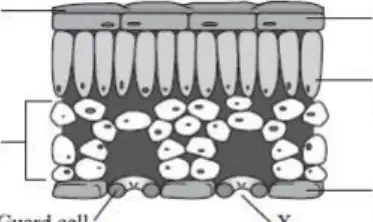
Look at the figure below. Which letters indicate cells in which many chloroplasts would likely be found?
A
B
C
D
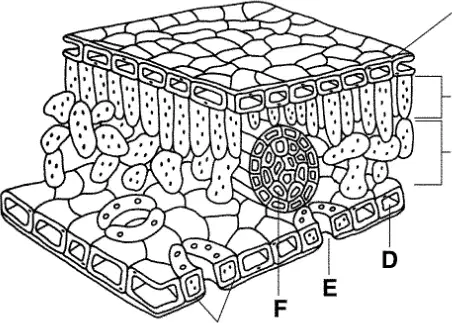
Which pair of letters represents the palisade and spongy mesophyll layers?
A. A and D
B. B and C
C. F and G
D. G and E
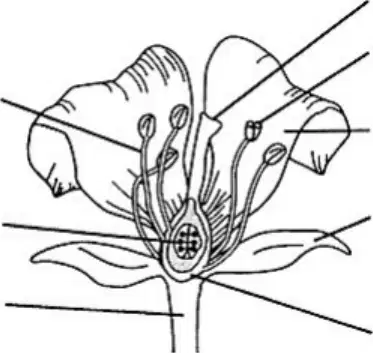
Which structure is represented by the letter A in the diagram above?
The stamen, a male structure which produces pollen
The pistol, a female structure which collects pollen and passes it to the ovary
The sepal, a modified leaf used for protection of the flower
The petals, decorative structures which attract pollinators
What is the main function of leaves?
Leaves provide support for growth and a place to store food.
Leaves provide a place for photosynthesis to occur.

