
 Worksheets
Wood/Trees: Types and Properties
Total questions: 64
Worksheet time: 32mins
What are the two main categories of trees that wood commonly comes from?
Evergreen and Helical
Coniferous and Deciduous
Tropical and Rainforest
Mountain and Island
Which type of tree keeps its leaves all year and is called an evergreen?
Deciduous
Mountainous
Tropical
Coniferous
Which type of trees lose their leaves every year?
Deciduous
Coniferous
Rainforest
Mountainous
Deciduous trees typically grow with which overall crown shape?
Round, wide spreading
Straight up, columnar
Helical, spiral shaped
Conical, cone shaped
Why do many deciduous trees shed leaves annually?
To maximize their lifespan
To conserve energy and water
To help fertilize the ground
For reproduction in spring
Coniferous trees usually grow in which form?
Round, wide spreading
Conical, cone shaped
Straight up, columnar
Helical, spiral shaped
What type of wood is most commonly produced by coniferous trees?
Softwood
Hardwood
Corewood
Finewood
What type of wood is most commonly produced by deciduous trees?
Corewood
Softwood
Hardwood
Finewood
Which statement best explains why hardwood is often harder than softwood?
Softwood lacks tight grain like hardwood
Coniferous trees are weak producers of hardwood
Deciduous trees grow slowly, creating denser grain
Deciduous trees are harder to grow, so wood is harder
When identifying wood, which feature is most useful for distinguishing species?
Leaf color in summer
Soil type under tree
Length of tree trunk
Grain pattern and pores
Which pairing correctly matches tree type to leaf characteristic?
Deciduous—needles and cones
Coniferous—broad flat leaves
Evergreen—retains foliage year-round
Deciduous—retains foliage year-round
Which statement about hardwood and softwood is accurate?
Hardwood always heavier than softwood
Softwood stronger than all hardwoods
Softwood only from evergreen species
Hardwood typically from deciduous species
A wood sample shows large open pores and prominent growth rings. Which class is it most likely?
Softwood from conifers
Finewood from mountain trees
Hardwood from deciduous trees
Corewood from tropicals
A student sees a tree with cones and needle-like leaves. Which wood type would it most likely produce?
Finewood from evergreens
Corewood from sapwood
Softwood from conifers
Hardwood from slow growth
Which growth habit helps coniferous trees shed snow efficiently?
Round, wide crown
Straight, column shape
Helical, spiral trunk
Conical, cone form
Which reason best describes an energy-saving advantage of leaf drop in temperate climates?
Stops wind damage to branches
Increases sunlight on forest floor
Improves root uptake of minerals
Reduces water loss during dormant season
Plywood is made up of thin layers of wood. What are these layers called?
Plys
Strands
Veneers
Sheets
Why are softwood and hardwood plywoods graded differently?
Softwood plywood always is a worse grade
Hardwood plywood can never be worse than a B grade
Each face of hardwood plywood is graded seperately
Different plywood means different grades
What does MDF stand for?
Medium Density Fiberboard
My Dancing Fortnite
Mid-Dimensioned Fir
Moderate Dent-Fiberboard
What material is MDF made of?
All of the Above
Woodchips
Scrapwood
Sawdust
How many board feet? 1 Piece- 8" x 12" x 3/4"
72 Bdft
36 Bd ft
1/2 Bdft
1 Bdft
How many board feet? 2 Pieces- 12" x 24" x 1"
2 Bdft
3 Bdft
4 Bdft
1 Bdft
How many board feet? 3 Pieces- 3' x 5' x 1"
30 Bdft
50 Bdft
45 Bdft
35 Bdft
How many board feet? 4 Pieces- 16" x 3" x 3/4"
1.25 Bdft
1 Bdft
2.5 Bdft
3.25 Bdft
How many board feet? 1 Piece- 10' x 12' x 3/4"
80 Bdft
12,960 Bdft
.625 Bdft
90 Bdft
When calculating board feet to order material, what should be done to the total board footage at the very end?
Add 10% to your calculations to account for scrap wood
Round the board footage up to the next whole number because that is how lumber suppliers charge for it
Nothing, the math should already be good to send to the wood supplier
Add 20% to you calculations so that you have extra material
When calculating board footage, what increment does board thickness get rounded to?
Round up to the nearest 1/8 inch
Round down to the nearest 1/2 inch
Round up or down to the nearest whole inch
Round up to the nearest 1/4 inch
Find the material price for 1 piece measuring 36 inches by 12 inches by 3/4 inch, made of Red Oak at $3.00 per board foot. Use board-foot formula: (T in inches ÷ 1) × (W in inches ÷ 12) × (L in feet).
$12.00
$8.25
$6.75
$9.00
Find the material price for 3 pieces measuring 4 feet by 8 feet by 1 inch, made of Alder at $1.75 per board foot. Assume board footage is calculated per piece then multiplied by quantity.
$160
$180
$168
$150
Find the material price for 2 pieces measuring 23 inches by 3 inches by 3/4 inch, made of Maple at $4.05 per board foot. Apply board-foot rounding for thickness.
$2.00
$8.00
$9.00
$4.05
Find the material price for 1 piece measuring 19 inches by 16 inches by 3/4 inch, made of Walnut at $9.50 per board foot. Include scrap wood allowance by rounding thickness to 1 inch.
$14.00
$19.00
$15.00
$18.00
Find the material price for 3 pieces measuring 3 feet by 18 inches by 1 inch, made of Cherry at $2.90 per board foot. Calculate total cost including quantity.
$42.50
$38.00
$40.60
$39.15
Why is plywood/MDF priced differently than solid wood?
Plywood/MDF is almost always cheaper
Solid wood gets used more often in furniture making
You can get much more plywood than solid wood
Plywood/MDF are priced by the Square Foot rather than the Board Foot
What is the margin of safety on the miter saw?
6"
3"
2"
4"
What side of a board should be facing the table/fence of the miter saw?
Convex
Concave
When cutting angles on the miter saw, what side should your "hold down" hand be on?
Obtuse (big) side
Acute (small) side
What type of cut should NOT be done on the miter saw?
Rip Cut
Miter Angle Cut
Bevel Cut
Cross Cut
Where on the board being cut should the blade for the miter saw line up when beginning a cut?
Outside edge toward the operator
Inside edge by the fence
Directly in the middle of the board
Wherever the blade lands when the saw is fully extended
What is the shortest length of material that can be safely cut on the miter saw?
4"
20"
10"
6"
What should be done if the blade guard is missing from the miter saw?
Don't use the saw
All of the Above
Alert your teacher to the problem
Unplug the saw so that it does not get accidentally turned on
What kind of cuts can be done on the table saw?
Dado/Rabbet Cuts
All of the Above
Cross Cuts
Rip Cuts
What is the margin of safety for the RIP table saw?
12"
7"
5"
3"
Where should you stand while operating the table saw?
As close to the blade without being in the margin of safety
Off to one side in case of kickback
On the opposite side, pulling the material through
Directly behind your piece to keep it under control
If material is too small to safely push through the table saw, what should be used?
Push Sticks
Auxiliary Fence
Support Roller
Miter Gauge
What is the correct blade depth setting for the rip table saw?
One saw tooth above your piece
1/2" above your piece
Directly flush with the top of your piece
1" above your piece
What should always be installed on the table saw before cutting?
All of the Above
Riving Knife
Fence
Blade Guard
If you are catching material that is being cut, what should not NOT do?
Help guide the material through the saw
Separate the pieces to avoid kickback
Keep the material from tipping off the back side of the table
Pull the material through from your side
When changing blade types, what must also be changed inside the table saw?
Fence
Sawstop Brake
Table Screws
Switch Box
What material should NEVER be run through the table saw?
Solid Wood
Metal
MDF
Plywood
What is the margin of safety on the DADO table saw?
8"
5"
12"
6"
How much does each dado blade add to the width of a cut?
1/4"
1/2"
1/16"
1/8"
What is the margin of safety on the jointer?
10"
4"
6"
8"
What is the only material that should be run through the jointer?
MDF
Metal
Plywood
Solid Wood
How much material is removed per each pass on the jointer?
1/8"
1/4"
1/16"
1/32"
How high should the outfeed table be set in regards to the cutter head?
1/8" above the cutter head
1/32" above the cutter head
1/16" above the cutter head
Flush with the top of the cutter head
What grain CANNOT be run on the jointer?
None of the Above
End Grain
Edge Grain
Face Grain
What is the ideal minimum length of piece that can be run on the jointer?
6"
12"
10"
8"
What pace should material be run through the jointer?
Steady
Slow
Variable
Fast
What is it called when the outfeed table setting is causing an unwanted chunk to be cut out of the end of a board?
Chunking
Tear-Out
Break Off
Snipe
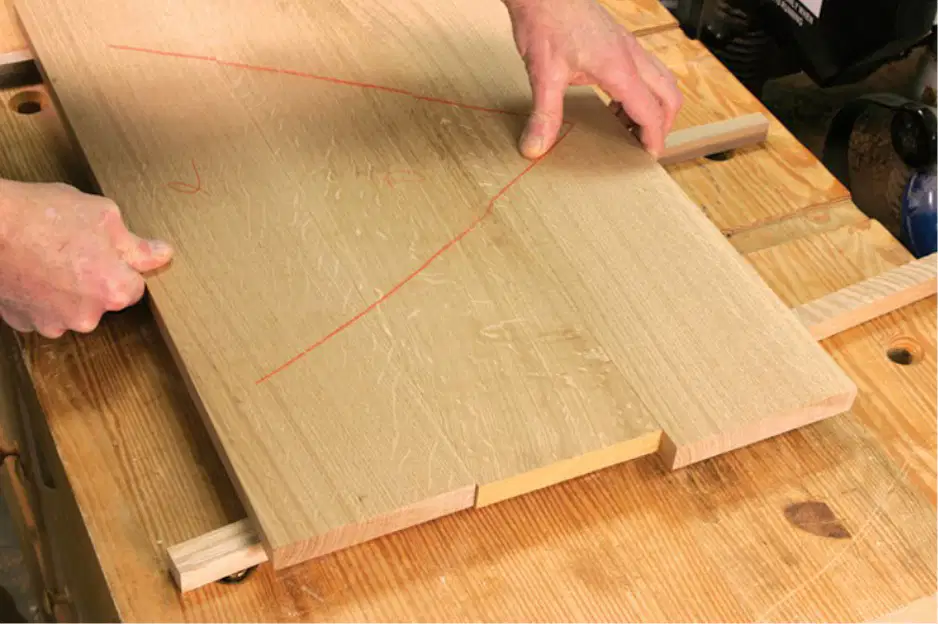
What type of wood joint is shown below?
Glued Butt Joint
Biscuit Joint
Dowel Joint
Miter Joint
What should be done to boards both before and after they are cut on the table saw? Mark only one oval.
Edge grains should be jointed
Cut the board to exact length
The board should be sanded
Plane the board down to the correct thickness
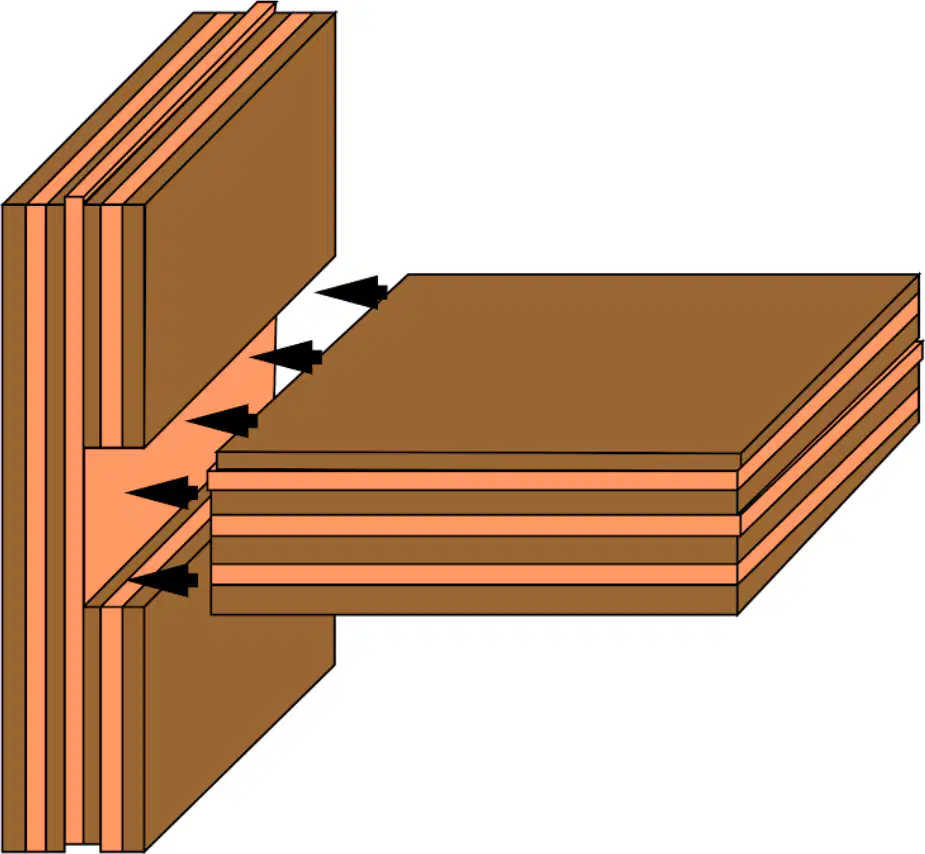
What type of wood joint is shown below? Mark only one oval.
Dado Joint
Biscuit Joint
Rabbet Joint
Lap Joint
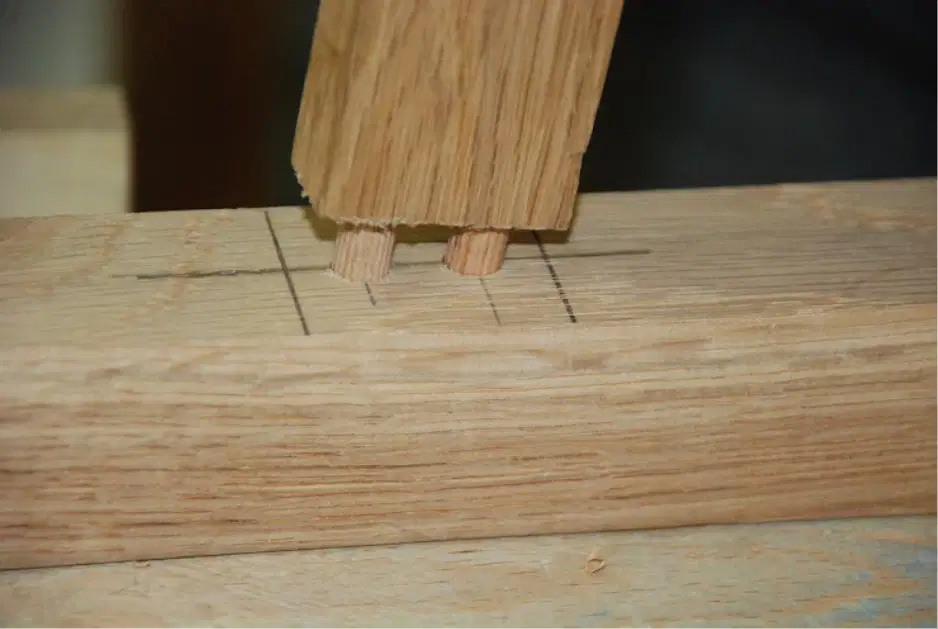
What type of wood joint is shown below? Mark only one oval.
Dado Joint
Biscuit Joint
Dowel Joint
Miter Joint
What are the names of the two pieces of a face frame (the front of a cabinet)? Check all that apply.
Front Post
Rails
Stiles
Trim

