
 Worksheets
5.9 Extra Benchmark Practice Round 1 (Science Penguin)
Total questions: 10
Worksheet time: 5mins
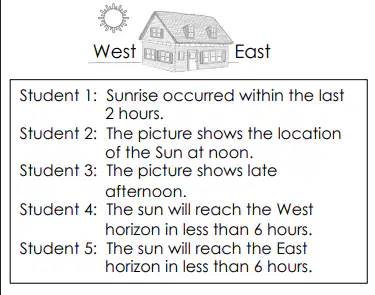
Based on the picture of the Sun's position relative to the house, which student explanation correctly identifies the approximate time of day shown?
Student 1
Student 2
Student 3
Student 4
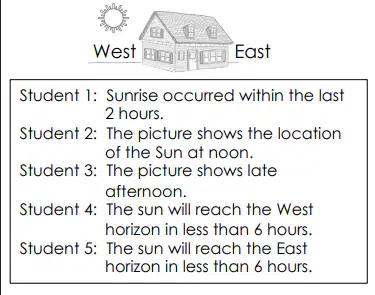
Compare the explanations from Student 1 and Student 3. What is a key difference in how they interpret the Sun's position in the picture?
Student 1 sees it as midday, while Student 3 sees it as evening.
Student 1 sees it as early morning, while Student 3 sees it as late afternoon.
Student 1 sees the Sun setting, while Student 3 sees it rising.
Both see it as noon, but differ on the horizon.
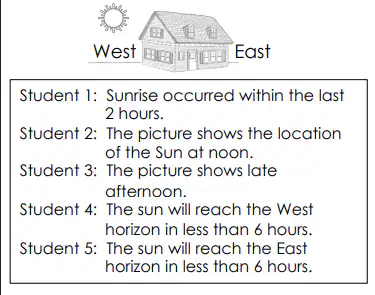
If you were to add a sixth student explanation: 'The Sun is about to set in the East,' which existing student explanation would it most contradict (disagree with) based on the picture?
Student 1
Student 2
Student 4
Student 5
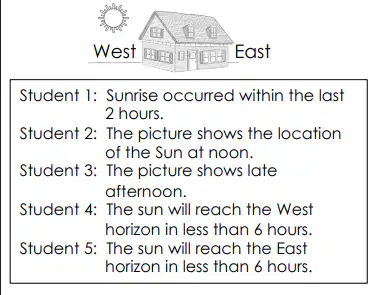
Contrast the predictions in Student 4 and Student 5's explanations with the picture. Which statement accurately describes why one is more likely correct than the other?
Student 4 is correct because the Sun moves from east to west; Student 5 is incorrect because the Sun doesn't reach the east horizon soon after sunrise.
Student 5 is correct because the Sun cycles back to the east quickly; Student 4 is incorrect because sunset is far away.
Both are correct since the horizons are interchangeable.
Neither is correct because the picture shows noon.
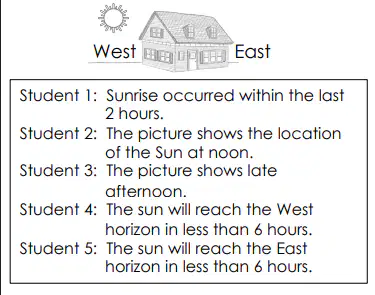
Based on the picture, which pair of student explanations can be contrasted because one correctly describes the recent past and the other incorrectly predicts the near future?
Student 1 and Student 2
Student 1 and Student 5
Student 3 and Student 4
Student 2 and Student 3
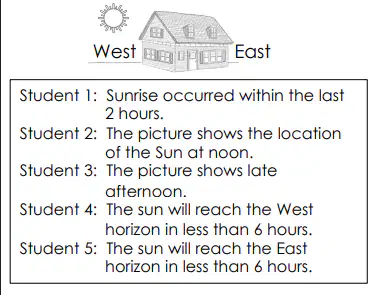
The picture demonstrates the apparent movement of the Sun. If the explanations were grouped by 'Morning,' 'Midday,' and 'Afternoon,' which student would NOT fit into the 'Morning' group?
Student 1
Student 4
Student 5
Student 3
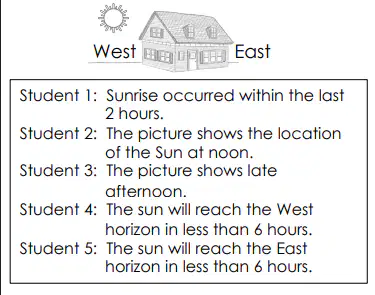
Compare the time references in Student 4 and Student 5's explanations to the picture's implied time of day. What can you conclude?
Both refer to sunset, but in different directions.
Student 4 refers to sunset in the west, which would be later; Student 5 refers to an impossible near-term sunrise.
Both are accurate for early morning.
Neither mentions time accurately.
Using the picture, contrast Student 2's explanation with the others. Which option best describes why it differs?
Student 2 assumes high noon, while others reference low Sun positions in morning or evening.
Student 2 mentions the horizon, while others do not.
All explanations including Student 2 agree on afternoon.
Student 2 is the only one mentioning sunrise.
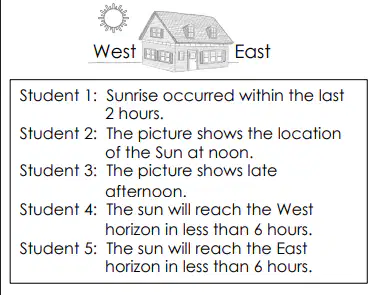
If you observe that the Sun in the picture is low near the east, how would Student 3's explanation compare to the actual depiction?
It matches perfectly as late afternoon.
It contradicts because late afternoon would show the Sun low in the west.
It aligns with midday positioning.
It supports a 6-hour horizon reach.
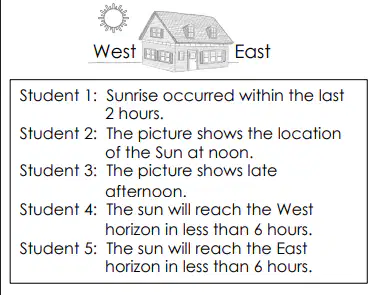
Based on the picture's depiction of the Sun's position, which statement best compares and contrasts the accuracy of explanations involving horizons (Students 4 and 5)?
Both are accurate; the Sun reaches both horizons within 6 hours.
Neither is accurate; horizons are not relevant.
Student 4 is inaccurate for early morning, as sunset is more than 6 hours away; Student 5 is inaccurate because the next east horizon event is the following day.
Student 5 is accurate, but Student 4 is not.

