
Font size
 Worksheets
Mid term 2
Total questions: 82
Worksheet time: 41mins
Which of the following teeth is most commonly missing in isolated oligodontia?
Maxillary central incisor
Mandibular first molar
Maxillary second incisor
Maxillary canine
Mandibular lateral incisor
Which condition is characterized by having extra teeth?
Anodontia
Hypodontia
Hyperdontia
Dentinogenesis imperfecta
Amelogenesis imperfecta
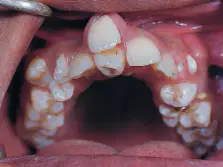
A 7-year-old child presents with retained deciduous teeth and absence of permanent tooth buds on radiograph. What is the most likely cause of this presentation?
Delayed eruption
Early tooth loss
Anodontia
Trauma to the jaw
Nutritional deficiency
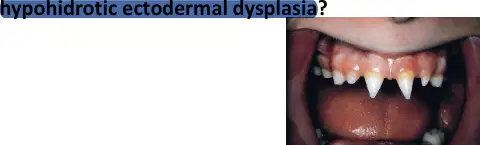
Which dental feature is most commonly observed in patients with hypohidrotic ectodermal dysplasia?
Macrodontia
Peg-shaped teeth
Taurodontism
Supernumerary teeth
Dens invaginatus
A 5-year-old presents with no erupted permanent teeth, peg-shaped deciduous teeth, dry shiny skin, and intolerance to heat. What is the most likely underlying condition?
Down’s syndrome
Vitamin D–resistant rickets
Hypohidrotic ectodermal dysplasia
Cleidocranial dysplasia
Amelogenesis imperfecta
Which syndrome is commonly associated with the presence of many unerupted supernumerary teeth?
Treacher Collins syndrome
Down’s syndrome
Cleidocranial dysplasia
Crouzon syndrome
Gorlin–Goltz syndrome
Which gene is commonly mutated in autosomal dominant amelogenesis imperfecta?
AMELX
Enamelin
Dentin sialophosphoprotein
MSX1
Pax9
Which of the following genes is mutated in the X-linked type of amelogenesis imperfecta?
A. AMELX
B. Enamelin
C. Dentin sialophosphoprotein
D. MSX1
E. Pax
Which of the following statements best explains why amelogenesis imperfecta typically affects all teeth?
It is caused by prenatal infection during calcification
It results from mutations in odontoblast genes
Genetic factors act throughout the whole duration of amelogenesis
The condition only affects enamel formed after birth
The affected teeth are exposed to high systemic fluoride
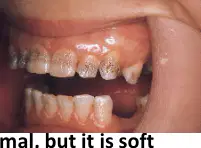
Which type of amelogenesis imperfecta is characterised by reduced enamel thickness with normal mineralisation?
Hypocalcified
Hypomaturation
Hypoplastic
Fluorosis
Turner hypoplasia
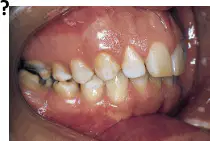
A 12-year-old presents with brownish-yellow opaque enamel on all teeth. Enamel thickness is normal, but it is soft and wears easily. Small opaque spots mimic fluorotic mottling. Which is the most likely diagnosis?
Hypoplastic AI
Hypocalcified AI
Hypomaturation AI
Fluorosis
Dentinogenesis imperfecta
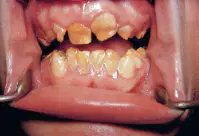
Which type of amelogenesis imperfecta shows normal enamel thickness and form on eruption but with weak, chalky, and opaque enamel?
Hypoplastic
Hypocalcified
Hypomaturation
Fluorosis
Dentinogenesis imperfecta
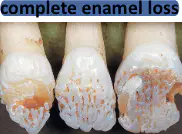
Which of the following inheritance patterns is associated with vertically ridged enamel in females and almost complete enamel loss in affected males?
Autosomal dominant
Autosomal recessive
X-linked recessive
X-linked dominant
Mitochondrial

A 10-year-old girl presents with enamel that is hard, translucent, but very thin and grooved. There is no post-eruptive breakdown, and family history reveals both autosomal dominant and recessive patterns in different relatives. What is the most likely type of amelogenesis imperfecta?
Hypocalcified
Hypoplastic
Hypomaturation
X-linked recessive AI
Fluorosis
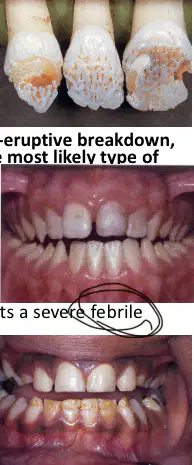
A 7-year-old presents with horizontal grooves across the incisal third of the maxillary incisors. His mother reports a severe febrile illness during infancy. What is the most likely diagnosis?
Fluorosis
Chronological hypoplasia
Dentinogenesis imperfecta
Amelogenesis imperfecta
Tetracycline staining

This is the close-up image of an affected female having a defect in enamel. The typical vertical ridged pattern of normal and abnormal enamel is noted resulting from Lyonisation. What is the type of amelogenesis imperfecta observed in this patient?
Hyoplastic AI
Hypomaturation AI
Hypocalcified AI
Snow-capped AI
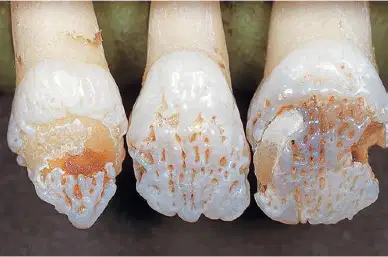
This is the close-up image of an affected female having a defect in enamel. The typical vertical ridged pattern of normal and abnormal enamel is noted resulting from Lyonisation. What is the usual mode of inheritance?
X linked dominant
Autosomal recessive
Y linked
Mitochondrial
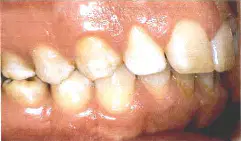
Presentation: Opaque white flecks and patches affecting the occlusal half of the tooth surface. Identify this variant of AI?
Hypomaturative AI – Snowcapped type
Hypoplastic AI – Pitted type
Hypocalcified AI – Generalized type
Hypomaturative AI – Diffuse type
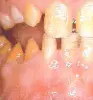
2. Presentation: Tooth morphology is normal but there are opaque white and discoloured patches. Identify this variant of AI.
Hypomaturative AI
Hypoplastic AI
Hypocalcified AI
Taurodontism
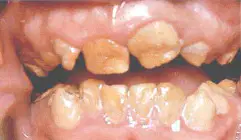
Identify the type of Amelogenesis imperfecta?
Hypocalcified AI
Hypoplastic AI
Hypomaturation AI
Taurodontism
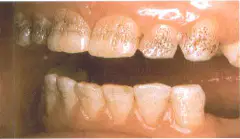
Identify the type of Amelogenesis imperfecta.
Hypoplastic AI
Hypomaturation AI
Hypocalcified AI
Snow-capped AI
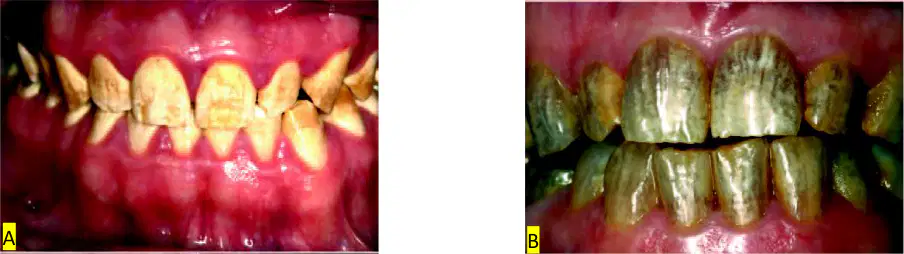
A male patient presents with diffuse yellow-white dentition. His mother has vertical bands of white, opaque enamel and translucent enamel. What genetic pattern and type of dental condition might this family be exhibiting?
Autosomal dominant pattern; Amelogenesis imperfecta
X-linked recessive pattern; Dentinogenesis imperfecta
Autosomal recessive pattern; Fluorosis
Mitochondrial inheritance; Enamel hypoplasia
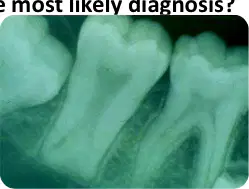
A radiograph shows a molar with an elongated crown, vertically enlarged pulp chamber, and apically displaced furcation. Roots appear short relative to the crown length. What is the most likely diagnosis?
Dentin dysplasia type I
Amelogenesis imperfecta
Taurodontism
Regional odontodysplasia
Fusion

A 14-year-old patient presents with pain in a lower premolar after biting into hard food. On examination, a small enamel-covered tubercle is seen on the occlusal surface, and radiograph reveals a pulp horn extending into this projection. What is the most likely cause of the patient’s symptoms?
Pulp necrosis due to dens invaginatus
Fracture of a supernumerary cusp exposing the pulp horn
Attrition of the enamel due to malocclusion
Apical periodontitis from untreated caries
Vertical root fracture extending to the pulp
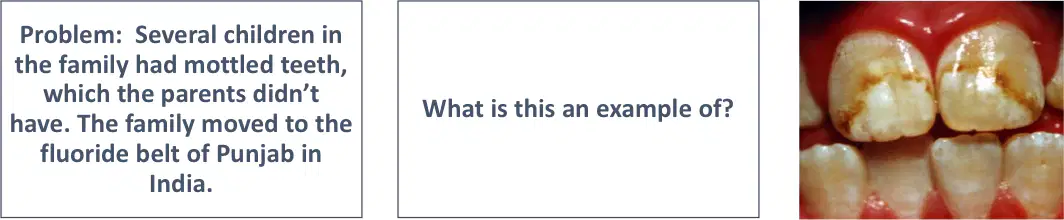
Several children in the family had mottled teeth, which the parents didn’t have. The family moved to the fluoride belt of Punjab in India.
Dental Caries
Dental Fluorosis
Gingivitis
Tooth Erosion
What is the term used to describe the appearance of teeth with white flecks, mild opacities, moderate pitting and staining, and severely corroded enamel due to excessive fluoride exposure?
Dental Fluorosis
Dental Caries
Enamel Hypoplasia
Gingivitis
Fill in the blank: The answer to the clinical problem described is _________.
Mottled Enamel
Dental Caries
Gingivitis
Fluorosis
Which of the following is NOT a variation of mottling in dental fluorosis?
Questionable white flecks
Mild opacities
Severe tooth decay
Moderate pitting and staining
Arrange the following variations of mottling in dental fluorosis in order of increasing severity:
1, 2, 3, 4
4, 3, 2, 1
2, 1, 3, 4
3, 1, 2, 4
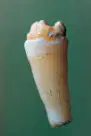
A single permanent tooth is found to be malformed. The patient has no history of systemic illness. Which of the following is the most likely explanation?
Fluorosis
Neonatal jaundice
Turner tooth
Congenital porphyria
Hypomaturation
Which of the following agents, when given during dental development, may cause permanent discoloration of teeth?
Amoxicillin
Tetracycline
Erythromycin
Fluoride mouthrinse
Acetaminophen
Which of the following best describes the pattern of enamel defects caused by exogenous factors (except fluorosis)?
Involves all permanent teeth uniformly
Affects dentine and cementum
Presents as generalized discoloration of all teeth
Involves randomly distributed patches of enamel
Shows a chronological pattern corresponding to the time of insult
Which congenital malformation is most common in the head and neck region?
Cleft lip
Cleft palate
Cleft lip and palate
Ankyloglossia
Craniosynostosis
What causes cleft lip during embryonic development?
Defective fusion of the medial nasal processes with each other
Defective fusion of the palatal shelves of the maxillary processes
Defective fusion of the medial nasal process with maxillary process
Defective fusion of the primary palate
Defective fusion of the secondary palate
A newborn girl presents with an isolated cleft palate. Genetic testing is negative for syndromic causes. Which factor is most likely to have contributed, based on developmental timing?
Environmental insult during weeks 4–6 of gestation
Genetic mutation affecting median nasal process development
Delay in palatal shelf growth during weeks 7–9 of gestation
Failure of nasal septum to fuse with primary palate
Disruption of neural crest migration in the 3rd week
During embryonic development, fusion of the median nasal process with the maxillary processes occurs at approximately which week to form the primary palate?
Week 4
Week 6
Week 7
Week 9
Week 1
When does cleft palate usually start to occur during embryonic life?
9th week
6th week
18th week
24th week
36th week
When does cleft lip usually start to occur during embryonic life?
18 - 27th week
4 – 7th week
12 – 24th week
1 – 2 years
0 – 3rd week
A 2-day-old male presents with a complete unilateral cleft lip extending into the nose. Which of the following developmental events most likely failed to occur?
Timely breakdown of the epithelial seam between palatal shelves
Adequate mesenchymal growth and migration between the median nasal and maxillary processes
Mandibular growth sufficient to lower the tongue out of the way of the palatal shelves
Fusion of the secondary palate during weeks 8–9 of development
Proper rotation of palatal shelves into a horizontal position
A newborn is diagnosed with an isolated cleft palate without involvement of the lip. Which of the following best explains its occurrence?
A. Failure of early fusion between the median nasal and maxillary processes
B. Prolonged failure of mesenchymal migration affecting both primary and secondary palates
C. Interference with palatal shelf growth and rotation after the primary palate has closed
D. Disruption of mandibular growth leading to incomplete alveolar ridge formation
E. Failure of neural crest cell migration during the 4th week of development
An infant presents with a combined cleft lip and palate. Which developmental disturbance is most consistent with this presentation?
Disturbance occurring only after closure of the primary palate
Failure limited to breakdown of epithelial seam between palatal shelves
Prolonged disruption affecting both primary and secondary palate closure
Disturbance occurring only in rotation of palatal shelves
Failure of nasal septum formation
Which environmental factor is associated with the etiology of orofacial clefts?
Fetal alcohol syndrome
Folic acid supplementation
Low vitamin A intake
Low protein diet
High calcium intake
Which genetic pathway is commonly implicated in the formation of cleft lip and palate?
Wnt signaling
Notch pathway
Hedgehog pathway
JAK-STAT pathway
MAP kinase pathway
Which of the following gene variants affects growth and patterning during palate development?
BMP4
FGFR2
IRF6
PTCH
MSX1
What is the typical inheritance pattern of Van der Woude syndrome, which includes cleft lip and palate among its features?
X-linked recessive
Autosomal recessive
Autosomal dominant
Mitochondrial
Y-linked
What syndrome is associated with cleft palate and cardiac defects as common features?
A. Apert syndrome
B. Crouzon syndrome
C. Down syndrome
D. Treacher Collins syndrome
E. Goldenhar syndrome
Which craniofacial syndrome involves mutation in the fibroblast growth factor receptor genes?
Down syndrome
Crouzon syndrome
Treacher Collins syndrome
Ascher syndrome
Cowden Syndrome
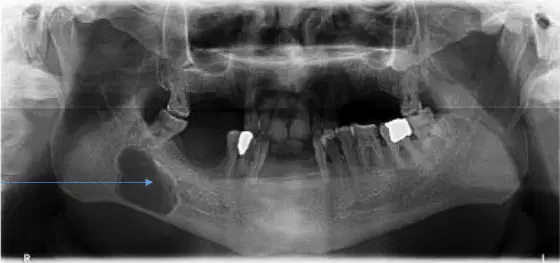
A panoramic X-ray reveals a well-defined, radiolucent lesion in the posterior mandible below the inferior alveolar canal in an asymptomatic patient. What is the likely diagnosis and management?
Stafne bone cyst; no treatment required
Dentigerous cyst; surgical removal
Ameloblastoma; aggressive surgical excision
Odontogenic keratocyst; enucleation
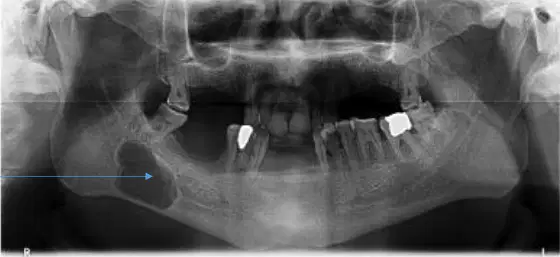
Which condition is characterized by a lobe of the submandibular gland indenting the lingual aspect of the mandible, often appearing as a cyst on radiographs?
Ranula
Dermoid cyst
Stafne's idiopathic bone cavity
Ameloblastoma
Odontogenic keratocyst
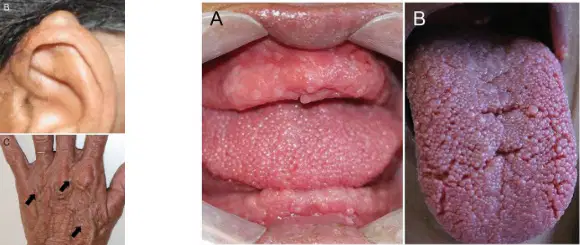
A patient presents with a narrow, bird-like face and multiple cobblestone-pattern papillomatous lesions on the oral mucosa. Family history includes breast and thyroid cancer. PTEN is mutated. What is the most likely diagnosis?
Cowden’s syndrome
Treacher-Collins syndrome
Crouzon syndrome
Van der Woude syndrome
White sponge naevus
The earliest histopathological change in enamel during dental caries is best described as:
Breakdown of enamel surface layer
Subsurface demineralisation beneath intact enamel
Cavitation with bacterial penetration
Loss of dentine matrix proteins
Necrosis of odontoblasts
Miller’s 1890 experiments and Orland’s germ-free animal studies together established that:
Vitamin D deficiency is essential for caries development
Caries occurs independently of bacteria if sugars are present
Bacterial metabolism of carbohydrates produces acids that demineralise teeth
Caries is solely dependent on salivary enzymes
Refined sugars directly dissolve enamel without bacterial activity
A 12-year-old child presents with white spot lesions on upper incisors. The lesions feel smooth and hard to probing. The most appropriate clinical approach is:
Immediate operative intervention with restoration
Extraction of affected teeth to prevent spread
Application of preventive measures to encourage remineralization
Prescription of antibiotics to eliminate cariogenic bacteria
Use of caries indicator dyes to assess extent of destruction
Which of the following best describes bacterial plaque in microbiological terms?
A. A collection of free-floating bacteria in saliva
B. A biofilm of bacteria in an extracellular polysaccharide matrix
C. A thin pellicle formed by salivary proteins
D. A mineralized deposit of calcium phosphate
E. A desquamated epithelial layer covering tooth surfaces
After how many hours of stopping toothbrushing does plaque become clinically visible on labial surfaces of incisors?
2–3 hours
6 hours
12–24 hours
48 hours
7 days
Why does plaque form more rapidly in patients with a high-sucrose diet?
Sucrose enhances mineral deposition on enamel
Sucrose is not metabolised by oral bacteria
Sucrose promotes matrix polysaccharide synthesis and bacterial growth
Sucrose neutralises salivary buffers
Sucrose increases gingival crevicular fluid
Which of the following methods is most effective for the removal of plaque from tooth surfaces?
Mastication of fibrous food
Rinsing with water
Toothbrushing with mechanical friction
Salivary flushing
Starvation diet
Why does plaque in stagnation areas predispose to dental caries?
It resists removal by toothbrushing
It enhances saliva flow
It metabolises dietary sugars to acids causing demineralization
It prevents remineralisation by fluoride
It increases gingival blood supply
Why are bacteria in a plaque biofilm more resistant compared to planktonic bacteria?
They grow faster and divide more rapidly
They remain isolated and do not interact
They are protected by extracellular polysaccharide matrix and cooperative activity
They secrete less polysaccharide and avoid immune detection
They cannot metabolise sucrose
What is the first stage in the formation of bacterial plaque after thorough cleaning?
Multiplication of lactobacilli on enamel surface
Colonisation by Streptococcus mutans in pits and fissures
Formation of a salivary pellicle on enamel
Deposition of food debris on tooth surface
Mineralisation of plaque into calculus
Which group of bacteria are most commonly associated with the initial colonisation of tooth surfaces?
Actinomyces species
Viridans streptococci
Lactobacillus species
Bacteroides species
Fusobacterium species
What makes Streptococcus mutans particularly cariogenic compared to other plaque bacteria?
Ability to completely mineralise the enamel surface
Dependence on protein-rich diets for metabolism
Ability to produce and store intracellular polysaccharide reserves
Failure to survive in low pH environments
Inability to metabolise sucrose
Which statement best describes the role of bacteria in caries development?
Lactobacilli alone initiate caries lesions
Caries develops from saliva rather than plaque
S. mutans group is the most potent cariogenic species
Actinomyces species are the only causative organisms
Caries does not occur in the presence of sucrose
A 20-year-old student reports irregular brushing and a high-sugar diet. On examination, heavy plaque deposits are present in occlusal pits and proximal surfaces. Microbiological analysis reveals high levels of Streptococcus mutans. Which property of this organism best explains its persistence and cariogenicity?
Inhibition of fluoride uptake into enamel
Exclusive colonisation of saliva, avoiding tooth surfaces
Storage of intracellular polysaccharides to maintain acid production during starvation
Lack of extracellular polysaccharide synthesis, preventing plaque formation
Rapid elimination from plaque after toothbrushing
According to the ecological plaque hypothesis, which factor supports the survival of S. mutans when sucrose is unavailable?
Direct utilisation of fluoride as an energy source
Production of alkali by Streptococcus salivarius
Acid production and pH reduction by other plaque bacteria
Increased mineral content of saliva
Mutation of S. mutans into non-cariogenic strains
Which property of S. mutans is most critical for initiating smooth surface caries?
Production of soluble fructans from fructose
Production of insoluble extracellular glucans from sucrose
Dependence on protein-rich diets for growth
Ability to ferment lactose into lactic acid
Survival without plaque biofilm formation
A 22-year-old patient has high levels of S. mutans in plaque but no clinical caries. According to the ecological plaque hypothesis, what is the most likely explanation?
The patient has low saliva flow preventing clearance
S. mutans alone cannot cause caries without a supportive microbial community
The patient’s enamel is resistant to all forms of acid attack
Lactobacillus species are absent, preventing caries development
Dietary sucrose is absent, so S. mutans cannot colonise tooth surfaces
Which acid is quantitatively predominant in plaque following sucrose exposure and is mainly responsible for caries lesions?
Acetic acid
Propionic acid
Lactic acid
Citric acid
Butyric acid
Which statement best describes the Stephan curve?
Rise in plaque pH within 2–3 minutes after sucrose intake
Fall in plaque pH within minutes, followed by a gradual return to resting level over about an hour
Stable plaque pH despite sucrose intake
Rapid mineralisation of plaque within 10 minutes
Curve showing saliva volume changes during mastication
A 17-year-old patient is examined after consuming a sugary soft drink. Using microelectrodes, the dentist records a rapid pH fall in plaque to levels capable of demineralising enamel. The pH remains low for about 15 minutes and only returns to resting values after about an hour. Which feature of this process is most responsible for caries formation?
Short duration of pH drop after sucrose intake
Predominance of lactic acid with greater ability to lower pH
Rapid clearance of sucrose from saliva by rinsing
Immediate availability of fluoride in the plaque matrix
Inverse relationship of calcium and phosphate with caries activity
What effect does ingestion of sucrose have on plaque metabolism?
No effect on plaque activity
It raises the pH above resting level
It causes a burst of metabolic activity and fall in pH
It prevents synthesis of extracellular polysaccharides
It leads to rapid mineralisation of enamel
Why is sucrose more cariogenic when taken in small increments at frequent intervals compared to a single large dose?
It is cleared more rapidly by saliva
It is less likely to diffuse into plaque
It maintains plaque acid levels persistently at destructive levels
It prevents acid from being trapped in plaque
It is less available for bacterial metabolism
What is the main effect of sucrose on plaque structure in addition to acid production?
Increased salivary clearance of acids
Significant increase in synthesis of extracellular polysaccharides
Reduction in bacterial colonisation of tooth surfaces
Prevention of acid diffusion into enamel
Neutralisation of plaque acids by saliva
Which statement best explains the protective effect of fluoride against dental caries?
It is incorporated into enamel only during development
It prevents sucrose metabolism by bacteria
It reduces enamel solubility and promotes remineralisation after acid attack
It neutralises acids by increasing plaque buffering power
It eliminates all bacteria from the plaque biofilm
A 14-year-old patient presents with multiple new carious lesions soon after eruption of the second permanent molars. The patient reports good oral hygiene practices and use of fluoride toothpaste, but frequent snacking on sticky sweets between meals. Which factor most likely explains the susceptibility of the newly erupted molars to rapid caries development?
Reduced salivary IgA activity in adolescence
Post-eruptive enamel maturation not yet complete
Excessive systemic fluoride uptake causing hypomineralisation
Early colonisation by Lactobacillus species alone
Low salivary thiocyanate concentration
A 16-year-old with high caries activity undergoes experimental treatment with monoclonal antibodies against S. mutans. Plaque is removed before application, and the effect lasts for several months by preventing recolonisation. What is the most likely mechanism of this protective effect?
Stimulating IgA secretion in saliva
Enhancing bicarbonate buffering in saliva
Binding to bacteria and preventing adhesion to plaque
Increasing salivary calcium and phosphate concentration
Neutralising lactic acid produced by bacteria
What is the earliest visible clinical sign of enamel caries?
A. A rough cavitated defect
B. A soft yellow discolouration
C. A white opaque spot under a contact point
D. A brown stained fissure
E. A radiolucent area at the dentine–enamel junction
Which zone of enamel caries reflects repeated cycles of demineralisation and remineralisation?
Translucent zone
Dark zone (Enamel crystals have grown to 50–100 nm)
Body of the lesion
Surface zone
Fissure wall zone
A 12-year-old patient presents with early chalky-white lesions on smooth surfaces adjacent to contact points. Probing reveals the enamel surface is still intact and hard. Which management approach is most appropriate at this stage?
Immediate operative cavity preparation and restoration
No intervention, as lesion will self-heal without management
Remineralisation therapy with fluoride and dietary modification
Extraction of the affected teeth
Antibiotic therapy to eliminate Streptococcus mutans
What is the earliest change in dentine during caries development?
Complete destruction of the dentine matrix
Demineralisation with intact collagen matrix
Penetration of bacteria into tubules
Liquefaction foci formation
Collapse of overlying enamel
What is the typical shape of a dentine caries lesion in section?
Cylindrical with parallel walls
Irregular with multiple apices
Conical with broad base at enamel junction and apex toward pulp
Oval with base at pulp chamber
Spherical with central cavity
Which dentine zone is soft, wet, brown, non-remineralisable and must usually be removed?
Caries-free dentine
Caries-affected dentine
Caries-infected dentine
Translucent zone
Dark zone

