
Font size
 Worksheets
MST - History of Architecture P1
Total questions: 110
Worksheet time: 55mins
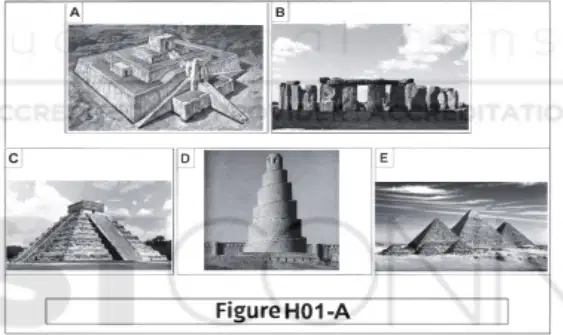
Structure A can be found in
Jordan
Iraq
Syria
Egypt
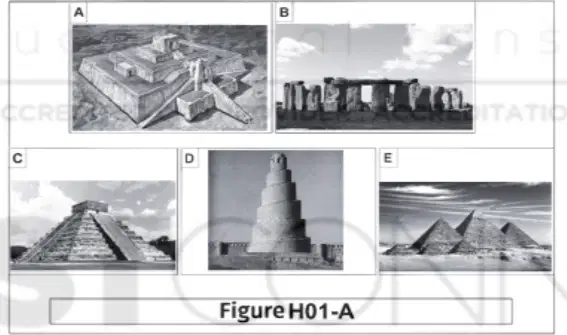
Structure B can be found in
Rotorua, New Zealand
Wiltshire, England
Newgrange, Ireland
Maeshowe, Scotland
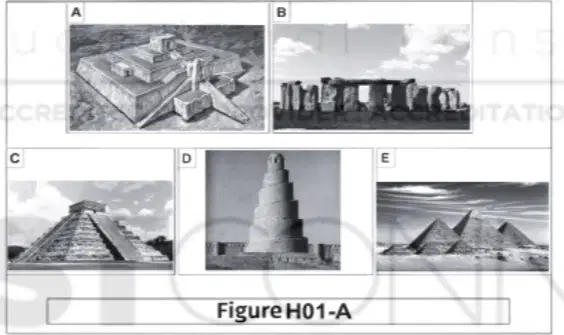
Structure C can be found in
Jordan
Iran
Colombia
Mexico
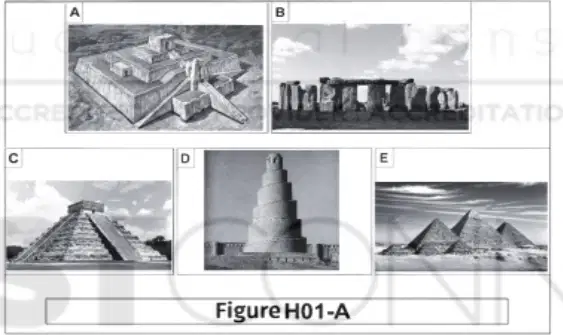
Structure D can be found in
Jordan
Iraq
Greece
Turkey
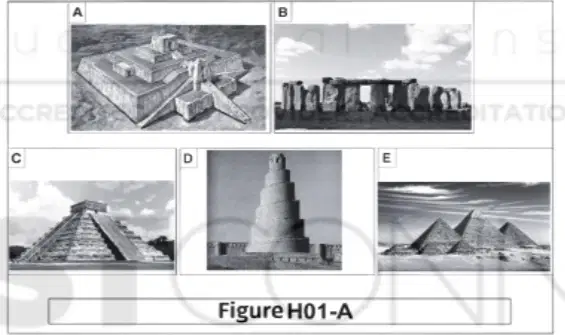
Structure E can be found in
Dahshur, Egypt
Giza, Egypt
Khufu, Egypt
Luxor, Egypt
It has a central chamber that is surrounded by small chambers.
Passage
Stone circle
Wedge
Court
Tombs oriented from north and south with long passage.
Passage
Stone circle
Wedge
Court
Consisting of a series of upright stones arranged in a circle and supporting horizontal slabs.
Passage
Stone circle
Wedge
Court
Formed of branches of trees and covered with turf.
Lean to
Stone circle
Hut
Court
One side is leaned to a cave and is supported by stones at the base.
Lean to
Stone circle
Hut
Court
What type of architecture is the Great Ziggurat of Ur?
Sumerian architecture
Persian architecture
Babylonian architecture
Assyrian architecture
Which area or country is known as Mesopotamia, where the development of architecture started?
Egypt
Iraq
Afghanistan
Turkey
What is the building material used in Sumerian architecture?
Cement
Stone
Mud
Mud bricks
What is the principal architectural monument of prehistoric buildings?
Tombs
Palaces
Watch towers
Temples
What kind of structure is Mesopotamia known for?
Minaret
Stonehenge
Ziggurat
Pyramid
Where can we find the Tarxien Temple?
Mexico
Turkey
Italy
Malta
Where can we find the Olmec Heads?
Mexico
Turkey
Italy
Malta
Where can we find the Nuraghe Temple?
Mexico
Turkey
Italy
Malta
Where can we find the Gobekli Tepe?
Mexico
Turkey
Italy
Scotland
Where can we find the Callanish Stones?
Mexico
Turkey
Italy
Scotland
It is a burial mound with a long, narrow path and a gallery.
Wedge
Court
Passage
Pit
It is a burial place-oriented north to south, with a long, narrow path that leads to an open court.
Passage
Court
Wedge
Dolmen
A tomb roofed by slabs laid directly on the side walls, often with one or more rows of outer wall
Passage
Cairn
Pit Grave
Wedge
A shelter inclined on one side of a cave, supported by rows of columns or other supports.
Lean-to
Hut
Teepee
Dolmen
An early settlement made of wooden twigs, typically located on flat plains or cliffs.
Shanty
Hut
Yurt
Lean-to
The prehistoric tomb composed of standing stones capped with a large horizontal slab?
Dolmen
Menhir
Tumulus
Cromlech
A circular arrangement of large stones enclosing a monument or burial mound?
Henge
Stonehenge
Cromlech
Dolmen
A single, tall, upright prehistoric stone, often of ritual significance?
Menhir
Dolmen
Obelisk
Cromlech
A prehistoric burial mound made of earth and stones, often covering one or more graves?
Tumulus
Passage Grave
Megalith
Dolmen
A structure formed by large stones, usually arranged without mortar, for ceremonial or burial use?
Megalith
Lintel
Henge
Obelisk
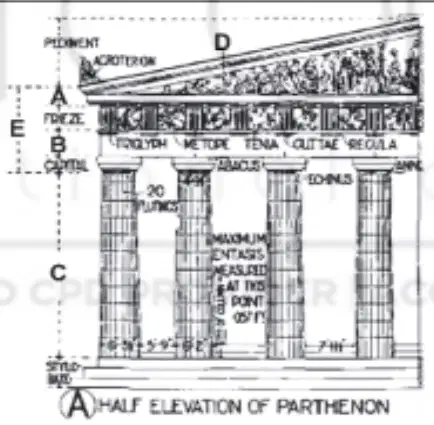
Item A is called:
Architrave
Tympanum
Entablature
Cornice
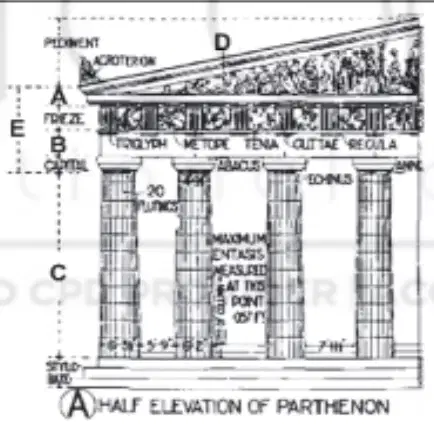
Item B is called:
Architrave
Tympanum
Entablature
Cornice
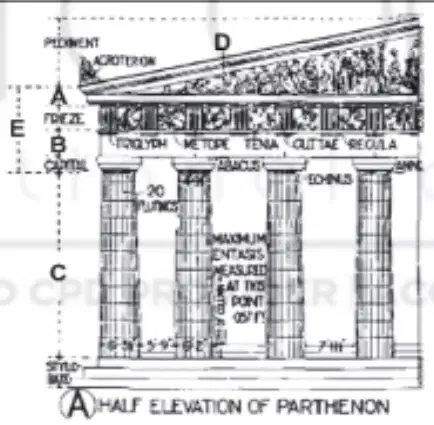
Item C is called:
Shaft
Tympanum
Entablature
Cornice
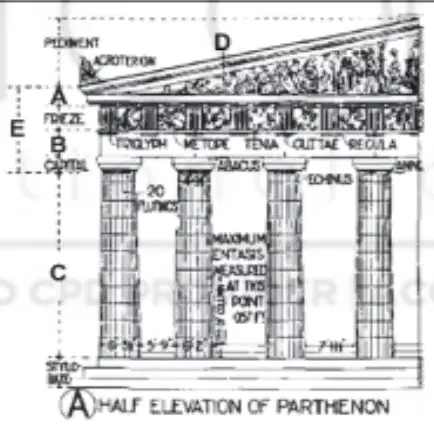
Item D is called:
Shaft
Tympanum
Entablature
Cornice
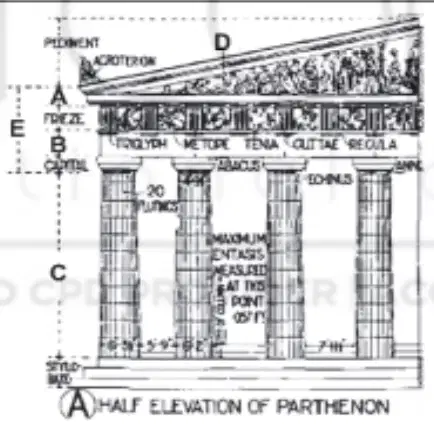
Item E is called:
Shaft
Tympanum
Entablature
Cornice
What is the construction system of the Greeks?
Trussed
Buttressed
Columnar and trabeated
Arcuated
What is the architectural character of the Greeks?
Vastness and magnificence
Simplicity and harmony
Ostentation and ornateness
Solidity and massiveness
What is the architectural character of the Romans?
Simplicity and harmony
Solidity and massiveness
Monumentality
Vastness and magnificence
What buildings are the Romans famous for?
Temple
Amphitheater
Aqueduct
Dwellings
Most famous and largest amphitheater of the Romans.
Colosseum
Verona
Marcellus
Orange
Tomb of Egyptian architecture characterized by a flat top, battered walls, and underground burial chambers.
Mastaba
Pyramid
Temple
Rock cut tomb
There are two types of Egyptian temples: cult and mortuary. Which of the following is an example of a cult temple?
Khons
Ramesseum
Hatshepsut
Mentuhotep
Tall tower with a square base and a tapered top.
Obelisk
Pyramid
Pylon
Mastaba
Byzantine secular building combining private apartments, chapels, and churches.
Palace of Mystras
Palace of Lausus and Antiochos
Palace of Porphyrogenitus
Palace of Constantinople
The largest pyramid in Giza.
Cheops
Chephren
Mycerinos
Queen's Pyramid
What is the supreme example of a Greek sanctuary in Athens?
Acropolis
Erechtheion
Parthenon
Propylaea
What is the principal decoration of walls and shafts of columns in Egyptian architecture?
Battered
Hieroglyphics
Papyrus
Scarab
What is the most important Roman architectural structure, famous for its great dome?
Parthenon
Pantheon
Colosseum
Aqueduct
What is an alternative ornamentation used by the Romans aside from marble?
Paintings
Painted fresco decorations
Wall sculpture
Granite
Which palace of West Asiatic architecture features 250 towers and 100 bronze gates?
Palace of Sargon
Palace of Xerxes
Palace of Nebuchadnezzar
Palace of Ashurbanipal
In Egyptian architecture, what is the meaning of the symbols lotus, papyrus, and palm?
Fertility
Eternity
Resurrection
Protection
In Egyptian architecture, what is the meaning of the symbol scarab or sacred beetle?
Fertility
Eternity
Resurrection
Protection
In Egyptian architecture, what is the meaning of the symbols spiral and feather?
Fertility
Eternity
Resurrection
Protection
What is the decorative feature of Egyptian architecture?
Pylon
Obelisk
Hieroglyphs
Sphinx
Which architectural style uses the gorge cornice moulding?
Egyptian Architecture
Roman Architecture
Baroque Architecture
Rococo Architecture
Which architectural style uses terra cotta, marble, and concrete?
Roman
Greek
Early Christian
Byzantine
Which architectural style uses ashlar and concrete stone?
Roman
Greek
Early Christian
Byzantie
Which architectural style uses marble, concrete, bricks, and other materials?
Roman
Greek
Early Christian
Byzantine
Which architectural style primarily uses marble?
Roman
Greek
Early Christian
Byzantine
Which architectural style is known for the use of mosaics, domes, and rich ornamentation?
Roman
Greek
Early Christian
Byzantine
The Greeks' beliefs are based on what?
Natural phenomena
Christianity
Ancestor worship
Life after death
What religious belief were Roman buildings based on?
Natural phenomena
Christianity
Ancestor worship
Life after death
What religious belief was most influential in Early Christian architecture?
Polytheism
Ancestor worship
Life after death
Monotheism
Which Egyptian tomb usually serves as the main building of a complex, surrounded by enclosed walls?
Mastaba
Pyramid
Rock Hewn
Ziggurat
Which tomb of nobility features porticoes at the front and an offering chapel behind?
Mastaba
Pyramid
Rock Hewn
Ziggurat
Which of the following is a cult temple?
Amun, Karnak
Luxor, Thebes
Temple of Hatshepsut
Ramesseum, Thebes
Which of the following is a mortuary temple?
Amun, Karnak
Luxor, Thebes
Temple of Hathor, Dendera
Temple of Isis, Philae
Which temple is dedicated to Queen Hatshepsut and built into a cliff face?
Temple of Horus, Edfu
Temple of Hatshepsut
Temple of Amun, Karnak
Temple of Seti I, Abydos
Which temple is known for its hypostyle hall with 134 massive columns?
Temple of Horus, Edfu
Temple of Isis, Philae
Temple of Amun, Karnak
Temple of Kom Ombo
Which temple is located on an island and dedicated to the goddess of magic and motherhood?
Temple of Amun, Karnak
Temple of Isis, Philae
Temple of Seti I, Abydos
Temple of Hapsehepsut
What are the architectural orders developed in ancient Greek architecture?
Doric, Ionic, and Corinthian
Tuscan, Composite, and Corinthian
Baroque, Gothic, and Classical
Volute, Pediment, and Stylobate
Which classical orders were developed by the Romans?
Doric and Ionic
Tuscan and Composite
Corinthian and Gothic
Baroque and Rococo
What do you call a capital that combines the volutes of the Ionic order with the acanthus leaves of the Corinthian order?
Doric capital
Tuscan capital
Ionic capital
Composite capital
Which ancient architecture is known for its tall, slender columns with distinctive capitals?
Persian
Egyptian
Greek
Byzantine
Who was the architect of the Parthenon?
Iktinos
Callicrates
Phidias
Pericles
What are the geographic characteristics of Greece?
Flat terrain
Rainforests and plains
Desert and sand dunes
Mountainous and surrounded by seas
What religious beliefs influenced Greek architecture?
Christianity
Islamic rituals
Natural phenomena
Ancestor worship
What factors influenced the design of Greek buildings?
Political hierarchy
Agricultural economy
Military conquest
Religious festivals, fine arts, and music
What is the climate of Greece?
Hot and dry climate
Cold and damp
Temperate with heavy rain
Humid and tropical
What were the major building materials used in ancient Greek architecture?
Mud bricks
Marble
Granite
Terracotta
What is the structural system used in ancient Egyptian architecture?
Columnar and squared
Columnar and round
Columnar and trabeated
Columnar and lintel
Which style is characterized by battered walls, no windows, and gorge mouldings?
Egyptian
Roman
Greek
Gothic
Which civilization built structures on platforms 6 to 10 meters high, with a conical shape and pipe holes?
West Asiatic
Pre-Columbian
Minoan
Romanesque
What type of column is characterized by a lotus or papyrus capital, commonly found in Egyptian architecture?
Lotiform column
Campaniform column
Palmiform column
Bell-shaped column
What is the term for the large hall in Egyptian temples filled with columns, often representing a papyrus forest?
Hypostyle hall
Peristyle court
Sanctuary
Nave
Which Roman building contains the largest unsupported dome in the world?
St. Peter's Basilica
Parthenon
Pantheon
Basilica of San Vitale
What is the largest surviving triumphal arch, completed in 315 AD?
Arch of Constantine
Arch of Septimius Severus
Arch of Titus
Arc de Triomphe
Which is the largest of the Roman hippodromes and one of the largest sports arenas ever built?
Olympia Stadium
Hippodrome of Constantinople
Circus Maximus
The Colosseum
Who began the construction of the Great Hypostyle Hall in the Temple of Karnak?
Amenhotep III
Seti I
Ramesses II
Horemheb
What was the primary function of the aqueducts designed by the Romans?
Water distribution
Act as monument
Fish farming
Electricity
What technique did the Egyptians use to create a perfectly level base for the pyramids?
Level tool
Dug a trench around the building site and filled it with water
Ancient tool equivalent to a carpenter's level
Flood the site with water
What method was used to transfer 2-ton stones during the construction of the pyramids?
Used cranes
Lifted them one by one on top of the other
Used rolled logs to move and position them
None of the above
Who was the chief architect of the Great Pyramid of Giza?
Hemiunu
Imhotep
Djoser
Khufu
What is the name of the ancient stone figure with the body of a lion and the head of a human?
Sphinx
Djinn
Uktena
Obelisk
Who was the architect of the Pyramid of Zoser?
Imhotep
Rameses
Cheops
Rameses III
Which architect was deified and honored during the reign of Rameses?
Imhotep
Senenmut
Amenhotep
Rameses II
What is the name of the sacred lake commonly found in Egyptian temples used for ritual purification?
Solar Basin
Lotus Pool
Sacred Lake
Temple Reservoir
What structure served as the gateway to Egyptian temples, often decorated with carvings and flanked by obelisks?
Pylon
Hypostyle Hall
Sanctuary
Peristyle
What is the tall, four-sided, tapering monument used by Egyptians as a symbol of the sun god Ra?
Ziggurat
Cenotaph
Stele
Obelisk
What was the architectural prototype of the Egyptian pyramid?
Menhir
Dolmen
Mastaba
Stepped pyramid
What is opus tessellatum in Roman architecture?
Brick layout
Mosaic
Mural
Collage
What type of Roman wall facing creates a net-like pattern?
Opus testaceum
Opus quadratum
Opus reticulatum
Opus mixtum
What is the warm room in an ancient Roman bath?
Sudatorium
Tepidarium
Caldarium
Laconicum
What is the sweating room in an ancient Roman bath?
Sudatorium
Tepidarium
Caldarium
Frigidarium
What is the name of the bedroom in an ancient Roman domus?
Atrium
Vestibulum
Cubicula
Tabernae
What is the triangular structure on top of an entablature?
Base
Shaft
Pediment
Architrave
Where is the pediment located in a Doric temple?
Placed below the entablature
Placed above the entablature
Rests beneath the architrave
It is part of the base
What is the purpose of the pediment in a Classical Greek temple?
Used as mouldings for framing a door, window, or other rectangular opening
It consists of the tympanum, often decorated with sculpture depicting scenes from Greek and Roman mythology or allegorical figures
Serves as the base for the column
All of the above
What do you call a wide, low-pitched gable surmounting a colonnade or a major division of a façade?
Tympanum
Pediment
Stylobate
Acroterium
In Greek architecture, what is another term for Cella?
Pronaos
Naos
Epinaos
Opisthodomos