
 Worksheets
Personal safety and Social Responsibility
Total questions: 97
Worksheet time: 49mins
What is one of the key learning outcomes of the STCW 2010 related to personal safety and social responsibility?
Observe safe working practices
Ignore safety procedures
Disregard orders
Avoid teamwork
Which learning outcome focuses on understanding and being understood in relation to shipboard duties according to the STCW 2010?
Understand orders and be understood in relation to shipboard duties
Perform emergency procedures without communication
Maintain shipboard equipment only
Navigate using electronic charts exclusively
According to the STCW 2010, what should you comply with during emergencies on board ship?
Emergency procedures
Navigation rules
Cargo handling procedures
Maintenance schedules
Which of the following is a precaution to prevent pollution of the marine environment as per STCW 2010 learning outcomes?
Dispose waste overboard
Take precaution to prevent pollution
Ignore environmental regulations
Use harmful chemicals freely
What action should be taken to control fatigue according to the STCW 2010 learning outcomes?
Understand and take necessary actions to control fatigue
Ignore signs of fatigue and continue working
Increase working hours to improve productivity
Avoid taking rest breaks during duty
How can you contribute to effective human relationships on board ship as per STCW 2010 learning outcomes?
Contribute to effective human relationships on board ship
Ignore communication with crew members
Create conflicts among crew members
Disregard teamwork and cooperation
At the end of the course, participants will be able to: ________ safe working practices.
Observe
Ignore
Disrupt
Neglect
At the end of the course, participants will be able to: Understand orders and be ________ in relation to shipboard duties.
understood
understandable
understanding
understands
At the end of the course, participants will be able to: ________ with emergency procedures.
Comply
Argue
Ignore
Struggle
At the end of the course, participants will be able to: Take precautions to prevent ________ of the marine environment.
pollution
erosion
navigation
overfishing
At the end of the course, participants will be able to: Contribute to effective human ________ on board ship.
relationships
machinery
navigation
cargo
At the end of the course, participants will be able to: Understand fully the Social ________.
Responsibilities
Networks
Events
Media
What are the three key points mentioned for observing safe working practices?
Importance of adhering to safe working practices at all times
Correct use of safety equipment
Apply safety procedures before, during and after specific task
All of the above
Who publishes the Code of Safe Working Practices for Merchant Seamen?
International Maritime Organization (IMO)
Maritime and Coastguard Agency (MCA)
United Nations
World Health Organization (WHO)
The Code is intended primarily for merchant seafarers on ______-registered ships.
UK
US
Canada
Australia
The Code is addressed only to ship owners and not to everyone on a ship regardless of rank or rating.
True
False
List two risks mentioned in the workplace according to the Code.
Fire and electrical hazards
Noise and air pollution
Water shortage and drought
Traffic congestion and delays
A statutory requirement for seafarers regarding health and safety information is:
Receiving training on health and safety procedures.
Ignoring health and safety guidelines.
Reporting only major accidents.
Relying solely on personal experience.
Who is responsible for protecting the health and safety of seafarers and others on board ships?
Ship owners and employers
Passengers
Port authorities
Cargo owners
Seafarers are required to take reasonable care for their own health and safety and that of others on board who may be affected by their acts or omissions.
True
False
Cooperate with anyone else carrying out health and safety duties, including compliance with control measures identified during the employer’s or Company’s _________?
risk assessment
annual review
training session
safety briefing
Report any identified serious hazards or deficiencies immediately to the appropriate ________ or other responsible person.
officer
employee
visitor
contractor
Make proper use of plant and machinery, and treat any hazard to health or safety (such as a dangerous substance) with _________
due caution
no concern
reckless abandon
complete disregard
minimal effort
Under the regulations, it is an offence for any person intentionally or recklessly to interfere with or misuse anything provided in the interests of _________?
health and safety
public transport
financial security
environmental protection
On every sea going ship on which more than five workers are employed, the company is required to appoint a _________
safety officer
chief engineer
medical officer
cook
The master must record the appointment of the safety officer in the official _________
logbook
register
journal
manifest
Should there be any unsafe situation or incidents it should be reported to the ________ who will address the situation.
safety officer
manager
security guard
cleaning staff
ILO is the United Nation’s body responsible for setting international standards for working and living conditions and promote _________?
workers’ rights
global trade
environmental protection
technological innovation
Which organization is responsible for setting international standards for working and living conditions and promoting workers’ rights?
WHO
ILO
IMO
UNESCO
Good hygiene is the responsibility of ________ on board.
all on board
the captain only
the cook only
the engineer only
Cleanliness of one’s environment and good housekeeping is the responsibility of ________ on board.
all on-board
the captain only
the engineering crew only
the housekeeping staff only
On board, simple infections can easily be spread from one person to _________.
another
himself
the captain
the doctor
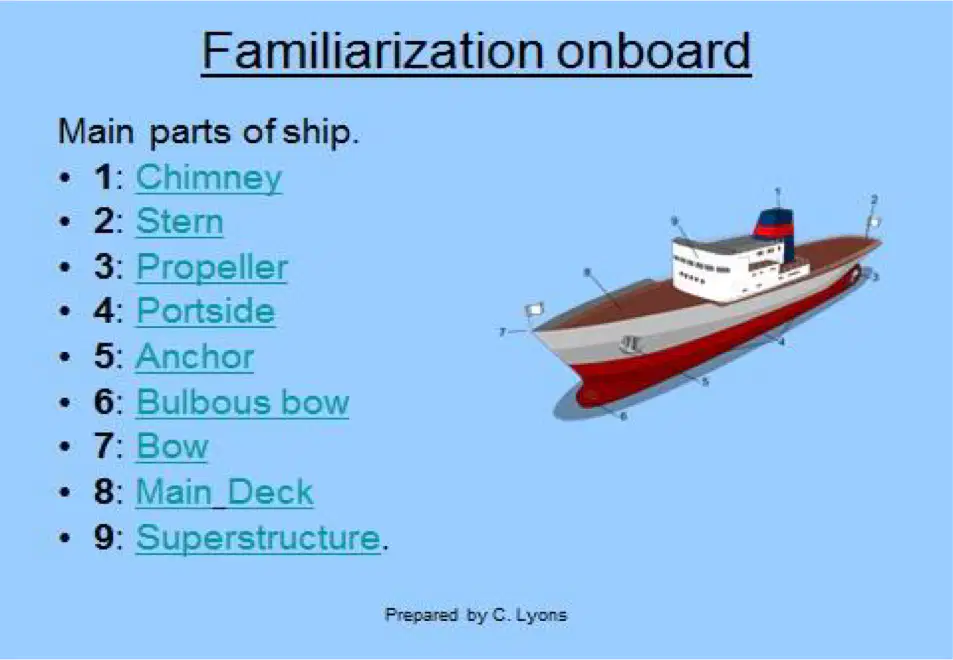
What is the name of the part labeled as number 1?
Chimney
Roof
Window
Door
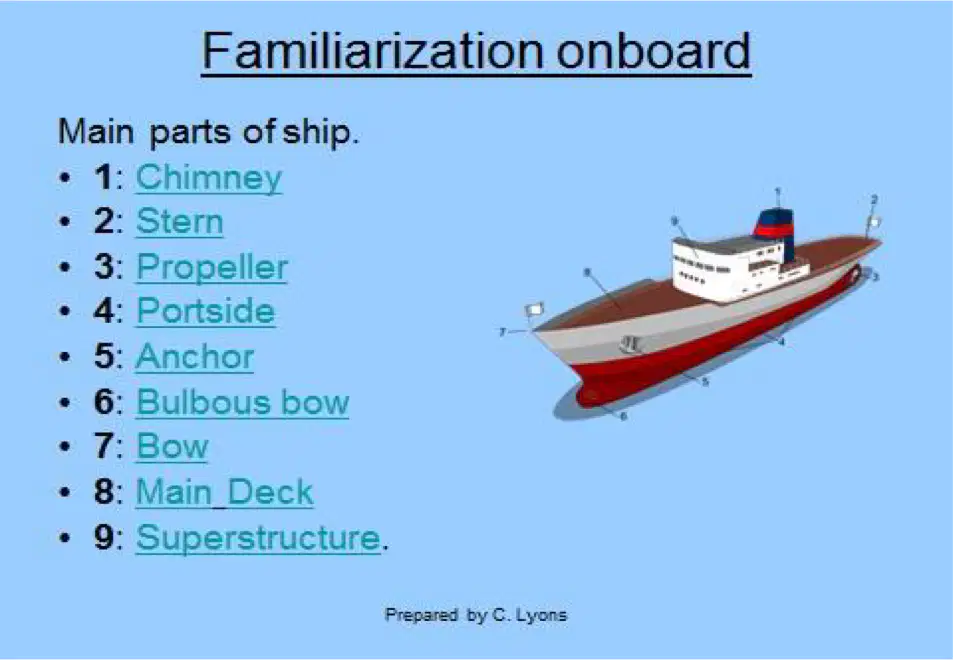
What is the name of the part labeled as number 2?
Stern
Bow
Hull
Deck
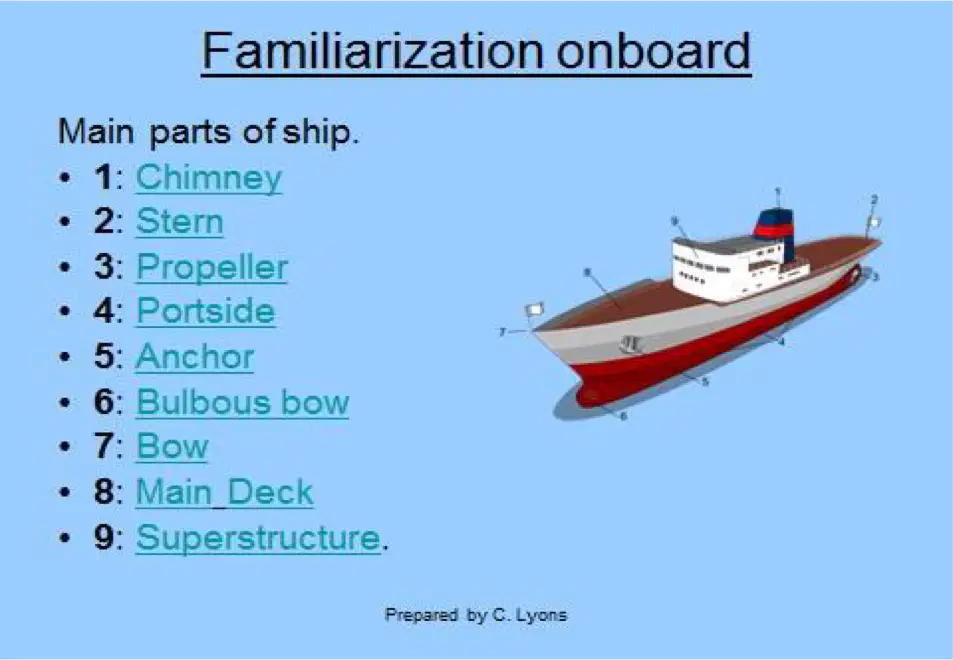
What is the name of the part labeled as number 3?
Propeller
Rudder
Wing
Engine
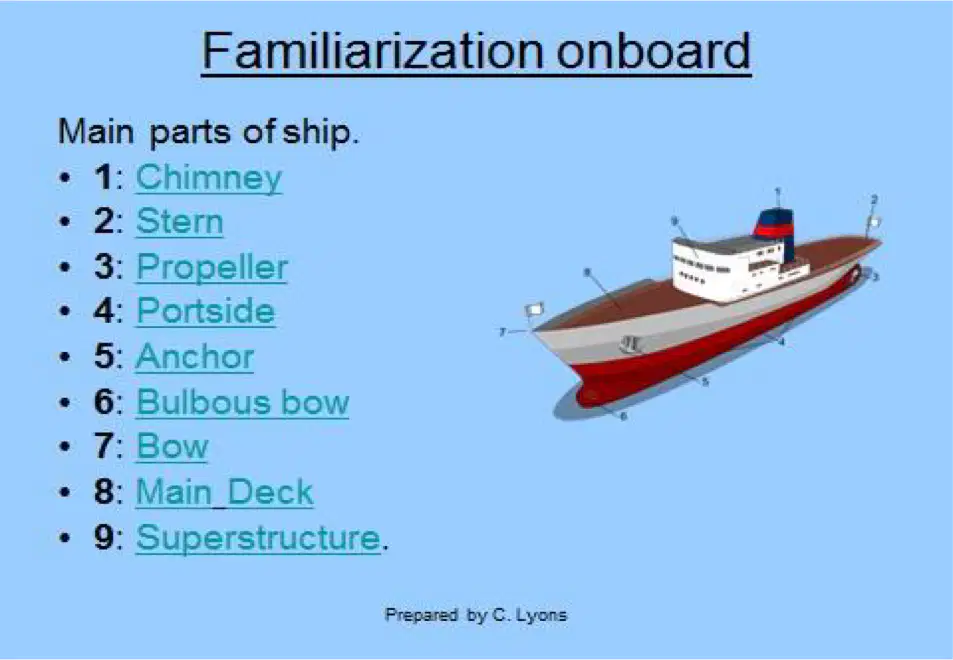
What is the name of the part labeled as number 4?
Portside
Starboard
Bow
Stern
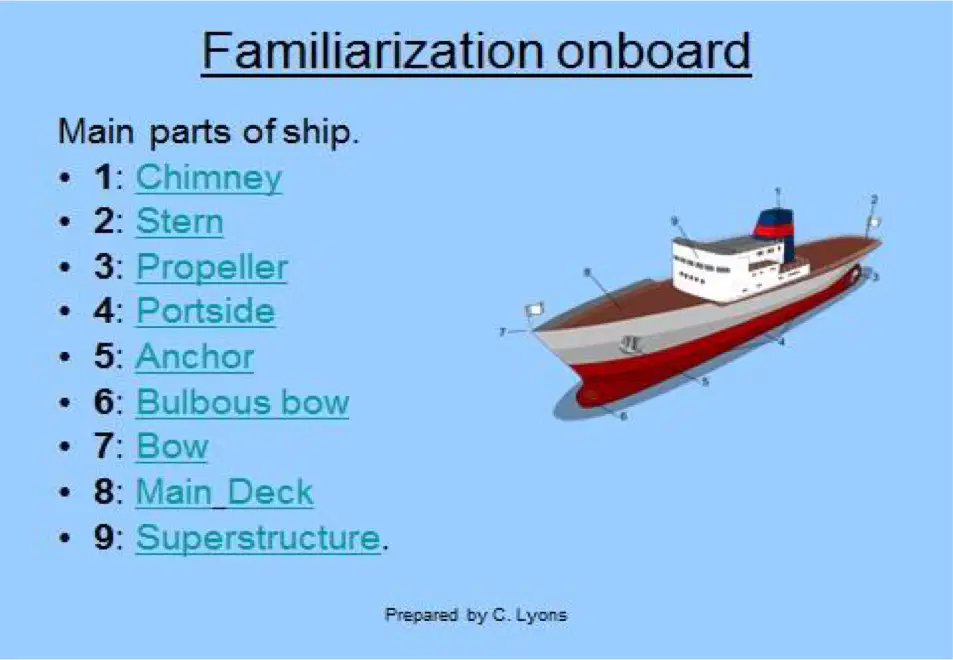
What is the name of the part labeled as number 5?
Anchor
Rudder
Propeller
Hull
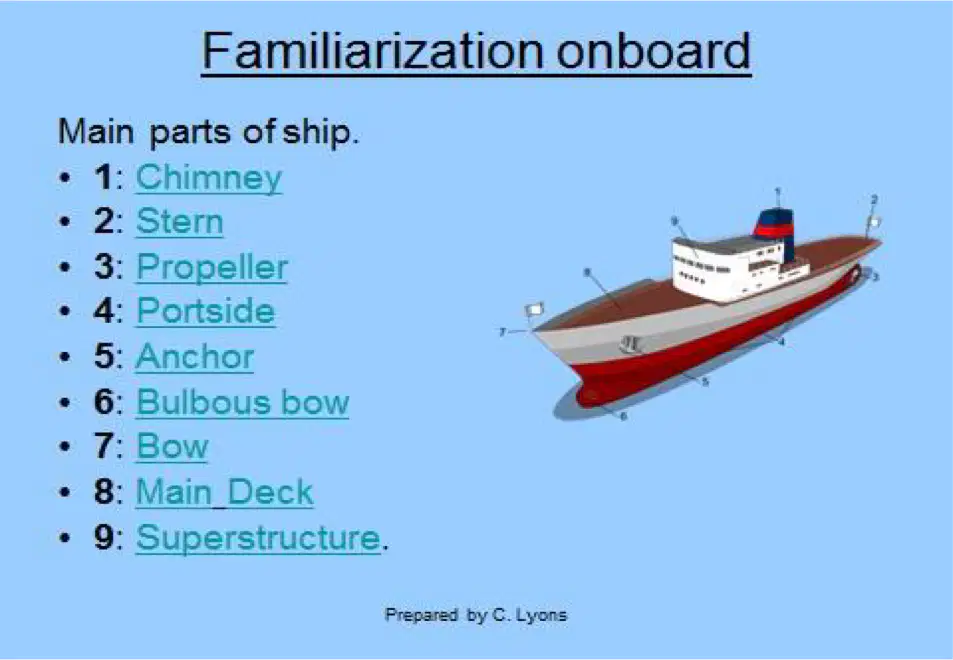
What is the name of the part labeled as number 6?
Bulbous bow
Rudder
Propeller
Anchor
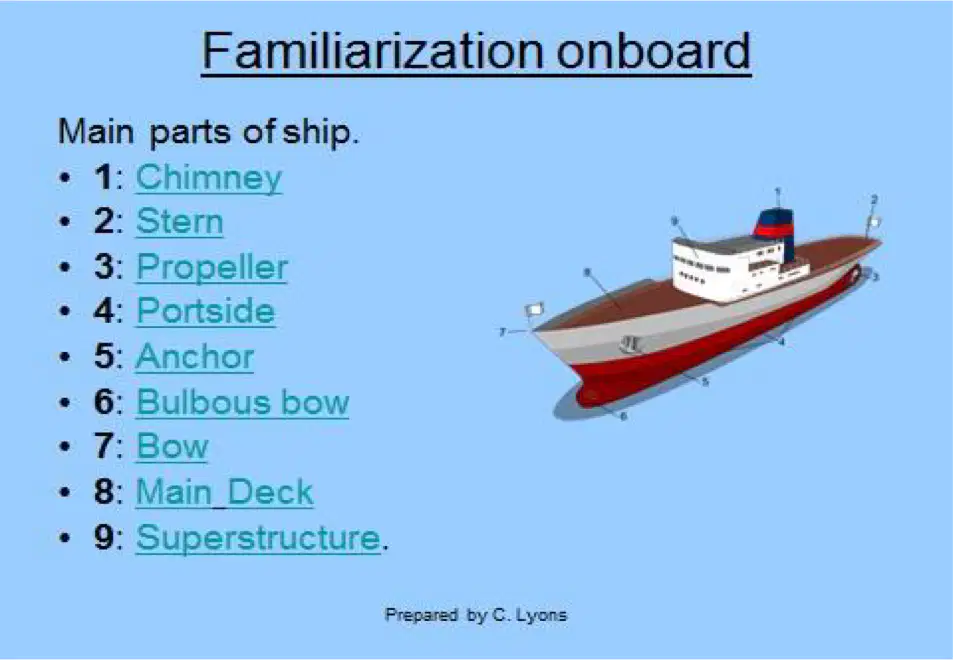
What is the name of the part labeled as number 7?
Bow
Stern
Deck
Hull
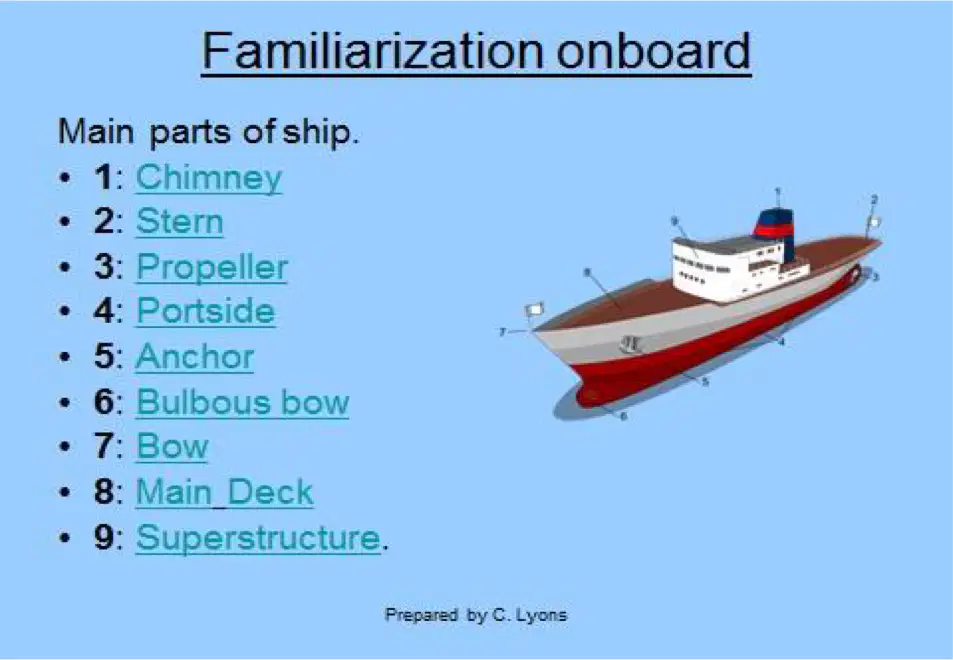
What is the name of the part labeled as number 8?
Main Deck
Engine Room
Bridge
Cargo Hold
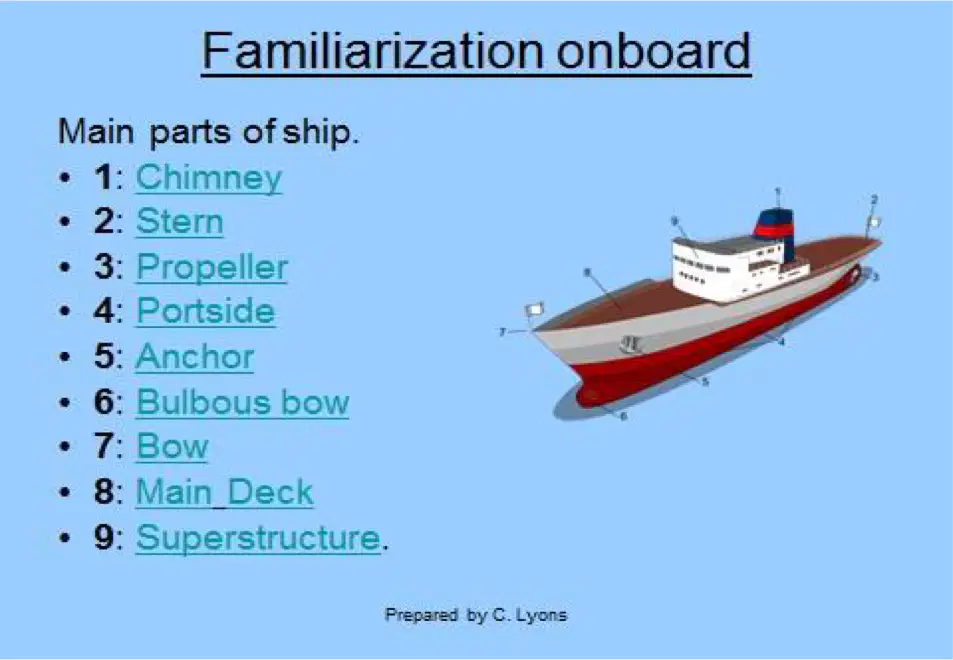
What is the name of the part labeled as number 9?
Superstructure
Hull
Deck
Keel
Nature of Shipboard Hazards: List any three hazards that can occur on a ship.
Slips, trips and falls; Burns; Hazards of chemicals.
Watching movies; Playing cards; Sunbathing.
Listening to music; Painting; Cooking gourmet meals.
Reading novels; Swimming in the sea; Stargazing.
Which protective device is commonly provided as protection against falling objects aboard ships?
Face and eye protection
Safety helmets
Respiratory protection
Life jacket
Face and eye protection are designed to protect from:
Splashes flying objects
Heat
Harmful lights particles
All of the above
Gloves are used based on the hazard from which protection is needed.
True
False
Special outer clothing is needed for protection based on the specific environment in which one is working. These are used to protect from ________ or heat.
splashes
cold
wind
dust
Respiratory protective equipment is essential for protection from irritating or dangerous dust, fumes or gases.
True
False
Which equipment is used for protection against drowning?
Safety helmet
Life jacket
Gloves
Face protection
Name any two types of other protective equipment mentioned in the text.
Lifesaving appliances, Fire fighting appliances
Kitchen utensils, Cleaning cloths
Office chairs, Desks
Books, Notebooks
What is the main objective of the International Safety Management (ISM) Code?
To ensure safety at sea, prevention of human injury or loss of life, and avoidance of damage to the environment and property.
To regulate international trade agreements between shipping companies.
To establish crew salary standards for international vessels.
To promote tourism and leisure activities on commercial ships.
What are the safety management objectives of the Company?
Provide for safe practices in ship operation and a safe working environment
Establish safeguards against all identified risks
Continuously improve safety management skills of personnel ashore and aboard ships
All of the above
According to the EU Marine Equipment Directive, what mark must equipment found on UK ships carry to show conformity?
Wheelmark
CE Mark
Anchor Mark
Star Mark
Precaution to be taken prior to entering enclosed spaces includes:
True
False
Precaution to be taken prior to entering enclosed spaces includes:
True
False
Precaution to be taken prior to entering enclosed spaces includes:
True
False
Precaution to be taken prior to entering enclosed spaces includes:
True
False
Precaution to be taken prior to entering enclosed spaces includes:
True
False
A confined space is defined as a space that is large enough and so configured that an employee can bodily enter and perform assigned work, has limited or restricted means for entry or exit, and is not designed for continuous employee occupancy.
True
False
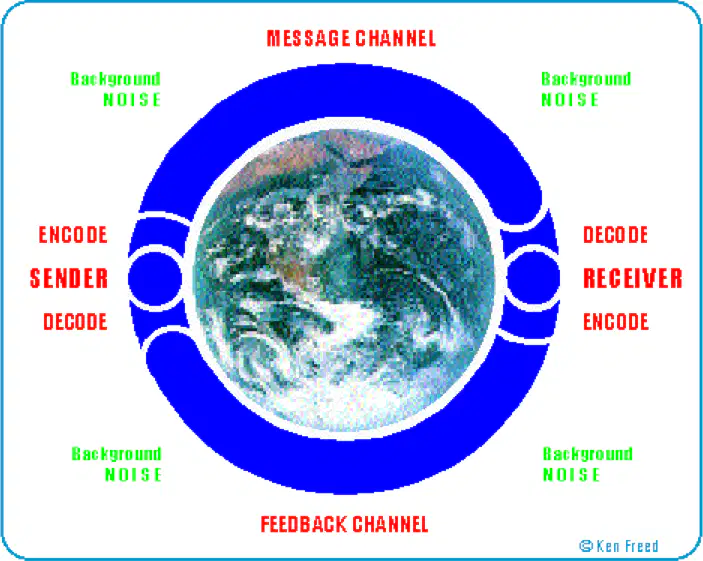
What are the main components shown in the communication cycle?
Sender, Receiver, Message Channel, Feedback Channel, Encode, Decode, Background Noise
Sender, Receiver, Message Channel, Feedback Channel, Encode, Decode, Visual Aid
Sender, Receiver, Message Channel, Feedback Channel, Encode, Decode, Written Report
Sender, Receiver, Message Channel, Feedback Channel, Encode, Decode, Presentation Slide
Which of the following is NOT a fundamental of communication?
Sender - Message
Receiver - Listening
Feedback - Responding, Acting
Noise - Interference
The person who listens in the communication process is called the ________.
Receiver
Sender
Speaker
Transmitter
Which of the following is an effective transmission skill?
Ignoring the message
Written communication
Closed eyes
Turning away
List any two effective listening skills mentioned in the text.
Direct eye contact, Sitting up straight
Interrupting frequently, Looking away
Talking over the speaker, Slouching
Ignoring the speaker, Checking your phone
Barriers to effective communication between individuals and teams within the ship include all of the following EXCEPT:
Receiver’s understanding
Feedback stage
Effective listening
Mode of transmission
What are two possible consequences of wrong communication?
Misunderstanding, Accidents
Happiness, Success
Clarity, Teamwork
Improvement, Motivation
Which of the following is considered an imminent danger according to emergency procedures?
Loss of life
Serious injury
Loss or damage to property
Damage to the environment
All of the above
Types of emergencies include Stranding or Grounding, Steering Failure, Gyro Failure, Engine Failure, Fire, Man Overboard, Collision, Flooding, Abandonment, Search & Rescue (internal), Bridge control/Telegraph failure, Hazardous Materials out of control, and _________?
Security Threat
Routine Maintenance
Weather Forecasting
Cargo Loading
Which of the following is NOT listed as a type of emergency that requires a contingency plan on board a vessel?
Grounding
Abandon ship
Routine maintenance
Man over board
What is the first step to take in the event of a fire on board according to the emergency procedures?
Raise the alarm.
Try to extinguish the fire yourself.
Ignore the fire and continue working.
Wait for instructions from the captain.
The correct procedure if fire proves to be uncontrollable is to close windows/doors/vents and withdraw from the compartment.
True
False
After extinguishing a fire, you should _______ all used fire fighting equipment.
Replace
Ignore
Hide
Discard
Which of the following is a correct step in fighting a fire on board?
Ignore the fire
Assemble fire party, correctly dressed with hose line and breathing apparatus
Leave all doors open
Increase fuel supply to the compartment
What is the signal for a general emergency alarm on a ship?
Three long blasts
Seven or more short blasts followed by one long blast on the ship's whistle or siren
A series of short blasts on the ship's bell
Order given by the captain
Emergency signals and duties allocation: What is the signal for fire on a ship?
Three long blasts
Seven or more short blasts followed by one long blast
A series of short blasts on the ship's bell
Order given by the captain
Emergency signals and duties allocation: What is the signal for man overboard?
Three long blasts
Seven or more short blasts followed by one long blast
A series of short blasts on the ship's bell
Order given by the captain
Emergency signals and duties allocation: Who gives the order to abandon ship?
The captain
The chief engineer
The first officer
The radio officer
How often should life boat drills be conducted on passenger vessels?
At intervals of not less than once per week
At intervals of not less than once per month
At intervals of not less than once per year
At intervals of not less than once per voyage
Before proceeding to the muster stations, what should everyone do?
Put on extra clothing and life jacket and head to the muster station
Call the captain for instructions
Go directly to the lifeboats without any preparation
Wait in your cabin until further notice
Values and need for training and drills: Which of the following is NOT a value of training and drills?
The crew know how to use the equipment
Keep the equipment readily available in good working order
Increase fear and panic in emergency situations
Knowledge of actions to be taken in emergency helps in minimising hazards
Marine Notices: How many different types of Marine Notice are there?
Three
Four
Two
Five
Marine Notices: What does MSN stand for and what is its purpose?
MSN stands for Marine Notice and is used to convey mandatory information that must be complied with under UK legislation.
MSN stands for Maritime Safety Network and is used to report voluntary safety incidents.
MSN stands for Marine Security Notice and is used to announce international maritime events.
MSN stands for Marine Survey Notification and is used to schedule vessel inspections.
What does 'Avast' mean in emergency terminologies?
Cancel an order
Stop or hold
Motionless or stop all activities
For next order
What does 'Belay' mean in emergency terminologies?
Cancel an order
Stop or hold
Motionless or stop all activities
For next order
What does 'Still' mean in emergency terminologies?
Cancel an order
Stop or hold
Motionless or stop all activities
For next order
What does 'Stand by' mean in emergency terminologies?
For next order
Cancel an order
Stop or hold
After a task has been momentarily halted
What does 'Carry on' mean in emergency terminologies?
For next order
Cancel an order
Stop or hold
After a task has been momentarily halted
Name one device used for internal communication and alarm system on board a ship.
Two way radio hand set
Anchor chain
Life jacket
Navigation light
Which system is used for public announcements on board a ship?
Public address system
Navigation radar
Engine telegraph
Fire alarm system
Every effort must be made to quickly get acquainted with the escape route on board.
True
False
Escape routes should be clearly marked on board a ship.
True
False
What is pollution caused by in shipping according to the worksheet?
Sewage, garbage, oil discharge, chemical discharge
Noise pollution, light pollution, air pollution, soil pollution
Plastic waste, electronic waste, nuclear waste, medical waste
Carbon dioxide, methane, nitrous oxide, ozone
What type of waste is described as 'Drainage and other wastes from any form of toilets and urinals'?
Sewage
Industrial waste
E-waste
Agricultural waste
Drainage from medical premises via wash basins, wash tubs and scuppers is considered what type of pollution?
Sewage
Air
Noise
Thermal
What is considered 'Garbage' according to the document?
Only domestic waste
All kinds of victual, Domestic, Cargo
Only operational waste
Only cargo waste
Oil discharge means petroleum in any form which includes:
Crude oil, Fuel oil, Sludge, Oil refuse, Refined products
Only crude oil
Only refined products
Only sludge
'Harmful substances' are those substances which are identified as marine pollutants in the _____________.
International Maritime Dangerous Goods Code (IMDG Code)
International Convention for the Safety of Life at Sea (SOLAS)
International Ship and Port Facility Security (ISPS) Code
International Oil Pollution Prevention (IOPP) Certificate
Pollution is caused by:
Only human activities
Only nature
Human activities and nature
Only industrial activities

