
 Worksheets
X Unit 4 Maintain Healthy Safe and Secure Working Environment
Total questions: 84
Worksheet time: 42mins
Fill in the blank: Data is a ______ and unprocessed form of facts and figures.
raw
organized
summarized
analyzed
Fill in the blank: Information is a processed and ______ data that can be easily interpreted.
meaningful
random
useless
scattered
Fill in the blank: Database is a collection of data, which is stored in a systematic manner, i.e., in the form of ______.
tables
folders
files
graphs
A Database Management System (DBMS) is:
a software system for managing databases
a programming language for web development
a hardware device for storing data
a type of operating system
Which of the following is NOT an example of a DBMS?
MS Access
LibreOffice Base
Oracle
Microsoft Word
Fill in the blank: Data Model is the ______ of database and it describes the manner in which data will be stored and retrieved.
structure
interface
user
query
Which of the following is NOT a type of data model?
Hierarchical data model
Network data model
Relational data model
Sequential data model
Fill in the blank: In Hierarchical Data Model, the data is organised into a ______ like structure.
tree
graph
ring
mesh
Fill in the blank: In Network Data model, multiple records are linked to the same ______ file.
master
child
index
log
Fill in the blank: The Relational data model is based on the principle of setting relationships between two or more ______ of the same database.
tables
columns
rows
fields
Data can be organised into two types. What are they?
Flat file and Relational
Hierarchical and Network
Sequential and Indexed
Logical and Physical
Fill in the blank: A table is a collection of logically related ______. It is organised as a set of columns and rows.
records
fields
files
attributes
Fill in the blank: In a database table, rows are referred to as ______ or tuples and columns as fields or attributes.
records
indexes
schemas
keys
Fill in the blank: A record is the set of related information that belongs to a particular instance of an ______.
object
array
method
class
Fill in the blank: A field describes a specific property of a record. It is also known as an ______.
attribute
entity
relation
schema
Fill in the blank: Entity is a real world object about which information is to be stored in a ______.
database
notebook
spreadsheet
folder
Fill in the blank: The details associated with the entity are called ______.
attributes
entities
relations
keys
A table is a collection of logically related records. It is organised as a set of columns, and can have any number of rows.
True
False
Data and Information are differentiated as follows:
Data is raw facts; Information is processed data.
Data is processed data; Information is raw facts.
Data and Information mean the same thing.
Data is always numerical; Information is always textual.
A database is a collection of organized data. Which of the following are real examples of databases?
Google Sheets and MySQL
Microsoft Word and Facebook
Photoshop and Excel
YouTube and PowerPoint
DBMS stands for ________. What is the purpose of DBMS?
Database Management System; to manage and organize data efficiently
Data Backup and Management System; to secure data only
Digital Business Management System; to handle online transactions
Database Monitoring Service; to monitor network traffic
Which of the following are advantages of a database?
Data redundancy is minimized, data can be shared, data integrity is maintained, and security is improved.
Data is always stored manually, data cannot be shared, data is less secure, and data redundancy increases.
Databases are always slow, data is never secure, and data cannot be accessed by multiple users.
Data is only available offline, data cannot be organized, and there is no data integrity.
Which of the following correctly defines the terms Table, Field, and Record with respect to Database?
Table: Collection of records, Field: Column in a table, Record: Row in a table
Table: Single value, Field: Collection of tables, Record: Database name
Table: Row in a table, Field: Collection of records, Record: Column in a table
Table: Database name, Field: Row in a table, Record: Collection of fields
A flat file database is a database that:
Stores data in a single table without relationships between tables.
Organizes data into multiple related tables.
Uses complex indexing for data retrieval.
Requires a network structure for data storage.
Data in a RDBMS is organized in which of the following ways?
In tables consisting of rows and columns
In a hierarchical tree structure
As a flat file with no structure
In a network of linked nodes
A primary key is a unique identifier for each record in a table. In a table, how many primary key(s) is/are possible?
Only one primary key is possible in a table.
Two primary keys are possible in a table.
No primary key is possible in a table.
Multiple primary keys are possible in a table.
State the relationship between a Primary key and Foreign key.
A Primary key uniquely identifies a record in a table, while a Foreign key establishes a link between two tables.
A Primary key allows duplicate values, while a Foreign key does not.
A Foreign key uniquely identifies a record in a table, while a Primary key establishes a link between two tables.
A Primary key and Foreign key are always the same field in a table.
A composite Primary key is:
a primary key made up of two or more columns
a key that is always unique
a key that cannot be null
a single column used as a primary key
Data Redundancy refers to the unnecessary repetition of data, while Data Consistency ensures that data remains accurate and uniform across the database. Which of the following best defines both terms?
Data Redundancy is unnecessary repetition of data; Data Consistency is maintaining accuracy and uniformity of data.
Data Redundancy is the accuracy of data; Data Consistency is the repetition of data.
Data Redundancy is the process of updating data; Data Consistency is deleting duplicate data.
Data Redundancy is storing data once; Data Consistency is ignoring data errors.
Redundancy or inconsistency in a database is controlled by:
Normalization
Denormalization
Data duplication
Manual entry
The main difference between Network data model and Hierarchical data model is:
Network model allows many-to-many relationships, while Hierarchical model allows only one-to-many relationships.
Hierarchical model allows many-to-many relationships, while Network model allows only one-to-many relationships.
Both models allow only one-to-one relationships.
Network model does not support relationships between records.
The different database objects include:
Tables, Views, Indexes, and Sequences
Tables, Files, Folders, and Programs
Views, Scripts, Applications, and Networks
Indexes, Routers, Users, and Printers

Name the fields in the given table.
Book_Id, Book_Name, Author_Name, Price, Publisher
Book_Id, Book_Title, Author, Cost, Publisher
ID, Name, Author, Price, Publisher
Book_Code, Title, Writer, Price, Publisher

The field that should be made the primary key is:
StudentID
Name
Address
PhoneNumber

Is there any alternate key in the table?
Yes, there is an alternate key in the table.
No, there is no alternate key in the table.
The table only has a primary key.
The table does not have any keys.
A primary key is different from a foreign key. Which of the following best explains the difference with an example?
A primary key uniquely identifies each record in a table, while a foreign key refers to the primary key in another table. For example, 'StudentID' in the Students table is a primary key, and 'StudentID' in the Marks table is a foreign key.
A primary key can have duplicate values, while a foreign key cannot have duplicates.
A foreign key uniquely identifies each record in a table, while a primary key is used to link tables.
A primary key and a foreign key are always the same in every table.
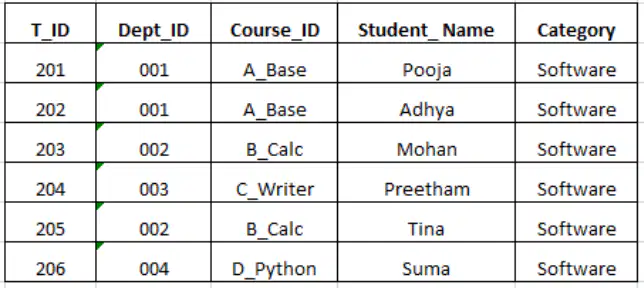
Name the fields in the given table.
Student_ID, Name, Age, Grade
Roll_No, Subject, Marks, Teacher
Product_ID, Price, Quantity, Supplier
Employee_ID, Department, Salary, Joining_Date
The total number of fields /attributes in the table is:
4
6
8
10
Identify the primary key field of the table.
Primary key field
Foreign key field
Data field
Index field
The total number of records / tuples in the table is:
10
15
20
25
Identify the key that can work as a foreign key for another table.
Primary key
Candidate key
Super key
Alternate key
Identify the composite key field(s) of the table.
StudentID, CourseID
StudentName, Grade
CourseID, Grade
StudentID, StudentName
Abhinav has designed a product table that contains the fields: [Product_ID, Product_Name, Price, Description]. How can he ensure that each row of the table is uniquely identified?
By setting Product_ID as the primary key
By allowing duplicate Product_ID values
By making Description a unique field
By not specifying any key
In a student information database table created in Calc, which field is most suitable to be selected as the primary key and why?
Student ID, because it uniquely identifies each student.
Student Name, because it is easy to remember.
Class, because it groups students together.
Age, because it changes every year.
What is/are the advantage(s) of database?
Reduces Data Redundancy
Sharing of Data
Data Integrity
All of these
Which of the following is NOT true about the primary key?
A primary key uniquely identifies records
A table can have only one primary key
A primary key field can be NULL
Value in the primary key field is different for every tuple.
Which of the following is not an example of DBMS?
PostgreSQL
SQLite
FoxPro
Impress
Data stored in a single table is known as __________.
Flat File
Relational
Both a & b
None of these
Data is stored in multiple tables, which are connected together via a common field.
Flat File
Relational
Both a & b
None of these
Which of the following data models sets a relation between the two or more tables?
Relational Data Model
Network Data Model
Hierarchical Data Model
Connection Data Model
The details associated with an entity are called __________.
Table
Attributes
Records
Primary key
A __________ is represented as rows in a table.
Field
Attribute
Record
Candidate key
Which of the following cannot be considered as an example of a database?
Dictionary
Newspaper
Marks Register
Telephone directory
A database is an organized collection of __________.
Data
Attributes
Record
None of these
Which of the following software is appropriate to store data about school students?
MS Access
Writer
Calc
Impress
Duplication of data is called __________.
Inconsistency
Consistency
Redundancy
Foreign Key
Which of the following is not the advantage of database?
Sharing of Data
Reduce Data Redundancy
Increase Data Inconsistency
Data Security
Which of the following field of table "Book" can act as primary key?
Book_number
Subject
Price
Author_name
A key which is referring to the primary key of another table is called __________.
Alternate Key
Primary Key
First Primary Key
Foreign Key

Identify foreign key from the table: “Sales”
SalesID
Profit
ClientID
clientphone
A foreign key is a reference of the ______ key in another table.
Alternate
Primary
Candidate
None of these
The users of the database can share the data among themselves. There are various levels of authorisation to access the data, and consequently the data can only be shared based with the authorized users. In this, we are discussing about the ___.
Advantage of Database
Disadvantage of Database
Database Servers
Structure of Database
In which of the following forms can a data value be represented?
Numeric
Character
Alphanumeric
All of the above
Data Security is an important concept in a database. It says _____________.
Only authorised users should be allowed to access the database.
Users identity should be authenticated using a username and password.
Both of the above.
Unauthorised users should be allowed to access the database under any circumstances.
__________ means that the data is accurate and consistent in the database.
Data Redundancy
Data Security
Data Integrity
Data Privacy
A ________ is a feature of a database using which we can enter data in a table in an easy and user friendly manner.
Query
Report
Form
Field
A __________ is an organized collection of data.
Database
Algorithm
Compiler
Spreadsheet
A ____ is a software package that can be used for creating and managing databases.
DBMS (Database Management System)
Operating System
Compiler
Spreadsheet
A ______ is a database management system that is based on the relational model.
RDBMS (Relational Database Management System)
NoSQL Database
Hierarchical Database
Object-Oriented Database
Three popular DBMS software are __________, __________, & __________.
Oracle, MySQL, MS Access
Photoshop, Illustrator, InDesign
Windows, Linux, MacOS
Python, Java, C++
A ________ is a unique value that identifies a row in a table.
Primary Key
Foreign Key
Index
Attribute
Composite Key is a combination of ______ columns.
two or more
one
primary
unique
The raw facts constitutes _____________.
Data
Information
Knowledge
Wisdom
An ___ is a real world object about which information is to be stored in a database.
Entity
Attribute
Record
Field
The data values for all the fields related to a person or object is called a ________.
Record
Field
Table
Database
All the field values that are eligible to be the primary key are the ______ keys for that table.
Candidate
Foreign
Composite
Alternate
STATE WHETHER THE FOLLOWING STATEMENTS ARE TRUE OR FALSE 1. A database cannot be organised.
True
False
STATE WHETHER THE FOLLOWING STATEMENTS ARE TRUE OR FALSE 2. Data is the collection of raw facts.
True
False
STATE WHETHER THE FOLLOWING STATEMENTS ARE TRUE OR FALSE 3. A table can be created without a primary key.
True
False
STATE WHETHER THE FOLLOWING STATEMENTS ARE TRUE OR FALSE 4. Two tables can be related in a network data model.
True
False
STATE WHETHER THE FOLLOWING STATEMENTS ARE TRUE OR FALSE 5. MS Access is an example of a database.
True
False
STATE WHETHER THE FOLLOWING STATEMENTS ARE TRUE OR FALSE 6. Data Integrity means that data is accurate and consistent in the database.
True
False
STATE WHETHER THE FOLLOWING STATEMENTS ARE TRUE OR FALSE 7. Base automatically adds the column as primary key if we don’t add.
True
False
The number of ways tables can be created in LibreOffice Base is:
Two
One
Three
Four

