
 Worksheets
6th Grade Science Midterm
Total questions: 20
Worksheet time: 10mins
Name
Class
Date
1.
1. The higher the temperature of water, the faster an egg will boil. Which is the dependent variable?
a)
The temperature of water
b)
How fast the egg boils
c)
The type of water
d)
Type of egg
2.
2. Which statement is true?
a)
The quicker a molecule moves, the warmer it is
b)
The quicker a molecule moves, the colder it is.
c)
The movement of molecule doesn't affect its temperature
d)
The slower a molecule moves, the warmer it is.
3.
3. Which of the following best describes reflection?
a)
Light bouncing off of a surface.
b)
Light being absorbed by a material.
c)
Light splitting into different wavelengths.
d)
All thee above
4.
4. Which of the following best describes transmission (of light)?
a)
to bounce light, sound, or an image off a surface
b)
an object or device that gives off light
c)
to send or pass on something, such as light or information
d)
a question that is being asked or tested in an experiment
5.
5. Which of these best shows the response of light waves to a one way mirror?
a)
Option 1
b)
Option 2
c)
Option 3
d)
Option 4
6.
6. What is happening between light and an object so that we can see the object?
a)
Light is blocking the object from our eyes.
b)
Light is reflecting off of the object into our eyes.
c)
Light is being transferred through the object.
d)
Light is reflecting off of our eyes.
7.
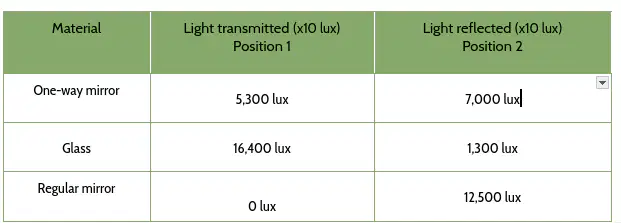
7. Based on the light meter data table, what does light do when it shines on a one-way mirror?
a)
Transmit
b)
Reflect
c)
Neither transmit or reflect
d)
Both transmit and reflect
8.
8. Which of the following statement(s) is/are correct
a)
A. Light travels in straight lines.
b)
B. When light shines on an object, it is reflected, transmitted,or some combination of these, depending on the object's materials.
c)
C. Regular mirrors transmit and reflect light.
d)
D. Both A and B
9.
9. In the case of multiple inputs, how does the brain respond?
a)
It combines all the inputs to form a single signal.
b)
It chooses the input closest to the eye.
c)
It responds to the input with the strongest signal strength.
d)
It ignores all but the first input received.
10.
10. Heat transfer occurs:
a)
in many directions
b)
both from warm objects to colder ones and from cold objects to warmer ones
c)
only from cold objects to warmer ones
d)
only from warm objects to colder ones
11.
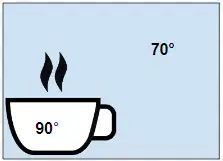
11. If a hot cup of coffee is left on a table in a room that is 70 degrees, what would the final temperature be when heat stops transferring?
a)
The final temperature is between 90° and 70° because most of the thermal energy is lost to the air around the substances
b)
The final temperature is 70° because the air warms the coffee to the temperature of the air.
c)
The final temperature is 90° because there is more coffee than air.
d)
The final temperature is between 90° and 70° because energy is transferred from the coffee to the air
12.
12. When you measure the temperature of an object, you are measuring _________.
a)
the average kinetic energy of its particles
b)
the specific heat of the object
c)
the sum of its kinetic and potential energies
d)
the average chemical energy of its particles
13.
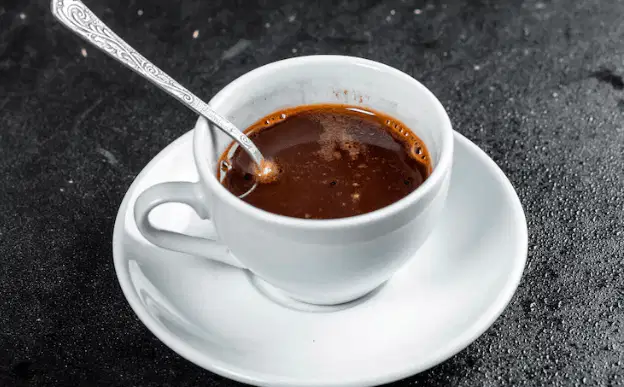
13. What is true about the transfer of heat from hot tea to the metal spoon?
a)
Heat goes from the metal to the tea by radiation.
b)
Heat goes from the hot tea to the metal spoon through radiation.
c)
Hot air rises and warms the air, then the spoon gets hot from the hot air.
d)
Heat goes from the hot tea to the spoon by conduction.
14.
14. A hot air balloon rises because the air is heated by ___.
a)
Convection
b)
Conduction
c)
Radiation
d)
Celsius Scale
15.
15. When heat energy is added to water in a pot on a stove, what changes occur to the water?
a)
Particles move faster, and temperature increases.
b)
Particles move faster, and temperature decreases.
c)
Particles move slower, and temperature increases.
d)
Particles move slower, and temperature decreases.
16.
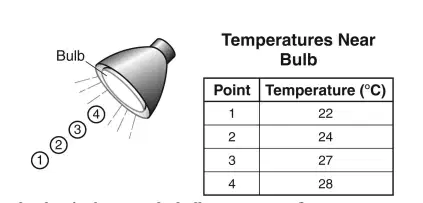
16. Which best explains why the air closest to the bulb was warmest?
a)
The bulb gave off light.
b)
The bulb radiated heat.
c)
The bulb conducted electricity.
d)
None of the above
17.
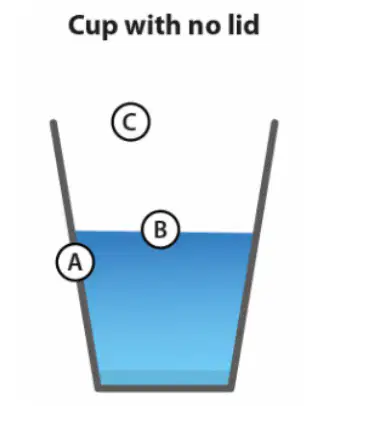
17. Which picture best describes the particles at letter B with hot water in the cup?
a)
Option 1
b)
Option 2
c)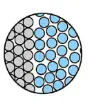
Option 3
d)
None of the above
18.
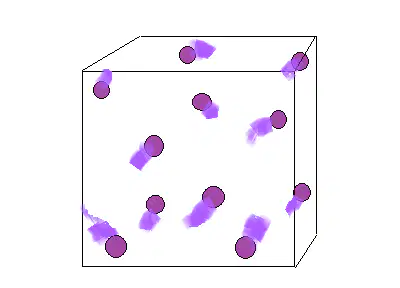
18. What state of matter does this picture show?
a)
Solid
b)
Liquid
c)
Gas
d)
Plasma
19.
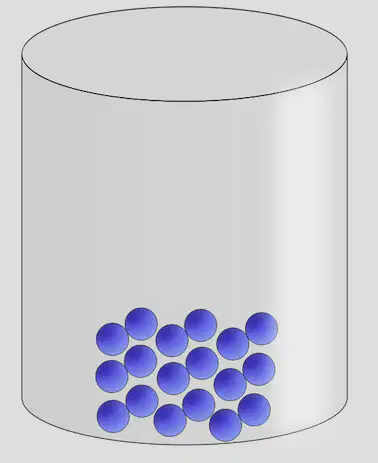
19. What state of matter does this picture show?
a)
Solid
b)
Liquid
c)
Gas
d)
Plasma
20.
20. What happens to the particles of water when evaporation occurs?
a)
They stop moving
b)
They move slower
c)
They disappear
d)
They move faster and spread out
100 %

