
Font size
 Worksheets
Lesson one: Principles of systematic desensitisation
Total questions: 29
Worksheet time: 15mins
How do you think phobias could be learned?
By classical conditioning, pairing a neutral stimulus with an aversive event
By natural maturation as the nervous system develops
By random chance without environmental influence
By normal preference changes unrelated to fear
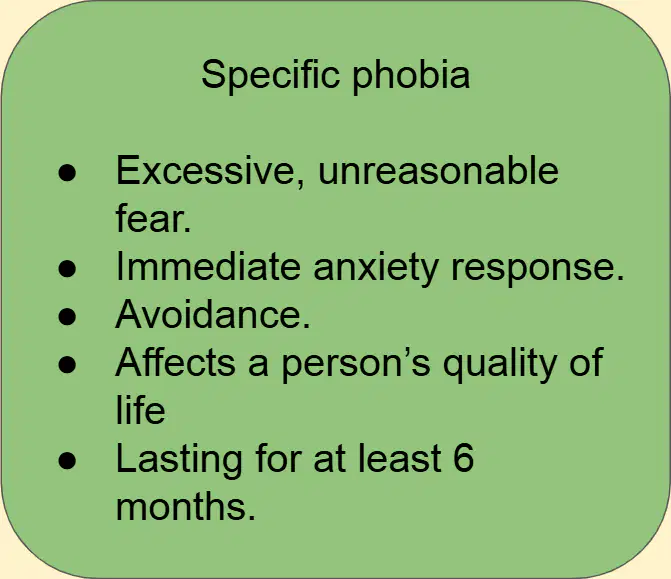
Specific phobia: Which features are suggested on the slide as characteristic of a specific phobia? Select all that apply.
Excessive, unreasonable fear
Immediate anxiety response
Avoidance
Affects a person’s quality of life
Lasting for at least 6 months
According to behaviourists, phobias are learned just like any other behaviour. Which explanation aligns with this view?
Phobias are acquired through conditioning when a negative experience becomes associated with a specific object or situation
Phobias are innate instincts present from birth and unrelated to experience
Phobias arise solely from genetic inheritance without any environmental influence
Phobias result from a sudden rational insight that permanently changes beliefs
Fill in the gaps to show how a phobia could have been conditioned. Using the example, "John has a phobia of dogs. This is because he was once attacked by a dog," which statement best illustrates conditioning of John’s phobia?
A painful dog attack becomes associated with dogs, so encountering dogs later triggers fear and avoidance
Reading factual information about dogs reduces fear and builds confidence
Avoiding all animals eliminates fear through lack of exposure
Practicing meditation makes dogs safe and removes the need for learning

The more we avoid a phobic stimulus, the more likely that behaviour becomes. What type of reinforcement is this?
Positive reinforcement
Negative reinforcement
Punishment
Extinction

The more we avoid a phobic stimulus, the more likely that behaviour becomes. Why is this negative reinforcement?
Removal of something negative (fear) strengthens avoidance behaviour
Addition of a pleasant stimulus encourages approaching the feared stimulus
Presentation of an aversive stimulus follows avoidance and reduces it
No consequence occurs so avoidance gradually fades

Systematic desensitisation — AIM: This therapy aims to extinguish an undesirable behaviour fear by replacing it with a more desirable one: relaxation. According to this AIM, what does systematic desensitisation do?
Extinguishes fear by replacing it with relaxation
Strengthens fear through repeated exposure without relaxation
Replaces relaxation with fear to increase alertness
Ignores undesirable behaviour and focuses on acceptance

Systematic desensitisation — AIM: This therapy aims to extinguish an undesirable behaviour fear by replacing it with a more desirable one: relaxation. Which pairing correctly identifies the behaviour being extinguished and its replacement?
Fear replaced by relaxation
Relaxation replaced by fear
Aggression replaced by compliance
Stress replaced by panic

Systematic desensitisation: What is reciprocal inhibition?
It is almost impossible to feel two opposing emotions at the same time
We can not feel fear and relaxation at the same time, as the two emotions are not compatible.
If we replace fear with relaxation, we will not be able to feel fear
In vivo or in vitro: In vivo is direct experience. In vitro uses visualisation. Which statements correctly match each approach to a phobia that would typically use it? Select all that apply.
In vivo is typically used for spider phobia where safe real exposure is feasible.
In vitro is typically used for fear of flying where direct exposure is impractical.
In vivo is typically used for dog phobia with controlled real-life interaction.
In vitro is typically used for agoraphobia in crowded malls as the primary method.

May not be appropriate for all phobias. How could exposure-based treatment not work for thanatophobia (fear of death)?
Ethical and practical limits prevent direct, realistic exposure to death itself
Clients cannot learn relaxation skills alongside an exposure hierarchy
Thanatophobia always resolves without treatment over time
Exposure works only for specific phobias involving animals
May not be appropriate for all phobias. Which phobias are least suitable for exposure-based treatment because safe, realistic exposure cannot be provided?
Fear of earthquakes
Fear of nuclear war
Fear of dogs
Fear of heights
According to the concept of biological preparedness, what did Seligman propose about phobias?
All phobias are fully learned through personal experience
Some phobias are biologically prepared, making them easier to acquire
Phobias arise randomly across all stimuli without any pattern
Phobias are caused solely by cultural norms

Why could it be advantageous to fear snakes, spiders, rats, heights, strangers, and dead or decaying things?
Because these fears are taught identically in all cultures
Because avoiding them provides an evolutionary advantage
Because they are the most common household nuisances
Because they are always associated with traumatic events
Which statement challenges the idea that all phobias are learned through direct bad experiences?
Everyone with a phobia reports a past trauma
Not everyone who has a phobia has had a bad experience
Phobias appear only after formal conditioning
Phobias distribute randomly across all stimuli

Which pattern in the population supports evidence for biological preparedness?
Random distribution of phobias across stimuli
Non-random distribution of phobias toward certain stimuli
Equal fear of flowers and snakes
Phobias concentrated only in people with trauma histories

What observation undermines the claim that a negative experience is necessary for every phobia?
Everyone has had a negative experience with the feared stimulus
Phobias only occur after repeated conditioning
Not everyone has had a negative experience with the feared stimulus
Phobias are limited to benign stimuli like flowers

What did Seligman (1971) report about conditioning fears?
It is much easier to condition fear of flowers than snakes and spiders
It is equally easy to condition fear of any stimulus
It is much easier to condition fear of snakes and spiders than flowers
Conditioning fear requires prior trauma

In the critique labeled Symptom substitution, what is the main limitation of treating only phobic symptoms?
The treatment eliminates the underlying cause directly
The problem may return in another form after symptoms are treated
Symptoms cannot be reduced without medication
Phobic reactions always disappear permanently

Which statement best reflects a criticism of systematic desensitisation (SD) when the cause of the phobia is unresolved?
SD cures the phobia and the broader problem is fully resolved
SD could cure the phobia, but the underlying problem remains
SD increases arousal to intolerable levels
SD relies only on avoidance behaviors

What is the typical description of flooding in exposure-based therapy?
Gradual exposure paired with relaxation training
Client forced into an inescapable situation with the feared stimulus
Brief exposure followed by avoidance strategies
Cognitive restructuring without any exposure

In flooding, why is fear expected to diminish over time during the session?
The client avoids the feared stimulus
The body can not maintain a high level of arousal indefinitely, so relaxation eventually replaces fear
The therapist provides constant distractions
The stimulus is removed immediately after brief exposure

Which feature characterizes systematic desensitisation as presented?
Immediate maximal exposure without coping skills
Gradually increasing the level of fear while practicing relaxation techniques
Use of aversive conditioning with punishment
No exposure, only cognitive talk therapy

Wolpe: Which treatment was used to overcome a girl's car phobia?
Systematic desensitization (SD)
Flooding
Counterconditioning
Aversion therapy

Compare SD to flooding. Which one seems more ethical?
Systematic desensitization (SD)
Flooding
Both are equally ethical
Neither is ethical
According to the worksheet, this therapy cannot be used on which clients?
Individuals with schizophrenia or depression
Clients with specific phobias
Adults with generalized anxiety
Clients without any diagnosed disorder
Why is the therapy described as ethical in terms of consent?
Clients can provide full informed consent
Clients are deceived to reduce anxiety
Consent is waived for faster progress
Consent is obtained only after treatment ends
How does moving at the client’s pace affect the therapy experience?
It is less stressful for the client
It makes therapy more stressful
It prevents clients from giving consent
It eliminates the need for ethical review

What did Capafons et al (1998) find?
Systematic desensitisation successfully treated a fear of flying.
Flooding was ineffective for fear of flying.
Cognitive restructuring cured a snake phobia.
Systematic desensitisation was only effective for children with social anxiety.

