
 Worksheets
MatSci - Final Exam
Total questions: 45
Worksheet time: 25mins
When this occurs and the stress is relieved, the material will no longer return to its original form, i.e., the deformation is permanent and nonrecoverable
Plastic Deformation
Ultimate stress
Strain
Young's modulus
It is the region where the material can be deformed and when released will return to its original configuration
Elastic Region
Plastic Region
Strain
Modulus of Elasticity
The amount of energy the material can absorb and still return to its original state.
Strength
Ductility
Stiffness
Resiliency
Measure of a material's ability to resist plastic deformation
Ductility
Stiffness
Hardness
Malleability
Gold is considered to be a very _____________ material
Ductile
Brittle
Stretchable
Malleable
Used to represent a three-dimensional periodic array of points coinciding with atom positions
Unit cell
Lattice
Metallic
Polymers
This crystal structure is known as __________ and has atoms at each corner of the cube and six atoms at each face of the cube
face-centered cubic
body centered cubic structure
simple cubic crystal structure
hexagonal close packed
A solid can be composed of many crystalline grains, not aligned with each other
grain boundary.
crystallographic
Monocrystalline Materials
Polycrystalline Materials
A substance in which the particles are arranged in an orderly, repeating, three-dimensional pattern
Miller index
Anisotropy
Ceramics
Crystal
Azurite has __________Crystal system
Tetragonal
Orthorombic
Monoclinic
Cubic
A tensile stress is to be applied along axis of cylindrical brass rod that has a diameter of 10mm. Determine the magnitude of the load required to produce a 2.5 x10^-3 mm change in diameter if the deformation is entirely elastic.
Note: the Poisson Ratio for the Brass v=0.34
Metal is a _ material because of its regular structure.
(a)
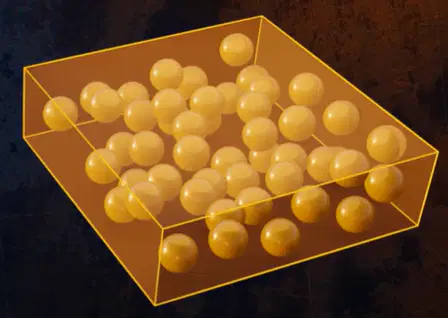
This is an _ material since the atoms are arranged randomly.
(a)
Which property describes a material's ability to return to its original shape after deformation?
Plasticity
Elasticity
Ductility
Brittleness
What is the measure of a material's resistance to deformation under load?
Elastic modulus
Yield strength
Hardness
Toughness
Which material property is characterised by permanent deformation?
Elasticity
Hardness
Plasticity
Ductility
What is the term for the maximum stress a material can withstand without permanent deformation?
Ultimate tensile strength
Yield strength
Hardness
Toughness
In which type of deformation does a material return to its original shape upon the removal of stress?
Plastic deformation
Elastic deformation
Ductile deformation
Brittle deformation
Which property best describes a material's ability to absorb energy and plastically deform without fracturing?
Hardness
Elasticity
Toughness
Brittleness
What is the measure of a material's ability to be stretched into a wire?
Which property indicates a material’s resistance to scratching or indentation?
A. Toughness
B. Elasticity
C. Hardness
D. Plasticity
Which term refers to the point at which a material begins to deform plastically?
A. Ultimate tensile strength
B. Yield point
C. Hardness
D. Toughness
What is the ability of a material to withstand impact without breaking?
A. Elasticity
B. Plasticity
C. Brittleness
D. Toughness
Metals are transparent to light.
False
True
____are composed of long molecular chains.
All are correct
Insulator
Monomer
Polymers
What are ferrous metals primarily composed of?
Copper
Aluminum
Iron
Zinc
What is the ability of a material to withstand impact without breaking?
A. Elasticity
B. Plasticity
C. Brittleness
D. Toughness
Which of the following is NOT a property assessed by non-destructive testing methods?
Cracking
Corrosion of reinforcement
Permeability
Color of concrete
What is the primary purpose of non-destructive testing (NDT)?
To only assess the aesthetic quality of concrete
To replace destructive testing methods
To evaluate concrete properties without causing damage
To damage the material being tested
What is the basic principle of ultrasonic testing?
Generating high frequency ultrasonic energy
Applying pressure to the concrete surface
Using visual inspection techniques
Measuring the temperature of concrete
Which of the following is a method of NDT?
Thermal Testing
Pressure Testing
Chemical Analysis
Dye Penetrant Testing
Which NDT method uses sound waves?
Magnetic Particle Testing
Ultrasonic Testing
Dye Penetrant Testing
Radiography Testing
What is the primary purpose of Dye Penetrant Inspection?
To evaluate mechanical properties
To detect surface-breaking defects
To measure weight
To assess internal structure
Which of the following is a destructive testing method?
Fatigue Testing
Visual Testing
Ultrasonic Testing
Dye Penetrant Testing
What is the main focus of Magnetic Particle Examination?
Ferromagnetic materials
Non-ferrous materials
Gas materials
Liquid materials
In Radiographic Testing (RT), what type of radiation is commonly used?
Gamma rays and X-rays
Ultraviolet rays and Infrared rays
Laser beams and Microwaves
Alpha and Beta particles
What is tensile strength?
The ability of a material to withstand pulling forces
The ability to resist impact
The ability to absorb heat
The ability to expand when heated
What is malleability?
The ability to return to its original shape after stretching
The ability to withstand corrosio
The ability of a material to be hammered or pressed into shape without breaking
The ability to conduct heat
Which of the following is a malleable material?
Copper
Glass
Rubber
Diamond
What is ductility?
The ability of a material to absorb energy when deformed
The ability to conduct electricity
The ability to be drawn into a wire
The ability to reflect light
What is compressive strength?
The ability of a material to return to its original shape
The ability of a material to withstand crushing forces
The ability to be bent into shape
The ability to absorb heat without melting
Which property makes glass an ideal material for windows?
Brittleness
Elasticity
Ductility
Transparency
Which of the following is an important property for a material used in parachutes?
Electrical conductivity
Elasticity
Hardness
Brittleness
The gradual deformation of a material under constant stress over time at elevated temperature is called:
Fatigue
Creep
Toughness
Elasticity
The phenomenon of material failure under repeated cyclic loading is called:
Creep
Fatigue
Brittleness
Ductility

