
 Worksheets
Government LEOC Review
Total questions: 97
Worksheet time: 49mins
What is the Force Theory of government?
The state arose out of a voluntary act of free people
The state was born out of force by one person or a small group
God created the state and chose individuals to rule
The state developed out of the early family
Which theory of government states that the head of the household was the government and this evolved over time?
Force Theory
Evolution Theory
Divine Right Theory
Social Contract Theory
Divine Right Theory claims that God created the state and chose individuals to be given ________ (Kings, Queens, etc).
Royal Birth
Democratic Rights
Military Power
Wealth
According to Social Contract Theory, the state arose out of a voluntary act of free people.
True
False
Who defended absolute powers of kings and believed a powerful state of nature imposes order?
Locke
Rousseau
Hobbes
Montesquieu
Locke believed that life, liberty, and property could never be taken away and that natural rights limited the power of kings.
True
False
Who believed the general will of the people could not be decided by government?
Hobbes
Locke
Rousseau
Montesquieu
According to Montesquieu, what was the main purpose of government?
To maintain law, order, political liberty, and property rights
To give unlimited power to monarchs
To enforce religious doctrine
To allow dictators to rule
Monarchy is ruled by a monarch, usually a king or queen, where the power is inherited.
True
False
Which type of government is based on the idea that there are limits to the rightful power of a government over its citizens and may coexist with other forms of government?
Dictatorship
Constitutional Monarchy
Theocracy
Oligarchy
In a dictatorship, who holds absolute authority and makes all decisions?
Monarch
Dictator or small group
Religious leaders
Wealthy families
Totalitarian governments control all aspects of life, including political, social, and economic aspects.
True
False
In a theocracy, rulers claim to represent and be directed by a set of ________ ideas.
religious
political
economic
scientific
Oligarchy/Aristocracy is a government where a small group of powerful people make most government decisions for their own benefit.
True
False
What is an example of a country with a Direct Democracy?
United States
Ancient Greece (Athens)
Canada
England
Which type of government is described as a government by the people, where citizens elect representatives for set term limits on their behalf?
Direct Democracy
Republic/Representative Democracy
Parliamentary Democracy
Federal System
In a Parliamentary Democracy, who has the primary political power?
Monarch
President
Prime Minister
Governor
In a Unitary system, sovereignty rests in a single, national government. Name one example of a country with a Unitary system.
United Kingdom or Japan
United States
Germany
India
In a Federal System, power is divided between national and regional levels of government. Which of the following is an example of a country with a Federal System?
United Kingdom
US
Japan
England
What is the major flaw of the Articles of Confederation?
Too much power to the president
Inability to tax the states
No written constitution
Too much power to the states
Who wrote the Declaration of Independence?
Thomas Jefferson
Benjamin Franklin
John Adams
George Washington
The Declaration of Independence states that all men are created equal and are endowed with certain unalienable Rights. Which of the following is NOT one of those rights?
Life
Liberty
Property
Pursuit of Happiness
What were the Federalist Papers written to try to gain support for?
The ratification of the Constitution.
The Declaration of Independence.
The Bill of Rights.
The Articles of Confederation.
Federalist Ten is one of the most highly regarded of American political writings. According to Madison, what does it talk about?
Factions and how factions are dangerous to the government.
The importance of a strong executive branch.
The need for a Bill of Rights.
The structure of the judicial system.
Federalist Fifty-One addresses which key concepts?
Separation of powers, checks and balances, and federalism.
Judicial review, popular sovereignty, and direct democracy.
Manifest Destiny, states' rights, and territorial expansion.
Economic policy, taxation, and trade regulations.
Which Article of the US Constitution establishes the Legislative Branch?
Article I
Article II
Article III
Article IV
Which Article of the US Constitution deals with the Amendment Process?
Article II
Article IV
Article V
Article VII
The First Amendment protects which of the following rights?
Freedom of speech
Freedom of the press
Freedom of religion
All of the above
The Fifth Amendment provides for ________, double jeopardy, self-incrimination, and private property.
due process
judicial review
equal protection
freedom of speech
The Sixth Amendment guarantees which of the following?
Abolished slavery
Trial by jury and other rights of the accused
Prohibition of excessive bail
Protection of rights not specifically enumerated
The Seventh Amendment guarantees a ________ trial by jury.
civil
criminal
military
federal
The Eighth Amendment prohibits excessive bail, as well as cruel and unusual ________.
punishment
rewards
taxes
celebrations
The Ninth Amendment protects rights not specifically enumerated in the ________ of Rights.
Bill
Declaration
Charter
Constitution
The Tenth Amendment reserves powers to the ________ and people.
states
president
Congress
Supreme Court
The 11th Amendment more clearly defines the original jurisdiction of the Supreme Court concerning a suit brought against a state by a citizen of another ________.
state
country
city
territory
The 12th Amendment redefines how the President and Vice-President are chosen by the ________ College.
Electoral
Academic
Judicial
Senate
The 13th Amendment abolished ________ in the United States.
slavery
taxation
voting rights
immigration
The 14th Amendment ensured that all citizens of all states had not only rights on the federal level, but on the ________ level, too.
state
county
city
regional
The 15th Amendment ensures that ________ cannot be used as criteria for voting.
race
age
education
property ownership
The 16th Amendment authorizes the United States to collect ________ tax without regard to the population of the states.
income
property
sales
inheritance
The 17th Amendment shifted the choosing of Senators from the state legislatures to the ________ of the states.
people
governors
courts
president
The 18th Amendment abolished the sale or manufacture of ________ in the United States.
alcohol
tobacco
firearms
sugar
The 19th Amendment ensures that ________ cannot be used as criteria for voting.
gender
age
income
education
The 20th Amendment set new start dates for the terms of the Congress and the ________.
President
Vice President
Supreme Court
Speaker of the House
The 21st Amendment repealed the ________ Amendment (prohibition).
18th
19th
20th
22nd
The 22nd Amendment sets a limit on the number of times a President could be elected. What is the limit?
One four-year term
Two four-year terms
Three four-year terms
No limit
The 23rd Amendment grants the District of Columbia the right to three electors in ________ elections.
Presidential
Congressional
Senate
Gubernatorial
The 24th Amendment ensured that no ______ could be charged to vote for any federal office.
tax
fee
permit
fine
The 25th Amendment clarifies the line of ______ to the Presidency.
succession
impeachment
election
appointment
The 26th Amendment guarantees that any person ___ or over may vote.
18
21
16
25
The 27th Amendment requires that any law that increased the pay of legislators may not take effect until after an ______.
election
amendment
session
debate
What is the minimum age required to be a member of the House of Representatives?
21 years old
25 years old
30 years old
35 years old
How long is the term for a member of the House of Representatives?
2 years
4 years
6 years
10 years
What is the minimum age required to be a Senator?
25 years old
30 years old
35 years old
40 years old
How long is the term for a Senator?
2 years
4 years
6 years
10 years
What is the minimum age required to be President of the United States?
25 years old
30 years old
35 years old
40 years old
How long is the term for the President of the United States?
2 years
4 years
6 years
2 four-year terms or 10 years
What are the formal qualifications for the Judicial Branch? The Judicial Branch has ______ formal qualifications and members are seated for life unless removed.
no
many
strict
age
What is the definition of Federalism?
A system where power is divided between a national government and more local governments
A system where only the national government has power
A system where only state governments have power
A system with no government
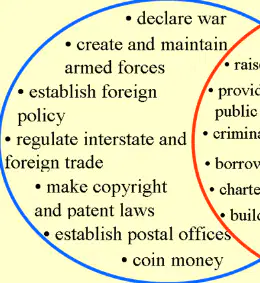
According to the Venn diagram, which of the following is a power delegated to the National Government?
Establish local governments
Declare war
Build roads
Conduct elections
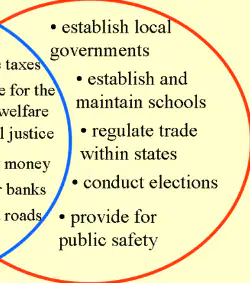
According to the Venn diagram, which of the following is a power reserved to the States?
Coin money
Establish foreign policy
Establish and maintain schools
Make copyright and patent laws
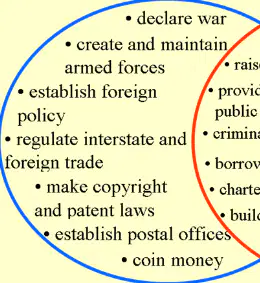
The power to regulate interstate and foreign trade is delegated to the __________ government.
national
state
local
provincial
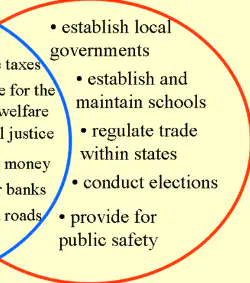
The power to conduct elections is reserved to the __________.
states
federal government
Supreme Court
President
What is the first step in how a bill becomes a law?
Bill is Drafted: Members of Congress, the Executive Branch, and even outside groups can draft (write or draw up) bills.
Bill is Voted on by the Senate.
Bill is Signed by the President.
Bill is Debated on the House Floor.
In which step is a bill introduced in the House of Representatives?
Introduced in House
Sent to Senate
Committee Review
Floor Debate
What happens if the House rejects any of the changes made by the Senate to a bill?
The bill goes to a conference committee of members from both houses to work out a compromise.
The bill is automatically passed without changes.
The bill is sent back to the President for approval.
The bill is discarded and cannot be reconsidered.
Both houses must approve changes made by the conference committee before a bill goes to the president.
True
False
A senator who wants to delay action on a bill or kill it altogether may delay the vote by speaking continuously. This is called a _________
filibuster
cloture
amendment
veto
A vote that cuts off a filibuster is called ________.
cloture
caucus
quorum
veto
Amendments attached to a bill that have nothing to do with the bill are called ________.
rider
clause
motion
veto
Paid professionals that try to influence legislation are called ________.
lobbyists
activists
journalists
legislators
A ________ vote is needed to pass certain bills (2/3 vote).
needed to pass
simple majority
unanimous
plurality
When a president doesn’t sign an approved bill in 10 days and Congress adjourns, it is called a ________.
pocket veto
line-item veto
filibuster
override
A body of people representing the states of the US, who formally cast votes for the election of the president and vice president is called the ________.
Electoral College
Senate
Supreme Court
Cabinet
The number of Electoral Votes for Florida was ___ in 2012 and ___ in 2016.
27 in 2012 and 29 in 2016
29 in 2012 and 27 in 2016
28 in 2012 and 28 in 2016
26 in 2012 and 28 in 2016
States where support for each candidate may be equal are called ________.
Swing States
Safe States
Red States
Blue States
Organizations or other groups created to raise and donate money to candidates and political parties are called ________.
PAC (Political Action Party)
Lobbyists
Superdelegates
Grassroots Committees
A preliminary election to appoint delegates to a party conference or to select the candidates for a principal, especially presidential, election is called a ________.
Primary Election
General Election
Runoff Election
Midterm Election
An election that does not require voters to be affiliated with a political party in order to vote for partisan candidates is called an ________.
Open Primary
Closed Primary
General Election
Runoff Election

Based on the diagram, which court is at the top of the U.S. court system?
U.S. Federal District Courts
U.S. Supreme Court
State Appeals Court
Court of Claims
What was the significance of the Supreme Court case Marbury v. Madison?
It established the power of judicial review for the Supreme Court.
It ended segregation in public schools.
It protected the right to remain silent.
It declared school dress codes unconstitutional.
McCulloch v. Maryland, 1819: What phrase did Chief Justice Marshall invoke to establish the right of Congress to pass laws to conduct the business of the U.S. government?
"Supremacy Clause"
"Necessary and proper"
"Clear and present danger"
"Separate but equal"
When a federal and state law are in conflict, which law is supreme according to Gibbons v. Ogden?
State law
Federal law
Local law
International law
According to the Supreme Court in Dred Scott v. Sandford, are slaves considered U.S. citizens?
Yes
No
What doctrine was established by the Supreme Court in Plessy v. Ferguson?
Judicial review
Separate but equal
Supremacy clause
Clear and present danger
According to Schenck v. United States, speech that presents a 'clear and present danger' is:
Protected by the First Amendment
Not protected by the First Amendment
What was the impact of the Supreme Court's decision in Brown v. Board of Education?
It upheld segregation in public schools.
It ended the doctrine of 'separate but equal' in public education.
It established the right to remain silent.
It protected symbolic speech.
Mapp v. Ohio, 1961: What type of evidence may not be used against a defendant in court according to Mapp v. Ohio?
Evidence obtained legally
Evidence obtained illegally
Hearsay evidence
Circumstantial evidence
What right did the Supreme Court affirm for defendants in criminal cases in Gideon v. Wainwright?
The right to a speedy trial
The right to a lawyer
The right to remain silent
The right to appeal
What must police inform suspects of according to Miranda v. Arizona?
The right to a lawyer
The right to remain silent
The right to a fair trial
The right to bail
According to Tinker v. Des Moines, are school dress codes that prohibit armbands in violation of the First Amendment's guarantee of freedom of expression?
Yes
No
What right did the Supreme Court recognize in Roe v. Wade?
The right to free speech
The right to privacy in matters of abortion
The right to a lawyer
The right to remain silent
What did the Supreme Court rule regarding Presidential immunity in United States v. Nixon?
The President has absolute immunity from judicial process.
The President cannot sustain unqualified immunity from judicial process.
The President can ignore Supreme Court rulings.
The President can pardon anyone for any reason.
What did the Supreme Court rule in Texas v. Johnson regarding flag desecration?
It is not protected as free speech.
It is protected as symbolic speech.
It is illegal under all circumstances.
It is only allowed for protest.
What question did the Supreme Court answer in District of Columbia v. Heller?
Whether the right to 'keep and bear arms' is an individual right
Whether the right to privacy applies to abortion
Whether school dress codes are constitutional
Whether evidence obtained illegally can be used in court
What is the term for these rights?
Civil Right
Political Right
Economic Right
Social Right
What are basic freedoms to think and act that all people have and that are protected against government abuse?
Civil Liberties
Economic Rights
Political Parties
Government Powers

