
 Worksheets
Early Transmission Systems Quiz
Total questions: 99
Worksheet time: 50mins
Which year is associated with the FWD carriage designed by Seldon?
1877
1887
1901
1920
What type of engine did the FWD carriage have?
One-cylinder engine
Two-cylinder engine
Electric engine
Steam engine
What was the purpose of the belt-driven high gear in the FWD carriage?
For speed
For torque
For braking
For steering
What was the function of the belt-driven low gear in the FWD carriage?
For torque
For speed
For fuel efficiency
For cooling
Explain the significance of having both a belt-driven high gear and a belt-driven low gear in the FWD carriage.
It allowed the vehicle to switch between speed and torque depending on driving conditions.
It made the vehicle heavier.
It reduced the need for a transmission.
It increased fuel consumption.
Strategically analyze how the transmission system in the 1877 FWD carriage might have influenced the development of modern manual transmissions.
It introduced the concept of selectable gears for different driving needs, which is fundamental in modern manual transmissions.
It eliminated the need for gears in vehicles.
It made vehicles slower and less efficient.
It was only used in electric vehicles.
Which company is associated with the development of the FWD multi-gear manual transmission in 1895?
Ford
Panhard and Levassor
Mercedes-Benz
General Motors
What type of transmission did Panhard and Levassor use in their 1895 vehicle?
Automatic transmission
Clutch-driven, three-speed, sliding-gear transmission
Continuously variable transmission
Dual-clutch transmission
In which year did Panhard and Levassor have a failed design for a multi-gear manual transmission?
1895
1900
1894
1889
Explain the significance of a clutch-driven, three-speed, sliding-gear transmission in the context of early automotive engineering.
It allowed for automatic gear changes without driver input.
It provided manual control over gear selection, improving vehicle performance and efficiency.
It was only used in electric vehicles.
It eliminated the need for a transmission entirely.
Which type of vehicles were common before 1898?
Belt- or chain-driven vehicles
Electric vehicles
Hydraulic vehicles
Steam-powered vehicles
What was a major safety concern with belt- or chain-driven vehicles?
Dangerous at close proximity
High fuel consumption
Slow speed
Difficult steering
Which company introduced the live rear axle in 1898?
Ford
Renault
Toyota
Chevrolet
What is the function of a differential-type rear axle in vehicles?
It increases engine power
It allows each wheel to turn at its own speed
It reduces fuel consumption
It improves braking efficiency
Explain why the introduction of the differential-type rear axle was significant for vehicle performance.
It allowed each wheel to turn at its own speed, improving handling and safety.
It made vehicles faster by increasing engine power.
It reduced the need for frequent maintenance.
It eliminated the need for transmissions.
Which device is used in manual transmissions to match the speeds of the gear and shaft?
Gear synchronizer
Clutch pedal
Flywheel
Transmission fluid
What is the main function of a gear synchronizer in a manual transmission?
To apply a friction device between gear and shaft to match speeds
To increase engine power
To lubricate the gears
To cool the transmission
How does a gear synchronizer help in gear selection?
It allows gear selection without gear grinding
It increases the speed of the vehicle
It reduces fuel consumption
It changes the direction of rotation
Explain why gear synchronizers are important for manual transmissions. Use reasoning and evidence from your understanding of transmission fundamentals.
They prevent gear grinding and ensure smooth gear changes by matching gear and shaft speeds.
They increase the horsepower of the engine.
They reduce the size of the transmission.
They eliminate the need for a clutch pedal.
Which car manufacturer introduced the synchromesh transmission in 1928?
Cadillac
Porsche
Warner
Ford
In 1952, which innovation did Porsche introduce to synchromesh transmissions?
Moly-coated steel rings
Radial springs
Blocker rings
Splined hub
Who introduced the modern cone-style synchronizer in the 1960s?
Warner
Cadillac
Porsche
Ford
Which component in a cone-style synchronizer is responsible for engaging the gears?
Engagement sleeve
Blocker rings
Radial springs
Metal inserts
Which of the following best defines "mechanical advantage" in the context of manual transmission fundamentals?
The ability to decrease input force
The increase of input force
The reduction of output force
The elimination of distance moved
What is the correct formula for calculating work in the context of mechanical advantage?
Work = force ÷ distance
Work = force + distance
Work = force × distance
Work = force - distance
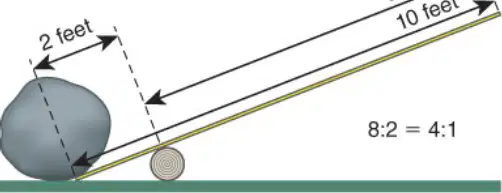
Which statement describes how mechanical advantage can be achieved using a lever?
By increasing the distance moved for less output force
By trading distance moved for greater output force
By reducing both force and distance
By keeping force and distance constant
A lever is used to move a rock with a pivot point 2 feet from the end nearest the rock and 8 feet from the end where force is applied. What is the mechanical advantage?
2:8 = 1:4
8:2 = 4:1
10:2 = 5:1
2:10 = 1:5
Which of the following is a function of a gear set in a manual transmission?
Provides mechanical advantage
Increases fuel efficiency
Controls engine temperature
Regulates tire pressure
What does a low gear in a manual transmission typically do?
The smallest gear turns the largest, resulting in gear reduction
The largest gear turns the smallest, increasing speed
All gears turn at the same rate
The smallest gear turns the smallest, maximizing speed
Why does a driver select different gears in a manual transmission?
To match the best gear for driving conditions
To change the color of the dashboard lights
To adjust the air conditioning
To increase the radio volume
Which term describes the difference in speed between gears in a manual transmission?
Speed differential
Torque ratio
Fuel ratio
Pressure gradient
Explain how gear reduction works in a manual transmission and why it is important for vehicle operation.
Gear reduction allows the smallest gear to turn the largest, providing more torque and control at low speeds, which is important for starting and climbing.
Gear reduction increases the speed of the vehicle, making it suitable for highway driving.
Gear reduction decreases the engine temperature, preventing overheating.
Gear reduction changes the direction of the vehicle, allowing for reverse movement.
What is a gear ratio found by?
Comparing the number of teeth of each gear
Measuring the diameter of each gear
Calculating the speed of each gear
Weighing each gear
If two gears have the same number of teeth, what is their gear ratio?
2:1
3:1
1:1
4:1
What mechanical advantage does a 1:1 gear ratio provide?
Increased torque
No mechanical advantage
Increased speed
Reduced friction
If the input gear has half as many teeth as the output gear, what is the gear ratio?
1:1
2:1
3:1
4:1
What happens when the drive gear (input) has fewer teeth than the driven gear (output)?
There is a mechanical advantage
There is no mechanical advantage
The gears rotate at the same speed
The output gear rotates faster than the input gear
A drive gear with 10 teeth and a driven gear with 30 teeth creates what gear ratio?
1:1
2:1
3:1
4:1
What is the formula for calculating gear ratio in a manual transmission?
Drive/Driven
Driven/Drive
Input/Output
Output/Input
In an overdrive situation, which gear is larger?
Driven gear
Output gear
Drive gear
Input gear
What happens to output speed as the gear ratio decreases?
Output speed decreases
Output speed remains the same
Output speed increases
Output speed fluctuates
Which gear should be selected for low vehicle speed?
Higher gear (low gear ratio)
Lower gear (high gear ratio)
Overdrive gear
Neutral gear
Explain why the output gear turns faster than the input gear in an overdrive configuration. Use reasoning based on gear sizes and transmission fundamentals.
Because the driven gear is larger than the drive gear, causing slower output
Because the drive gear is larger than the driven gear, causing faster output
Because both gears are the same size, resulting in equal speeds
Because the input gear is always faster than the output gear
Which of the following best describes the ultimate task of a manual transmission?
To multiply torque and increase speed depending on gear selection
To reduce engine noise
To control the vehicle's braking system
To manage fuel efficiency
What happens when a vehicle is in low gear (high ratio) in a manual transmission?
Torque is multiplied as the vehicle starts
Speed is increased as the vehicle moves
Fuel consumption is reduced
Braking power is enhanced
When a manual transmission is in high gear (low ratio), what is the primary effect?
Increases speeds as the vehicle moves
Multiplies torque as the vehicle starts
Reduces engine temperature
Enhances tire grip
Explain why a manual transmission uses a high ratio (low gear) when a vehicle starts moving.
To multiply torque and help the vehicle overcome initial resistance
To increase speed immediately
To reduce fuel consumption
To improve braking efficiency
A driver shifts from low gear to high gear as the vehicle accelerates. What reasoning supports this action in terms of transmission fundamentals?
High gear (low ratio) increases speed, which is necessary as the vehicle moves faster
Low gear (high ratio) is needed for high speeds
High gear (low ratio) multiplies torque for starting
Low gear (high ratio) increases speed as the vehicle moves
Which component is the main power source in a manual transmission system?
Flywheel
Clutch assembly
Engine
Output shaft
What is the correct order of power flow in a manual transmission drivetrain?
Crankshaft, Flywheel, Clutch assembly, Output shaft, Axles/wheels
Flywheel, Crankshaft, Clutch assembly, Output shaft, Axles/wheels
Clutch assembly, Crankshaft, Flywheel, Output shaft, Axles/wheels
Output shaft, Flywheel, Crankshaft, Clutch assembly, Axles/wheels
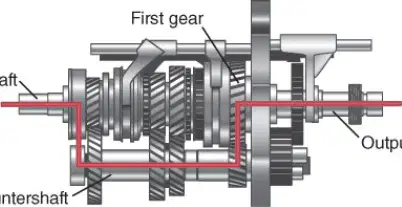
Why is it important for power to flow through the entire drivetrain in a vehicle?
To ensure the engine remains cool
To transmit motion from the engine to the wheels
To reduce fuel consumption
To increase the size of the transmission
If the clutch assembly fails in a manual transmission, which part of the power flow is interrupted?
Between the crankshaft and flywheel
Between the flywheel and output shaft
Between the output shaft and axles/wheels
Between the axles/wheels and engine
Which component transmits power when released (in the up position) in a manual transmission system?
Clutch pedal
Gear on input shaft
Countershaft
Flywheel
What is the function of the gear on the input shaft in a manual transmission?
Transfers power to meshed gear on countershaft
Stops the engine
Controls the speed of the vehicle
Engages the clutch pedal
If the clutch pedal is not released (not in the up position), what happens to the transmission of power in a manual transmission system?
Power is not transmitted
Power is increased
Power is transferred to the countershaft
Power is transmitted to the wheels directly
Explain how the gear on the input shaft contributes to the operation of a manual transmission system.
It transfers power to the meshed gear on the countershaft, enabling the transmission to function.
It stops the engine from running.
It controls the clutch pedal movement.
It increases the speed of the vehicle directly.
A vehicle is not moving even though the engine is running and the clutch pedal is pressed down. Using your understanding of manual transmission fundamentals, what could be the reason?
The clutch pedal is disengaged, so power is not being transmitted to the transmission.
The gear on the input shaft is broken.
The countershaft is not connected to the wheels.
The flywheel is spinning too fast.
Which pedal in a manual transmission vehicle is located on the far right and controls power output?
Accelerator pedal
Brake pedal
Clutch pedal
Parking brake pedal
What is the primary function of the brake pedal in a manual transmission vehicle?
Controls power output
Stops/slows vehicle
Operates clutch system
Changes gears
Where is the clutch pedal located among the floor pedals in a manual transmission vehicle?
Far right
Center
Far left
Next to the accelerator
If a driver wants to operate the clutch system in a manual transmission vehicle, which pedal should they use?
Accelerator pedal
Brake pedal
Clutch pedal
Parking brake pedal
Explain how the arrangement of the floor pedals in a manual transmission vehicle supports safe and efficient driving.
The pedals are randomly placed for convenience.
The accelerator is in the center for easy access.
The clutch is on the far left, brake in the center, and accelerator on the far right, allowing the driver to use both feet efficiently and control power, speed, and gear changes safely.
All pedals perform the same function.
What happens when you push down the clutch pedal in a manual transmission vehicle?
It disconnects clutch components
It accelerates the vehicle
It engages the brakes
It turns off the engine
Which of the following is a function of the clutch pedal in a manual transmission vehicle?
Selecting forward or reverse gear
Increasing fuel efficiency
Activating windshield wipers
Controlling air conditioning
In manual transmission layouts, where does the transmission send power?
To the final drive assembly
To the headlights
To the steering wheel
To the exhaust system
Which type of vehicles commonly use manual transmission layouts described in the material?
RWD vehicles
Electric vehicles
AWD vehicles
Hybrid vehicles
Explain why the clutch pedal must be pushed down before changing gears in a manual transmission vehicle.
To disconnect clutch components and allow gear selection without damaging the transmission
To increase the speed of the vehicle
To activate the headlights
To engage the parking brake
Which of the following best describes a transaxle in a vehicle's drivetrain?
A layout where transmission and final drive are integrated into a common assembly
A layout where transmission and engine are separated
A layout used only in rear-wheel drive vehicles
A layout where transmission is not connected to the final drive
Transaxles are most commonly found in which type of vehicles?
FWD vehicles
AWD vehicles
RWD vehicles
Hybrid vehicles
Explain why a transaxle layout is advantageous for front-wheel drive (FWD) vehicles.
It allows for a more compact drivetrain assembly, which is ideal for FWD vehicles.
It increases the weight of the vehicle.
It separates the transmission and final drive, making maintenance easier.
It is only used in sports cars.
What is the primary function of depressing the clutch pedal in a manual transmission vehicle?
It increases the engine speed
It closes contacts of the clutch safety switch
It engages the brakes
It shifts the transmission to neutral
Which gear in a manual transmission provides the best pulling power?
Second gear
Third gear
First gear
Fifth gear
After the starter motor cranks the engine over and the vehicle is in gear, what should the driver do next?
Depress the clutch pedal again
Release the pedal and step on the gas
Turn off the engine
Shift to reverse
Why is first gear considered the lowest gear in a manual transmission?
It allows the vehicle to move at high speed
It provides the least pulling power
It is used for starting and provides the best pulling power
It is only used for reversing
Which of the following is the correct sequence for changing gears in a manual transmission vehicle?
Release pedal, push clutch pedal, move gearshift lever
Push clutch pedal, move gearshift lever to next gear position, release pedal
Move gearshift lever, push clutch pedal, release pedal
Push clutch pedal, release pedal, move gearshift lever
What is one advantage of having different gear ratios in a manual transmission?
Reduces engine noise
Allows for a variety of speeds
Increases fuel consumption
Limits acceleration from a stop
Why is it beneficial to travel without over-revving the engine in a manual transmission vehicle?
It increases engine wear
It improves fuel efficiency and engine longevity
It decreases acceleration
It reduces gear ratio options
How does a manual transmission help a vehicle accelerate from a stop?
By using a single fixed gear ratio
By allowing the driver to select a lower gear ratio
By automatically shifting gears
By disengaging the clutch permanently
Which of the following is a primary function of shafts in a manual transmission drivetrain?
To accommodate bearings and individual gears
To generate electrical signals
To store fuel
To cool the engine
What is the purpose of having a smooth surface on transmission shafts?
To reduce metal-to-metal friction and overheating
To increase the weight of the shaft
To make the shaft more flexible
To improve electrical conductivity
Why do bearings and gears rotate on a thin film of oil in manual transmission shafts?
To prevent overheating and reduce friction
To increase the speed of rotation
To make the shaft magnetic
To allow for electrical insulation
What is the function of splined surfaces on transmission shafts?
To allow parallel grooves to mate with component matching grooves
To increase the shaft diameter
To provide a surface for painting
To make the shaft hollow
Explain how the design of a shaft in a manual transmission helps in reducing friction and overheating.
By providing a smooth surface and allowing rotation on a thin film of oil
By increasing the shaft length
By adding more gears to the shaft
By making the shaft out of plastic
A transmission shaft is not properly machined and lacks a smooth surface. What potential problems could arise in the drivetrain operation?
Increased friction and overheating, leading to possible failure of bearings and gears
Improved fuel efficiency
Enhanced electrical conductivity
Reduced need for lubrication
Which of the following best describes the function of shoulders on shafts in a manual transmission drivetrain?
They are raised areas that provide firm support for gears and bearings to butt against.
They are grooves cut to accommodate snap rings.
They are flat surfaces for mounting the transmission.
They are holes drilled for lubrication.
What is the purpose of shaft grooves in a manual transmission drivetrain?
To accommodate snap rings.
To increase the strength of the shaft.
To reduce friction between gears.
To provide a surface for painting.
Explain why shoulders are important for the operation of gears and bearings in a manual transmission drivetrain.
They prevent gears and bearings from moving out of position by providing firm support.
They allow for easier removal of gears and bearings.
They reduce the weight of the transmission.
They increase the speed of gear rotation.
Which material is commonly used to make friction bearings (bushings) in manual transmission shaft ends?
Steel
Brass/Bronze
Aluminum
Plastic
What is the primary function of bearings in manual transmission shaft ends?
To increase friction between gears
To center and hold shafts in alignment
To lubricate the gears
To connect the transmission to the engine
Why are machined surfaces important at the ends of transmission shafts?
They reduce the weight of the shaft
They hold bearings in place
They increase the speed of rotation
They prevent gear rotation
Explain how friction bearings (bushings) made of brass/bronze contribute to the operation of a manual transmission.
They provide sliding metal-to-metal contact, allowing smooth movement and reducing wear.
They increase the friction between gears, causing faster rotation.
They act as insulators to prevent heat transfer.
They hold the transmission fluid in place.
A technician notices rough gear rotation in a manual transmission. Based on your understanding of shaft ends and bearings, what could be a possible cause?
Bearings are not properly holding the shafts in alignment.
The transmission fluid is too clean.
The gears are made of plastic.
The clutch is too tight.
Which of the following best describes gears used in manual transmission drivetrains?
Flat parts with teeth on the inside
Round parts with teeth cut on the outside perimeter
Square parts with smooth edges
Cylindrical parts with no teeth
What is the purpose of cutting gear sets on the same angle in a manual transmission?
To reduce the weight of the gears
For precise contact between gears
To make the gears more colorful
To increase the number of teeth
Which of the following are types of gear teeth found in manual transmission drivetrains?
Spiral and bevel
Spur and helical
Flat and round
Toothed and smooth
Explain why gears in a manual transmission are cut on the same angle. Use reasoning to support your answer.
To ensure precise contact and efficient power transfer between gears
To make the gears easier to manufacture
To reduce the cost of production
To allow for random gear engagement
Which type of gear has straight teeth that are parallel to the shaft?
Helical gears
Bevel gears
Worm gears
Spur gears
What is a characteristic of spur gears during operation?
Operate quietly
Noisy during operation
Low stress on bearings
Used in passenger vehicles
Which type of gear is commonly used in heavy-duty vehicles?
Helical gears
Bevel gears
Spur gears
Worm gears

