
 Worksheets
Personal Career Final Review
Total questions: 82
Worksheet time: 50mins
Which note-taking style is best for a lecture with a clear structure and sequence?
Cornell Notes
Four-Quadrant Method
Mind Mapping
Linear Notes
Which is a drawback of Linear Notes?
Not suitable for lectures
Hard to write quickly
Difficult to see relationships between ideas
Requires too much color and drawing
What is the main benefit of Mind Mapping?
Builds a table of contents automatically
Best for chronological details
Encourages creativity and helps memory
Allows easy citation tracking
The Four-Quadrant Method typically includes which sections?
Vocabulary, Quotes, Title, Date
Notes, Summary, Quotes, Questions
Notes, Questions, Vocabulary, Summary
Notes, References, Title, Summary
Cornell Notes divide the page into:
Left: Notes, Right: Cues, Top: Summary
Four boxes with time blocks
Right: Notes, Left: Cues/Questions, Bottom: Summary
Three equal columns
A student needs to brainstorm ideas for a project and show connections between themes. Which method is most appropriate?
Four-Quadrant Method
Linear Notes
Mind Mapping
Cornell Notes
A benefit of Cornell Notes is:
Helps self-testing and recall
Designed only for science courses
Requires no setup time
Best for artistic learners only
When reviewing with the Four-Quadrant Method using 15-minute intervals, the main purpose is to:
Replace all other note systems
Avoid asking questions
Focus on quick, structured review sessions
Take linear notes faster
Which method is most time-consuming to create but offers strong visual representation?
Four-Quadrant Method
Linear Notes
Cornell Notes
Mind Mapping
The Curve of Forgetting shows that without review, after 1 day we typically forget about:
10%
25%
50%
75%
What action most effectively combats forgetting according to the curve?
Rewriting notes once a month
Reviewing within 24 hours, then weekly
Cramming the night before an exam
Reading the textbook only once
The main concept of the Curve of Forgetting is that memory:
Only changes with visual materials
Is constant across all people
Decays rapidly without review
Improves without practice
A practical strategy after class to improve retention is:
Focus only on new content
Skip questions and summaries
Avoid looking at notes until the test
Schedule short review sessions
If a student reviews right after class and again one week later, their retention will:
Decline rapidly
Improve
Depend entirely on test difficulty
Stay the same as no review
The Curve of Forgetting is best described as:
A time management tool
A psychological concept about memory decay
A writing method
A grading rubric
Which schedule best applies spacing to slow memory decay?
Single long session before exams
Brief sessions within 24 hours and weekly
Unplanned reading when time allows
Monthly marathon study sessions
Choosing to Enlist offers benefits such as:
GI Bill education benefits and training
Immediate master’s degree access
No long-term commitments
Flexible class schedules only
A student wants to earn money and build workplace experience right away. Which path fits best?
Employed
Enlist
Enrolled
Explore
A student wants specialized knowledge and higher earning potential. Which path?
Enlist
Enrolled
Explore
Employed
Which is a potential drawback of entering the workforce immediately?
Time commitment is too flexible
May limit opportunities without further education
No chance to learn new skills
Requires a PhD
A student considering a gap year likely values:
Immediate salary
Travel, volunteering, and personal growth
Military discipline
Corporate experience only
Which path explicitly includes CTE programs?
Employed
Enlisted
Enrolled
Explore
A student says they want to save money for college and support their family now. Which path matches the rationale?
Enlisted
Enrolled
Explore
Employed
A student wants structured training, discipline, and future education benefits. Which path?
Explore
Enrolled
Employed
Enlisted
In the CRAVEN method, the letter C most closely stands for which idea?
Citation style used by the author
Content creation and storytelling tips
Credentials list at the end page
Criteria of credibility used for sources
Which example best shows strong Criteria of Credibility for an article?
Viral post repeating unverified rumors
Short infographic with catchy slogans only
Personal blog with opinions and no links
Peer‑reviewed study with methods and data
Reputation in CRAVEN asks you to consider whether the author or organization is:
Charging money for full access
Using images and colorful charts
Posting frequently on social media
Respected within the relevant field
Which question aligns with the transparency check in CRAVEN?
Is the headline short and memorable?
Can the references and data be verified?
Does the site have many pop‑up windows?
Is the article entertaining and funny enough?
Vested Interest helps you detect which potential problem in a source?
Financial or bias motives distorting facts
Outdated website code and slow loading
Complex vocabulary that confuses readers
Typos that reduce reading comprehension
Which source most likely shows low vested interest?
Company blog promoting its own product line
Influencer review with affiliate purchase links
Sponsored article labeled as paid partnership
Nonprofit educational site with no sales pitch
Expertise in CRAVEN is primarily about evaluating:
Age of the article’s web domain
Author’s qualifications and credentials
Number of photos included in text
Reading level measured by word count
Which example best illustrates Neutrality in reporting?
Fact‑focused news report from a wire service
Political blog pushing one perspective only
Satirical video with jokes about events
Fan page praising a favorite public figure
Which item is NOT one of the CRAVEN elements?
Expertise
Neutrality
Reputation
References
Which pair best matches a CRAVEN evaluation outcome?
Journal article with data → strong criteria
Sponsored content → no vested interest
Blog with no sources → high credibility
Satire site with jokes → neutral reporting
MLA recommended font and size:
Calibri, 12 pt
Times New Roman, 12 pt
Arial, 11 pt
Garamond, 10 pt
MLA spacing throughout, including Works Cited:
Variable
Double
1.5
Single
MLA margins:
0.75 inch all around
1 inch on all sides
0.5 inch top and bottom only
1.25 inch left only
MLA header location:
Top right: First name + date
Bottom center
Top right: Last name + page number
Top left, first page only
MLA title formatting:
Left-aligned, italicized
Underlined and centered
Centered, no bold/underline/italics
Bold and centered
First line indentation in MLA:
No indent
¼ inch
1 inch
½ inch
MLA top-left heading order:
Date, Student Name, Teacher Name, Class Name
Class Name, Date, Student Name, Teacher Name
Teacher Name, Student Name, Date, Class Name
Student Name, Teacher Name, Class Name, Date
In-text citation with one author:
(John 45)
(Smith 45)
(45 Smith)
(Smith, 45)
In-text citation with two authors:
(Smith, Jones 78)
(Smith and Jones 78)
(Smith & Jones 78)
(Smith/Jones 78)
In-text citation for three or more authors:
(Smith and others 102)
(Smith et al. 102)
(Smith, Jones, Lee 102)
(Smith et. al 102)
No author—use the title:
(“Benefits of Education” 12)
(Education Benefits 12)
(Benefits of Education)
(Benefits 12)
Corporate author in-text citation:
(APA 34)
(A.P.A. 34)
(American Psychological Association 34)
(American Psychological Assoc. 34)
Direct quote formatting requires:
Italics only
All caps + date
Quotation marks + author and page number
Bold + title of source
Paraphrasing requires:
Italics and a page number only
No citation if in your own words
Citation of the original source
A footnote instead of in-text citation
Works Cited page title:
Bibliography
Works Cited
Citations
References
Works Cited order:
Alphabetical by author's last name
Alphabetical by title only
By page number
By date
Hanging indent means:
Second and subsequent lines indented ½ inch
No indentation anywhere
First line indented further than the rest
Title is indented
Book entry example follows which rule?
Author, Title (italicized), Publisher, Year
Author, Address, Publisher, Year
Author, Journal Name, Year
Author, Title (quotation marks), Publisher, Year
Time management primarily helps students:
Increase social media time
Reduce stress, improve productivity, and balance life
Avoid planning altogether
Study only the day before
A core principle of time management is to:
Multitask constantly
Prioritize tasks by importance and urgency
Work without breaks
Always pick the easiest task
Which tool is helpful for time management?
Only mental notes
Ignoring deadlines
Random scrolling
Planners and calendars
A common mistake in time management is:
Reviewing regularly
Scheduling study blocks
Focusing on urgent but unimportant tasks
Breaking projects into smaller steps
For a two-week research paper, the best approach is to:
Wait until the last night
Start multiple projects simultaneously
Schedule milestones and work consistently
Ignore the rubric
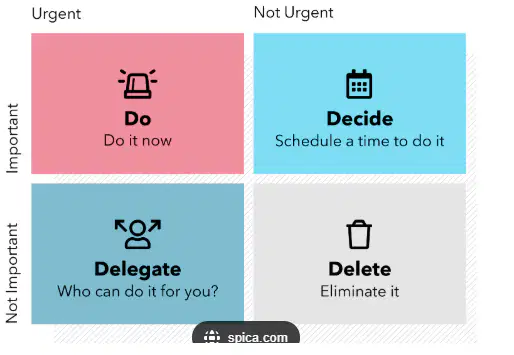
A task that is Urgent & Important should be:
Deleted
Delegated
Done first
Scheduled next month
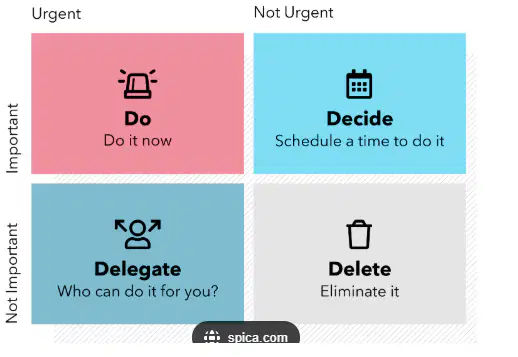
Studying for a test tomorrow is:
Neither
Urgent & Important
Urgent, Not Important
Important, Not Urgent
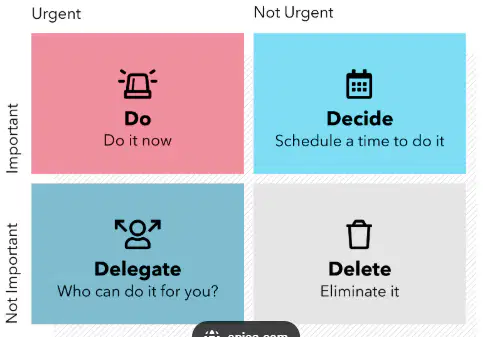
Answering non-essential emails during study time is:
Urgent & Important
Important, Not Urgent
Urgent, Not Important
Neither
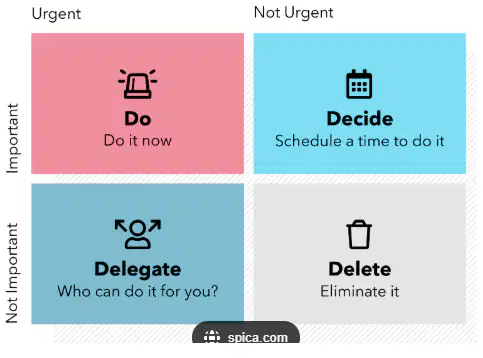
Scrolling social media for hours is:
Urgent & Important
Urgent, Not Important
Neither Urgent nor Important
Important, Not Urgent
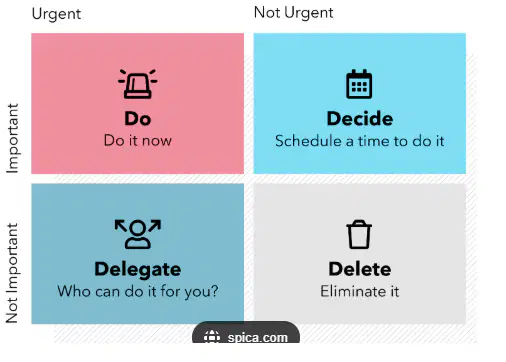
A research paper due in two weeks belongs in:
Important, Not Urgent
Urgent & Important
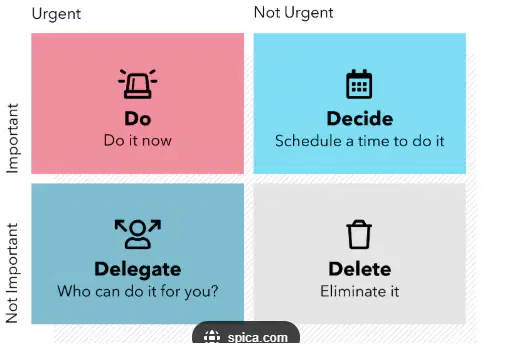
When using the Eisenhower Matrix, tasks that are Important but Not Urgent should usually be:
Done only if time remains
Delegated immediately
Scheduled and planned
Ignored entirely
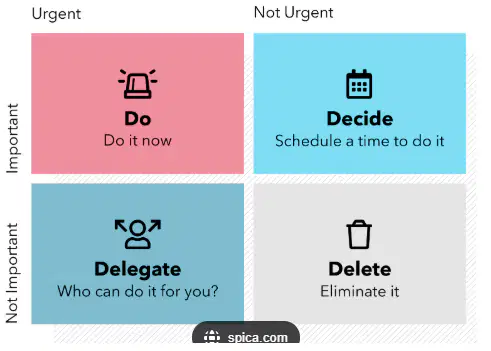
Career planning and skill development should be:
Delegated
Deleted
Scheduled (Important, Not Urgent)
Done only if urgent

Which Level requires you to think critically, use multiple resources, and draw your own conclusion?
Level 1
Level 2
Level 3
Level 4

When asked to create questions, which level should you NOT waste your time on?
Level 1
Level 2
Level 3
Level 4

Which is not an example of a level 1 question?
Who is Lennie Small?
How does Lennie Small compare to George Milton?
What city did George and Lennie run away from?
When does the novel take place?
There are _____ levels in Costa's Levels of Thinking
2
1
3
4
Imagine what would happen if dinosaurs didn't go extinct.
Level 3
Level 2
Level 1
Compare and contrast a simile to a metaphor.
Level 1
Level 2
Level 3
Level 4
Recall from memory.
Level 1
Level 2
Level 3
Compare and contrast a simile to a metaphor.
Level 1
Level 2
Level 3
Level 4


