
 Worksheets
Basic Process Controls
Total questions: 10
Worksheet time: 11mins
What is the primary purpose of process control in industry?
To eliminate the need for sensors
To maintain process variables at desired values
To increase raw material consumption
To reduce operator involvement completely
Feedforward control acts by:
Predicting and compensating for disturbances
Reducing sensor accuracy
Correcting errors after they occur
Eliminating the need for feedback
Override control is mainly used to:
Increase production speed
Eliminate feedback loops
Reduce the number of sensors
Protect equipment from unsafe conditions
Split-range control is applied when
The process has no disturbances
One controller output drives multiple actuators
Multiple sensors measure one variable
Two controllers share one actuator
Adaptive control differs from conventional control because it:
Uses fixed parameters
Eliminates sensors
Requires no feedback
Adjusts parameters automatically based on process changes
In a cascade control system, how do the response speeds of the master and secondary controllers typically compare?
Both controllers respond at the same speed
The master controller responds faster than the secondary controller
The master controller responds slower, while the secondary controller responds faster
The secondary controller does not respond to disturbances
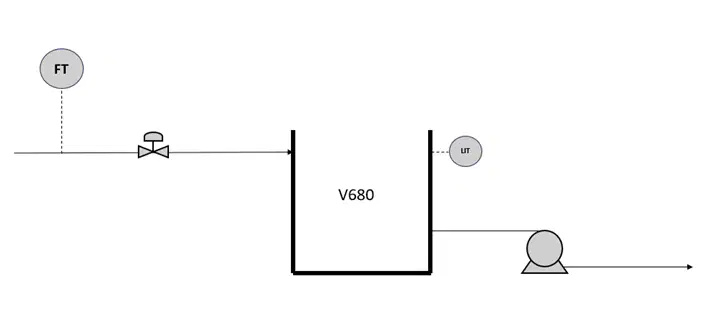
Objective: Maintain the liquid level in the tank.
Available Instrument: Level transmitter, Flow transmitter
Level Control
Cascade Control
Override Control
Ratio Control
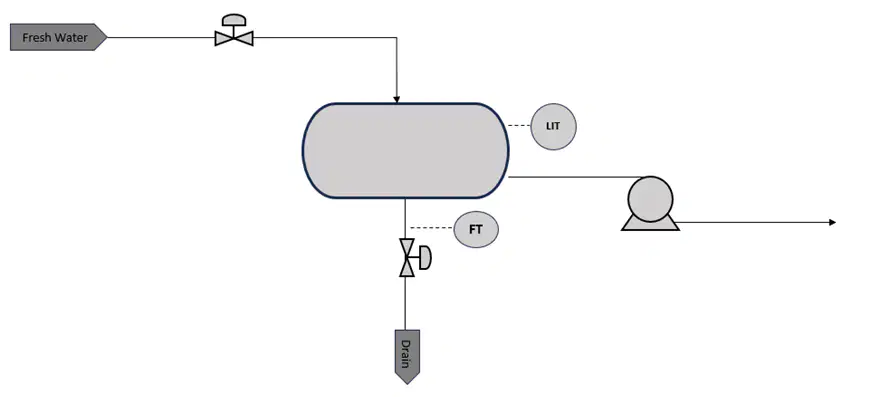
Objective: Drain a minimum quantity of water from the tank to allow fresh water makeup, thereby maintaining water quality.
Requirement: Ensure the tank level does not fall below the safe limit, as this could cause the pumps to run dry.
Available Instrument: Level transmitter, Flow transmitter
Level Control
Cascade Control
Override Control
Ratio Control
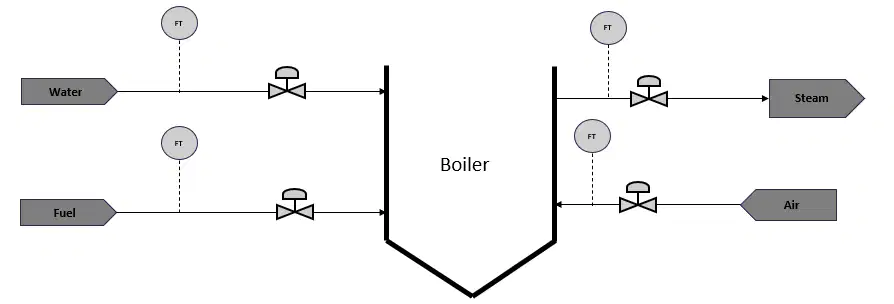
Process Description: Fuel is burned in the boiler to generate heat, which is then used to convert water into steam.
The inlet consists of two streams — fuel and air.
Control Requirement: Identify the type of control strategy that can be applied to ensure efficient combustion from the given options
Available Instrument: Air Flow, Fuel Flow, Steam Flow and Water flow transmitters
Fuel Flow Control, Air Flow control
Fuel Flow Control, Air Ratio Control
Fuel ratio Control, Air Flow control
Fuel Ratio Control, Air ratio Control
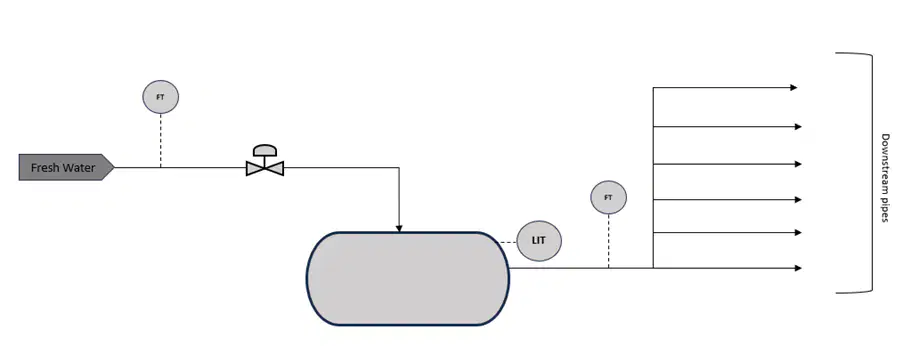
System Description:
The steam drum has an inlet pipe equipped with a flow transmitter followed by a control valve. A level transmitter is installed on the drum, and the outlet pipe includes a flow transmitter.
Challenge:
Since the outlet flow varies depending on downstream demand, significant changes can cause the drum level to deviate from its setpoint.
Control Requirement:
Determine how the control strategy can be optimized to maintain stable drum level under fluctuating outlet flow conditions
Steam Flow can be used as Constraint to limit the outlet flow.
Steam Flow can be used as FeedForward to detect the demand change
Steam Flow can be used a Cascade to Feed Flow
Process to be optimized only from consumers, not here.

