
 Worksheets
Angiogram Limitations and Causes of Ischemia
Total questions: 98
Worksheet time: 49mins
Which coronary structures are visualized directly on standard angiography?
Epicardial arteries luminal silhouette
Capillary network perfusion map
Microvascular flow heterogeneity
Arteriolar resistance profiles
Which statement best characterizes microcirculation in relation to angiography?
Not directly seen on angiograms
Always normal when angiogram is normal
Dominated solely by flow stimuli
Composed only of epicardial vessels
Vulnerable plaque is mainly associated with which event?
Endothelial cell prostacyclin rise
Plaque rupture with thrombosis
Capillary obstruction increase
Demand ischemia without angina
Persistent vasospasm can progress to which outcome?
Myocardial infarction event
Improved CFR response
Enhanced exchange capacity
Atheroma regression
Microvascular dysfunction contributes to ischemia by impairing which process?
Aortic valve opening and closing
Coronary physiology and myocardial blood flow
Pulmonary venous oxygenation
Epicardial lumen visualization on angiogram
Which statement reflects the continuum concept of vessel dysfunction?
Microvascular damage always excludes macro disease
Macro and micro levels can both be affected
Vasospasm occurs only in capillaries
Only epicardial disease causes ischemia
Which vascular segment contributes the largest fraction of total coronary resistance?
Arteriolar microcirculation
Epicardial conductance vessels
Capillary exchange network
Large intramyocardial veins
Primary function of epicardial arteries in coronary hemodynamics is best described as (a) .
Which structural change indicates microvascular remodeling linked to dysfunction?
Focal atheroma formation
Increased smooth muscle thickness
Reduced capillary density
Coronary artery remodeling
Endothelial dysfunction mechanistically leads to which immediate functional effect?
Augmented capillary diameter
Improved EDHF responsiveness
Enhanced thromboxane inhibition
Impaired vasodilation capability
Which mediator list aligns with impaired vasodilation in dysfunction?
High coronary venous pressure
Low ventricular wall tension
Excess hemoglobin saturation
NO, EDHF, prostacyclin deficits
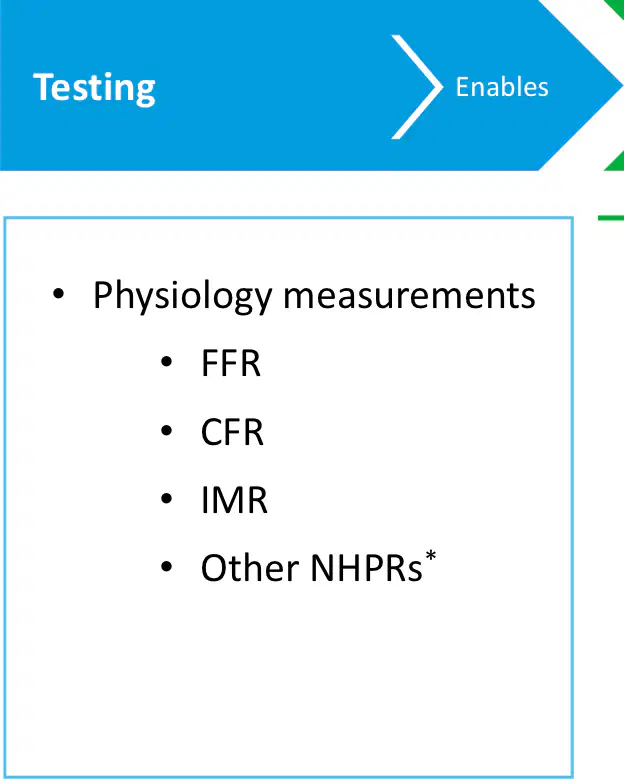
Which physiology measurement is listed as part of coronary testing to enable diagnosis?
Pulmonary Capillary Wedge Pressure
Left Ventricular Ejection Fraction
Peak Systolic Velocity (PSV)
Fractional Flow Reserve (FFR)
Select the guideline sources explicitly referenced for microvascular angina consensus.
US Preventive Services Task Force 2018
NICE Guidance 2012
AHA Scientific Statement 2015
ESC Guidelines 2019
Which metric defines the ratio of cycle‑averaged coronary flow during maximal vasodilation to flow at rest in a stenosed segment?
Index of microcirculatory resistance measure
Fractional flow reserve wire procedure
Coronary flow reserve ratio definition
Instantaneous wave free ratio method
IMR is best described as what type of measurement?
Perfusion pressure distal to aorta
Pressure ratio during wave‑free period
Procedure measuring isolated segment flow
Guidewire‑based microvascular function
Fill in the blank: FFR is a (a) procedure that measures pressure and flow through an isolated coronary segment.
Which condition refers to decreased blood flow through small coronary vessels that supply oxygen to the heart?
Coronary flow reserve finding
Coronary microvascular dysfunction
Hyperemic microvascular resistance
Resting Pd/Pa perfusion ratio
Which index is calculated as Pd divided by Pa during late diastole without hyperemia?
Fractional flow reserve
Hyperemic microvascular resistance
Instantaneous wave‑free ratio
Index of microcirculatory resistance
A patient has preserved FFR but low CFR. What does this pattern most likely indicate?
Increased hyperemic microvascular resistance
Elevated epicardial stenosis severity
Low resting Pd/Pa ratio
Normal microcirculatory function
Which metric is a resting ratio of distal coronary artery pressure to aortic pressure, assuming venous pressure is near zero?
IMR
CFR
FFR
Pd/Pa
Which statement best defines hyperemic physiological measurements in coronary physiology?
They measure autonomic tone in the epicardial wall
They quantify venous return without arterial input
They simulate stress to maximize flow and oxygen demand
They assess flow at resting conditions only
Which induction method is used to achieve maximal coronary hyperemia during invasive measurement?
Intracoronary papaverine bolus
Intramuscular dopamine injection
Oral beta-blocker administration
Transcutaneous nitroglycerin patch
Name one intravenous agent commonly infused to induce coronary hyperemia.
(a)
Which group consists entirely of hyperemic pressure ratios?
FFR, IMR, CFR, HMR
iFR, DFR, Pd/Pa, RFR
FFR, iFR, CFR, dPR
CFR, Pd/Pa, HMR, DFR
Which ratio is non-hyperemic and does not require pharmacologic vasodilation?
FFR
IMR
iFR
HMR
What is the primary purpose of comparing rest and hyperemic states in coronary flow assessment?
To measure coagulation activity changes
To evaluate the difference in blood flow capacity
To detect electrical conduction abnormalities
To quantify pericardial pressure variation
Which measurement is specific to the microcirculation rather than the epicardial artery?
cFFR
FFR
IMR
resting Pd/Pa
Which measure applies to the entire coronary tree rather than only the epicardial artery?
IMR
FFR, cFFR
CFR
Pd/Pa, iFR, RFR
Fill in the blank: Non-hyperemic pressure ratios do not induce (a) .
Which statement correctly contrasts macrovasculature and microvasculature assessment for CMD?
Macrovasculature and microvasculature require identical indices
Both macro- and microvasculature are assessed only with iFR
Macrovasculature uses FFR; microvasculature uses IMR or HMR
Macrovasculature is evaluated with IMR; microvasculature with FFR
Which of the following is highlighted as requiring hyperemia in this session’s focus?
FFR, CFR, IMR
Pd/Pa, cFFR, iFR
RFR, dPR, DFR
iFR, DFR, Pd/Pa
Which practical scenario best justifies using non-hyperemic ratios?
When hyperemia must be avoided or is contraindicated
When quantifying thermodilution-derived CFR values
When assessing microcirculatory resistance during vasodilation
When measuring maximum exercise capacity under stress
Select the correct pairing of measure to vascular domain.
FFR—microcirculation; IMR—epicardial artery
IMR—microcirculation; FFR—epicardial artery
CFR—epicardial artery only; iFR—entire tree
Pd/Pa—microcirculation; CFR—epicardial artery
Which contrast agent option is mentioned for use when standard hyperemic drugs are contraindicated?
Epinephrine infusion
Thermodilution saline bolus
Radiopaque contrast media
Carbon dioxide gas
Determining CMD severity requires measurements that distinguish between the _______ and _______.
macrovasculature and microvasculature
arteries and veins
left and right ventricles
systolic and diastolic pressures
Which formula defines fractional flow reserve during maximum hyperemia?
Distal pressure divided by proximal pressure
Proximal minus distal pressure difference
Proximal pressure divided by distal pressure
Distal minus proximal pressure difference
FFR primarily indexes which physiologic property of the coronary circulation?
Microvascular resistance at rest
Collateral flow during exercise
Left ventricular end-diastolic pressure
Epicardial conductance under hyperemia
During hyperemia induced by adenosine, which arterial segment contributes 0–10% of total resistance?
Epicardial conductance arteries
Terminal arteriolar network
Pre-arteriolar resistance vessels
Capillary meshwork and venules
What does a reduced FFR value signify regarding stenosis-level obstruction?
Greater physiologic obstruction of epicardial stenosis
Higher distal pressure than proximal pressure
Improved microvascular vasodilation capacity
Lower aortic pressure during hyperemia
BLANK: The pressure measured distal to a stenosis used in FFR calculation is abbreviated (a) .
BLANK: The proximal reference pressure used in FFR calculation is abbreviated (a) .
Why is FFR discussed in a module on coronary microvascular dysfunction?
FFR is unaffected by microvascular tone changes
FFR replaces coronary flow reserve entirely
FFR directly measures microvascular resistance only
Microvascular disease alters FFR-based epicardial assessment
In clinical workflows for CAD or CMD, which vascular territory is typically assessed first?
Pulmonary arterial circulation
Coronary venous system pressures
Capillary bed for diffusion defects
Epicardial vessels with potential stenosis
How can coexisting CMD modify ischemic patterns in obstructive CAD?
Ischemia is confined strictly to stenotic segments
Hyperemia eliminates all ischemia evidence
Ischemia may appear in non-stenotic territories
Perfusion becomes uniformly normal everywhere
Which statement best explains pseudonormal FFR values in the presence of CMD?
Aortic pressure is underestimated by the catheter
Epicardial dilation exaggerates stenosis gradient
Collateral flow overestimates Pa during exercise
Microvascular dysfunction blunts hyperemia, raising Pd
When CMD is present, how might FFR misrepresent stenosis severity?
Always classifies lesions as hemodynamically severe
Overestimates severity due to higher resistance
Underestimates physiologic severity of stenosis
Shows no change compared to normal microvasculature
Which component of coronary physiology is most directly gauged by FFR during pharmacologic hyperemia?
Stenosis-level pressure drop across epicardial lesion
Absolute coronary flow in microvasculature at rest
Oxygen extraction fraction in capillaries
Left ventricular end-systolic wall stress
A patient has obstructive CAD and CMD. What planning consideration should guide lesion assessment?
Measure only Pa because Pd is unreliable
Ignore CMD because FFR isolates epicardial flow
Interpret FFR cautiously due to attenuated hyperemia
Avoid adenosine since FFR requires resting state
Which pharmacologic agent is depicted as inducing maximum hyperemia for FFR?
Nitroglycerin for vasodilation
Epinephrine for stress testing
Adenosine as the hyperemic agent
Dopamine for inotropy
Which statement best describes FFRangio in clinical practice?
Requires CT imaging with CFD modeling workflow
Measures microvascular resistance using thermodilution
Generates 3D arterial reconstruction from angiography
Uses coronary pressure wire during hyperemia
Fill in the blank: FFR-CT creates a three-dimensional model of the coronary vasculature using (a) .
Which core principle underlies both FFRangio and FFR-CT analyses?
Estimation of pressure drop across stenosis via modeling
Assumption of steady laminar flow in large arteries
Measurement of collateral flow using Doppler velocity
Direct invasive pressure transduction at the lesion
A cath lab aims to reduce wire-based FFR. Which approach aligns with this goal while preserving physiological lesion assessment?
Use resting Pd/Pa during routine coronary angiography
Perform standard treadmill stress testing protocols
Adopt FFRangio with angiographic 3D reconstruction
Switch to IVUS for lumen area measurements
A patient has CTA showing 50–70% LAD stenosis. Which next step best leverages non-invasive physiology to guide management?
Proceed directly to stent implantation
Order FFR-CT to estimate lesion-specific ischemia
Rely on percent stenosis alone for decision
Schedule invasive FFR without hyperemia
Which statement best describes what Coronary Flow Reserve (CFR) integrates across the coronary circulation?
Epicardial stenosis severity only
Microvascular resistance changes only
Combined macro- and microvascular function
Capillary leukocyte activity exclusively
Fill in the ratio used to calculate CFR (Flow). CFR equals (a) divided by flow at rest.
CFR measured by transit time uses which variables in its ratio?
Pressure at rest and hyperemia
Mean transit time at rest and hyperemia
Velocity at rest and exercise
Diameter at baseline and peak
During hyperemia, CFR primarily increases myocardial oxygen delivery by which mechanism?
Reducing venous capacitance
Decreasing myocardial oxygen extraction
Increasing coronary blood flow
Increasing arterial oxygen content
CFR can be measured in different ways. Select the two named approaches.
Pressure-derived CFR
Capillary density CFR
Flow-based CFR
Transit-time CFR
Why does a mild epicardial stenosis often not reduce resting coronary flow?
Epicardial arteries maintain constant pressure drop
Resting flow equals maximal flow in health
Resting flow is limited by microvascular resistance
Collateral vessels always bypass stenosis
At rest, approximately what degree of diameter reduction is typically needed to influence coronary flow rate?
About 50% reduction
About 100% reduction
About 25% reduction
About 85% reduction
Which statement about CFR is accurate regarding predictive value?
Weak predictor of adverse events
Predictive only with microvascular disease
Predictive only with epicardial disease
Strong independent predictor of events
Mean transit time (Tmn) measured during adenosine hyperemia corresponds to which physiologic state?
Flow at maximal vasodilation
Autoregulation under anemia
Capillary leukocyte adhesion
Basal flow at rest
CFR decreases with increasing stenosis. Which limitation accompanies CFR interpretation?
It is specific to microvascular disease
It requires invasive pressure wires
Normal reference values are unclear
It ignores epicardial lesions entirely
Which component of the coronary tree is affected by endothelial and smooth muscle function relevant to CFR?
Epicardial veins
Resistance arteries
Cardiac lymphatics
Pericardial vessels
When calculating CFR (Flow), what procedural step must be performed to obtain the numerator?
Quantify plaque composition
Record diastolic pressure
Induce pharmacologic hyperemia
Measure flow during rest
A patient has resting Tmn of 2.0 s and hyperemic Tmn of 1.0 s. What is CFR by transit time?
3.0
0.5
1.0
2.0
Which pathophysiologic feature in capillaries can influence CFR according to the schematic?
Pericardial pressure fluctuations
Arterial stiffness over 500 μm
Epicardial plaque composition exclusively
Systemic inflammation and leukocyte adhesion
Which variable remains relatively stable at rest despite increasing coronary stenosis due to compensatory microvascular changes?
Trans-stenotic gradient rises steadily
Epicardial resistance increases markedly
Resting coronary flow remains stable
Distal coronary pressure falls progressively
As stenosis worsens, how does distal coronary pressure behave?
Increases to preserve perfusion
Remains unchanged at baseline
Oscillates with cardiac cycle only
Decreases progressively with severity
Fill in the blank: Resting distal coronary perfusion pressure is intrinsically associated with the (a) capacity of the coronary circulation.
Which determinant is highlighted as critical for myocardial ischemia in non-hyperaemic conditions?
Left ventricular wall stress
Epicardial plaque composition
Vasodilator capacity at rest
Systolic blood pressure level
During resting conditions, what does microvascular resistance determine?
The reserve capacity to vasodilate
The need for hyperaemic testing
The extent of collateralization
The epicardial stenosis morphology
Why does microvascular resistance decrease in the presence of a coronary stenosis?
To prevent distal edema formation
To trigger reactive hyperemia
To compensate and maintain flow
To limit flow and pressure
What happens to the coronary circulation’s reserve capacity as stenosis persists and compensatory vasodilation continues?
It expands to meet demand
It shifts to collateral pathways
It remains unchanged at rest
It is progressively depleted
Strategic scenario: A patient has a 70% diameter stenosis under non-hyperaemic conditions. Predict the combined effect on resting flow, distal pressure, and trans-stenotic gradient.
Resting flow stable, pressure falls, gradient increases
Resting flow falls, pressure rises, gradient decreases
Resting flow rises, pressure stable, gradient unchanged
Resting flow stable, pressure rises, gradient increases
Which formula expresses the Index of Microcirculatory Resistance (IMR) in its simplest form?
IMR = Pd/Pv
IMR = FFR × CFR
IMR = Pa − Pv
IMR = Pd × TmnHyp
In IMR calculation, what does Pd represent?
Lowest diastolic pressure
Peak systolic pressure
Proximal arterial pressure
Venous pressure at rest
During hyperemia, mean transit time is denoted as TmnHyp. What physiologic variable does shorter TmnHyp indicate?
Reduced adenosine dose
Higher venous pressure
Lower distal pressure
Higher flow at hyperemia
Select the statement describing a recognized advantage of IMR compared with CFR.
Directly measures venous pressure
Requires no hyperemia induction
More dependent on epicardial stenosis
More reproducible values
Complete the relationship: Resistance equals ΔPressure divided by (a)
Which pressure gradient is used when conceptualizing IMR as resistance?
Pd − Pv
Pa − Pd
Pa − Pv
Pd − Pa
Flow in thermodilution during IMR assessment is inversely related to which measured quantity?
Fractional flow reserve (FFR)
Mean transit time (Tmn)
Proximal temperature
CFR ratio
Identify the sensor configuration used to measure Tmn in the coronary artery during IMR assessment.
External chest impedance leads
Epicardial Doppler probe only
Single mid-vessel pressure sensor
Proximal thermistor and distal sensor
IMR is considered independent of which factor that can influence CFR?
Epicardial coronary artery stenosis
Thermistor calibration drift
Adenosine infusion rate
Venous pressure variability
State one clinical context where IMR has shown prognostic value.
Atrial fibrillation episodes
Hypertension without CAD
Stable angina without ischemia
ST-segment elevation myocardial infarction
Which device system is shown providing practical IMR measurements alongside FFR and CFR?
Portable echocardiography unit
Transesophageal Doppler platform
Swan-Ganz catheter console
Coroventis CoroFlow cardiovascular system
When interpreting IMR values, what does a higher numeric IMR generally signify?
Improved coronary flow reserve
Higher thermistor temperature
Greater epicardial stenosis
Greater microvascular resistance
A patient has Pd of 80 mmHg and TmnHyp of 0.30 seconds. Calculate IMR using the simple formula.
32 units
24 units
26 units
30 units
Which statement best distinguishes CFR from IMR?
IMR depends on epicardial stenosis grade
CFR equals Pd times TmnHyp
IMR is calculated as flow ratio at rest
CFR reflects flow reserve of the whole vessel
During hyperemia induced with adenosine, the arrow labeled A to B represents what in the schematic?
Electrical signal propagation speed
Time as flow at hyperemia
Pressure drop across stenosis
Temperature increase along vessel
Which statement best describes the procedural efficiency of measuring fractional flow reserve (FFR) and index of microcirculatory resistance (IMR) during invasive coronary assessment?
They can be measured simultaneously in under five minutes
They need noninvasive imaging and overnight monitoring
They require separate catheters and over 30 minutes
They must be staged across two different procedures
Fill in the blank: Routine IMR measurement in European centers of excellence occurs in approximately (a) of centers for daily clinical decision making.
A patient presents with suspected ischemia without clear epicardial stenosis. How should simultaneous FFR and IMR inform next steps?
Use FFR and IMR together to decide on revascularization benefit
Proceed directly to epicardial revascularization without physiology
Delay invasive assessment until noninvasive tests return
Rely on symptoms alone to guide microvascular therapy
In the diagnostic framework, which combination indicates predominantly microvascular disease?
High IMR with high FFR
Low IMR with low FFR
High IMR with low FFR
Low IMR with high FFR
A vessel shows low FFR and normal IMR. What condition is most consistent with this pattern?
Macrovascular disease
Mixed coronary disease
Adequate vascular function
Microvascular disease
A patient post-PCI develops angina. Which FFR–IMR pattern best flags risk for post-PCI angina?
High FFR with high IMR
High IMR with low FFR
Low IMR with high FFR
Low FFR with low IMR
Complete the statement: High IMR combined with low FFR suggests (a) .

