
 Worksheets
ĐỀ CƯƠNG MÔN TIẾNG ANH 6 HỌC KỲ 1
Total questions: 91
Worksheet time: 26hrs 6mins
I. Pronunciation: Choose the word whose underlined part is pronounced differently from the other three.
coffee
sleepy
free
meet
I. Pronunciation: Choose the word whose underlined part is pronounced differently from the other three.
big
wide
quiet
exciting
I. Pronunciation: Choose the word whose underlined part is pronounced differently from the other three.
lake
bag
take
nature
I. Pronunciation: Choose the word whose underlined part is pronounced differently from the other three.
island
plaster
coast
longest
I. Pronunciation: Choose the word whose underlined part is pronounced differently from the other three.
smile
so
spring
noise
I. Pronunciation: Choose the word whose underlined part is pronounced differently from the other three.
creative
think
big
idea
I. Pronunciation: Choose the word whose underlined part is pronounced differently from the other three.
finger
leg
neck
elbow
I. Pronunciation: Choose the word whose underlined part is pronounced differently from the other three.
mothers
centers
aunts
cousins
I. Pronunciation: Choose the word whose underlined part is pronounced differently from the other three.
shops
plays
streets
parks
I. Pronunciation: Choose the word whose underlined part is pronounced differently from the other three.
exciting
quiet
wide
terrible
II. Multiple choice: Green Hotel? Go to the end of the road. It’s on your ______.
direction
leg
turn
left
II. Multiple choice: She’s not very happy. Her exam results are ______ than her sister’s.
better
worse
badder
gooder
II. Multiple choice: You ______ buy a ticket to enter the zoo. It’s not free.
mustn’t
don’t
won’t
must
II. Multiple choice: There are many famous paintings in this ______.
supermarket
gallery
memorial
cathedral
II. Multiple choice: Have you got any ______? I’ve cut my finger.
compass
painkiller
plasters
suncream
II. Multiple choice: Viet Nam ______ Tet according to the lunar calendar.
decorates
celebrates
makes
does
II. Multiple choice: My grandma will cook banh chung – our special ______ at Tet.
flower
meal
food
fruit
II. Multiple choice: There are ______ tigers at the zoo.
a few
a little
a
much
II. Multiple choice: We ______ you a Happy New Year and a good fortune in the coming year!
wish
say
chee
sing
II. Multiple choice: There is ______ meat in the sandwich.
a
an
some
any
II. Multiple choice: Children often receive ______ in red envelopes during Tet.
lucky money
banh tet
sweets
wishes
II. Multiple choice: There are many natural and ______ wonders in Viet Nam.
human
man-make
man-made
people made
II. Multiple choice: You must ______ their rules when you visit their place.
read
follow
get
pass
II. Multiple choice: There is not ______ cheese in my house.
a
an
some
any
II. Multiple choice: He likes to ______ his house with flowers and plants.
hang
make
decorate
do
II. Multiple choice: What do Vietnamese people usually do to ______ Tet?
come
eat
have
celebrate
II. Multiple choice: My grandma will cook banh chung – our special ______ at Tet.
flower
meal
food
fruit
II. Multiple choice: The kids love to play and have ______ during the holiday.
sadness
fight
bad luck
fun
II. Multiple choice: In Viet Nam, Tet is a good time for family ______.
saying
preparing
gathering
singing
II. Multiple choice: There is ______ money in the pocket.
a few
an
some
any
II. Multiple choice: ______ students passed the exam because it was very difficult.
A few
A little
A lot
Much
II. Multiple choice: Joe always puts ______ salt on his food.
many
a few
few
much
II. Multiple choice: Giving ______ to children is a tradition at Tet Holiday.
sweets
new clothes
special food
lucky money
II. Multiple choice: People often spend time visiting their ______ during Tet.
neighbours
teachers
relatives
friends
II. Multiple choice: Nguyen Bieu street is ______ than Phan Dinh Phung street.
crowded
more crowded
crowder
more croweder
II. Multiple choice: Viet Nam ______ Tet according to the lunar calendar.
decorates
celebrates
makes
does
II. Multiple choice: Travelling by cars is ______ than travelling by motorbikes.
More safer
safe
much more safer
safer
II. Multiple choice: ______ colours like blue and yellow can make people feel happy.
A lot
Any
Some
A
II. Multiple choice: I always ______ my parents a long and happy life.
make
wish
celebrate
have
II. Multiple choice: I think New York is ______ than Paris.
expensiver
more expensive
more expensively
expensive
II. Multiple choice: I don’t have ______ homework to do at Tet.
a little
many
a
any
II. Multiple choice: My father cooks ______ than my mother.
badder
more bad
worse
bad
II. Multiple choice: On New Year Eve, we watch fireworks and ______ a wish.
do
make
have
get
II. Multiple choice: You ______ eat in class.
Should
shouldn’t
must
mustn’t
II. Multiple choice: I think we ______ break things on the first day of the new year.
mustn’t
can’t
needn’t
shouldn’t
II. Multiple choice: We will have a family ______ on the day when a year ends.
cleaning
gathering
watching
talking
II. Multiple choice: Does your mother ______ special foods on New Year?
cook
hang
plant
give
There is a “STOP” sign ahead. We ______ stop now.
must
mustn’t
should
shouldn’t
I ______ shorts and shirts to the pagoda tomorrow.
won’t wear
don’t wear
should wear
may wear
A: Excuse me. Could you tell me the way to the cinema? B: “______”
Don’t do that.
I’m sorry I don’t like films.
Sure. Go straight ahead. Then turn right.
I have a class.
People in small towns are ______ than people in big cities.
friendly than
friendlier
more friendly
friendly
This pagoda is ______ than the palace.
most historic
more historic
the historic
historicer
Living in the countryside is ______ than living in the city.
most expensive
more cheap
noisier
cheaper
A city house is ______ than a country house.
most modern
more modern
moderner
modern
The kids ______ spend so much time in front of the TV.
should
must
shouldn’t
mustn’t
You ______ sweep your house on the first day of the new year.
should
must
shouldn’t
mustn’t
You ______ eat fresh food.
should
must
shouldn’t
mustn’t
A: “Lets’ go to the park weekend?” – B: “Ok, ______.”
No, thanks!
That’s fine!
Thank you!
I’m fine, thanks!
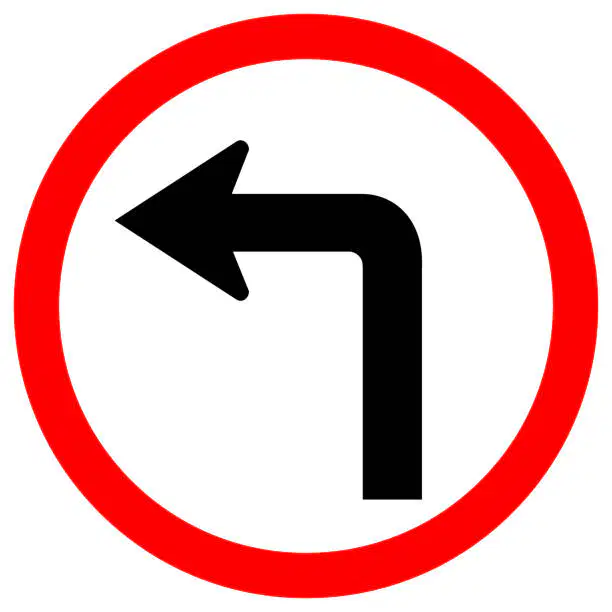
The sign below says that you must ___________.
turn left
turn right
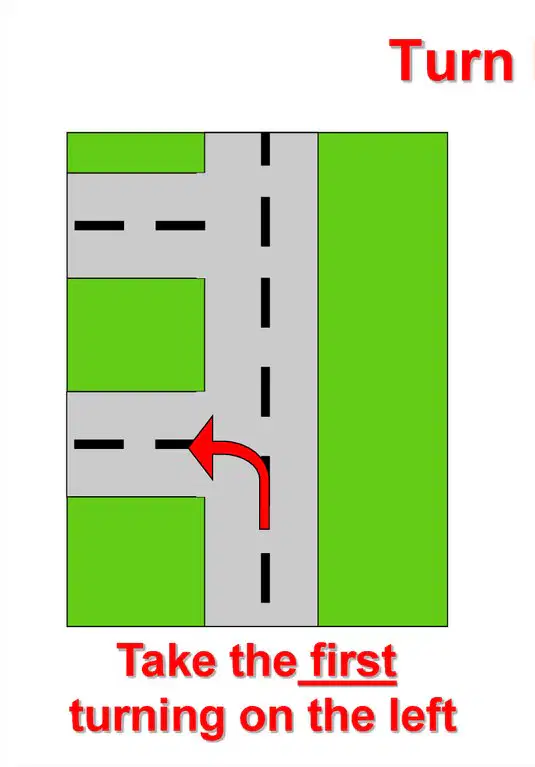
The sign below says that you must ___________.
take the first turning on the left
turn right
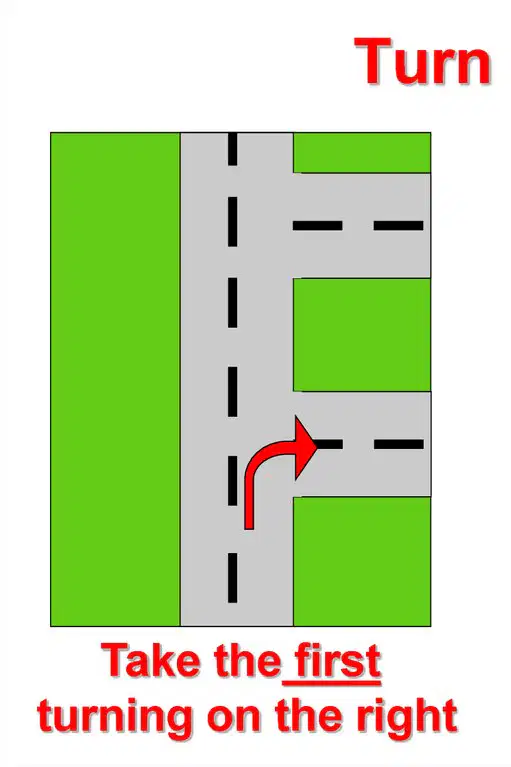
The sign below says that you must ___________.
take the first turning on the right
cross the road
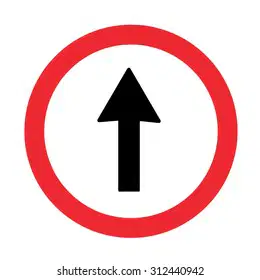
The sign below says that you must ___________.
turn right
go straight
Read the passages and use them to answer the questions.
Phu Quoc Island
Fly to Phu Quoc Island, off the coast of southern Viet Nam, you can see some of Viet Nam’s prettiest beaches with white sands and tropical rainforests.
One of the most popular beaches here is Long Beach, which is on the west coast of the island. This is an excellent place to enjoy fresh seafood.
Sa Pa
Terraced rice paddies line the mountainsides of northern Viet Nam.
Take a bus through the winding hills to Sa Pa, and book a stay at a hotel with a fantastic view of the mountains.
Many visitors report that it’s best to visit Sa Pa during the rainy season when the fields are green and lush.
Around September, when it’s time to harvest, the fields turn bright gold.
Decide if the statement is True or False based on the passages:
Both Phu Quoc Island and Sa Pa are in the south of Viet Nam.
True
False
Decide if the statement is True or False based on the passages:
Visitors can eat good seafood at Long Beach.
True
False
Decide if the statement is True or False based on the passages:
Phu Quoc Island is on the west coast of Viet Nam.
True
False
Decide if the statement is True or False based on the passages:
The rice paddies in Sa Pa are green and lush all year round.
True
False
Decide if the statement is True or False based on the passages:
September is the best time to visit Sa Pa.
True
False
Decide if the statement is True or False based on the passages:
Sa Pa is hilly and mountainous.
True
False
Read the passage and use it to answer the questions.
My neighbourhood My name is Nick. My neighbourhood is not in the city. It’s in the suburbs.
It is very peaceful and quiet. It is a new neighbourhood, and there are a lot of big houses and some apartment buildings.
There are a lot of big trees and there aren’t many cars so the streets are very clean. There’s a park in my neighbourhood, which has a small playground for children.
I like to play baseball there with my friends after school. There aren’t any restaurants, bars or cinemas on my road. But, if you go to Main Street, you can find a lot of things to do.
I like my neighbourhood because it is very safe. There is no crime, and all of my neighbours take care of each other.
I think I am lucky to live in my neighbourhood.
Decide if the statement is True or False based on the passage:
Nick’s neighbourhood is old but peaceful and quiet.
True
False
Decide if the statement is True or False based on the passage:
The streets are clean because there aren’t many cars and the neighbourhood is green.
True
False
Decide if the statement is True or False based on the passage:
Nick likes to play baseball with his friends after school.
True
False
Decide if the statement is True or False based on the passage:
There are more things to do on Nick’s road than on Main Street.
True
False
Decide if the statement is True or False based on the passage:
Nick is happy about his neighbourhood.
True
False
Read the passage and use it to answer the questions.
Lunar New Year, or Tet, is Vietnam's main holiday.
It is the most important occasion in the year which falls sometimes between 19th January and 20th February on the Western calendar.
Tet marks the beginning of spring and the start of a new year.
Tet’s preparations and celebrations nowadays are shorter than those in the past.
Streets are decorated with coloured lights and red banners.
Shops are full of goods. People are busy buying gifts, cleaning and decorating their houses and cooking traditional foods. Houses are often decorated with plants and flowers at this time.
Peach blossom is traditional at Tet in the North while apricot blossom is traditional in the South.
The kumquat tree with its ripe deep orange fruits is popular throughout the country.
One of Tet’s most special foods is Banh Chung, which is made from sticky rice, green beans and fatty pork.
Mut, which is candied fruits such as sugared apples, plums or tomatoes, is also popular.
Choose the best answer based on the passage:
What is another name of Tet?
Vietnamese holiday
Lunar New Year
Traditional holiday
Vietnamese main holiday
Choose the best answer based on the passage:
What does Tet sometimes take place on Western calendar?
from 19th January to 20th January
from 19th January to 19th February
from 19th January to 20th February
from 19th January to 20th February
Choose the best answer based on the passage:
What does Tet mark?
the end of the year
the start of a new month
the beginning of a new year
the beginning of spring and the start of a new year
Choose the best answer based on the passage:
What do people decorate the streets with?
plants and flowers
coloured lights and red banners
peach blossom and apricot blossom
traditional foods
Choose the best answer based on the passage:
What do people do in Tet?
A. People buy gifts, clean and decorate their houses and cook traditional foods
B. People enjoy traditional food.
C. People clean their house and wait for the first footer
D. People plan trees around their house
Rewrite each sentence so that it is closest in meaning to the original one:
Hoa is taller than Chau.
Chau is ______.
Rewrite each sentence so that it is closest in meaning to the original one:
The museum is bigger than the art gallery.
The art gallery ______.
Rewrite each sentence so that it is closest in meaning to the original one:
The market is older than the shopping centre.
The shopping centre ______.
Rewrite each sentence so that it is closest in meaning to the original one:
The food here is worse than my cooking.
My cooking ______.
Rewrite each sentence so that it has the same meaning as the first one:
The weather today is better than yesterday.
The weather ______.
Rewrite each sentence so that it has the same meaning as the first one:
The neighborhood in the suburb is more peaceful than the city center.
The living place in the city center ______.
Rewrite each sentence so that it has the same meaning as the first one:
National roads are usually wider than city streets.
City streets ______.
Rewrite each sentence so that it has the same meaning as the first one:
Going shopping in that supermarket is more expensive than in this open-air market.
Shopping in this open-air market ______.
Rewrite each sentence so that it has the same meaning as the first one:
It’s wetter in rainy seasons than in sunny ones.
In sunny seasons ______.
Complete the second sentence so that it has the same meaning as the first one, using SHOULD or SHOULDN’T:
It’s good if children help their parents decorate the house.
Children (a) help their parents decorate the house.
Complete the second sentence so that it has the same meaning as the first one, using SHOULD or SHOULDN’T:
It’s not a good idea for children to ask for lucky money.
Children (a) ask for lucky money.
Complete the second sentence so that it has the same meaning as the first one, using SHOULD or SHOULDN’T:
People think that breaking things at Tet is bad luck.
You (a) break things at Tet.
Complete the second sentence so that it has the same meaning as the first one, using SHOULD or SHOULDN’T:
It’s a good idea to dress beautifully during New Year’s Day.
People (a) dress beautifully during New Year’s Day.
Complete the second sentence so that it has the same meaning as the first one, using SHOULD or SHOULDN’T:
Playing games all night is not good for small children.
Small children (a) play games all night.
Complete the second sentence so that it has the same meaning as the first one, using SHOULD or SHOULDN’T:
I am not happy when children lie to their parents.
Children (a) lie to their parents.
Complete the second sentence so that it has the same meaning as the first one, using SHOULD or SHOULDN’T:
It’s good if you say “Thank you” to a person who has helped you.
You (a) say “Thank you” to a person who has helped you.
Complete the second sentence so that it has the same meaning as the first one, using SHOULD or SHOULDN’T:
Getting up early every day is good for your health.
You (a) get up early every day.
Put the words in the correct order to make the right sentence:
must/ This/ today./ finish/ essay/
.........................................................................
Put the words in the correct order to make the right sentence:
we/ Shall/ Ha Long Bay/ weekend?/ go/ to/ this/
.........................................................................
Put the words in the correct order to make the right sentence:
city./ in/ the/ Living/ is/ more/ than/ countryside/ living/ in/ the/ peaceful/
.........................................................................
Put the words in the correct order to make the right sentence:
Dalat./ the/ It/ waterfalls/ in/ beautiful/ is/ most/
.........................................................................
Reorder the words to make a correct question:
in / there / students / Are / many / class? / your /
(a)
Reorder the words to make a correct sentence:
modern / yours. / My / more / than / is / house
(a)
Reorder the words to make a correct question:
tell / the / to / bus / Can / way / you / me / stop? / the /
(a)
Reorder the words to make a correct sentence:
Children / bed / should / go / early. / to /
(a)
Reorder the words to make a correct sentence:
at Tet / should / house / with / They / their / many / decorate / flowers.
(a)

