
NEW
Font size
 Worksheets
Descriptive Geometry Quiz
Total questions: 46
Worksheet time: 23mins
What is the primary aim of descriptive geometry courses for first-year students?
To teach students how to draw artistic sketches.
To enable students to master project tools and understand architectural design in three-dimensional space.
To focus on the history of geometry.
To study the properties of two-dimensional shapes.
Which type of projection is defined as the representation of a point onto a plane perpendicular to it?
Orthogonal projection.
Parallel projection.
Conic projection.
Perspective projection.
What does descriptive geometry primarily focus on?
The study of artistic drawings.
The representation of objects in two-dimensional space.
The analysis of historical architectural designs.
The creation of sculptures.
What is the inadequacy of using a single projection plane for describing an object in space?
It does not provide sufficient information about the object.
It makes the object appear distorted.
It is difficult to use for large objects.
It requires advanced tools to implement.
What is the name of the plane onto which all resulting images of an orthogonal projection are cast?
Horizontal Projection Plane
Frontal Projection Plane
Profile Projection Plane
Assembling Projection Plane
Which plane is perpendicular to the horizontal plane and presents images resulting from an orthogonal projection?
Horizontal Projection Plane
Frontal Projection Plane
Profile Projection Plane
Assembling Projection Plane
What is the name of the line of intersection between the horizontal and frontal projection planes?
Ground line
Intersection line
Projection line
Axis line
Which plane is referred to as the "Profile" or "Side" plane in Monge's projections?
Horizontal Projection Plane
Frontal Projection Plane
Profile Projection Plane
Assembling Projection Plane
What are the coordinates used to describe the Horizontal Projection Plane?
(X, Y)
(X, Z)
(Y, Z)
(A, B)
What are the coordinates used to describe the Frontal Projection Plane?
(X, Y)
(X, Z)
(Y, Z)
(A, B)
What are the coordinates used to describe the Profile Projection Plane?
(X, Y)
(X, Z)
(Y, Z)
(A, B)
What does the assembly of Monge's projection planes allow us to obtain?
The desired number of projections for any object in space
The coordinates of a single projection
The intersection of two planes
The axis of rotation for an object
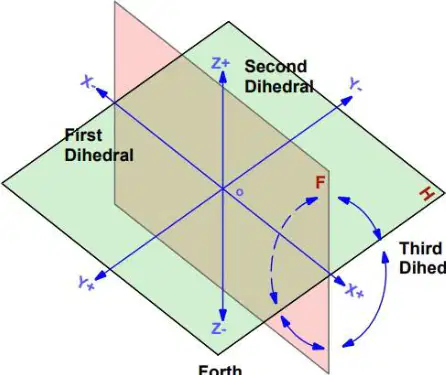
What are the four dihedral angles formed by Monge's projection planes?
Horizontal, Frontal, Profile, and Axial angles
Dihedral angle 01, Dihedral angle 02, Dihedral angle 03, and Dihedral angle 04
Acute, Obtuse, Right, and Reflex angles
First, Second, Third, and Fourth quadrants
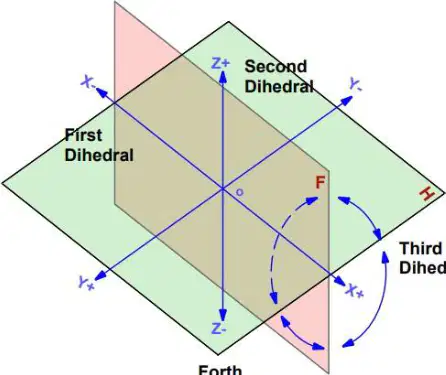
Which dihedral angle contains all points with coordinates (y+, z+)?
Dihedral angle 01
Dihedral angle 02
Dihedral angle 03
Dihedral angle 04
What is the purpose of a drawing plane in orthogonal projections?
To create three-dimensional models of objects
To provide a set of two-dimensional projections of an object in space
To divide space into quadrants
To rotate objects around an axis
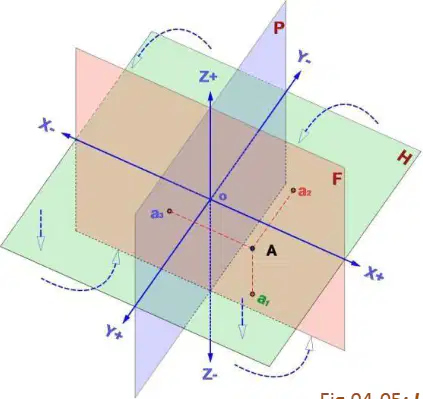
What happens when the horizontal plane is folded onto the frontal plane?
The superposition of planes H and F occurs
The superposition of axes (X+, X-) occurs
The superposition of axes (Y+, Y+) and (Z+, Z-) occurs
The planes remain unchanged
What happens to the Y-axis when folding downwards in orthogonal projections?
Y moves upwards and Y+ moves downwards.
Y moves downwards and Y+ moves upwards.
Y remains unchanged.
Y+ moves upwards and Y moves downwards.
What is the relationship between the horizontal projection « a1 » and the frontal projection « a2 »?
They have the same elevation (z).
They have the same vertical line.
They have the same (x) value.
They are unrelated.
What happens to the profile projection « a3 » when folding the Profile plane onto the Frontal plane?
It moves to the same vertical line as « a2 ».
It moves to the same horizontal line as « a2 ».
It remains unchanged.
It moves to the same elevation as « a1 ».
What is the point defined as in descriptive geometry?
A large element with weight and volume.
An infinitely small element with neither weight nor volume.
A measurable object with defined dimensions.
A three-dimensional object.
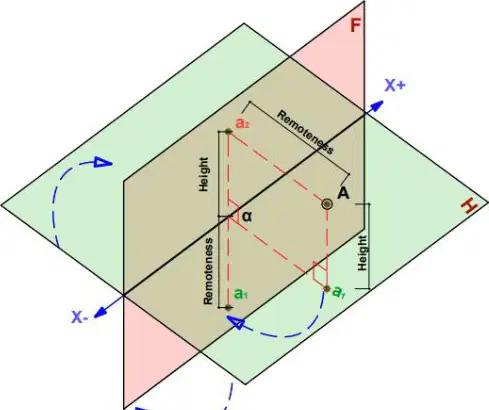
What are the three projections of a point "A" in space as defined in descriptive geometry?
(x, y) in the Horizontal plane, (x, z) in the Frontal plane, (y, z) in the Profile plane
(x, z) in the Horizontal plane, (y, z) in the Frontal plane, (x, y) in the Profile plane
(y, z) in the Horizontal plane, (x, y) in the Frontal plane, (x, z) in the Profile plane
(x, y) in the Profile plane, (x, z) in the Horizontal plane, (y, z) in the Frontal plane
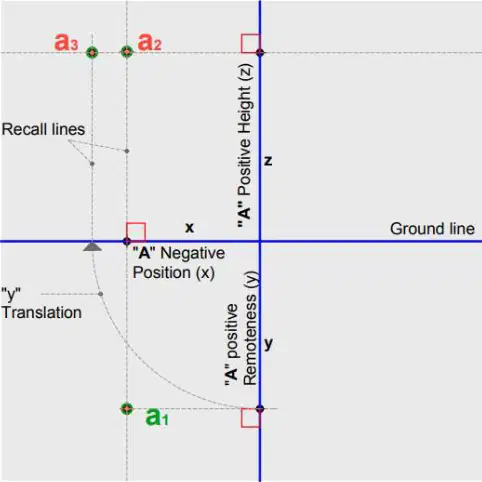
What does the "Recall line" represent in the orthographic drawing of a point "A"?
The line connecting the projections of "A" on the Horizontal and Frontal planes
The line connecting the projections of "A" on the Profile and Frontal planes
The line perpendicular to the ground line where a2 and a3 have the same (z) values
The line parallel to the ground line where a1 and a2 have the same (x) values
What is the "position" of a point "A" in descriptive geometry?
The distance separating "A" from the Frontal projection plane
The distance separating "A" from the Profile projection plane
The distance separating "A" from the Horizontal projection plane
The distance separating "A" from the ground line
What does the "height" of a point "A" represent in descriptive geometry?
The distance separating "A" from the Frontal projection plane
The distance separating "A" from the Profile projection plane
The distance separating "A" from the Horizontal projection plane
The distance separating "A" from the ground line
What does the "remoteness" of a point "A" represent in descriptive geometry?
The distance separating "A" from the Frontal projection plane
The distance separating "A" from the Profile projection plane
The distance separating "A" from the Horizontal projection plane
The distance separating "A" from the ground line
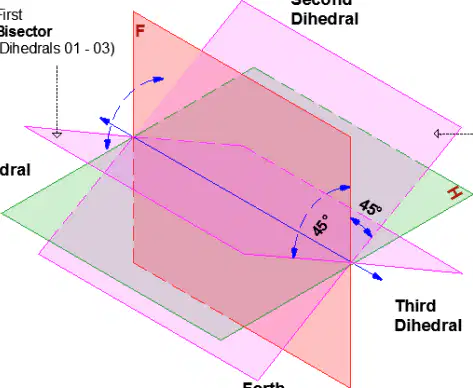
What is the purpose of bisecting planes in orthogonal projections?
To divide the projection planes into equal halves.
To divide the four dihedral angles into 45° angles.
To create parallel projection planes.
To eliminate dihedral angles.
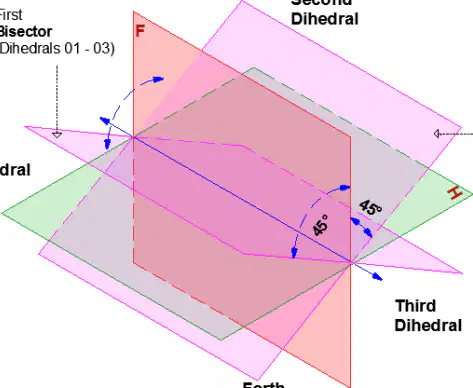
Which dihedral angles does the first bisector divide?
1st and 2nd dihedral angles.
2nd and 4th dihedral angles.
1st and 3rd dihedral angles.
3rd and 4th dihedral angles.
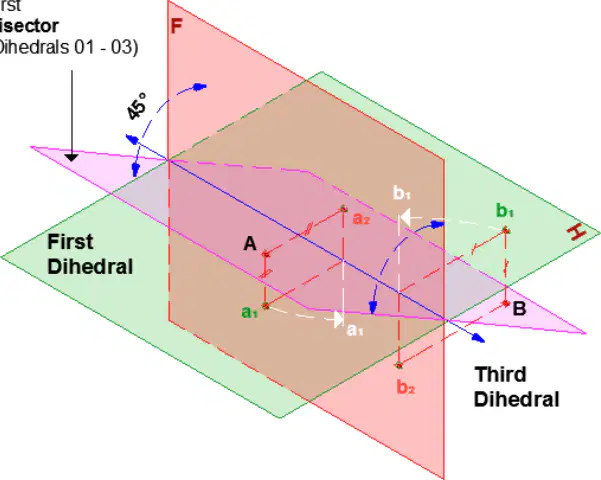
What is true about points belonging to the first bisector in the first dihedral angle?
Their heights and distances are negative.
Their heights and distances are positive.
Their heights are positive, and distances are negative.
Their heights are negative, and distances are positive.
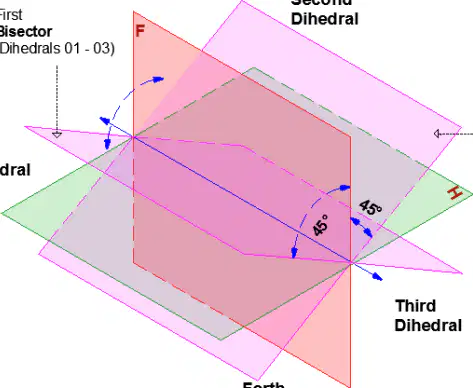
What is the relationship between remoteness and height for points on the bisecting planes?
Remoteness is greater than height.
Remoteness is less than height.
Remoteness is equal to height in absolute values.
Remoteness and height are unrelated.
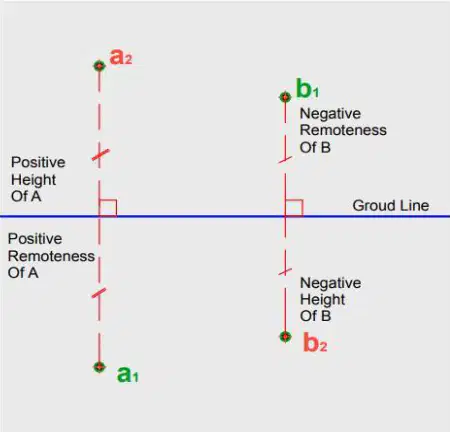
What is the relationship between the projections of points belonging to the 1st bisector with respect to the ground line?
They are symmetrical
They are parallel
They are perpendicular
They are random
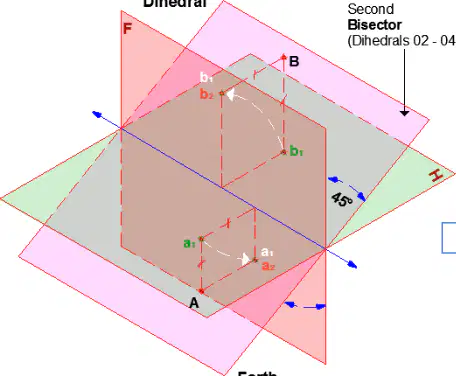
In the 2nd dihedral angle, what is the nature of the heights and remoteness of points belonging to the 2nd bisector?
Heights are positive, and remoteness is negative
Heights are negative, and remoteness is positive
Both heights and remoteness are positive
Both heights and remoteness are negative
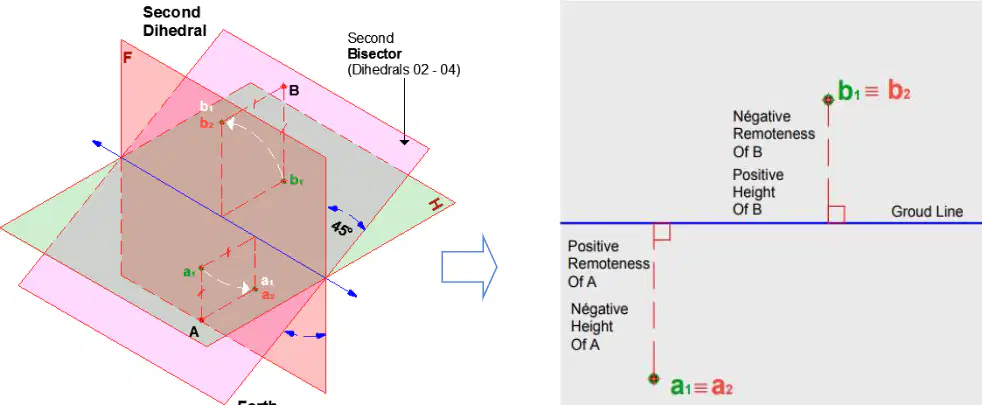
What happens to the projections of points belonging to the 2nd bisector on the drawing plane?
They are symmetrical
They are confused
They are parallel
They are perpendicular
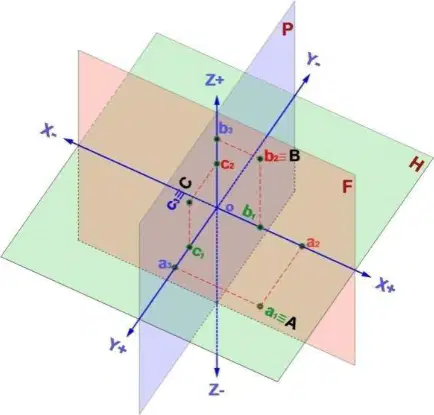
What is the coordinate of a point on the Horizontal Projection Plane?
(x, y, 0)
(0, y, z)
(x, 0, z)
(0, 0, 0)
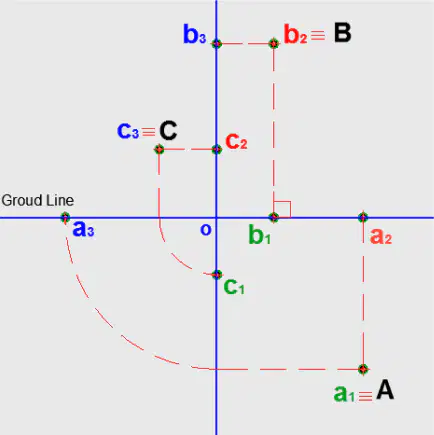
Which axis is the Profile projection of a point on the Horizontal Projection Plane located on?
Height axis (Z+, Z-)
Ground line (X+, X-)
Remoteness axis (Y+, Y-)
Frontal axis (X, Y)
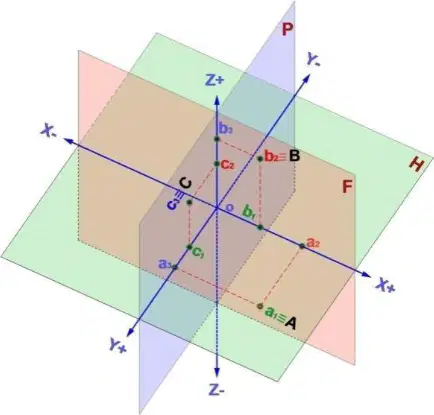
What is the coordinate of a point on the Frontal Projection Plane?
(x, y, 0)
(0, y, z)
(x, 0, z)
(0, 0, 0)
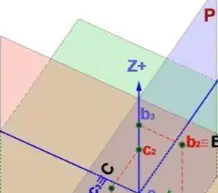
Where does the Frontal projection of a point on the Profile Projection Plane coincide?
On the remoteness axis (Y+, Y-)
On the height axis (Z+, Z-)
On the ground line (X+, X-)
On the frontal axis (X, Y)
What is the significance of the "ground line" in descriptive geometry?
It serves as a reference for measuring distances in the Profile projection.
It represents the intersection of the Horizontal and Frontal projection planes.
It is used to define the limits of the projection planes.
It indicates the height of a point in three-dimensional space.
Which projection method is primarily used to create a realistic representation of an object?
Axonometric projection.
Perspective projection.
Orthogonal projection.
Isometric projection.
What does the term "dihedral angle" refer to in the context of projection planes?
The angle between the horizontal and vertical axes.
The angle formed by the intersection of two lines.
The angle between a line and a plane.
The angle formed between two intersecting planes.
What is the primary purpose of using auxiliary views in descriptive geometry?
To create a three-dimensional model.
To enhance the aesthetic quality of the drawing.
To simplify the drawing process.
To provide a clearer representation of complex shapes.
In descriptive geometry, what does the term "projection" refer to?
The method of representing three-dimensional objects in two dimensions.
The process of measuring distances in space.
The analysis of structural integrity.
The technique of creating artistic renderings.
What is the significance of the "first bisector" in relation to the dihedral angles?
It is used to measure the distance between two points.
It divides the dihedral angle into two equal parts.
It indicates the direction of the ground line.
It determines the height of the projection.
In descriptive geometry, how is the "Profile Projection Plane" defined?
It is the plane that represents the side view of an object.
It is the plane that combines all three views of an object.
It is the plane that represents the top view of an object.
It is the plane that represents the front view of an object.
What is the significance of the ground line in descriptive geometry?
It serves as a reference for measuring height.
It indicates the horizontal projection of points.
It represents the intersection of all projection planes.
It is used to define the vertical axis.
Which projection plane is primarily used to visualize the height of an object?
Horizontal Projection Plane
Profile Projection Plane
Assembling Projection Plane
Frontal Projection Plane
What is the effect of rotating an object in three-dimensional space on its projections?
It alters the position of its projections on the planes.
It changes the object's dimensions.
It has no effect on the projections.
It only affects the frontal projection.

