
 Worksheets
India & South Asia Chapter Review
Total questions: 45
Worksheet time: 24mins
Which ancient Indian civilization's culture greatly influenced later societies in India?
Harappan
Vedic
Mughal
Gupta
Cholan
Which TWO major river systems are located in Northern India?
Ganges
Indus
Nile
Niger
Tigris & Euphrates
What was a major factor that contibuted to South Asia's decentralization throughout most of its history?
South Asia's wide array of biomes, regions, and climates
South Asia's abundance of desireable resources resulted in constant warfare between rival warlords
The hot, tropical climate prevented large scale agriculture and large populations
The Himalyas mountains and Indian Ocean isolated South Asia from the rest of the world
SELECT ALL of the valuable trade goods produced in India:
sugar
spices
cotton
silk
dyes
Which was the most valuable South Asian trade export to the West?
sugar
spices
cotton
silk
dyes
Which best describes Hinduism?
ancient Vedic religion that believes in one supreme deity with many avatars that can be worshipped as deities
nontheist religion what does not believe in or worship any deities but still believes in spiritual concepts like an immortal soul
polytheistic religion with many deities that are worshipped
animistic religion in which nature spirits and ancestors are worshipped
The endless reincarnation cycle of birth, death, and rebirth that is a core belief of Hinduism and Jainism
Samsara
Moksha
Karma
Dharma
Escape from Samsara, the goal of Hinduism
Samsara
Moksha
Karma
Dharma
Hindu belief that the good and bad deeds that one accumulates in life have consequences on their future lives
Samsara
Moksha
Karma
Dharma
Hindu belief that there are responsibilies and duties that a person must fulfill to lead a good life
Samsara
Moksha
Karma
Dharma
How did the Gupta Empire maintain control over most of India?
small kingdoms became provinces governed by local rulers
they used their large army to maintain control and crushed any uprisings immediately
trade goods such as spices were hoarded in the capital
they allowed the Brahmin caste to control the government, creating a theocracy
SELECT ALL of the religions that originated in India:
Hinduism
Jainism
Buddhism
Taoism
Islam
Which religion split from Hinduism, is nontheist, and focuses on nonviolence as a means to achieve moksha
Hinduism
Jainism
Buddhism
asceticism
Which religion split from Hinduism, is nontheist, and became much more popular in east Asia than India?
Hinduism
Jainism
Buddhism
asceticism
Which is a lifestyle in which a person renounces worldly possessions to pursue a spirittual life?
Hinduism
Jainism
Buddhism
asceticism
An epic poem completed during the Gupta golden age that teaches Hindu beliefs & philosophy
Bhagavad Gita
Upanishads
Vedas
Qur'an
The writing system that became the universal language of scholarship in India during the Gupta golden age
Sanskrit
Arabic
Hindi
Urdu
Which ruler greatly expaned and organized the territory of the Gupta Empire?
Chandragupta II
Aryabhata
Shri Gupta
Chandragupta Maurya

Which caste is at #1?
Brahmin (priests)
Kshatriya (warriors)
Vaishya (skilled workers)
Shudra (unskilled workers)
Untouchables
Which caste is at #5?
Brahmin (priests)
Kshatriya (warriors)
Vaishya (skilled workers)
Shudra (unskilled workers)
Untouchables
Which caste is at #4?
Brahmin (priests)
Kshatriya (warriors)
Vaishya (skilled workers)
Shudra (unskilled workers)
Untouchables
Which caste is at #2?
Brahmin (priests)
Kshatriya (warriors)
Vaishya (skilled workers)
Shudra (unskilled workers)
Untouchables
Which caste is at #3?
Brahmin (priests)
Kshatriya (warriors)
Vaishya (skilled workers)
Shudra (unskilled workers)
Untouchables
SELECT ALL of Aryabhata's acheivements in astronomy & mathematics:
correctly calculated the periods of rotation and revolution of the Earth
discovered that the moon and planets reflect the Sun's light and do not produce their own
discovered the irrational number Pi
invented the base 10 number system, which includes zero
invented the Cartesian coordinate plane and rules for graphing on three axes
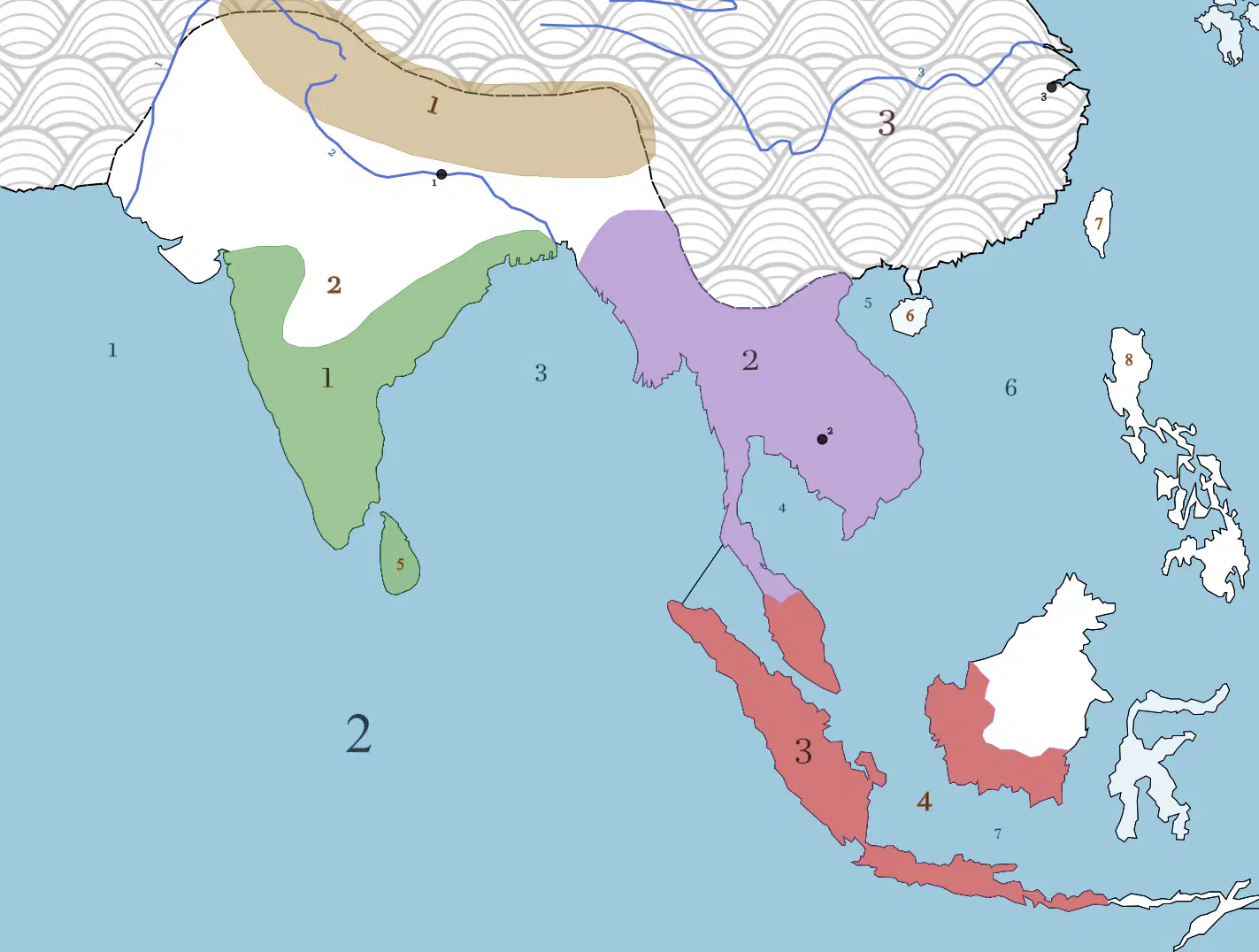
Which Empire is at #1 (Green)?
Chola
Khmer
Srivijaya
Mongol
Which Empire is at #2 (Purple)?
Chola
Khmer
Srivijaya
Mongol
Which Empire is at #3 (Red)?
Chola
Khmer
Srivijaya
Mongol
Which river is at #1?
Indus
Ganges
Yangtze
Yellow
Which Empire is at #2?
Indus
Ganges
Yangtze
Yellow
Which city is at #1?
Pataliputra (Patna)
Angkor
Hangzhou
Beijing
Which city is at #2?
Pataliputra (Patna)
Angkor
Hangzhou
Beijing
Which body of water is at #2?
Indian Ocean
Bay of Bengal
Java Sea
Gulf of Thailand
Gulf of Tonkin
Which body of water is at #3?
Indian Ocean
Bay of Bengal
Java Sea
Gulf of Thailand
Gulf of Tonkin
Which body of water is at #7?
Indian Ocean
Bay of Bengal
Java Sea
Gulf of Thailand
Gulf of Tonkin
Which body of water is at #4?
Indian Ocean
Bay of Bengal
Java Sea
Gulf of Thailand
Gulf of Tonkin
Which body of water is at #5?
Indian Ocean
Bay of Bengal
Java Sea
Gulf of Thailand
Gulf of Tonkin
Which island(s) is at #5?
Sri Lanka
Indonesia
Philippines
Hainan
Taiwan
Which island(s) is at #4?
Sri Lanka
Indonesia
Philippines
Hainan
Taiwan
Which island(s) is at #8?
Sri Lanka
Indonesia
Philippines
Hainan
Taiwan
Which island(s) is at #6?
Sri Lanka
Indonesia
Philippines
Hainan
Taiwan

SELECT ALL that are true of this structure:
It is the Angkor Wat
It was built by the Khmer Empire
It is a Buddhist temple
It was built by the Mughal Empire
It is the Taj Mahal
What is a thalassocracy?
government which derives its power through a strong navy and/or control of maritime trade
democratic government ruled by elected representatives
absolute government rule by a single individual
government in which land is divided and controlled by local lords
government rule by the noble elite or small group of noble families
What happened to Hinduism after the fall of the Gupta Empire?
Bhakti Yoga, the path of prayer, became popular and various regional Hindu deities became popular in different parts of India
Hinduism was gradually replaced by Islam as religion of India
Buddhism and Jainism gained in popularity, with all three religions having equal representation in India
Hinduims remained a unified religion as scholars & priests continued to collaborate as during the Gupta golden age
What event weakened the Gupta Empire and led to its breakup?
Invasion of the Hephtalites (White Huns)
Invasion of the Mongols
Invasion of the Muslims
A great flood destroyed all of the crops leading to years fo famine
SELECT ALL of Aryabhata's acheivements in astronomy & mathematics:
correctly calculated the periods of rotation and revolution of the Earth
discovered that the moon and planets reflect the Sun's light and do not produce their own
discovered the irrational number Pi
invented the base 10 number system, which includes zero
invented the Cartesian coordinate plane and rules for graphing on three axes

