
 Worksheets
Titsem in Mongolian Script
Total questions: 33
Worksheet time: 17mins
What is the meaning of 'Titsem' in the context of Mongolian script?
It refers to a diacritical mark used for vowel separation.
It is the name of a Mongolian ruler.
It means 'horse' in Mongolian.
It is a type of traditional Mongolian clothing.
The 'Titsem' symbol in Mongolian script originated from which source?
It was derived from the Old Uyghur script.
It was created during the Qing dynasty.
It originated from Tibetan script.
It was invented in the 20th century.
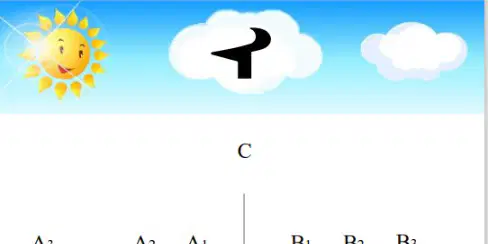
What letter is being illustrated in the diagram related to the passage about 'Titsem'?
A
B
C
D

Look at the diagram showing the stroke order for the traditional script character. What is the first stroke you should make when writing this character?
The first stroke is a downward line starting from the top, as shown in the diagram.
The first stroke is a horizontal line from left to right.
The first stroke is a small dot at the top right corner.
The first stroke is a curved line starting from the bottom.
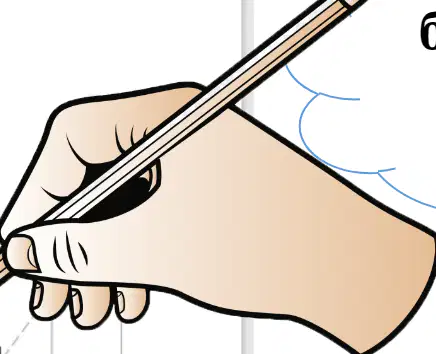
Which of the following describes the correct steps to write the character shown in the diagram using the traditional script?
Start with the top horizontal stroke, then add the vertical stroke, followed by the left and right side strokes.
Begin with the bottom stroke, then add the left vertical stroke, followed by the top horizontal stroke.
Write the left side stroke first, then the right side stroke, and finish with the bottom stroke.
Start with the vertical stroke, then add the bottom stroke, followed by the top horizontal stroke.
What is the main function of the 'Shuud' character in Mongolian script?
It is used at the beginning of words
It is written in the middle of words
It is used only in names
It is not used frequently
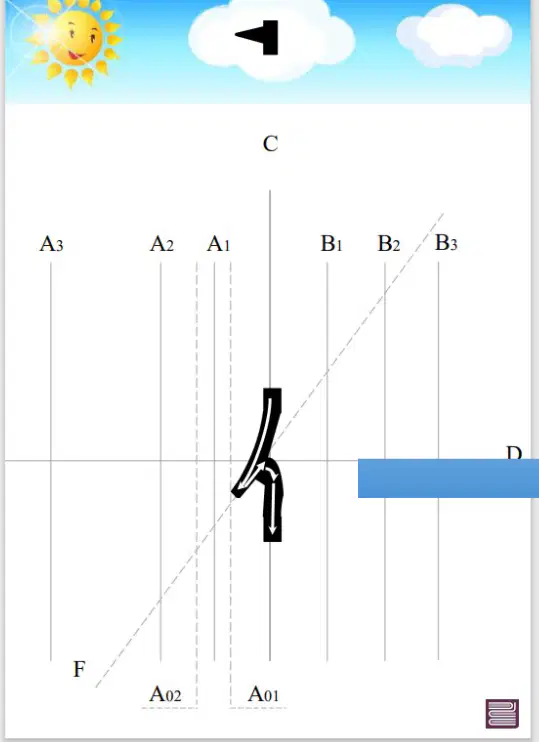
The diagram shows the structure of the 'Shuud' character in Mongolian script. What does the diagram illustrate about the character's position in writing?
It is positioned at the beginning of a word.
It is always written at the end of a sentence.
It is placed in the middle of a word.
It is used only in vertical writing.
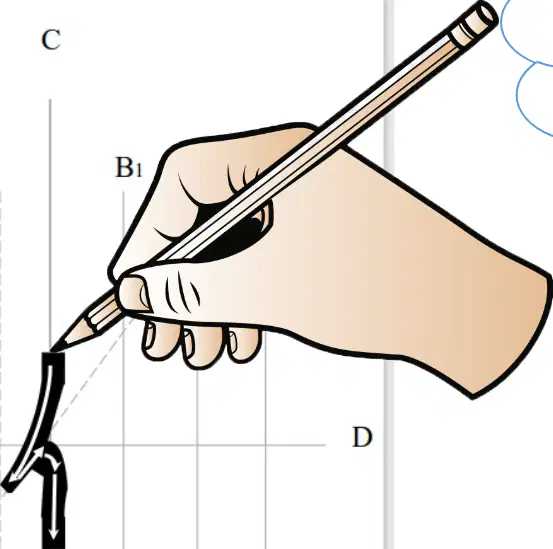
Refer to the diagram showing the steps for writing in the traditional script. Fill in the blank: The first stroke should start at point C and follow the direction indicated by the arrow.
The first stroke should start at point C and follow the direction indicated by the arrow.
The first stroke should start at point A and move away from the arrow.
The first stroke should start at point B and follow the direction opposite to the arrow.
The first stroke should start at point D and ignore the direction of the arrow.
Writing in the traditional script involves using which of the following methods?
Using classical characters and forms
Using modern simplified characters
Using only phonetic symbols
Using digital shorthand
Which Cyrillic letters are written using the 'Шилбэ' stroke?
и and ь
а and б
н and г
о and у
What is another name for the 'Шилбэ' stroke?
Long tooth
Short line
Curved hook
Dot
What does the blue arrow in the diagram indicate?
The blue arrow indicates the transformation or application of the 'Шилбэ' stroke to form the letters 'i' and 'N'.
The blue arrow shows the direction of writing for the letter 'M'.
The blue arrow represents the color coding for vowels in the diagram.
The blue arrow marks the starting point for drawing the letter 'A'.

Look at the diagram showing the steps to write the traditional script character. Which of the following options correctly replicates the character as shown in the diagram, following the indicated strokes and directions?
Option A: The character is written exactly as shown in the diagram, following the correct stroke order and direction.
Option B: The character is written with the strokes in reverse order.
Option C: The character is written with missing strokes.
Option D: The character is written with extra strokes not shown in the diagram.
According to the instructions, where is the 'Гэдэс' (stomach) written in a Mongolian word?
In the middle of the word
At the beginning of the word
At the end of the word
Outside the word
What does the name 'Гэдэс' refer to in the context of Mongolian script?
The head
The stomach
The tail
The leg
The 'Гэдэс' part of the Mongolian script is written more hanging and less forward than the 'Шүд' (tooth) part.
True
False
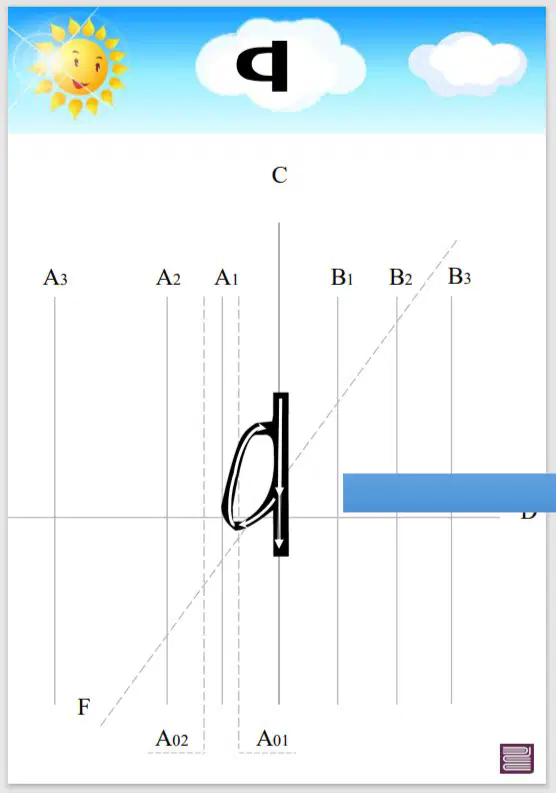
Which part of the Mongolian script does the diagram illustrate?
Head
Stomach
Tooth
Tail
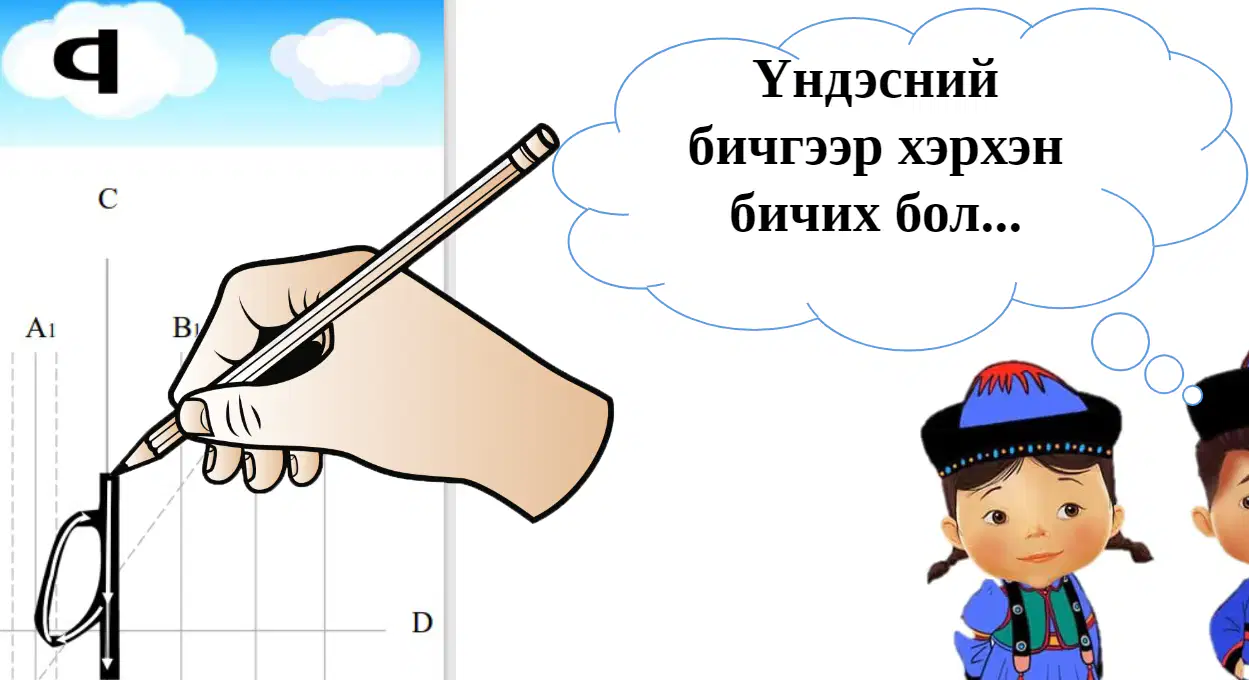
Look at the diagram showing how to write the character 'ᠬ' in the national script. What is the character shown in the diagram?
ᠬ
ᠭ
ᠪ
ᠰ
What does the term 'суул' refer to in Mongolian script?
The beginning of a word
The end of a word
The middle of a word
A type of animal
According to the passage, which letters use the 'tail' (суул) form at the end of a word in Mongolian script?
A) a, э, н
B) b, d, g
C) m, o, p
D) t, s, l
Fill in the blank: In Mongolian script, the 'tail' (суул) is used to write the letters ___, ___, and ___ at the end of a word.
a, э, н
б, г, д
о, у, м
т, с, р

Look at the diagram showing the steps to write the traditional script character. Practice writing the character by following the steps shown in the diagram.
The answer should be the correctly written character as shown in the diagram.
A character with the strokes written in the wrong order.
A character missing one of the strokes.
A character with an extra stroke added.
Read the passage: In Mongolian script, the final letter of a word is written separately. The separation from the previous letter is called 'Orkhits', and joining the previous letter is called 'Tsatslaga'. B and feminine word letters x, g are joined. Other letters (n, m, l, r, ya) are written separately. Which of the following letters are always written separately at the end of a word in Mongolian script?
B
x
n
g
Look at the diagram. Which letter is being shown in the writing process in the diagram? Fill in the blank: The letter shown in the diagram is _____.
T
L
F
E
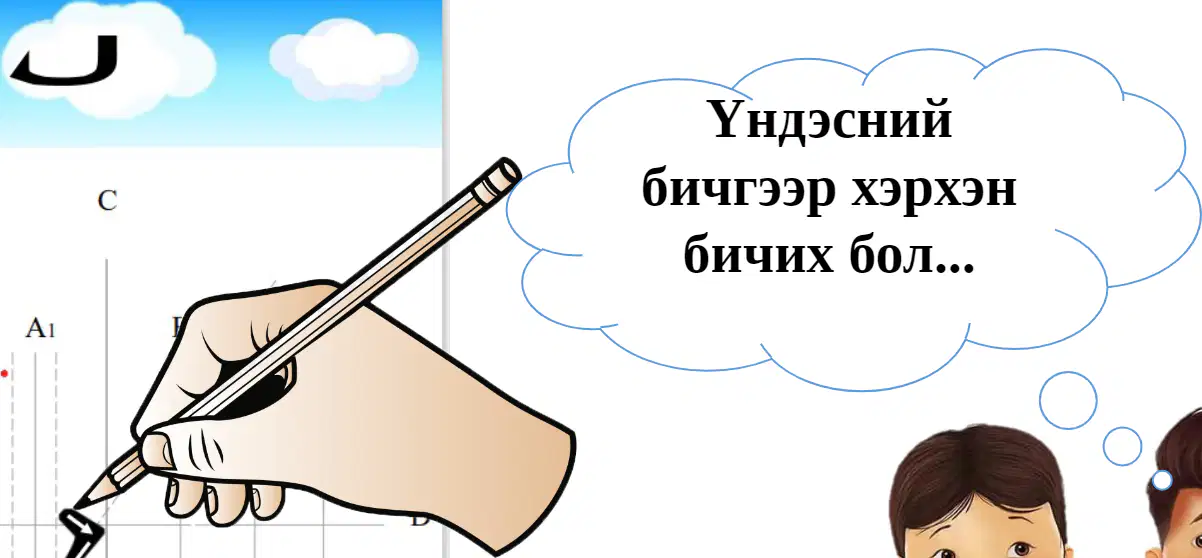
Look at the diagram showing the steps to write the traditional Mongolian script character. Which character is shown in the diagram?
ᠵ (Mongolian letter 'Ja')
ᠪ (Mongolian letter 'Ba')
ᠬ (Mongolian letter 'Qa')
ᠰ (Mongolian letter 'Sa')
Which letters are written using the 'Нум' shape at the end of words in Mongolian script?
The letters 'и' and 'ь' are written using the 'Нум' shape at the end of words.
The letters 'а' and 'о' are written using the 'Нум' shape at the end of words.
The letters 'н' and 'г' are written using the 'Нум' shape at the end of words.
The letters 'у' and 'ө' are written using the 'Нум' shape at the end of words.
In Mongolian script, the 'Нум' (Bow) shape is used at the end of words. It is named 'Нум' because it looks like a bow. The letters 'и' and 'ь' at the end of words are written using this shape.
True
False
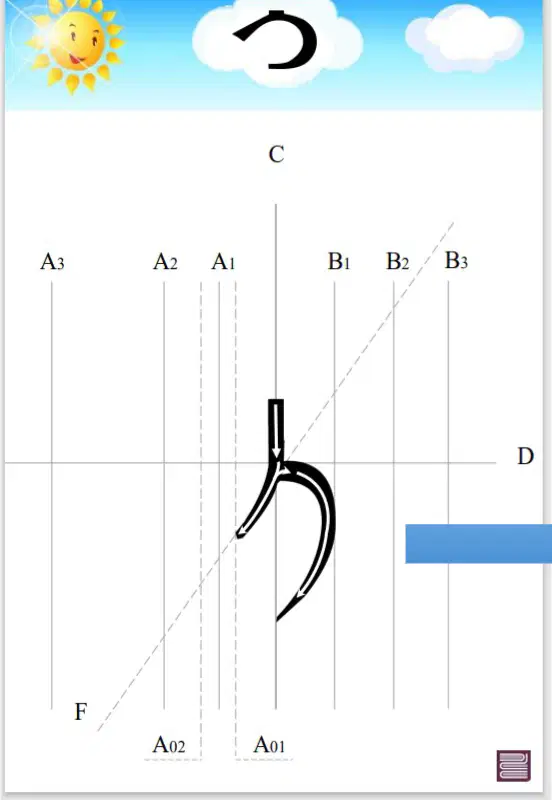
Which part of the diagram represents the 'Нум' shape used for the letters 'и' and 'ь'?
The curved shape in the center of the diagram represents the 'Нум' shape used for the letters 'и' and 'ь'.
The straight vertical line on the left side of the diagram represents the 'Нум' shape used for the letters 'и' and 'ь'.
The small circle at the top of the diagram represents the 'Нум' shape used for the letters 'и' and 'ь'.
The horizontal line at the bottom of the diagram represents the 'Нум' shape used for the letters 'и' and 'ь'.
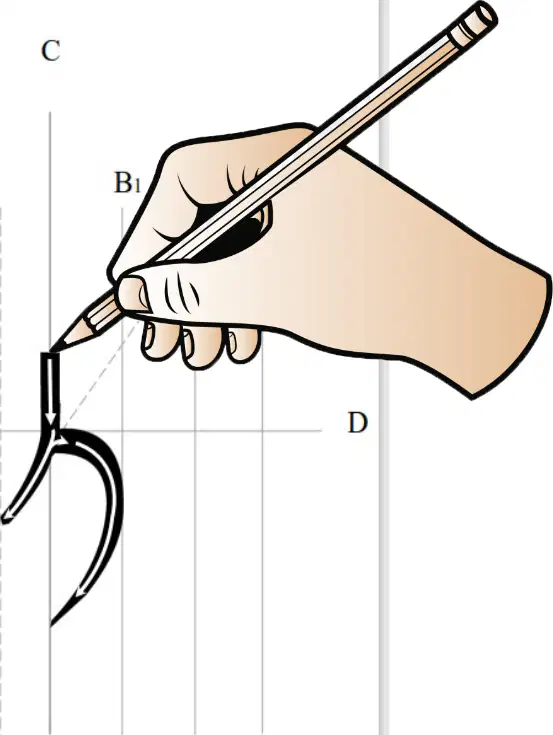
What is the first step in writing the character shown in the diagram?
Start at the top and draw a straight vertical line downwards, then curve to the left at the bottom.
Begin at the bottom and draw a horizontal line to the right.
Start at the middle and draw a diagonal line upwards to the left.
Begin at the top and draw a circle clockwise.
According to the passage, what is the 'bow with a belly' in Mongolian script?
A type of punctuation
A character written at the end of a word, made from a belly and a bow
A number
A verb
Which letters are written using the 'bow with a belly' form at the end of a word in Mongolian script?
A) O, U
B) U, Ü
C) U, Ü (as stated in the passage)
D) A, E
Fill in the blank: In Mongolian script, the 'bow with a belly' is used to write the letters ____ and ____ at the end of a word.
U and Ü
A and E
O and Ö
I and Y
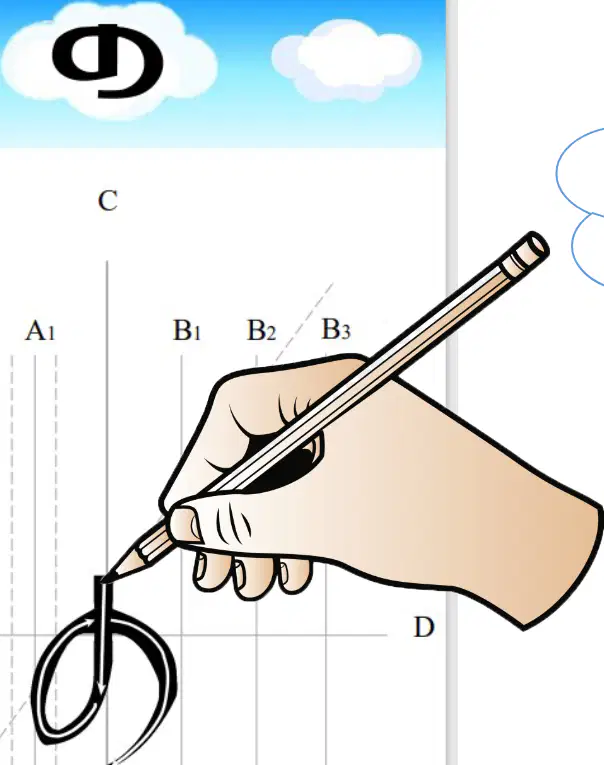
Look at the diagram showing the step-by-step process of writing a character in the traditional script. What character is being written?
Ф
Б
Д
Ж

