
 Worksheets
IS_Section Quiz_8.5_e — Worksheet Questions (Grade 13)
Total questions: 77
Worksheet time: 39mins
All metals conduct electricity equally well.
True
False
The resistance of an insulator is larger than that of a conductor.
False
True
When the resistance of a circuit is higher, the voltage is smaller.
True
False
A thinner wire has a higher resistance.
False
True
The resistance of a resistor cannot be adjusted.
False
True
A nichrome wire always conducts electricity poorer than a copper wire.
False
True
The resistance of an insulator is zero.
True
False
Resistance has no effect on the voltage of a circuit.
False
True
A longer wire has a higher resistance.
True
False
A hi-fi volume control is an application of resistors.
True
False
Which of the following statements about resistance is/are correct? (1) The resistance of a material measures the opposition of the material to the flow of electric current. (2) Good conductors have zero resistance. (3) A resistor has a larger resistance than a rheostat.
(1) and (2) only
(3) only
(2) and (3) only
(1) only
The resistance of a wire decreases when (1) its thickness increases. (2) its length increases. (3) the voltage in the circuit decreases.
(1) and (2) only
(1) only
(3) only
(2) and (3) only
Which of the following copper rods has the lowest resistance?
A copper rod of length 5 cm and thickness 5 mm
A copper rod of length 10 cm and thickness 5 mm
A copper rod of length 10 cm and thickness 10 mm
A copper rod of length 5 cm and thickness 10 mm
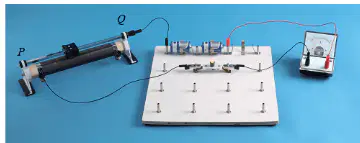
Which of the following methods can increase the brightness of the bulb in the circuit below? (1) Move the sliding contact towards P. (2) Move the sliding contact towards Q. (3) Add more electric cells to the circuit.
(2) only
(3) only
(1) and (3) only
(1) and (2) only
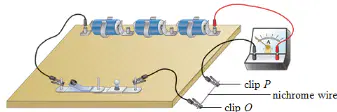
Which of the following methods can increase the brightness of the bulb in the circuit below? (1) Reduce the distance between clips P and Q. (2) Relocate the number of electric cells in the circuit. (3) Replace the nichrome wire with a thicker one.
(1) and (2) only
(1), (2) and (3)
(2) and (3) only
(1) and (3) only
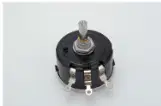
Which of the following statements about the device below is correct?
It can be used in the dimmer switch for a lamp.
Its resistance cannot be changed.
It is a sliding rheostat.
It can be used to measure resistance.

The diagram is an analogy to show the effect of length on the resistance of a wire. What do the obstacles in the analogy represent?
Free electrons
Resistance
Current
Voltage

The diagram is an analogy to show the effect of length on the resistance of a wire. Which of the following correctly explains the effect of length on the resistance of a wire using the analogy?
If the road is longer, fewer lorries can travel through the road in a given time.
If the road is longer, there are more obstacles on the road, and thus the ‘resistance’ to the lorries is higher.
If the road is longer, more lorries can travel through the road in a given time.
If the road is longer, there are more obstacles on the road, and thus the ‘resistance’ to the lorries is lower.
Which of the following will affect the resistance of a wire? (1) Thickness of the wire (2) Material of the wire (3) Voltage across the wire
(1), (2) and (3)
(1) and (2) only
(1) and (3) only
(2) and (3) only
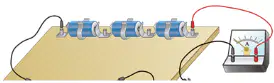
Which of the following methods can increase the brightness of the bulb in the circuit below?
(1) only
(2) only
(1) and (3) only
(2) and (3) only
When light bulbs are connected in series, they are connected one after the other on the same single path.
True
False
The current is the same at every point in a series circuit.
True
False
The current is the same at every point in a parallel circuit.
True
False
If a gap appears in a series circuit, no current can flow in the circuit.
True
False
If a gap appears in a branch of a parallel circuit, no current can flow in the other branch.
True
False
The voltage is the same at all points in a series circuit.
True
False
The brightness of different light bulbs must be the same in a series circuit.
False
True
The voltage across each branch of a parallel circuit is the same.
True
False
The current flowing through each branch of a parallel circuit is the same.
False
True
In a parallel circuit, the voltage of the electric cells is equal to the sum of the voltages in the branches.
False
True
Which of the following statements about a parallel circuit is correct?
The current in the main loop is equal to the current in each branch.
A larger current flows in the branch with a larger resistance.
The voltage is different across each branch.
The voltage across each branch is equal to the voltage across the electric cells.
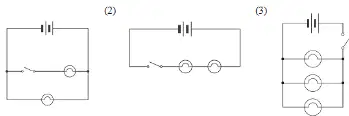
Which of the following circuits can turn the light bulbs on or off at the same time? The three small diagrams labeled (1), (2), and (3) show different switch placements controlling two bulbs.
(2) only
(2) and (3) only
(1) only
(1) and (3) only
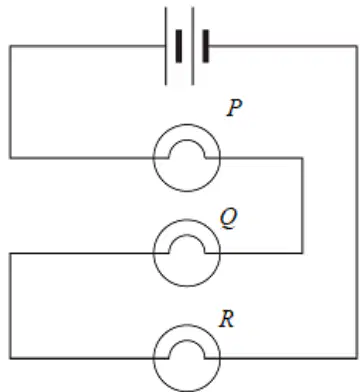
In the circuit, if the current flowing through light bulb P is 1 A, what are the currents flowing through light bulbs Q and R respectively?
Q: 2 A; R: 2 A
Q: 1 A; R: 1 A
Q: 1 A; R: 2 A
Q: 2 A; R: 1 A
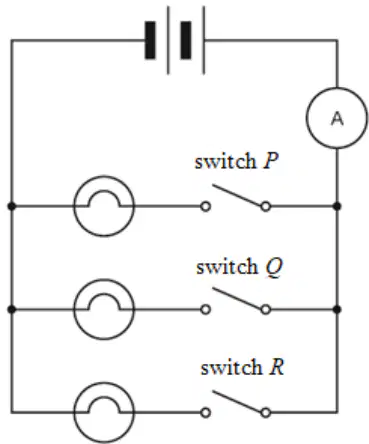
The three light bulbs in the circuit are the same. If switch P is closed, the ammeter reading is 1 A. What will the ammeter reading be if all switches are closed?
2 A
3 A
0 A
1 A
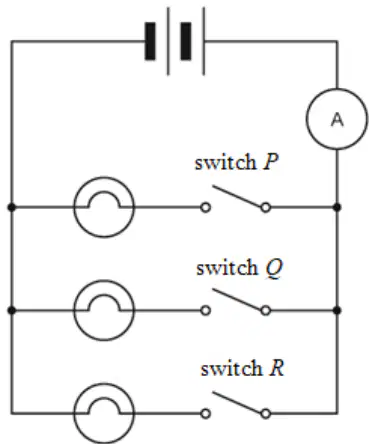
The three light bulbs in the circuit are the same. If switch P is closed, the ammeter reading is 1 A. If all switches are closed and one of the light bulbs is broken, what will the ammeter reading be?
2 A
1 A
3 A
0 A
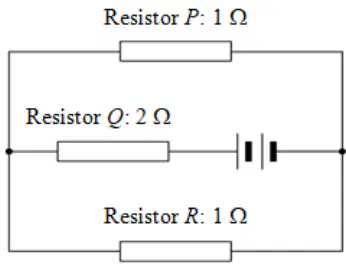
If the current flowing through resistor P is 1 A, what is the current flowing through resistor Q?
1 A
It cannot be determined.
0 A
2 A
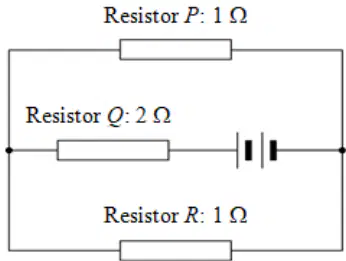
If resistor Q is removed, what will the current flowing through resistor R be?
1 A
2 A
It cannot be determined.
0 A
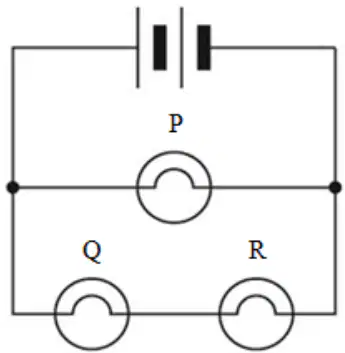
Three identical light bulbs P, Q and R are connected in a circuit. The voltage of the electric cells is 3 V. What is the voltage across light bulb P?
1.5 V
It cannot be determined.
4.5 V
3 V
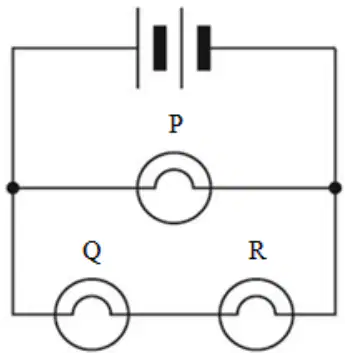
Three identical light bulbs P, Q and R are connected in a circuit. The voltage of the electric cells is 3 V. If light bulb Q is broken, what will the voltages across light bulbs P and R be?
Light bulb P: 1.5 V; Light bulb R: 0 V
Light bulb P: 3 V; Light bulb R: 0 V
Light bulb P: 1.5 V; Light bulb R: 1.5 V
Light bulb P: 3 V; Light bulb R: 3 V
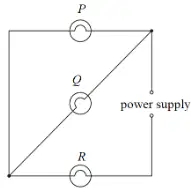
Which of the following statements about the circuit shown is correct? The diagram shows three light bulbs labeled P, Q and R connected by wires to a power supply; P is at the top left, R at the bottom left, and Q is on a diagonal branch leading to the power supply.
Light bulbs P and Q are connected in parallel.
Light bulbs P and Q are connected in series.
Light bulbs P, Q and R are connected in parallel.
Light bulbs P, Q and R are connected in series.
The mains voltage in Hong Kong is 110V .
False
True
The pins of a three-pin plug are connected to the live wire, neutral wire and earth wire respectively.
True
False
Domestic circuits are connected in series.
False
True
Connecting too many electrical appliances to a mains socket may result in short circuit.
True
False
The earth wire is used to protect us from getting an electric shock.
True
False
The mains voltages in different countries are the same.
False
True
Electric kettles work on the magnetic effect of electric current.
False
True
Electric motors convert kinetic energy into electrical energy.
False
True
Fuse rating shows the maximum current that can flow through the fuse.
True
False
Overloading can cause a dangerously large voltage in a circuit.
False
True
Which of the following statements about a live wire is correct?
A live wire protects us from getting an electric shock.
A live wire carries the voltage that drives the current flowing through the appliance.
The colour of a live wire is green.
A live wire provides a return path for the electric current.
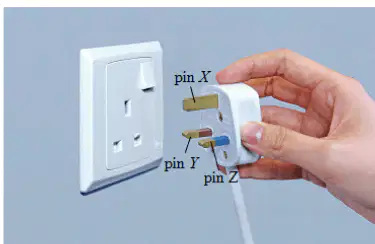
When an electrical appliance is in normal operation, which pins will electric current flow through? The diagram shows a wall socket and a plug with pins labeled X, Y and Z.
Pins X and Z
Pins Y and Z
Pins X and Y
Pins X, Y and Z
Which of the following electrical appliances make use of the heating effect of electric current? (1) Hairdryer (2) Electric toothbrush (3) Rice cooker
(2) and (3) only
(1) and (3) only
(1) and (2) only
(1), (2) and (3)
Which of the following electrical appliances makes use of the magnetic effect of electric current?
Electric kettle
Fan
Light bulb
Toaster
Which of the following statements about a fuse is INCORRECT?
Fuse rating shows the maximum current that can flow through the fuse without burning it.
The metal wire of a fuse melts when the current is larger than the fuse rating.
The fuse used in an appliance should have a fuse rating slightly lower than the current drawn by the appliance during normal operation.
After a fuse burns out, it cannot be used again.
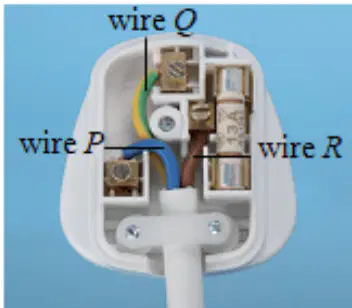
Which of the following wires provide(s) a return path for the current? The diagram shows the interior of a three-pin plug with wires labeled P, Q and R connected to their respective terminals.
Wires P and R only
Wire P only
Wire Q only
Wires Q and R only
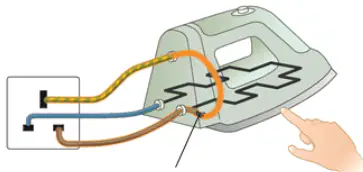
In the diagram, an appliance has a fault which causes the live wire to touch the metal casing. We would not get an electric shock if we touch the metal casing, because
the current will flow through the earth wire to the ground instead of through our body.
the current will flow through the metal casing to the ground instead of through our body.
the current will flow through the earth wire to the neutral wire instead of through our body.
the current will flow through the metal casing to the neutral wire instead of through our body.
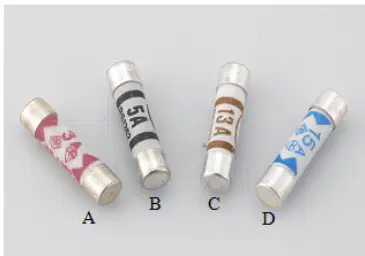
Under normal operation, the current flowing through a rice cooker is 10A . Which of the following fuses should we choose to protect the rice cooker? The diagram shows four cartridge fuses labeled A, B, C and D with visible current ratings.
A
C
D
B
Which of the following electrical appliances make use of the magnetic effect of electric current? (1) Electric door lock (2) Loudspeaker (3) Washing machine
Electric door lock
Loudspeaker
Washing machine
None of these
Which of the following is/are safety precautions when using electricity? (1) Install a fuse with fuse rating slightly lower than the current in the circuit under normal operation. (2) Leave enough space around electrical appliances to prevent overheating. (3) Repair damaged electrical appliances by ourselves.
(1) only
(1) and (3) only
(2) and (3) only
(2) only
A1. All non-metals are electrical insulators.
True
False
A2. In a series circuit, the current is the same at every point.
True
False
A3. A fuse is used to prevent a dangerously large current flowing through a circuit.
False
True
[E] A4. To produce light of certain brightness, a light bulb of a higher efficiency requires a smaller power input to work.
False
True
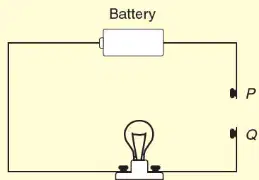
Rods made of different materials are connected between points P and Q in the circuit diagram with a battery and a light bulb. Which rod would cause the bulb to light?
Plastic rod
Glass rod
Wood rod
Copper rod
B2. Which of the following statements about the current in a closed circuit is correct?
Nuclei flow from the positive pole of the electric cell towards the negative pole.
Free electrons flow from the positive pole of the electric cell towards the negative pole.
Nuclei flow from the negative pole of the electric cell towards the positive pole.
Free electrons flow from the negative pole of the electric cell towards the positive pole.
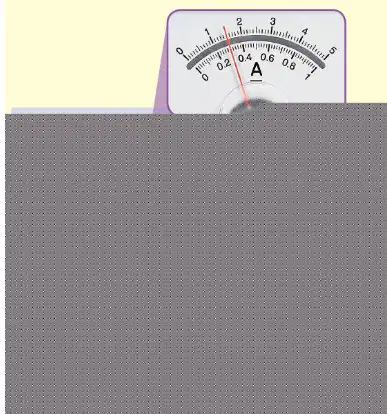
The photo shows an ammeter connected in series with a light bulb. B3. Answer the following question.
the current through the bulb is 0.3 A
the voltage across the bulb is 1.5 A
the voltage across the bulb is 0.3 A
the current through the bulb is 1.5 A
B4. Which of the following statements about an electromagnet are correct? (1) It works by making use of the heating effect of current. (2) It can be ‘turned off’ by cutting off the current. (3) Its strength increases with the current flowing through it.
(1) and (3) only
(2) and (3) only
(1) and (2) only
(1), (2) and (3)
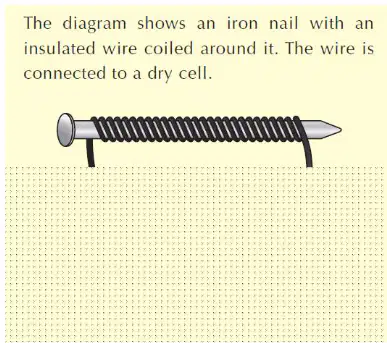
The diagram shows an iron nail with an insulated wire coiled around it. The wire is connected to a dry cell. B5. Answer the following question.
Nothing will happen to the nail.
The nail will melt.
The nail will become a magnet.
Electric current will flow through the nail.
[E] B6. Which of the following nichrome rods has the highest resistance?
A nichrome rod of length 20 cm and thickness 3 mm
A nichrome rod of length 20 cm and thickness 5 mm
A nichrome rod of length 10 cm and thickness 5 mm
A nichrome rod of length 10 cm and thickness 3 mm
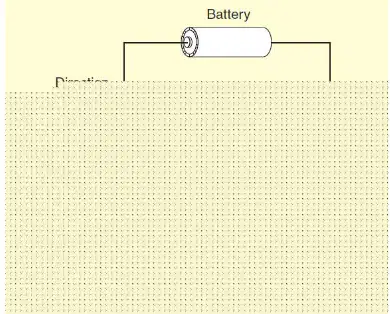
Three identical light bulbs are connected to a battery as shown in the diagram. The arrow indicates the direction of the current flow. B8. Answer the following question.
The current in Bulb 1 is greater than the current in Bulb 3.
The current in Bulb 2 is the same as the current in Bulb 1.
The current in Bulb 2 is the same as the current in Bulb 3.
The current in Bulb 1 is greater than the current in Bulb 2.
B9. Which of the following statements about an earth wire is correct?
The colour of an earth wire is brown.
An earth wire carries the mains voltage.
An electrical appliance without an earth wire cannot function normally.
An earth wire is used to protect us from getting an electric shock.
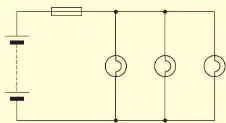
In the circuit diagram, the current through each light bulb in normal operation is 0.5 A. Which of the following is the most suitable rating of the fuse in the circuit? B10. Answer the following question.
2 A
0.5 A
1 A
3 A
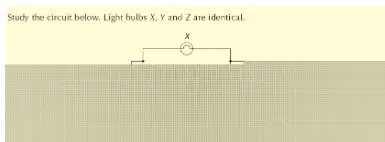
Study the circuit below. Light bulbs X, Y and Z are identical. C2(a) Answer the following question.
B. bulb X: 0.8 A; bulb Z: 0.4 A
D. bulb X: 1.2 A; bulb Z: 0 A
A. bulb X: 0.4 A; bulb Z: 0.8 A
C. bulb X: 0.6 A; bulb Z: 0.6 A
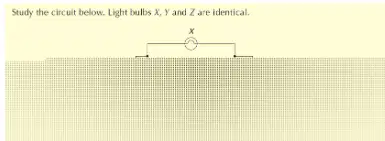
Study the circuit below. Light bulbs X, Y and Z are identical. C2(b) Answer the following question.
D. The current would remain unchanged.
C. The current would become zero.
B. The current would become very small.
A. The current would become very large.
C3(a) What is the mains voltage of Hong Kong?
B. 200 V
D. 250 V
C. 220 V
A. 110 V

A 1500 W microwave oven works on the mains voltage of Hong Kong. [E] C3(b) The microwave oven is turned on for 15 minutes. What is the electrical energy used?
C. 13 500 J
A. 1350 J
B. 1500 J
D. 1 350 000 J

