wayground logo

Free Printable Worksheets

Font size

S
M
L
XL
Worksheets

INV 9 Test FOSS WW

Total questions: 21

Worksheet time: 27mins
Name
Class
Date
1.
Greenhouse gases are of concern to scientists interested in climate change. Check each statement that helps explain why scientists are concerned about greenhouse gases; leave each statement that does not help explain the concern blank.
a)
Greenhouse gases absorb thermal energy radiated by the Sun.
b)
Carbon dioxide (a greenhouse gas) is breathed out by billions of people all over the world.
c)
Greenhouse gases absorb more energy from visible light than from infrared radiation.
d)
Thermal energy that encounters greenhouse gases cannot escape the atmosphere.
2.
Define paleoclimatolgy.
a)
the study of climates
b)
the study of ancient climates
c)
the study of ancient places
d)
the study of ancient organisms
3.
How do we know what the climate was like in the past?
a)
Record nitrogen levels
b)
Utilize solar panels
c)
Record the surface temperatures aroudn the globe
d)
Analyze ice cores
4.
As we add greenhouse-gases like carbon dioxide to the atmosphere, we can expect...
a)
more oxygen gas in the atmosphere.
b)
a contiuously cooling global climate.
c)
the Antarctic ice sheets to grow.
d)
a contiuously warming global climate.
5.
Why are ice cores important for understanding past climate?
a)
Air bubbles trapped in ice provide information about the atmosphere of the past.
b)
Ocean and lake sediments include tiny fossils and chemicals that are used to interpret past climates.
c)
Coral skeleton formed in the winter has a different density than that formed in the summer.
d)
Tree-ring growth is influenced by climate conditions.
6.
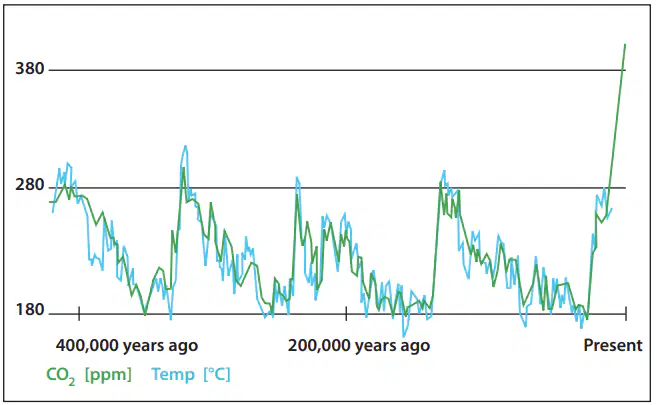
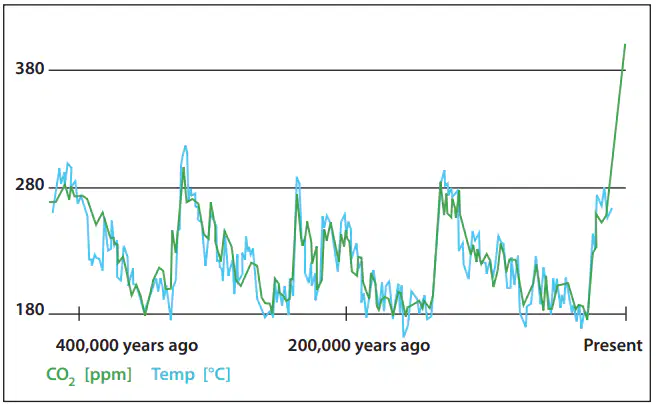
Here is the CO2 and Temperature Relationship graph. Describe the general pattern of the data (before the Industrial Revolution).
a)
The global CO2 levels spike to 280 ppm and back down to 180 ppm repeatedly.
b)
The global CO2 levels spike to 380 ppm and back down to 180 ppm repeatedly.
c)
The global CO2 levels spike to 380 ppm.
d)
The global CO2 levels are always around 280 ppm.
7.
Here is the CO2 and Temperature Relationship graph. What does this graph suggest about Earth's "natural" state of CO2?
a)
The global CO2 levels we see in the present are at a natural level.
b)
The global CO2 levels are exactly the same as the temperature in Celsius.
c)
The global CO2 levels naturally fluctuate between 280 and 180 ppm.
d)
The global CO2 levels we see in the present are around 280 ppm.
8.
When you increase the greenhouse-gas concentration, what happens to the amount of infrared energy in the atmosphere?
a)
Increases
b)
Decreases
c)
Stays the same
9.
Carbon Sinks (places that absorb carbon more than release it) include...
a)
forests, wildfires, and deforestation
b)
burning fossil fuels, wildfires, and deforestation
c)
forests, atmosphere, and volcanoes
d)
forests, fossil fuel formation, and oceans
e)
fossil fuel formation, living things, and volcanoes
10.
Carbon Sources (places that release carbon more than absorb it) include...
a)
forests, wildfires, and deforestation
b)
burning fossil fuels, wildfires, and deforestation
c)
forests, atmosphere, and volcanoes
d)
forests, fossil fuel formation, and oceans
e)
fossil fuel formation, living things, and volcanoes
11.
What are some ways society could reduce carbon dioxide emissions?
a)
Use electricity and use public transportation
b)
Harness more solar-, wind-, and water-powered energy
c)
Start a gasoline engine
d)
Stop providing public transportation
e)
Make products less efficient
12.
True or False: The troposphere has gone up by 0.6 degreese Celsius in the past 100 years.
a)
True
b)
False
13.
What are the consequences of rising sea levels?
a)
flooding of low-lying farmland
b)
flooding of mountain homes
c)
droughts near the coastlines
d)
erosion of the coastline
14.
Predicted changes due to climate change include...
a)
increased frequency of storms and hurricanes
b)

permanent decrease in Earth's temperatures

c)

loss of seasons worldwide

d)

glaciers growing larger

e)

all regions on Earth receiving the same amount of rainfall each year

15.
This is an image demonstrating...
a)
Tornado Formation
b)
The Greenhouse Effect
c)
Hurricane Formation
16.
The greenhouse gas having the greatest role in human-caused global warming is
a)
methane
b)
carbon dioxide
c)
CFCs (chlorofluorocarbons)
d)
ozone
17.

What is the primary cause of current climate change?

a)

Solar flares

b)

Human activities, such as burning fossil fuels

c)

Natural variations in Earth's orbit

d)

Volcanic eruptions

18.

Global warming refers specifically to an increase in

a)

Earth's average surface temperature.

b)

temperatures everywhere on Earth.

c)

precipitation from Earth's atmosphere.

d)

the number of storms on Earth.

19.

Which of the following is a direct effect of increased atmospheric greenhouse gases?

a)

Stabilization of sea levels

b)

Decrease in global average temperature

c)

Increase in global average temperature

d)

Reduction in extreme weather events

20.

Which human activity contributes most to the increase of carbon dioxide in the atmosphere?

a)

Planting trees

b)

Burning fossil fuels

c)

Using solar panels

d)

Recycling plastics

21.

What is one method scientists use to study ancient atmospheric conditions?

a)

Measuring current rainfall

b)

Analyzing tree rings

c)

Observing animal migration

d)

Counting sunspots