
 Worksheets
Economics in Business Pre-Test (Grade 11)
Total questions: 45
Worksheet time: 23mins
The opportunity cost of a new city park is the (unit 1)
cost of staff and maintenance for the park.
increased congestion from traffic around the park.
best alternative use of resources given up for the park.
lack of personal incentive for people to take care of a public park.
Which do economists consider to be a productive resource (factor of production)? (unit 1)
Labor.
Profit.
Money.
Interest.
In every economic system, people must choose how to (unit 1)
satisfy all of the wants of society.
make the best use of scarce resources.
create an equal distribution of income.
save money to reduce the national debt.
A small business would like to hire more workers. Each additional worker hired costs the business $100 a day. The additional revenue the business receives from having more workers is $150 per day for first worker, $130 per day for the second worker, $110 per day for the third worker; and $90 for the fourth worker. How many workers in total should the business hire to maximize its profits? (unit 2)
One worker.
Two workers.
Three workers.
Four workers.
The essential difference between a command economy and a market economy is that in a market economy (unit 1)
shortages occur more often than surpluses.
buyers and sellers determine resource allocation.
central planning creates an effective incentive system for consumers and producers.
the prices of products and resources are largely determined by government regulation of businesses.
Which is a basic economic question that must be answered by all economic systems? (unit 1)
How will corporations be organized?
How can markets be kept competitive?
What goods and services will be produced?
What form of central planning will the government use?
Profits are equal to total (unit 2)
revenue minus total cost.
assets minus total liabilities.
sales minus wages and salaries.
sales minus taxes and depreciation.
If the government decides to increase the payroll taxes on the wages and salaries of workers, then there will most likely be: (unit 3)
an increase in saving.
an increase in investment.
a decrease in unemployment.
a decrease in consumption.
A high school student buys a dinner at a restaurant. The restaurant offers a special price which takes 20 percent off the regular price of the dinner. In this exchange, (unit 2)
the student and the restaurant benefit.
the student benefits, but the restaurant does not.
the restaurant benefits, but the student does not.
neither the student nor the restaurant benefits.
Some members of Congress want to increase the general level of tariffs. If this increase occurs, then we should expect (unit 6)
a decrease in U.S. inflation.
a decrease in U.S. import quotas.
a decrease in imports into the U.S.
an increase in U.S. exports to other nations.
The specialization of labor usually results in (unit 2)
an increase in inflation.
a more equal distribution of income.
an increase in output per hour worked.
a decrease in economic interdependence.
Which best describes what the law of comparative advantage means for trading nations? (unit 6)
Each trading nation can benefit by exporting goods that it produces at low opportunity costs and importing goods it produces at high opportunity costs.
It produces at high opportunity costs and importing goods it produces at low opportunity costs.
people enjoy least and importing goods that they enjoy most.
people enjoy most and importing goods that they enjoy least.
When there is a surplus of a product in a competitive market, it is usually the case that the (unit 2)
market price of the product will eventually decrease.
market price of the product will eventually increase.
quantity of the product exchanged in the market will eventually decrease.
quantity of the product exchanged in the market will not change, but supply will increase.
The exchange rate between the U.S. dollar and the Japanese yen changes from 1=100yento 1=125 yen. This change means that (unit 6)
there will be an increase in U.S. exports to Japan.
there will be a decrease in U.S. exports to Japan.
Japanese goods will be more expensive for Americans.
U.S. goods will be less expensive for Japanese.
If the government charges a new tax of one dollar on every pair of blue jeans sold, which would most likely result? (unit 2)
Consumers would pay a higher price for blue jeans and buy fewer pairs of blue jeans.
Consumers would pay a higher price for blue jeans and blue jeans sellers would make larger profits.
Consumers would pay a higher price and blue jeans sellers would limit the number blue jeans consumer could buy.
Blue jeans sellers would increase the quantity sold in order to make up for the taxes paid to the government.
Which would most likely decrease the quantity of corn sold in a competitive market? (unit 2)
An increase in the price of fertilizer.
An increase in the incomes of consumers.
A decrease in the price of farm equipment.
An improvement in the technology of growing corn.
A newspaper reports that the price of oranges increased and the quantity sold decreased. In a competitive market, this situation would most likely be the result of (unit 2)
a decrease in demand.
an increase in demand.
an increase in supply.
a decrease in supply.
Business firms wish to sell their products at high prices. Households wish to buy products at low prices. In a market economy this conflict of interest is resolved by (unit 2)
lawsuits.
competition.
collective bargaining.
government regulation.
A newspaper reports, "COFFEE GROWERS’ MONOPOLY BROKEN INTO SEVERAL COMPETING FIRMS." If this is true, we would expect the coffee-growing industry to (unit 2)
decrease output and decrease prices.
increase output and increase prices.
decrease output and increase prices.
increase output and decrease prices.
Which is most essential for an efficient market economy? (unit 1)
Effective labor unions.
Strong government regulation.
Active competition in the marketplace.
Responsible decisions by business leaders.
The major purpose of the commercial banking system in the economy is to (unit 4)
sell corporate stocks and bonds
hold financial assets for the Federal Reserve System
loan funds from depositors to credit-worthy borrowers
earn a rate of return on money invested with government agencies
When workers join unions and elect representatives to negotiate with their employers, this is referred to as (unit ?)
a closed shop
the seniority system
collective bargaining
right to work legislation
Which item is included in the basic money supply in the United States? (unit 4)
Gold
Silver
Corporate bonds
Checking account deposits
When commercial banks increase their loans to businesses and consumers, this usually results in (unit 4)
a decrease in the spending power of consumers and businesses
an increase in government control over the economy
an increase in the banks’ excess reserves
an increase in the nation’s money supply
Inflation is a (3)
sharp rise in the price of a major product
substantial decline in the consumer price index
sustained increase in the general level of prices
rapid movement of the economy toward full-employment
A decrease in real interest rates provides an incentive for people to save (4)
more and borrow more
less and borrow less
more and borrow less
less and borrow more
Which best describes the general relationship between the risk that a business will default on a loan and the interest rate charged for the loan? (4)
A lower interest rate is charged on loans with more risk of default
A higher interest rate is charged on loans with less risk of default
A lower interest rate is charged on loans with less risk of default
The interest rate charged on loans is the same regardless of the risk of default
In a market economy, high wages depend mostly on (unit 1)
responsible business leaders
high output per worker
actions of government
minimum wage laws
Why do medical doctors generally earn more than farmers? (unit 1)
Medical doctors are more efficient than farmers
Medical doctors provide a service rather than make a product
There are fewer medical doctors than farmers in our economy
Medical doctors are more scarce, given the demand for their services
People who take the risks of organizing productive resources to produce goods and services in the expectation of making profits are (unit 1)
economists
stockbrokers
entrepreneurs
business managers
Which would most likely decrease the productivity of labor? (unit 1)
A rise in the pay of workers
A fall in the rate of interest
A reduction in the tax rates on income
A decline in the amount of capital goods
Economies that grow rapidly over time usually have a high rate of (unit 1)
growth in gold reserves
capital investment
unemployment
tariffs
Government rather than private business provides a public good such as flood control because (unit 5)
private businesses do not like to produce services for the government
those who do not pay for a public good still receive the benefits
when a person uses a public good, less is available for others
a public good does not benefit individuals
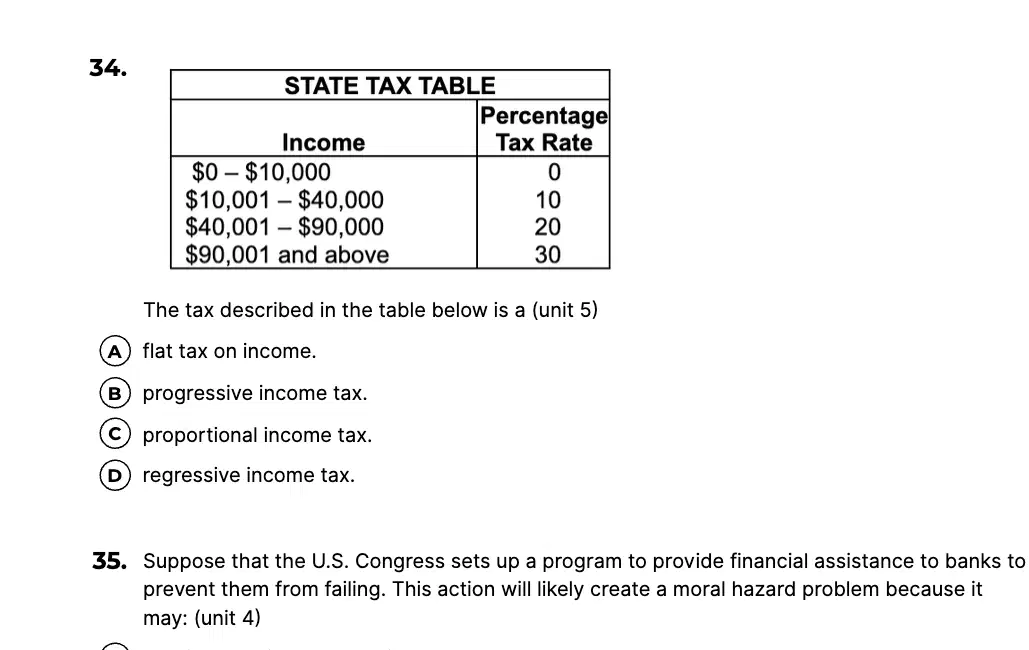
The tax described in the table is a (unit 5). State tax table: income 0– 10,000 taxed at 0%; 10,001– 40,000 at 10%; 40,001– 90,000 at 20%; $90,001 and above at 30%.
flat tax on income
progressive income tax
proportional income tax
regressive income tax
Suppose that the U.S. Congress sets up a program to provide financial assistance to banks to prevent them from failing. This action will likely create a moral hazard problem because it may: (unit 4)
restrict bank investments in real estate
encourage bank officials to make riskier loans
reduce the amount of deposits made by bank customers
increase the screening by banks of deposits from bank customer
Gross domestic product (GDP) is a measure of (unit 3)
the price level of goods and services sold
total spending by federal, state, and local governments
the quantity of goods and services produced by private businesses
the market value of the nation’s output of final goods and services
A nation has an international trade surplus when (unit 6)
its exports are greater than its imports
its imports are greater than its exports
its tax revenues are greater than its government expenditures
its gold reserves are greater than gold reserves of its trading partners
Which best measures a nation’s standard of living over time? (unit 3)
Rate of inflation
Rate of unemployment
Real income per capita
Money income per capita
The maximum output a nation could possibly produce in any one year is limited by its (unit 1)
productive resources
business investment
unemployment rate
consumer income
Which would usually increase total spending in the economy? (unit 4)
An increase in tax rates
An increase in interest rates
An increase in the savings rate
An increase in business investment
During a recession in an economy, there will be an increase in (unit 3)
imports
unemployment
economic growth
business spending
Unexpected inflation is most likely to benefit people (unit 3)
saving money in accounts at financial institutions
owing money on loans at fixed interest rates
living on fixed incomes and pensions
holding life insurance policies
One reason the federal government might reduce taxes is to (unit 4)
slow down the rate of inflation
slow down a rapid rise in interest rates
decrease business spending on plant and equipment
increase consumer spending and stimulate the economy
A government budget surplus exists when (unit 4)
tax revenues are greater than government spending
government spending is decreased
the national debt is increasing
taxes are increased
Which monetary policy would the Federal Reserve most likely adopt to fight high inflation during a period of low unemployment? (unit 4)
Raise the federal funds rate
Increase the supply of money
Increase federal government spending
Lower the reserve requirements for banks

