
Font size
 Worksheets
AP BIO - Cellular Energetics (MCQs & FRQs)
Total questions: 25
Worksheet time: 51mins
Which process directly generates the most ATP in aerobic cellular respiration?
Pyruvate oxidation ATP yield
Chemiosmosis via ATP synthase
Citric acid cycle ATP formation
Glycolysis pathway ATP production
In cellular respiration, oxygen's primary role is to:
Act as an oxidizing agent in Krebs
Accept electrons at the end of ETC
Initiate water formation in Krebs
Combine with CO2 to form water
During photosynthesis, the splitting of water molecules is most directly associated with:
ATP synthesis in stroma
Generation of NADPH in light reactions
Function of Photosystem II
Calvin cycle carbon fixation
A mutation prevents a cell from producing RuBisCO. Which process is immediately impacted?
Light-dependent electron transport
Fixation of carbon into organic molecules
ATP production in cyclic photophosphorylation
Conversion of acetyl CoA to pyruvate
Where are proton gradients primarily established—highest proton concentration—in photosynthesis and cellular respiration, respectively?
Thylakoid lumen; mitochondrial intermembrane space
Stroma; mitochondrial matrix
Intermembrane space; thylakoid lumen
Thylakoid lumen; mitochondrial matrix
Why do muscle cells switch to lactic acid fermentation during strenuous exercise?
Reduce FAD to FADH2 for Krebs
Produce small ATP for immediate use
Regenerate NAD+ so glycolysis continues
Use CO2 as final electron acceptor
A toxin inhibits NADH dehydrogenase (Complex I) in mitochondrial ETC. What is the immediate effect?
Stop the Krebs cycle completely
Prevent reduction of FAD to FADH2
Sharp decrease in proton gradient across inner membrane
Increase ATP via substrate-level phosphorylation
Which of the following describes the flow of electrons during the light-dependent reactions of photosynthesis?
Electrons are removed from water at PSII, move through the ETC, and reduce NADP+ to NADPH
Electrons start at PSI, move to PSII, then to ATP synthase, and finally to NADH
Electrons move from NADPH to PSII, pass ATP synthase, and return to chlorophyll
Electrons leave chlorophyll, go directly to Calvin cycle, and form glucose
In the reduction phase of the Calvin cycle, what molecule is oxidized?
Glyceraldehyde-3-phosphate (G3P)
NADPH to NADP+
3-phosphoglycerate (3-PGA)
Ribulose-1,5-bisphosphate (RuBP)
Which of the following is an input to both the Krebs (Citric Acid) cycle and the Calvin cycle?
A six-carbon sugar
Water (H2O)
CO2
ATP
During glycolysis, a phosphate group is transferred from PEP (phosphoenolpyruvate) to ADP to form ATP. This mechanism is known as:
Oxidative phosphorylation
Photophosphorylation
Substrate-level phosphorylation
Chemiosmosis
Which statement accurately compares the roles of NADH and NADPH?
Both carry high-energy electrons for ATP synthesis in mitochondria
NADH is used in catabolic reactions; NADPH is used in anabolic reactions
Both are oxidized in the electron transport chains of chloroplasts
Both are produced in the stroma of the chloroplast
If a cell has sufficient levels of ATP, the enzyme phosphofructokinase (PFK) will be inhibited. PFK’s inhibition shows which process?
Oxidative phosphorylation
The Krebs cycle
Glycolysis
Pyruvate oxidation
Chlorophyll appears green because it:
Absorbs green light most efficiently
Reflects and transmits green light
Is energized only by green light photons
Converts green light energy into chemical energy
Which of the following is NOT an output of the Krebs (Citric Acid) cycle per glucose molecule?
2 ATP or 2 GTP
4 FADH2
6 NADH
4 CO2
The primary difference between cyclic and non-cyclic photophosphorylation is that cyclic photophosphorylation:
Occurs in the stroma instead of the thylakoid membrane
Does not require light energy
Involves both Photosystem I and Photosystem II
Does not produce oxygen or NADPH
Which molecule is a product of photosynthesis and a reactant in cellular respiration?
Glucose
Water
Oxygen gas
Carbon Dioxide
In the process of chemiosmosis in the mitochondrion, the energy to phosphorylate ADP is derived from:
The direct transfer of a phosphate from an intermediate substrate
The NADH generated in the Krebs cycle
The flow of electrons through the electron transport chain
The kinetic energy of protons flowing down their concentration gradient
How does the anatomical structure of a C4 plant aid in minimizing photorespiration?
It spatially separates initial CO2 fixation and the Calvin cycle into mesophyll and bundle-sheath cells
It separates the light reactions and the Calvin cycle into two different chloroplasts
It uses PEP carboxylase to initially fix CO2 in bundle-sheath cells
It separates initial CO2 fixation and the Calvin cycle by time
Which of the following would inhibit the FADH2-driven part of the electron transport chain but still allow for NADH-driven ATP synthesis?
A toxin that inhibits Complex II (Succinate Dehydrogenase)
A toxin that inhibits Complex IV (Cytochrome c Oxidase)
A chemical uncoupler that makes the membrane leaky to protons
An inhibitor of ATP synthase
Many species of bacteria grow in the mouths of animals and can form biofilms on teeth (plaque). Within plaque, the outer layers contain high levels of oxygen and the layers closest to the tooth contain low levels of oxygen. The surface of the tooth is covered in a hard layer of enamel, which can be dissolved under acidic conditions. When the enamel breaks down, the bacteria in plaque can extract nutrients from the tooth and cause cavities.
Certain types of bacteria (e.g., Streptococcus mutans) thrive in the innermost anaerobic layers of the plaque and are associated with cavities. Other types of bacteria (Streptococcus sanguinis) compete with S. mutans but are unable to thrive in acidic environments.
(a) Identify the biochemical pathway S. mutans uses for metabolizing sugar and describe how the pathway contributes to the low pH in the inner layers of plaque.
(b) Normal tooth brushing effectively removes much of the plaque from the flat surfaces of teeth but cannot reach the surfaces between teeth. Many commercial toothpastes contain alkaline components, which raise the pH of the mouth. Predict how the population sizes of S. mutans AND S. sanguinis in the bacterial community in the plaque between the teeth are likely to change when these toothpastes are used.
The pyruvate dehydrogenase complex (PDC) catalyzes the conversion of pyruvate to acetyl-CoA, a substrate for the Krebs (citric acid) cycle. The rate of pyruvate conversion is greatly reduced in individuals with PDC deficiency, a rare disorder.
(a) Identify the cellular location where PDC is most active.
(b) Make a claim about how PDC deficiency affects the amount of NADH produced by glycolysis AND the amount of NADH produced by the Krebs (citric acid) cycle in a cell. Provide reasoning to support your claims based on the position of the PDC-catalyzed reaction in the sequence of the cellular respiration
pathway.
(c) PDC deficiency is caused by mutations in the PDHA1 gene, which is located on the X chromosome. A male with PDC deficiency and a homozygous female with no family history of PDC deficiency have a male offspring. Calculate the probability that the male offspring will have PDC deficiency.
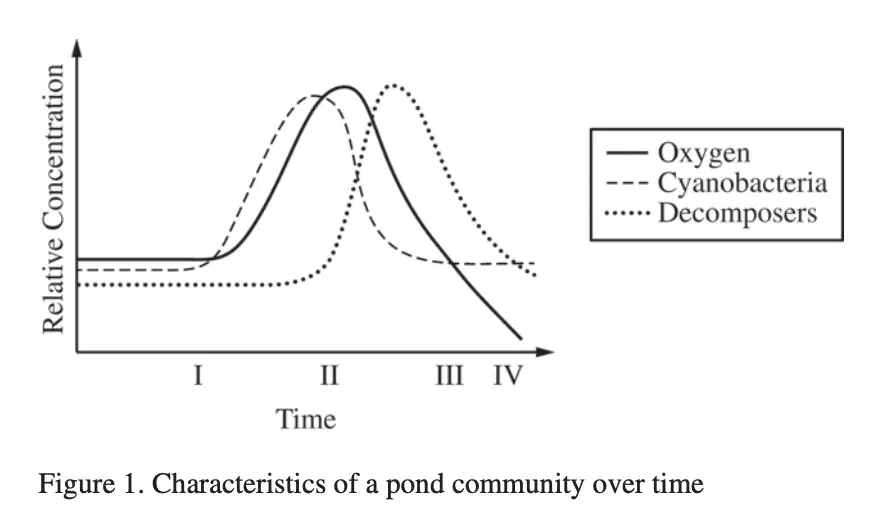
Microcystis aeruginosis is a freshwater photosynthetic cyanobacterium. When temperatures increase and nutrients are readily available in its pond habitat, M. aeruginosis undergoes rapid cell division and forms an extremely large, visible mass of cells called an algal bloom. M. aeruginosis has a short life span and is decomposed by aerobic bacteria and fungi.
Identify the metabolic pathway and the organism that is primarily responsible for the change in oxygen level in the pond between times I and II AND between times III and IV.
Researchers hypothesize that the plant compound resveratrol improves mitochondrial function. To test this hypothesis, researchers dissolve resveratrol in dimethyl sulfoxide (DMSO). The solution readily passes through cell membranes. They add the resveratrol solution to mammalian muscle cells growing in a nutrient-rich solution (culture medium) that contains glucose. They measure ATP production at several time points after the addition of the resveratrol solution and find an increase in ATP production by the muscle cells.
(a) Describe the primary advantage for a mammalian muscle cell in using aerobic respiration over fermentation.
(b) Identify an appropriate negative control for this experiment that would allow the researchers to concludemthat ATP is produced in response to the resveratrol treatment.
(c) Predict the effect on short-term ATP production when resveratrol-treated mammalian muscle cells are grown in a culture medium that lacks glucose or other sugars.
(d) The researchers find that resveratrol stimulates the production of components of the electron transport chain. The researchers claim that treatment with resveratrol will also increase oxygen consumption by the cells if glucose is not limiting. Justify the claim.

