
Font size
 Worksheets
Art UIL - Part B
Total questions: 55
Worksheet time: 28mins

Which art genre best fits the painting of many desserts on stands labeled “Cakes” by Wayne Thiebaud (1963)?
Landscape painting showing mountains and trees
Still life featuring everyday dessert objects
Abstract expressionist lines and splatters
Historical scene with famous past events
Match each artist to the main subject or style shown.
Wayne Thiebaud
Dessert still life on cake stands
Chuck Close
Large portrait built from colorful units
Jackson Pollock
Drip painting with energetic splatters

In the portrait titled “Jasper” by Chuck Close (1997–1998), which technique is suggested by the colorful repeating units across the face?
Loose sketch lines with quick charcoal marks
Flat color blocks without visible texture
Random splashes with poured enamel paint
Grid-based pattern forming a large image

Which work on the slides is identified as Modern rather than Contemporary?
Cathedral by Jackson Pollock, 1947
All three are labeled Contemporary
Jasper by Chuck Close, 1997–1998
Cakes by Wayne Thiebaud, 1963

Select all statements that describe Jackson Pollock’s “Cathedral.”
Built from a grid of colored squares
Uses drip technique with layered lines
Shows carefully arranged fruit desserts
Created in 1947 in Modern period
Which comparison is most accurate when looking across the three artworks?
Thiebaud and Pollock both paint portraits
Thiebaud focuses on objects; Close focuses on people
Pollock and Thiebaud both show historical events
Close and Pollock both use drip techniques

Look at the Rothko painting with two large color rectangles. Which art approach best describes this work?
Color field painting focusing soft-edged blocks
Pop art using bright icons from advertisements
Cubist collage with overlapping sharp shapes
Realistic landscape with detailed natural forms

In Rothko’s Untitled, how do the colors create feeling?
Tiny patterns make it look busy
Soft edges make colors seem to breathe
Big areas of single colors feel calm
Strong outlines make shapes pop

The portrait titled Hartley shows a seated figure with loose brushwork. Which feature is typical of expressive portraiture?
Strict geometric shapes throughout
Perfectly smooth airbrushed surfaces
Flat color with no shading
Visible brushstrokes showing emotion
Match each artist to the artwork shown.
Mark Rothko
Untitled (two color rectangles)
Alice Neel
Hartley (seated figure portrait)
Anselm Kiefer
Zim Zum (textured landscape)

The textured landscape titled Zim Zum looks rough and layered. Which material effect is most noticeable?
Smooth digital gradients
Thin watercolor washes only
Thick surfaces with scraped textures
Flat poster-like printing

Which statements are true about the artwork shown?
It explores color, portrait, and landscape
The image shows a detailed photograph
The artist is from a different background
It is contemporary

Which pairing of artist and nationality is correct for the artworks shown?
All three — German
Anselm Kiefer — American
Alice Neel — German
Mark Rothko — American

In the painting labeled "Christ Blessing," which detail helps identify it as a Renaissance religious scene?
Landscape with distant town and church
Bright abstract patterns and shapes
Cubist geometry and flat color fields
Mechanical devices and gears imagery
Modern city skyscrapers at sunset
Match each artwork to its artist.
Christ Blessing
Giovanni Bellini
The Nativity
Petrus Christus
The Storyteller
Giovanni Domenico Tiepolo

Which features in "The Nativity" by Petrus Christus suggest the setting is the birth of Jesus?
Infant lying on the ground
Mary and Joseph present
Angels near the family
Roman battle scene banners
Space rockets in background

What is a key difference between Bellini’s "Christ Blessing" and Tiepolo’s "The Storyteller" shown here?
One focuses on a single sacred figure
One uses only black and white tones
Both show quiet landscapes only
Both are Netherlandish Renaissance works
Both depict nighttime candle scenes

In "The Storyteller" by Tiepolo, what visual clue shows it belongs to the Baroque period?
Dynamic crowd with movement and drama
Monochrome blue palette throughout
Simple shapes without any shading
Empty background with blank walls
Stick figures with minimal detail
Match each region and time with the artwork shown.
Italian, 16th Century
Christ Blessing
Netherlandish, c. 1450
The Nativity
Italian, 1773–1777
The Storyteller

Which elements in Bellini’s "Christ Blessing" symbolize peace and blessing?
Calm sunset landscape
Raised right hand gesture
Aggressive battle armor
Shepherd’s staff-like rod
Exploding fireworks display

In the portrait titled That Gentleman, which artistic choice best creates a quiet, reflective mood in the room scene?
High-contrast outlines around every object
Crowded patterns and busy decorative details
Strong spotlight and deep surrounding shadows
Bright flat colors across the whole wall
Match each artist to the country listed on their artwork panel.
Andrew Wyeth
United States
Rembrandt van Rijn
Netherlands
Raoul Dufy
France

Which features are typical of Baroque portraiture as seen in Rembrandt's Self Portrait? Select all that apply.
Flat shapes with bright, playful color
Careful attention to facial texture
Complex, moody atmosphere around the figure
Dramatic light and shadow modeling

Golfe Juan by Raoul Dufy uses color differently than the other two works. What best describes his approach?
Naturalistic, muted browns and grays
Monochrome values with little hue change
Bold, saturated blues, greens, and reds
Black-and-white line drawing without paint
Arrange the artworks from earliest to latest by the year shown on their labels.
Self Portrait
1659
Golfe Juan
1927
That Gentleman
1960

Which comparison between Wyeth’s That Gentleman and Rembrandt’s Self Portrait is most accurate?
Both use controlled light to model three-dimensional form
Both emphasize bright cityscapes with flat patterns
Both show outdoor views with distant coastlines
Both rely on high-energy brushwork and neon color
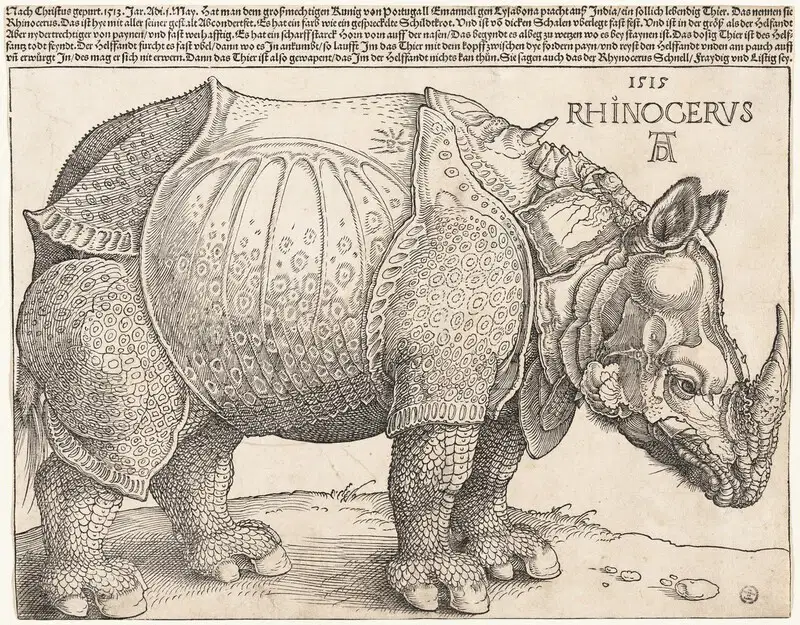
Look at the print of a rhinoceros. Which statement best describes the technique used to create this artwork shown with the title and date 1515?
It is a watercolor sketch on thin parchment
It is a marble sculpture polished and carved
It is a carved woodblock print with ink on paper
It is an oil painting on a wooden panel
Match each artist to the artwork shown.
Albrecht Dürer
The Rhinoceros
Bartolomé Esteban Murillo
Saint Rufina
Ercole de’ Roberti
Ginevra Bentivoglio

Which features in the rhinoceros image show the artist combined observation with imagination?
A second horn growing from the neck
Wings on the animal’s back
Armored plates like a knight’s gear
Detailed skin texture with small patterns

The painting of Saint Rufina includes jugs and a palm branch. What do these objects most likely represent in Baroque portraits of saints?
Trade goods for market scenes
Decoration to fill empty space
Scientific tools for experiments
Symbols of the saint’s story and virtues

Compare the two portraits. Which statement best distinguishes the Renaissance style in Ginevra Bentivoglio from the Baroque style in Saint Rufina?
Renaissance uses loose brushwork and dramatic light
Baroque avoids emotion and uses flat color
Baroque favors calm profiles and precise detail
Renaissance favors calm profiles and precise detail
Match each artwork to its country or region shown in the slides.
The Rhinoceros
German
Saint Rufina
Spanish
Ginevra Bentivoglio
Ferrarese (Italy)

In the painting titled La Mousmé, which movement best fits its bold brushwork and modern date shown on the slide?
Renaissance portraiture style
Modern Post-Impressionism
Baroque dramatic naturalism
Neoclassical ideal harmony

Which clues on the Magritte slide help identify Surrealism ideas?
An easel aligned with outdoor landscape
Plain window with closed curtains
Illusion of painting blending with reality
Artist described as Belgian on slide

Which painting on the slides belongs to the Renaissance period?
La Mousmé, 1888, modern
La condition humaine, 1933, modern
Ginevra de' Benci, c. 1474/1478
Starry Night, 1889, modern

Which visual feature in Van Gogh's La Mousmé shows Post‑Impressionist style?
Precise mathematical perspective
Expressive, thick color strokes
Flat shapes with strict symmetry
Smooth, invisible brush marks

Look at the painting of a girl in a white dress beside a washstand. Which art movement best matches its soft light and everyday moment?
Cubism with sharp geometric planes
Surrealism with dreamlike fantasy
Impressionism with soft light effects
Expressionism with bold emotional color

Which feature in the boat scene with overlapping angular shapes shows a Cubist approach?
Multiple fragmented viewpoints and planes
Careful shading to mimic photographs
Strong outlines and flat cartoon color
Smooth realistic water reflections
Match each artist to the likely country shown on the title panels.
Mary Cassatt
American
Georges Braque
French
Amedeo Modigliani
Italian

In Cassatt’s bathroom interior, which detail helps suggest an everyday domestic setting?
A grand palace balcony
An outdoor fishing harbor
A basin and wooden cabinet
A crowded city street

Which two features are typical of Cubism as seen in the fishing boats scene?
Neutral earth-tone palette
Emphasis on fleeting sunlight
Fragmented geometric forms
Highly realistic single viewpoint
What is the purpose of a color wheel?
To show how colors relate to each other and create moods in artwork
To mix colors together to create new ones
To display the names of colors
To separate primary colors from secondary colors
What happens when complementary colors are placed side by side?
They blend together
They create a lot of contrast and make each other look vibrant
They form secondary colors
They become analogous colors
Which of the following is NOT a primary color?
Red
Blue
Green
Yellow
What features may be included in a landscape painting, but are not usually the largest or most important part?
The land itself
Buildings, animals, or people
Flowers and food
Abstract shapes
What is the main idea conveyed in Mary Cassatt's Girl Arranging Her Hair?
The importance of perfection in art
The dignity and grace in everyday moments
The resilience of the artist in adversity
The depiction of religious themes
Which of the following is an example of a subject that might appear in Religious and Spiritual paintings?
A still life of fruits
A portrait of a famous scientist
A depiction of Jesus Christ or Buddha
A landscape of a mountain range
Which colors are considered cool colors?
Red, orange, yellow
Blue, green, purple
Gold and brown
White, black, gray
What effect do neutral colors like white, black, gray, tan, and ivory have on a painting?
They create a sense of balance and harmony
They make objects appear closer
They create a sense of distance
They make objects stand out
What does light help create in a painting, according to the text?
A sense of realism
Mood and atmosphere
A sense of movement
A focal point
Which artist is known as a master of chiaroscuro?
Bellini
Rembrandt
Goya
Murillo
What is the texture of an object?
The way it feels on its surface when touched.
The color of the object.
The size of the object.
The shape of the object.
What type of line is commonly associated with fast-paced or chaotic movements?
Curved line
Horizontal line
Jagged or zigzag line
Vertical line
What effect does leaving out details in the background of a painting have?
It creates a sense of depth and distance.
It emphasizes the foreground objects.
It makes the painting appear more colorful.
It highlights the use of complementary colors.
What does the horizontal line of the bridge in 'Blind Man of Toledo' help to achieve in the painting?
It creates a sense of movement in the painting
It separates the middle ground from the background
It highlights the foreground of the painting
It adds more color to the composition

