
 Worksheets
8.2 Unit Assessment MP2 Quarterly
Total questions: 22
Worksheet time: 11mins
Name
Class
Date
1.
1. Why are slow-motion videos useful for studying sound?
a)
They show detailed vibrations and movements.
b)
They make objects invisible.
c)
They change the sound produced.
d)
They add new sounds.
2.
2. What happens to the air around a vibrating object?
a)
It disappears.
b)
It changes color.
c)
It also begins to vibrate.
d)
It turns into water.
3.
3. Which of the following is a reason louder sounds have more energy?
a)
They vibrate at the same level as softer sounds
b)
They cause larger vibrations and thus transfer more energy
c)
They produce less sound vibration
d)
Louder sounds actually have less energy
4.
4. When we drop different-sized books on the table, what might we observe with the laser?
a)
Smaller book = less laser movement, larger book = more laser movement
b)
Both books result in the same laser movement
c)
Larger book = less laser movement, smaller book = more laser movement
d)
Neither book causes laser movement at all
5.
5. How do we calculate the frequency of waves?
a)
Frequency is found by measuring the total height of the waves.
b)
Frequency is calculated by counting how often the waves repeat in a set time.
c)
Frequency is determined by the time at the starting position.
6.
6. What can be inferred from larger waves on a graph?
a)
Larger waves indicate greater motion at higher amplitudes.
b)
Larger waves mean the recording was done at night.
c)
Larger waves show that fewer samples were taken.
7.
7. How does amplitude of a sound wave affect its loudness?
a)
Higher amplitude means softer sound
b)
Amplitude does not affect the loudness of a sound.
c)
Amplitude and pitch are the same.
d)
Higher amplitude means louder sound
8.
8. How can we use graphs of vibrations to understand sounds from a sound source?
a)
Graphs can only show loudness.
b)
Graphs can only show duration of sound.
c)
Graphs can show frequency and pitch
d)
Graphs do not help in understanding sounds.
9.
9. If amplitude remains constant but frequency increases, what happens to the pitch?
a)
The pitch decreases.
b)
The pitch increases.
c)
The pitch remains the same.
d)
The pitch fluctuates.
10.
10. Why can't we hear any sound when air is removed from a container?
a)
Because sound needs a medium to travel
b)
Because the sound was too loud
c)
Because the tuning fork was broken
d)
Because particles in the air absorbed it
11.
11. How does the movement of particles in a gas compare to those in a liquid when sound travels through them?
a)
Gas particles move more freely and are farther apart
b)
Gas particles move slower and are closer together
c)
Liquid particles absorb the sound more
d)
Gas particles remain stationary
12.
12. According to our models, which state of matter has particles that are closest together?
a)
Liquid
b)
Gas
c)
Solid
d)
Plasma
13.
13. True/False: The sound that we actually hear is the vibration of particles.
a)
True
b)
False
14.
14. What happens to the frequency of a wave when the amplitude is tripled?
a)
the frequency is tripled
b)
the frequency is a third of what it was
c)
amplitude does not affect frequency
15.
15. A sound wave cannot travel through which of the following?
a)
Metal
b)
Water
c)
Air
d)
Vacuum
16.
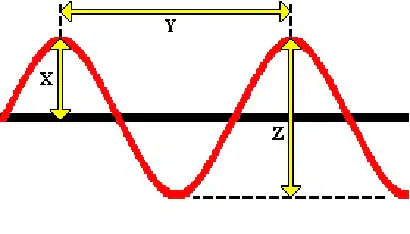
16. Study the diagram carefully. It shows a wave with three distances marked 'X', 'Y' and 'Z' respectively. Which of the statements below correctly describes the distance stated?
a)
Z - Amplitude, Y - Wavelength
b)
X - Amplitude, Y - Wavelength
c)
Y - Amplitude, Z - Wavelength
d)
X - Amplitude, Z - Wavelength
17.
17. What parts of the instrument are the sound sources?
a)
strings
b)
musician
c)
Instrument's frame
d)
air
18.
18. What would you expect to see these sound sources doing anytime one of them produces a sound?
a)
It remains completely still.
b)
It vibrates.
c)
It emits heat but does not move.
d)
It changes color.
19.
19. What does the musician need to do differently when she interacts with these sound sources in order to get them to produce softer sounds?
a)
Strike the instrument
b)
Use a softer or lighter touch when interacting with the instrument.
c)
Increase the force applied to the instrument.
d)
Adjust the instrument to amplify its vibrations.
20.
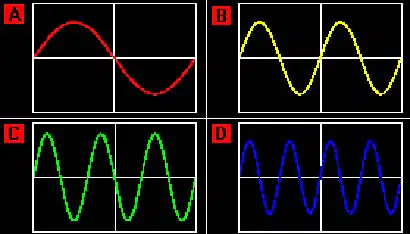
20. The graphs show how the displacement of air molecules changed with time when different sound waves were passing. The scales are the same for each graph. Which graph shows the sound with the highest frequency?
a)
A
b)
B
c)
C
d)
D
21.
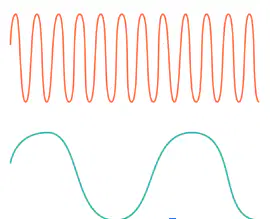
21. The number of waves that pass a fixed point in unit time
a)
Amplitude
b)
Frequency
c)
Rarefaction
d)
Wavelength
22.
22. A place where no sound exists is...
a)
in the air
b)
under water
c)
space
d)
all of the above
100 %

