
Font size
 Worksheets
Unit 2 Progress Check: MCQ
Total questions: 16
Worksheet time: 19mins
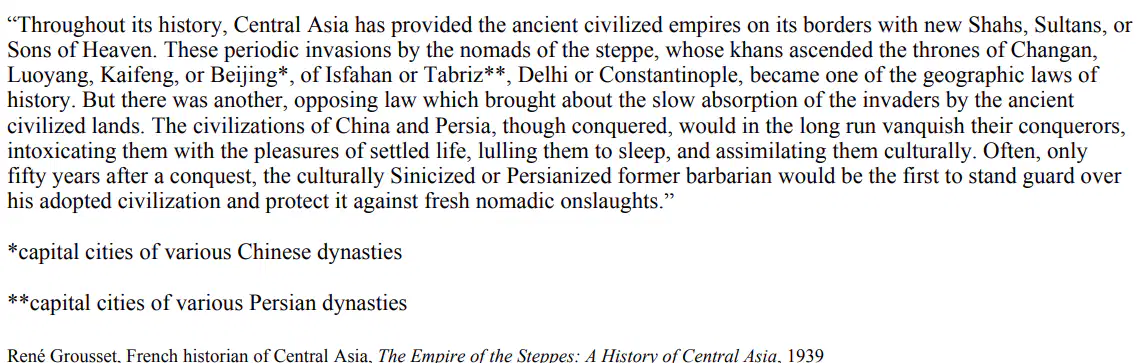
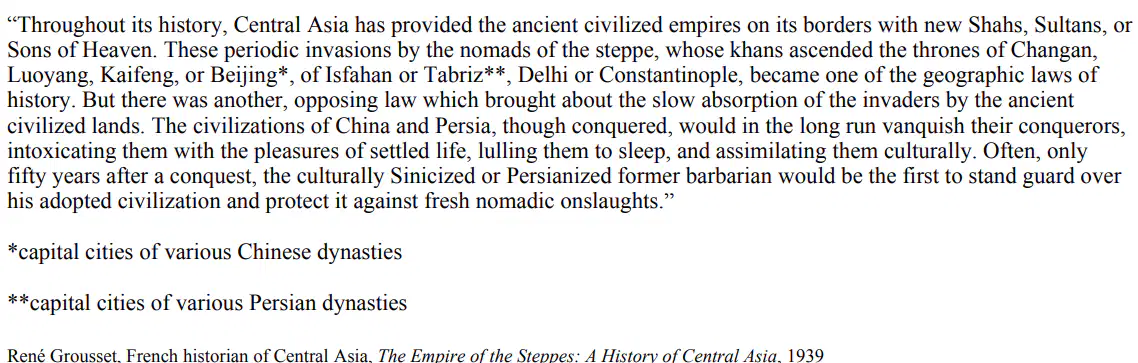
Which of the following demonstrates the assimilation of nomadic conquerors into conquered societies during the period circa 1250–1450?
The rulers of the Mali Empire converting to Islam through the influence of North African merchants and missionaries
The rulers of the Yuan dynasty adopting Chinese court culture and methods of rule
Trading states in Southeast Asia such as the Khmer and Srivijaya empires adopting syncretic Hindu-Buddhist practices
Chinese, Persian, and Indian artisans expanding their output because of a rising demand for luxury goods in Afro-Eurasia
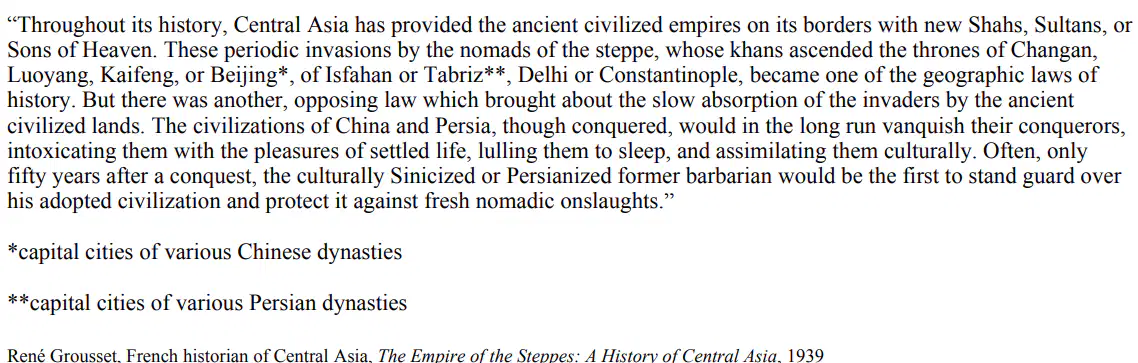
Which of the following developments in the period circa 1250–1450 represents a situation that did not lead to conquerors assimilating into the cultures of the conquered societies?
Invading armies establishing and maintaining a separate community, as illustrated by the European crusader kingdoms in the Middle East
Merchants establishing diasporic communities and introducing their own traditions into the indigenous cultures, as illustrated by South Asian Muslim merchants spreading Islam to the islands of Southeast Asia
Settled societies successfully resisting nomadic encroachments, as illustrated by the Mamluks of Egypt defeating the Mongols or Muscovy expelling the Golden Horde from Russia
Conquering states fragmenting into several units because of political and social friction, as illustrated by the breakup of the Mongol Empire into individual khanates
The Mongol conquests resulted in all of the following developments EXCEPT
a revival of trade on the overland Silk Roads
transfers of scientific and technological knowledge
the initial diffusion of Buddhism and Christianity to East Asia
the spread of pathogens across Eurasia, including the bubonic plague
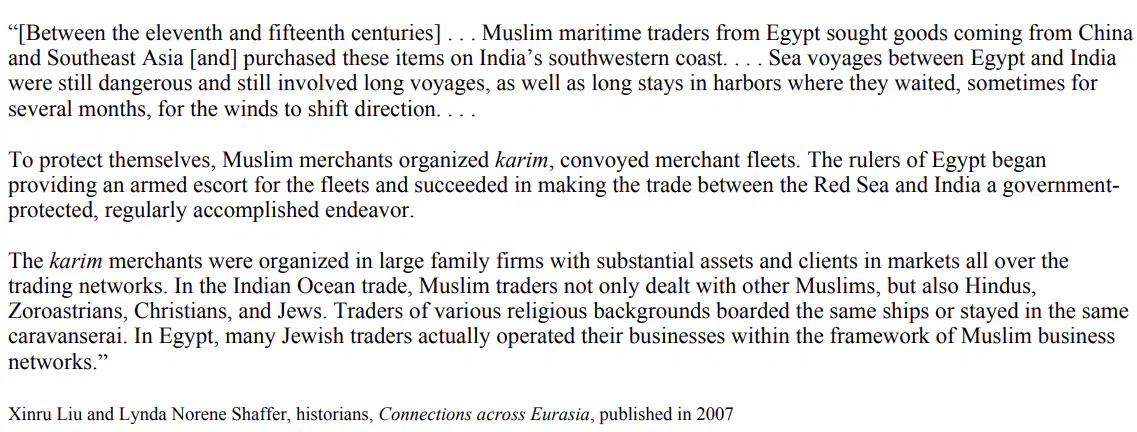
The “long stays in harbors” mentioned in the description of the sea journeys in the first paragraph were most likely necessary because Indian Ocean maritime trade in the period circa 1200–1450
increased significantly in volume, creating bottlenecks in key ports
required the approval of Muslim religious authorities to make sure it was carried out in accordance with Islamic principles
had to take into account environmental factors such as the timing and direction of the monsoons
could only be carried out if ships stayed close to shore through the entire journey from Egypt to India
Based on the pattern of trade described in the third paragraph, the Egyptian karim merchants were most likely directly involved in which of the following broader developments in the Indian Ocean in the period circa 1200–1450?
The establishment of diasporic merchant communities
The transfer of European scientific knowledge to South Asia
The creation of new monotheistic religions
The introduction of new financial innovations such as paper money
The integration of West African states into wider regional and transregional economic networks in the period circa 1200–1450 was carried out mostly via the
Swahili coast trade routes
Silk Road trade networks
trans-Saharan trade routes
Indian Ocean trade routes
The spread of Islam into sub-Saharan West Africa in the period circa 1200–1450 was mostly a result of the conversion of the rulers of which of the following states?
Mamluk Egypt
The Mongol khanates
The Ming dynasty
The Mali Empire
In the period circa 1200–1450, which of the following most directly enabled merchants to bring salt and other bulk products to markets in sub-Saharan Africa?
The diffusion of new maritime technologies such as the lateen sail
The adoption of innovative practices in overland trading, such as the use of camel caravans and saddles
The transfer of East Asian technologies to western Afro-Eurasia during the period of Pax Mongolica
The shared use of the Arabic language and common practice of Islam by both North African and sub-Saharan merchant communities
Read the following passage and then answer the question. “On several occasions, Ghazan Khan went to the observatory at Maragha and watched the Muslim, Christian, and Chinese astronomers make their observations. He looked at all the operations and instruments, studied them, and asked about their procedures, which he understood in spite of their difficulty. He also ordered the construction of a dome in order to investigate the Sun’s motion and he spoke out with his astronomers about it. All of them said that although they had never seen such an instrument, it was reasonable and sensible. He gave orders for the construction of an observatory next to his tomb in Tabriz in Persia. He explained how to construct the observatory with such clarity that local wise men marveled at his intelligence, because such work had not been done in any era. Those wise men said that constructing the observatory would be extremely difficult. He guided them, whereupon they commenced building it and they finished it following his instructions. Those wise men and all the engineers agreed that nobody had done such a thing before nor had imagined doing it.” (Note: Ghazan Khan was ruler of the Mongol Ilkhanate, whose territories included most of the Muslim Middle East and reigned 1295–1304. Maragha was an astronomical observatory in present-day Azerbaijan, established by a grant from the first Ilkhanid ruler in the mid-thirteenth century. Passage from Rashid al-Din Hamdani, Persian Muslim historian and government minister in Ghazan Khan’s court, excerpt from a universal history commissioned by Ghazan Khan, completed circa 1316.) Which of the following best describes the author’s purpose in the passage?
To provide detailed descriptions of the instruments used at the Maragha and Tabriz observatories
To evaluate the importance of the astronomical discoveries made by Ilkhanid scientists
To portray his patron as a generous supporter of the sciences and a man of unusual intelligence
To criticize Ghazan for his vanity and remind him to focus on religious and spiritual pursuits
Read the following passage and then answer the question. “On several occasions, Ghazan Khan went to the observatory at Maragha and watched the Muslim, Christian, and Chinese astronomers make their observations. He looked at all the operations and instruments, studied them, and asked about their procedures, which he understood in spite of their difficulty. He also ordered the construction of a dome in order to investigate the Sun’s motion and he spoke out with his astronomers about it. All of them said that although they had never seen such an instrument, it was reasonable and sensible. He gave orders for the construction of an observatory next to his tomb in Tabriz in Persia. He explained how to construct the observatory with such clarity that local wise men marveled at his intelligence, because such work had not been done in any era. Those wise men said that constructing the observatory would be extremely difficult. He guided them, whereupon they commenced building it and they finished it following his instructions. Those wise men and all the engineers agreed that nobody had done such a thing before nor had imagined doing it.” (Note: Ghazan Khan was ruler of the Mongol Ilkhanate, whose territories included most of the Muslim Middle East and reigned 1295–1304. Maragha was an astronomical observatory in present-day Azerbaijan, established by a grant from the first Ilkhanid ruler in the mid-thirteenth century. Passage from Rashid al-Din Hamdani, Persian Muslim historian and government minister in Ghazan Khan’s court, excerpt from a universal history commissioned by Ghazan Khan, completed circa 1316.) Which of the following best describes the historical situation in Eurasia at the time the passage was written?
Frequent warfare limited the opportunities for cultural, scientific, and artistic innovation.
Political upheaval and reorganization increased cultural and scientific exchanges across regions.
Revived long-distance trade spread pathogens and infections to regions that had not been previously affected by them.
The invention and spread of new weapons and military tactics radically transformed the global balance of power.
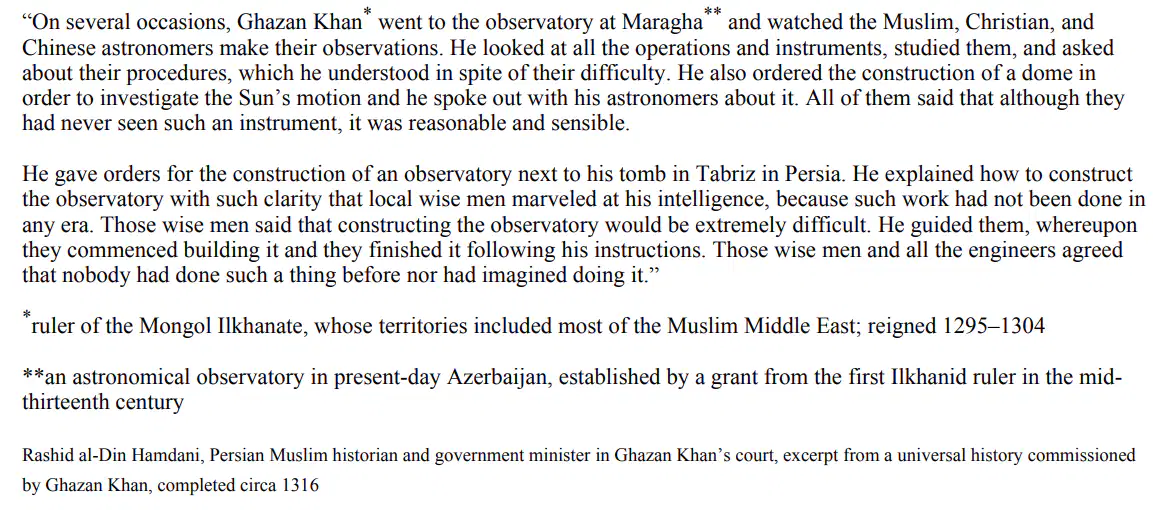
Which of the following best describes the historical circumstances of Rashid al-Din’s career? (Rashid al-Din Hamdani was a Persian at the court of a Mongol ruler and oversaw the composition of a universal history.)
His career illustrates the destructive impact of the Mongol conquests on many established urban centers.
His career illustrates the possibilities for diffusion and intermingling of cultures brought about by the Mongol conquests.
His career illustrates the Mongols’ success in preserving their nomadic and tribal culture despite the growing diversity of their subjects.
His career illustrates the importance of traveler accounts written by foreign visitors to the Mongol court.
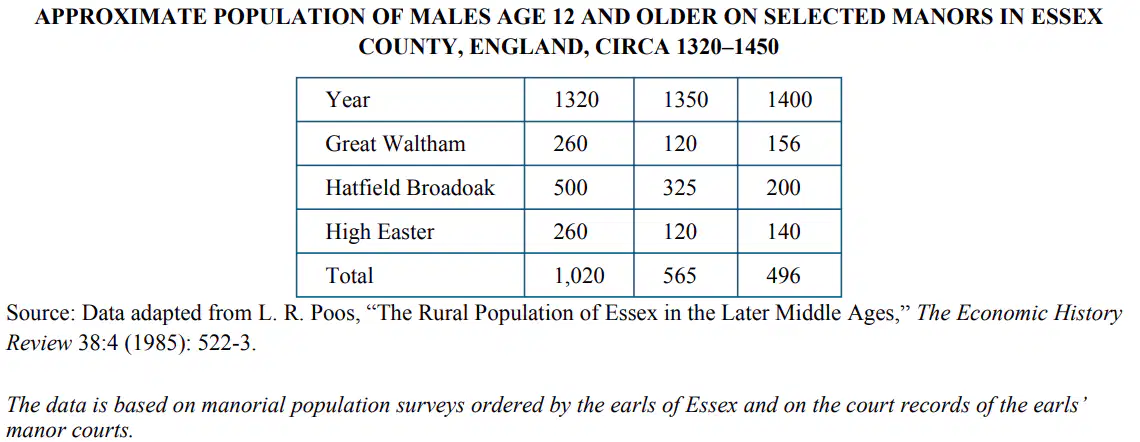
Based on the information in the table titled “Approximate Population of Males Age 12 and Older on Selected Manors in Essex County, England, Circa 1320–1450,” in which of the following periods did the Black Death outbreak of the bubonic plague strike Essex County?
Before 1320
Between 1320 and 1350
Between 1350 and 1400
After 1400
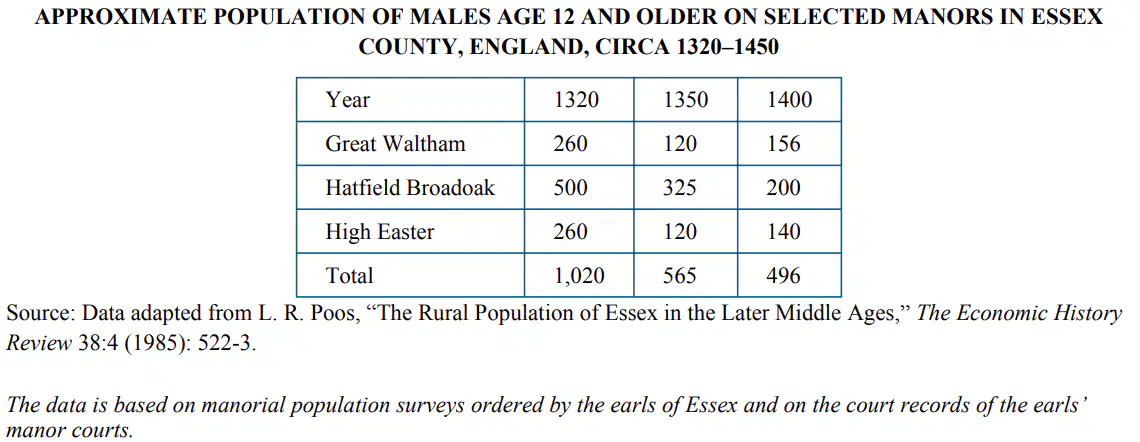
A comparison between the data for the three manors shown in the table titled “Approximate Population of Males Age 12 and Older on Selected Manors in Essex County, England, Circa 1320–1450” best illustrates which of the following?
It was equally devastating across all areas of western Europe.
It had virtually no effect on the populations of some regions of England.
In some but not all areas, the population was beginning to recover by 1400.
In most areas, the population reverted to pre-1320 levels by 1400.
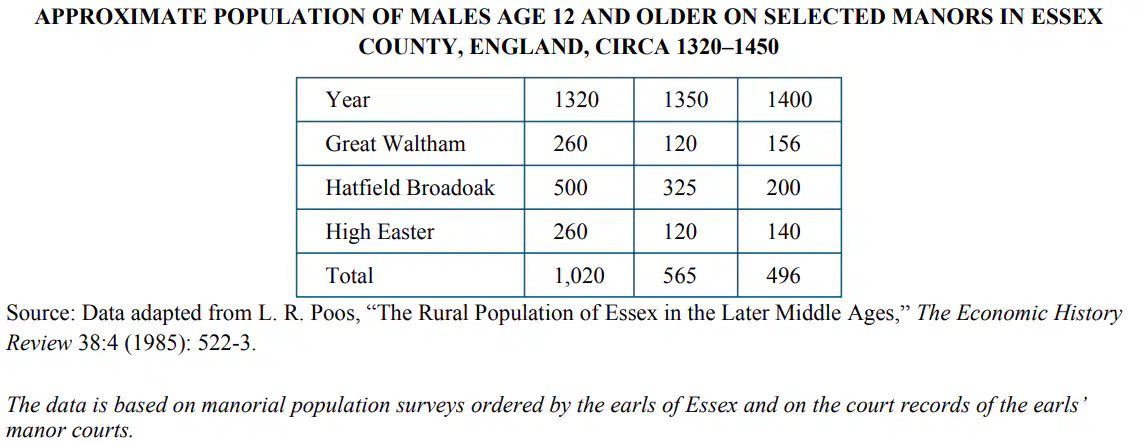
Which of the following best describes the change in the total population of males age 12 and older in the three manors shown in the table from 1320 to 1400?
It declined to less than a quarter of its 1320 level (over 75% decline).
It increased to more than double its 1320 level (over 50% increase).
It declined to less than a half of its 1320 level (over 50% decline).
It stayed virtually unchanged compared to its 1320 level.
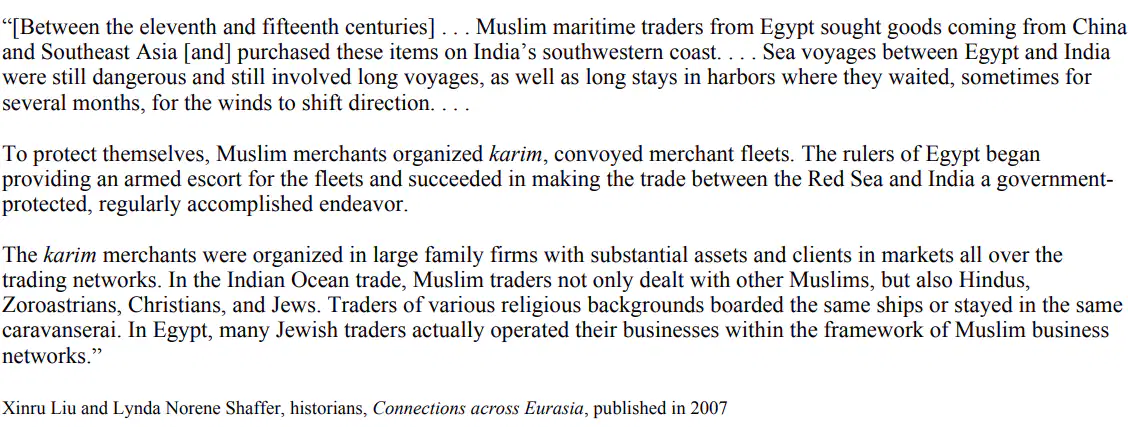
The pattern of trade described in the passage was most characteristic of which of the following types of goods in the period 1200–1450 ?
Daily food staples such as bread or milk
Bulk commodities such as grain or coal
Luxury goods such as spices or porcelain
Livestock such as pigs or cattle
“On Wednesday we entered the great city of Tabriz in Persia. Commerce flourishes here. Today, there must be at least 200,000 householders within the city limits. From Tabriz all the way to Samarqand, the prince Timur has established relays of horses kept ready at command so that his messengers may ride on his missions night and day without hindrance. The posthouses have been built at intervals of a day’s or half a day’s journey apart.
We then stopped at a caravanserai in a local village for the accommodation of travelers and merchants on the road, before proceeding to the capital city of Samarqand in Central Asia, which Timur has lavishly adorned. The richness and abundance of this great capital and its district is indeed a wonder to behold. It is not only rich in agriculture but also in manufactures, as silk and other crafts are all produced here in abundance. Turks, Arabs, Christians of all sects, and Hindus all reside here. The markets of Samarqand are filled with merchandise imported from distant and foreign countries. From Russia and Central Asia come leathers and linens and from China silks that are the finest in the whole world. The goods that are imported to Samarqand from China are the most precious of all those brought from any foreign land, for the craftsmen of China are said to be far more skillful than those of any other nation.”
Ruy González de Clavijo, ambassador of the Iberian kingdom of Castile, report of his journey to the empire of the Turko-Mongol ruler Timur, circa 1404
In your response, be sure to address all parts of the question. Use complete sentences; an outline or bulleted list alone is not acceptable. Use the passage to answer all parts of the question that follows.
a) Identify the main argument made in the passage about Timur’s empire
b) Identify ONE major economic development in Eurasia in the period circa 1200–1450 that is illustrated by the passage.
c) Describe ONE example of how economic interactions such as those described in the passage affected the cultural development of Eurasia in the period 1200–1450.

