
 Worksheets
Page 1
Total questions: 148
Worksheet time: 1hrs 15mins
Which field of study most directly examines Organizational Culture and Change within firms?
Human and organization behavior
Corporate finance and markets
Operations research optimization
Managerial accounting practices
A course labeled KMF3013: Human and Organization Behavior most likely focuses on which primary theme?
How patents create monopolies
How machines improve throughput
How people act in organizations
How taxes shape profit reports
Which concept best describes shared values, norms, and practices that influence employee behavior?
Organizational culture construct
Market demand elasticity
Capital budgeting criteria
Statutory compliance codes
Change management in organizations typically aims to achieve which outcome?
Eliminate all informal networks
Align people with new strategies
Replace ethics with pure efficiency
Increase taxes on competitors
Which statement best distinguishes culture from strategy in a company?
Culture defines market share
Strategy sets long-term goals
Culture guides daily behaviors
Strategy dictates employee emotions
If an organization plans a merger, which aspect will most affect employee integration?
Length of the new brand name
Similarity of product lines
Age of legacy information systems
Compatibility of cultures involved
Which practice commonly reinforces organizational culture over time?
Random hiring decisions
Fixed asset depreciation
Quarterly tax filings
Rituals and shared stories
A leader wanting to shift culture should prioritize which first step?
Diagnose current cultural norms
Replace every middle manager
Freeze wages across departments
Outsource all core functions
Which risk appears when change initiatives ignore existing culture?
Guaranteed market expansion
Instant productivity increase
Automatic legal compliance
Employee resistance and cynicism
In the title 'Organizational Culture and Change,' the conjunction suggests which relationship?
Hierarchy of subordination
Separation without overlap
Interdependence of the two
Random coincidence of topics
Which phrase best captures organizational culture?
A formal hierarchy chart and policies
A system of shared meaning among members
A collection of buildings and office layouts
A list of products and market segments
What aspect is described as the soul and life of an organization?
Physical structures and office designs
Shared identity, thinking, values, ways of working
Financial statements and budgets
Market share and growth rate
Which statement explains a common perception held by members?
It is a temporary project guideline only
It is a personal belief unrelated to work
It is a shared system covering vision and standards
It is a government regulation on employment
Select the characteristic that emphasizes creating new ideas and accepting uncertainty.
Attention to detail
Aggressiveness in negotiations
Innovation and risk taking
Stability in processes and routines
Which pair correctly matches sector and cultural trait emphasis?
Health sector—attention to detail focus
Financial sector—team orientation focus
Health sector—aggressiveness focus
Financial sector—innovation focus
Outcome orientation primarily emphasizes which focus?
Methods and procedures used
Number of teams created
Level of employee satisfaction
Results achieved and performance
People orientation most directly concerns which priority?
Customer profit maximization
Impact on individuals and well-being
Strict compliance with rules
Speed of decision making
Team orientation is best demonstrated by which practice?
Rigid departmental silos maintained
Solo performance evaluations only
Cross-functional collaboration and cohesion
Individual bonuses exclusively
Which combination signals a culture prioritizing stability?
Frequent experimentation and pivots
Loose standards and minimal controls
Consistent routines and predictable processes
Aggressive market disruption tactics
Identify all seven primary characteristics of organizational culture listed.
Which characteristic is directly associated with firms like Tesla and Microsoft as examples?
Stability in operations
Outcome orientation
Innovation and risk taking
Aggressiveness in competition
Which statement best defines a dominant culture in an organization?
Temporary norms arising during a crisis
Shared core values held by most members
Unique practices limited to one project team
External reputation shaped by industry media
Select the feature that most accurately characterizes subcultures within organizations.
Beliefs shaped solely by national policy
Mini cultures by departments or locations
Values mandated only by executives
Informal attitudes of individual leaders
Which list most closely reflects core values described for organizations?
Charisma, luck, improvisation, rivalry
Aggression, isolation, unpredictability, dominance
Speed, secrecy, profit maximization, hierarchy
Exemplary, collegiality, integrity, tenacity, equity
What distinguishes a strong culture from a weak culture?
Procedures documented but rarely practiced
Norms varying greatly between shifts
Core values intensely held and widely shared
Policies frequently revised without consensus
A company has regional offices with distinct ways of working while sharing the same mission. What does this scenario illustrate?
Breakdown of organizational values and identity
Presence of subcultures alongside a dominant culture
Strong culture preventing any local variation
Complete cultural uniformity across all regions
Which question reflects how dominant culture influences decision-making?
What are our quarterly tax obligations?
Which vendor offers the lowest price today?
How many interns should we hire this summer?
Can we do things in an aggressive manner?
If core values are accepted throughout the organization, what immediate effect is most likely?
Guaranteed industry-leading financial results
Reduced need for any formal policies
Elimination of all subcultures instantly
Greater alignment of behavior across units
Which situation would most undermine a strong culture?
Widely shared values that employees ignore
Values intensely held only by senior leaders
Frequent celebrations of individual achievements
Clear processes for cross-team collaboration
An enterprise wants to strengthen integrity and equity across divisions. Which approach aligns with building a strong culture?
Rotate managers without discussing values
Allow each team to define values independently
Rely on slogans posted in common areas
Embed values in hiring, training, and rewards
Which statement best differentiates core values from subcultures?
Core values are informal norms; subcultures are codified policies
Core values are primary and organization-wide; subcultures are localized
Core values exist only in executive teams; subcultures are enterprise-wide
Core values change frequently; subcultures remain constant
Which statement best describes a core function of organizational culture highlighted on the slide?
Sets prices for all product lines
Determines legal status of firms
Eliminates external market pressures
Defines boundaries between organizations
Organizational culture primarily helps members by providing which benefit?
A sense of identity for members
Uniform pay across departments
Guaranteed lifetime employment
Automatic skill certification
Culture facilitates commitment to what, according to the slide?
Short-term individual bonuses
Personal brand development
Departmental rivalry incentives
Something larger than self-interest
Which cultural function supports system-wide consistency and predictability?
Promotes constant structural upheaval
Maximizes turnover of staff annually
Removes all formal policies entirely
Enhances stability of the social system
Culture serves as a mechanism for what organizational need?
Sense-making and control for fitting employees
Automated outsourcing of core processes
Instant compliance with external regulators
Guaranteed innovation in every project
Identify the most direct cultural function that differentiates one organization from another.
Controls national economic policy
Eliminates external partnerships
Mandates identical processes
Defines organizational boundaries
A company wants employees to feel part of a shared mission beyond their own goals. Which cultural function is most relevant?
Generate commitment to larger purpose
Increase individual sales quotas only
Focus solely on personal achievements
Prioritize competitive internal politics
Which scenario best illustrates culture enhancing social system stability?
Random role changes without notice
Unclear expectations across teams
Frequent policy reversals weekly
Consistent norms guiding daily behavior
In onboarding, which cultural role helps new hires interpret how to fit into workflows and expectations?
External benchmarking committee
Immediate promotion to leadership
Sense-making and control mechanism
Mandatory overtime assignments
Which phrase on the slide captures how culture distinguishes an organization’s identity relative to others?
Defines the boundary between organizations
Sets quarterly revenue projections
Determines global market share
Dictates national hiring policies
Which condition makes culture a barrier to change within an organization?
Leaders encouraging adaptive experimentation
Values misaligned with rapid change needs
External market stability and predictability
Employee autonomy and flexible processes
What risk arises when strong cultures pressure employees to conform?
Enhanced inclusion through flexibility
Higher agility during major shifts
Improved creativity in all teams
Institutionalized bias across practices
Why can incompatible cultures undermine mergers or acquisitions?
They destroy integration despite strategic fit
They instantly grow market share and profits
They guarantee unified leadership decisions
They replace due diligence with quick wins
Identify the best mitigation when culture values conflict with rapid change.
Ignore culture and focus on technology
Increase rules to enforce strict compliance
Delay transformation until resistance fades
Realign cultural values to change imperative
A firm with a strong conformity norm plans to diversify hiring. What is the primary cultural risk?
Bias becomes embedded in systems
Compliance costs fall dramatically
Teams spontaneously become innovative
Turnover drops due to belonging
Which statement most accurately describes culture as a liability for diversity?
Rituals welcome nontraditional perspectives
Norms encourage constructive dissent
Shared values broaden unique voices
Pressure to conform limits inclusion
During a merger, two companies hold conflicting decision-making norms. What outcome is most likely?
Guaranteed success with minimal friction
Instant alignment on governance policies
Rapid unification of all workflows
Integration failure despite business synergy
Which scenario signals culture acting as a barrier to change?
Leaders reward experimentation routinely
Systems support flexible resource shifts
Values prioritize stability over adaptation
Employees iterate and learn from pilots
What is a practical first step to reduce institutionalized bias in a strong culture?
Audit norms and redefine inclusion behaviors
Ban all traditions and ceremonies immediately
Replace hiring with internal referrals only
Centralize decisions to limit local variance
Which principle should guide cultural due diligence before acquisitions?
Prioritize speed over compatibility
Assume cultures will merge organically
Assess value alignment to integration needs
Ignore norms and focus on financials
Which action most directly initiates an organization’s culture during its early stage?
Investors approve annual strategic objectives
Customers provide ongoing market feedback
Managers set quarterly performance benchmarks
Founders hire value-aligned employees consistently
Founders indoctrinating and socializing employees primarily serves which purpose?
Align thinking and feeling with founders’ beliefs
Accelerate product development timelines
Replace all informal communication channels
Reduce external stakeholder influence
What role does founders’ behavior play in shaping culture?
Operates as a cost-control mechanism
Serves as a marketing positioning tool
Functions as a compliance checklist
Acts as a model employees internalize
Select the practice most consistent with culture formation described: Founders...
Keep only employees who share core assumptions
Base retention solely on quarterly sales
Rotate staff between unrelated departments
Delegate hiring fully to external agencies
If founders consistently retain employees who mirror their values, which cultural outcome is most likely?
Minimal identity with leadership expectations
Strong value congruence across the workforce
Rapid erosion of shared assumptions
High variance in decision-making philosophies
Which statement best explains indoctrination in early culture building?
Structured socialization to embed shared norms
Ad-hoc mentoring focused on task accuracy
Periodic training on compliance procedures
Informal networking to increase visibility
A new firm wants employees to internalize specific beliefs and values. Which approach aligns with the slide?
Ban informal socialization during work hours
Outsource culture workshops twice yearly
Automate onboarding with technical tutorials
Leaders model behaviors employees emulate
Which scenario best illustrates founders acting as role models?
Leaders demonstrate desired decisions daily
Leaders publish lengthy policy manuals
Leaders avoid visible day-to-day involvement
Leaders rely solely on external consultants
Which concept connects hiring like-minded employees to long-term culture stability?
Compliance replaces informal socialization
Diversity eliminates value coherence
Turnover guarantees innovative disruption
Selection reinforces shared assumptions
When employees identify with founders, what is the most likely effect on organizational culture?
Decision rights shift entirely to customers
Culture depends only on formal incentives
Policies become purely symbolic artifacts
Beliefs and values become widely internalized
Which practice ensures candidates align with organizational values during hiring?
External benchmarking reports
Selection focused on culture fit
Onboarding led by peers
Randomized job assignments
What key role does senior leadership play in sustaining culture?
Set behavioral norms organization-wide
Approve all expense reports
Run daily performance appraisals
Design individual job tasks
Socialization in organizations primarily aims to do what?
Reduce legal compliance risks
Eliminate informal networks
Increase quarterly sales targets
Help newcomers adapt to culture
During selection, which information exchange supports better mutual fit?
Withholding role expectations entirely
Delegating interviews to algorithms
Providing organizational culture insights
Sharing only salary figures
Identify the most direct mechanism for transmitting norms to new hires.
Annual shareholder meetings
Competitive market analyses
Structured socialization processes
Anonymous employee surveys
A company wants to reduce turnover among new employees. Which intervention best aligns with culture retention principles?
Increase pay without orientation
Enhance onboarding and socialization
Rotate managers weekly
Automate resume screening only
Which statement best distinguishes selection from socialization?
Selection sets strategy; socialization audits
Selection trains norms; socialization hires
Selection assesses fit; socialization develops fit
Selection markets jobs; socialization compensates
Top management can reinforce culture most effectively by which action?
Model and reward desired behaviors
Focus solely on quarterly profits
Avoid communicating expectations
Delegate culture to external consultants
A startup formalizes mentoring, peer shadowing, and culture workshops. These practices together exemplify which domain?
Socialization methods for newcomers
Financial controls and reporting
External branding and PR
Technical training on software
Which hiring approach is most likely to undermine culture over time?
Providing clear culture information
Selecting solely for technical skills
Using structured behavioral interviews
Assessing cultural alignment deeply
Which stage involves learning before joining the organization?
Metamorphosis stage during onboarding
Encounter stage before day one
Outcome stage after probation
Prearrival stage prior to entry
In the encounter stage, what is the key challenge for a new employee?
Balancing workload expectations
Choosing formal training modules
Seeing reality and confronting divergence
Negotiating compensation packages
Which statement best defines metamorphosis in organizational socialization?
Performance appraisal and feedback
Change and adjustment to work and group
Observation of informal norms
Initial orientation and paperwork
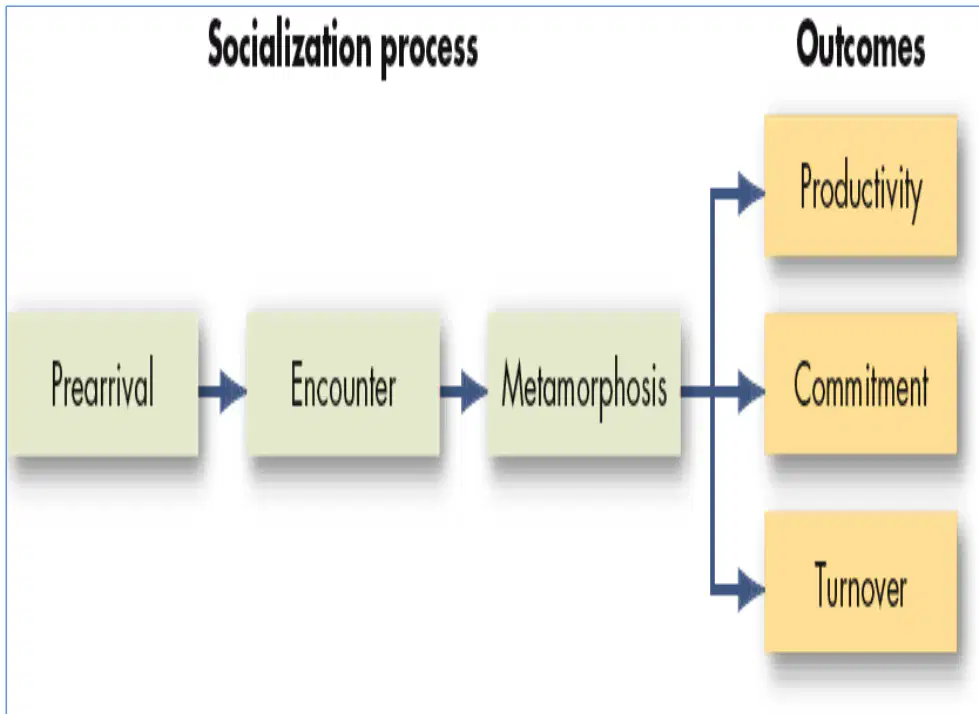
Arrange the stages of socialization in correct order shown in the diagram.
Encounter → Prearrival → Metamorphosis
Metamorphosis → Encounter → Prearrival
Prearrival → Encounter → Metamorphosis
Prearrival → Metamorphosis → Encounter
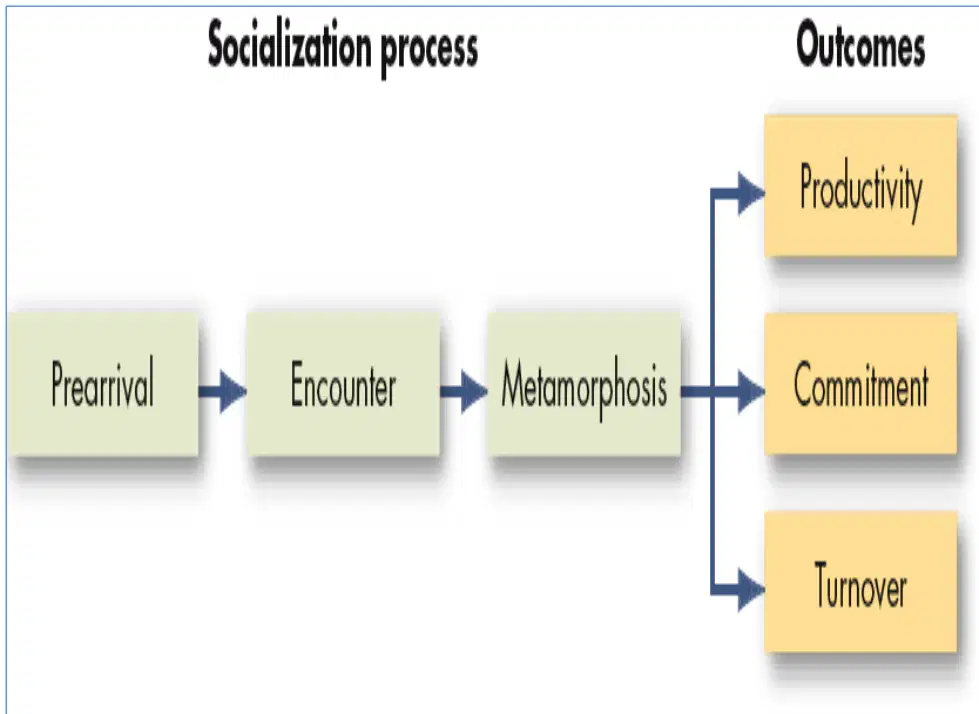
Which outcome is directly linked to successful socialization in the diagram?
Productivity and commitment
Salary growth and bonuses
Market share expansion
Absenteeism reduction only
Identify the outcome that organizations aim to decrease through effective socialization.
Productivity levels
Commitment intensity
Training duration
Turnover rates
Which activity most appropriately fits the prearrival stage?
Adapting to team processes
Completing on-the-job rotation
Researching culture before joining
Comparing expectations with reality
During encounter, a mismatch between expectations and reality appears. What is a strategic response for the employee?
Ignore differences entirely
Switch departments immediately
Seek feedback and clarify norms
Request immediate promotion
Metamorphosis leads to improved outcomes. Which combination reflects this link?
Higher turnover and lower commitment
Lower productivity and higher turnover
Stable turnover with lower productivity
Higher commitment and lower turnover
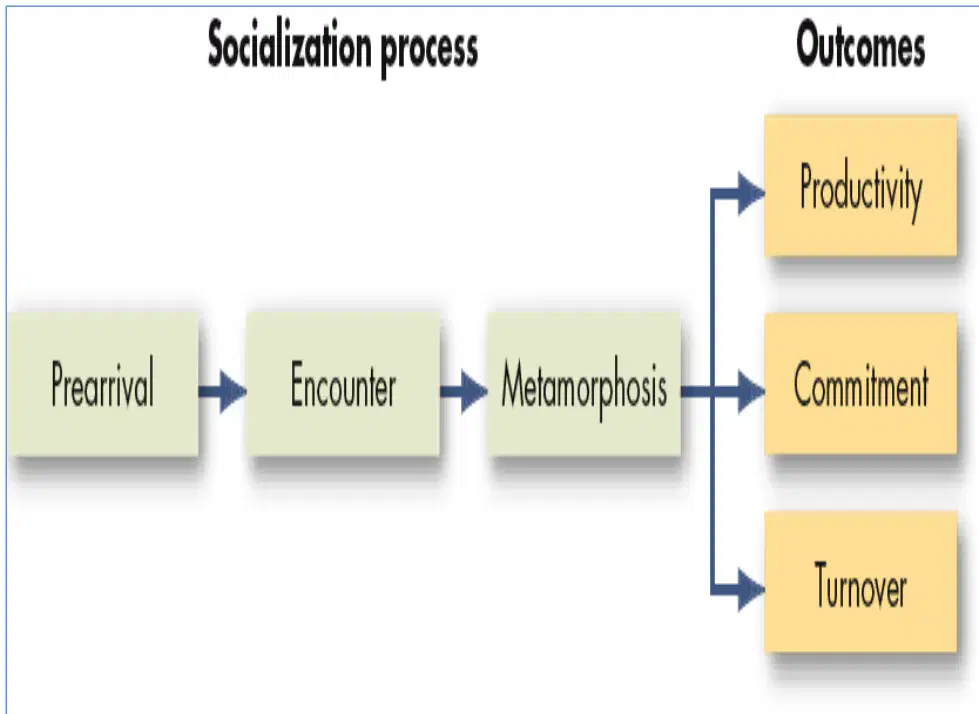
Which description best captures the overall socialization process depicted?
Circular feedback loop without endpoints
Single meeting followed by evaluation
Linear stages culminating in outcomes
Random events determined by chance
Which pairing describes onboarding conducted with cohorts rather than one person at a time?
Individual approach with tailored mentoring
Formal approach with policy briefings
Collective approach with cohort sessions
Serial approach using role models
In a program where milestones are set and time-bound, which alternative is being used?
Variable pacing by situational needs
Fixed schedule with clear timelines
Random sequencing without structure
Investiture that validates identity
A newcomer receives guidance from experienced insiders who model the role. Which alternative fits this design?
Serial using role incumbents
Random without clear mentors
Divestiture removing prior identity
Informal with ad-hoc learning
Which outcome is most directly targeted by programs that build alignment and loyalty to the organization?
Lower absenteeism rates
Greater commitment
Faster facility upgrades
Higher training spend
A bootcamp with explicit rules, structured activities, and assessments is best described as which alternative?
Random design without sequence
Informal design shaped by peers
Variable design with flexible timing
Formal design with standardized content
Which pairing describes onboarding that intentionally strips prior professional identity to reshape norms?
Investiture validating newcomer identity
Collective with cohort integration
Fixed with predetermined deadlines
Divestiture redefining prior identity
What outcome would most plausibly result from effective socialization that speeds proficiency?
Higher productivity
Stronger brand equity
Lower training costs
Broader market share
A program lets each team adapt onboarding steps as needed rather than following a universal timetable. Which alternative applies?
Formal with strict procedures
Serial with designated mentors
Variable with flexible milestones
Fixed with uniform milestones
Designing onboarding with unstructured experiences and no defined sequence reflects which alternative?
Random with unpredictable steps
Serial with role-model guidance
Collective with cohort sessions
Investiture with identity validation
Which outcome is a typical result of strong socialization fit that reduces early exits?
Lower facility maintenance
Greater capital investment
Higher payroll taxes
Lower turnover
Which element initiates the formation of organizational culture in the depicted process?
Employee socialization sets shared norms
Top management formalizes all procedures
Selection criteria define role behaviors
Founder’s philosophy shapes early beliefs
In the flowchart, which stage directly influences who enters the organization to fit desired values?
Organization culture dictates office layout
Top management sets quarterly budgets
Socialization delivers onboarding rituals
Selection criteria align with founder values
What is the primary mechanism by which cultures are sustained over time according to the summary bullets?
Managerial action reinforces key values
External consultants redesign policies
Annual parties maintain employee morale
Market competition filters weak practices
Which pair best represents feedback loops maintaining culture in the diagram?
Selection criteria ↔ Market trends
Socialization ↔ Competitor practices
Founders ↔ External stakeholders
Top management ↔ Organization culture
A new CEO wants to shift culture. Which leverage points in the model should be prioritized first?
Supplier contracts and inventory systems
Compensation reporting to shareholders
Physical facilities and branding colors
Top management and socialization practices
Which statement best describes the role of socialization in the process?
It measures quarterly performance
It sets legal compliance standards
It transmits norms to new members
It selects executives for promotion
If selection criteria drift away from founder philosophy, what is the most likely consequence?
New hires dilute original cultural values
Employee benefits instantly increase
Production costs uniformly decrease
Market share automatically expands
Which sequence best captures the initial culture formation flow?
Supplier input → Pricing strategy
Employee surveys → Facility design
Market trends → Budget allocation
Founder philosophy → Selection criteria
Which action most directly sustains culture after formation?
Consistent managerial reinforcement
Eliminating onboarding processes
Occasional external benchmarking
Random hiring without fit tests
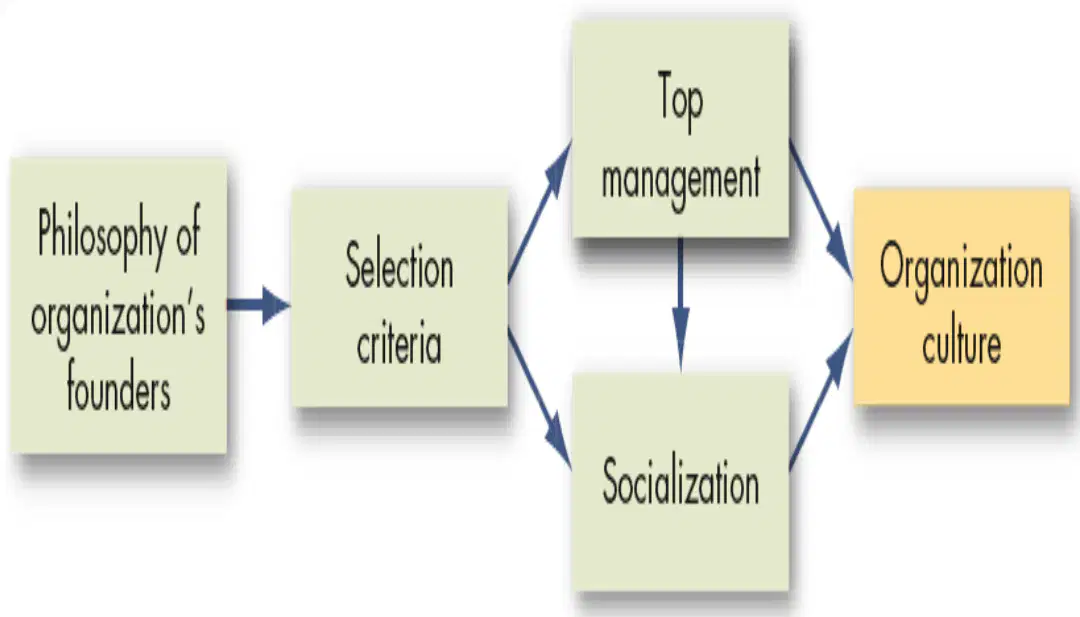
Which component is explicitly identified as the source of organizational culture’s initial values?
Competitor strategic choices
Government regulatory frameworks
Organization’s founders’ philosophy
Customer loyalty programs
Which method most directly connects present practices to organizational history and legitimizes current behaviors?
Language with insider jargon
Material symbols like office size
Rituals that repeat daily activities
Stories that anchor present to past events
A weekly recognition meeting that reinforces teamwork values is best described as which cultural mechanism?
Language that signals membership
Stories that explain founding decisions
Rituals that repeat and reinforce values
Material symbols that show status
What do material symbols primarily communicate within an organization?
Why past decisions were legitimate
How projects should be scheduled
Which teams must collaborate
Who is important and holds status
Which example best illustrates language as a way employees learn culture?
Founders’ stories shared at onboarding
Executives moving to larger offices
Using specialized jargon to show membership
A daily stand‑up reinforcing agility
An organization introduces branded hoodies worn only by senior engineers. Which cultural element is most evident?
Stories linking past to present legitimacy
Language with insider acronyms and slang
Rituals that repeat sequences of activities
Material symbols signaling status and importance
Which statement about rituals is most accurate?
They repeat actions to reinforce key values
They justify present practices through history
They rely on jargon to indicate membership
They communicate status via physical cues
A new hire hears a story about a tough client win that shaped the firm’s bias for action. What function is the story serving?
Reinforcing values through repeated activities
Signaling status through attire and perks
Anchoring present practices in past events
Indicating membership through special jargon
Which pairing is correct for how employees learn culture?
Material symbols — reinforce key values through repetition
Language — special expressions that signal belonging
Rituals — communicate who is important
Stories — indicate membership via jargon
A company’s executive dining room and reserved parking spots are examples of what?
Stories legitimizing current rules
Rituals promoting collaboration
Material symbols conveying importance
Language defining insider groups
To strengthen a culture emphasizing customer empathy, which action fits the ritual mechanism?
Create weekly role‑play sessions with feedback
Issue badges for top customer ratings
Share a founding tale about early customers
Adopt acronyms describing service stages
Which characteristic supports developing high ethical standards in organizations?
High tolerance for rivalry
High tolerance for risk
High tolerance for turnover
High tolerance for secrecy
An organization aiming for strong ethics should show what level of aggressiveness?
Very high aggressiveness
Aggressiveness fluctuating wildly
Low to moderate aggressiveness
Zero aggressiveness always
What managerial practice helps establish ethical norms by example?
Avoiding public statements
Relying on informal rumors
Delegating all decisions
Being a visible role model
Which practice sets clear standards by outlining expected conduct?
Communicating ethical expectations
Reducing reporting requirements
Hiring external consultants
Centralizing performance reviews
Providing ethical training primarily serves which purpose?
Build skills for ethical decisions
Replace compliance policies entirely
Reduce operational costs quickly
Limit employee initiative broadly
Rewarding ethical acts and punishing unethical ones most directly influences what?
Office layout
Capital structure
Brand aesthetics
Behavioral reinforcement
Which approach offers confidential support to report misconduct?
Increasing sales targets
Enhancing office perks
Scheduling longer meetings
Providing protective mechanisms
A firm with low to moderate aggressiveness is most likely to do which of the following?
Avoid competition entirely
Compete with relentless hostility
Compete firmly without hostility
Ignore competitor actions consistently
A manager seeking to strengthen ethics could combine role modeling with which other practice?
Outsourcing discipline decisions
Minimizing documented procedures
Expanding speculative risk-taking
Communicating expectations clearly
Which practice best reflects building on employee strengths in a positive organizational culture?
Rotating duties without assessing strengths
Discovering and sharing individual strengths
Focusing feedback on correcting weaknesses
Assigning tasks strictly by seniority
What is the primary intent of rewarding more than punishing in workplace culture?
Reinforce desired behaviors with praise
Increase compliance through fear
Eliminate performance reviews entirely
Reduce training costs companywide
Choose the statement that aligns with emphasizing individual vitality and growth.
Helping employees learn and grow
Prioritizing output over development
Keeping roles static to limit change
Outsourcing learning to external firms
Which limitation is noted for positive organizational culture?
It requires strict punishment systems
It may not work for all organizations
It guarantees universal effectiveness
It eliminates the need for managers
A manager publicly praises a team member for a well-executed client presentation. Which cultural principle is being applied?
Punishment-centric accountability
Discovering latent weaknesses
Articulating praise for doing right
Neutral feedback without recognition
Select the best next step after identifying an employee’s strength in strategic analysis.
Avoid mentioning the strength
Assign routine tasks unrelated
Replace strategy work with admin
Share and build on the strength
In a positive organizational culture, how should leaders balance praise and correction?
Punish only during annual reviews
Praise rarely, punish frequently
Reward more often than punish
Ignore both to stay neutral
Why might a positive culture not succeed in some organizations?
Different contexts and people vary
It conflicts with legal standards
It always increases turnover rates
It prohibits performance measurement
Which action most directly supports employees’ career growth?
Limiting access to training budgets
Helping employees learn new skills
Tracking hours instead of outcomes
Mandating overtime for everyone
Refer to the diagram showing interconnected wooden figures linked by ropes. What organizational idea does the visual suggest?
Strict hierarchy with no links
Individual competition over teams
Interdependence among employees
Isolated roles without interaction
Which strategic shift is highlighted as making Microsoft richer?
From innovation to strict control
From secrecy to radical openness
From agility to heavy planning
From decentralization to central command
What primary benefit is claimed for a transformation to openness in businesses?
Staying young and relevant
Reducing labor costs quickly
Eliminating competition entirely
Guaranteeing immediate profits
Complete the statement: Our ambitions are bold, and so must be our desire to ______.
Change and evolve our culture
Delay and minimize all change
Protect and preserve our traditions
Centralize and formalize processes
Change and evolve our culture
In the article excerpt, what mindset shift is described at Microsoft?
From lean to waterfall mindset
From fixed to growth mindset
From growth to fixed mindset
From customer-first to product-first
According to the excerpt, becoming more adaptive requires being less obsessed with which activity?
Detailed planning routines
Customer listening tours
Learning from failures
Experimentation cycles
Which practice aligns with a growth mindset in an organization?
Relying on a few superstars
Encouraging learning from everything
Defending rigid procedures
Punishing calculated risk-taking
Why might a culture of openness help a technology firm remain competitive over time?
It accelerates learning and adaptation
It reduces tax obligations permanently
It guarantees patent approvals
It prevents employee turnover entirely
Which strategic approach is implied by the phrase “less obsessed with planning, more concerned with flexibility”?
Vertical integration orientation
Cost leadership orientation
Classical planning orientation
Adaptive strategy orientation
What risk could result from depending on a few superstars in a fixed mindset culture?
Independent problem-solving everywhere
Stronger shared knowledge flows
Instant innovation across teams
Bottlenecks and limited learning
Which statement best defines workplace spirituality in organizations?
Mindfulness practices detached from work context
Motivation driven solely by financial incentives
Personal beliefs expressed through formal religious rites
Inner life nourished by meaningful community work
What is explicitly stated as NOT being part of workplace spirituality?
Organized religious practices
Seeking purpose in daily tasks
Community-focused meaningful work
Recognition of employees’ inner life
Employees seeking meaning and purpose in their work most closely aligns with which cultural emphasis?
Process standardization orientation
Transaction-focused sales culture
Strict compliance orientation
Workplace spirituality orientation
Choose the statement that aligns with workplace spirituality without conflating it with religion.
Promotions tied to specific religious affiliations
Proselytizing during team meetings
Mandatory attendance at weekly worship services
Finding purpose through collaborative community projects
A company designs roles to connect tasks to community impact. Which outcome is most consistent with workplace spirituality?
Employees focus solely on efficiency metrics
Employees avoid discussing personal meaning
Employees rely only on external rewards
Employees feel their inner life is nourished
Identify the misconception about workplace spirituality.
It is about organized religious practices
It values meaningful community-based tasks
It supports purpose-seeking in roles
It recognizes inner life in work
Which practice best embeds workplace spirituality into organizational culture?
Mandating uniform prayer sessions
Linking projects to societal contribution
Quantifying output without context
Restricting discussions on meaning
Consider an onboarding program that highlights how each role serves the community. What primary need does this address?
Compliance with legal standards
Technical skill acquisition only
Short-term sales targets
Meaning and purpose in work
Which indicator suggests a culture grounded in workplace spirituality?
Decisions ignore community ramifications
Employees describe work as meaningful to others
Employees avoid discussing personal values
Recognition focuses only on output volume
An employee says, “My tasks contribute to our community, and that nourishes me.” Which concept does this reflect?
Transactional leadership
Formal religious doctrine
Process reengineering
Workplace spirituality