
NEW
Font size
 Worksheets
4_Macroscopic Muscle Movement_Muscular System PPT
Total questions: 15
Worksheet time: 8mins
Which criterion is commonly used when naming muscles in Latin-based anatomy?
Dietary macronutrient composition
Preferred athletic performance level
Average daily movement frequency
Muscle size and relative magnitude
The term biceps brachii best indicates which naming principle?
Number of origins on a muscle
Primary muscle function performed
Exact insertion bone location
Overall muscle fiber orientation
A muscle named deltoid reflects which characteristic used in anatomical nomenclature?
Flexor function at the elbow joint
Triangular shape reminiscent of delta
Superior location near the skull
Two heads originating on femur

In the anterior view diagram, which labeled muscle group primarily extends the knee at the front of the thigh?
Quadriceps group
Adductor group
Gastrocnemius group
Hamstring group

Which labeled muscle in the posterior view most directly contributes to shoulder elevation and scapular retraction?
Latissimus dorsi
Gluteus medius
Trapezius
Triceps brachii

A sprinter reports tightness in the muscles highlighted on the back of the thigh in the posterior diagram. Which labeled group is most likely involved, and what is a primary joint action of this group?
Quadriceps group; knee flexion
Gluteus medius; hip extension
Adductor group; hip abduction
Hamstring group; knee flexion

During a plank, which two labeled anterior muscles work together most to resist trunk extension by maintaining abdominal bracing?
Pectoralis major and deltoid
Rectus abdominis and external obliques
Biceps brachii and trapezius
Quadriceps group and gastrocnemius
Which muscle is labeled on the front of the thigh and primarily flexes the hip and extends the knee when acting with its group?
Rectus femoris of the quadriceps group
Biceps femoris of the hamstrings group
Gastrocnemius of the calf muscle group
Adductor longus of the medial thigh
In the anterior forearm labeling, which muscle runs superficially along the radial (thumb) side and helps flex the wrist?
Flexor carpi radialis on the radial side
Flexor carpi ulnaris on the ulnar side
Extensor digitorum on the dorsal side
Extensor carpi ulnaris on the ulnar side
On the posterior view, which large superficial back muscle spans from the lower thoracic region to the humerus and contributes to shoulder extension and adduction?
Rhomboid major running to medial scapula
Infraspinatus covering posterior scapula
Trapezius spanning skull to scapula
Latissimus dorsi spanning trunk to humerus
A runner reports tightness along the outer hip and lateral thigh. Based on the posterior labels, which muscle or structure most likely contributes to lateral knee stabilization through the iliotibial tract?
Adductor magnus pulling medially on femur
Semitendinosus crossing medially at knee
Tensor fasciae latae tightening the IT band
Gluteus maximus deep to the IT band
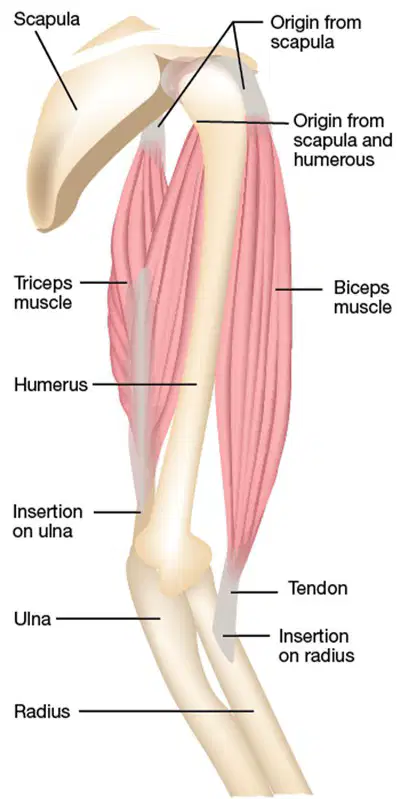
Which statement best defines a tendon in the musculoskeletal system?
Connects muscle to muscle for force sharing
Connects nerve to muscle for signal delivery
Connects muscle to bone for force transfer
Connects bone to bone for joint stability
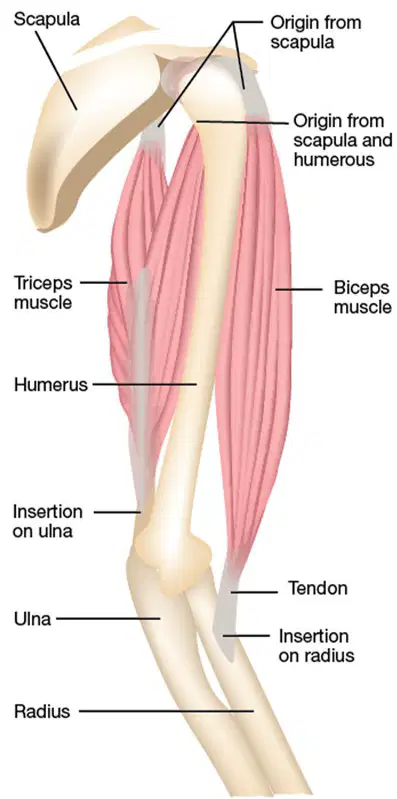
During elbow flexion in a biceps curl, which role pairing is correct for the primary muscles involved?
Biceps and triceps are both antagonists
Biceps and triceps are both prime movers
Biceps is antagonist, triceps is prime mover
Biceps is prime mover, triceps is antagonist
A muscle attaches to two bones. The attachment on the more stationary bone is called ______, and the attachment on the more movable bone is called ______.
tendon; belly
insertion; origin
origin; insertion
belly; insertion

A student designs a movement where the forearm extends at the elbow after flexion. Which coordinated muscle actions most likely produce this motion?
Both biceps and triceps fully relax
Both biceps and triceps contract strongly
Triceps contracts while biceps relaxes
Biceps contracts while triceps relaxes

