
NEW
Font size
 Worksheets
Fossil Record/Biogeography
Total questions: 14
Worksheet time: 28mins

When examining fossil layers...
those at the surface are younger than those at the bottom.
those at the surface are older than those at the bottom.
fossils will only be seen in the layer nearest the surface.
fossils will only be seen in the layer nearest the bottom.

How does the fossil record provide evidence of evolution?
It proves that there are animals that are now extinct.
It shows that bones can be preserved in mud.
Newer, complex fossils show structural similarities with older, simpler fossils.
It tells us that there are different layers of rock in the Earth.

What is stasis?
A type of crab that proves evolution is true.
When an organisms shows remarkably little evolutionary change over a long period.
When a gap appears in the fossil records.
When an organism evolves a LOT over a short period of time.

If closely-related species normally live nearby each other, how can you explain this image?
These organisms are not actually closely-related.
The llama swam across the Atlantic Ocean millions of years ago.
The llama does not share a common ancestor with camels.
South America, Asia, and Africa were once connected but broke apart millions of years ago.

What is is the study of how and why plants and animals live where they do?
Evolution
Adaptive Radiation
Biogeography
Biogeology
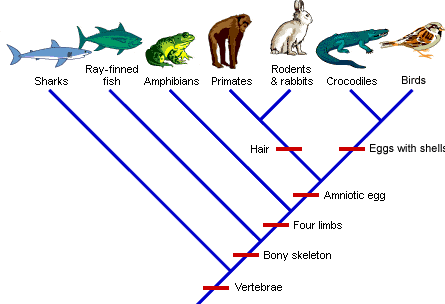

Based on the image, which species is MOST related to penguin E?
Penguin A
Penguin C
Penguin F
Penguin B


This pattern of evolution describes slow changes that occur in a population over a long period of time
Punctuated Equilibrium
Gradualism
Coevolution
Extinction

A model that describes evolution as a slow, ongoing process by which one species changes to a new species; When this form of evolution takes place, we can find fossils with "intermediate" traits
Homeostasis
Stasis
Punctuated Equilibrium
Gradualism

divergence
gradualism
punctuated equilibrium
isolation

