
 Worksheets
Introduction to Forms of Supply
Total questions: 61
Worksheet time: 31mins

Which statement best explains why materials are supplied in different forms for manufacturing?
To increase the number of suppliers involved
To make storage more complicated for factories
To avoid meeting safety regulations entirely
To match process needs and part geometry

Which example correctly matches a product with a suitable material form?
Pipelines with casting material
Engine blocks with pipe material
Car panels with sheet material
Car panels with powder material

Which approach modifies material properties through thermal methods rather than mechanical methods?
Cold working operations
Heat treatment processes
Rolling and drawing
Pressing and bending
Cold working is best described as which of the following?
Powder sintering under high vacuum conditions
Rapid quenching to increase ductility greatly
Heating above melting temperature of the metal
Plastic deformation below recrystallisation temperature

Which set lists common cold working methods?
Extrusion, injection molding, carburizing, quenching
Solution treating, aging, hot isostatic pressing
Rolling, drawing, pressing, bending, hammering
Casting, forging, sintering, annealing, tempering
Which supply form is typically used for long, uniform cross-sections such as round, square, or hex shapes?
Plate stock with wide flat surfaces
Sheet stock with thin flexible form
Coated sheet with zinc layer
Bar stock with consistent cross-section
At what thickness does a flat metal product generally transition from being called a sheet to being called a plate?
Around 0.5–1 mm thickness
Around 2–3 mm thickness
Around 6 mm thickness
Around 12 mm thickness
Which option best describes common uses of plates in engineering?
Structural components and base plates
Electrical wiring and small coils
Precision springs and watch parts
Thin cladding and roofing panels
Which statement correctly distinguishes sheet from plate?
Sheet is thicker and more rigid than plate
Sheet is thinner and more formable than plate
Sheet has irregular cross-sections unlike plate
Sheet is only supplied with protective coatings
What is the primary purpose of galvanised coated sheets in engineering applications?
Improve electrical conductivity for circuits
Enhance hardness through heat treatment
Provide corrosion resistance via zinc coating
Increase magnetic response for motors
Which bar shape is LEAST typical for general bar stock?
Wide flat plates for gussets
Hex bars for fastener blanks
Square bars for frames and keys
Round bars for shafts and pins
A fabricator needs thin material for deep drawing of automotive panels. Which supply form is most appropriate?
Galvanised bar for corrosion resistance
Hex bar for precision fasteners
Sheet metal for high formability
Thick plate for heavy machining
Why might a designer specify galvanised sheet rather than plain sheet for an outdoor enclosure?
To reduce density and weight significantly
To allow magnetic induction hardening
To obtain zinc-based corrosion protection
To increase thickness beyond plate limits
Which statement best distinguishes a pipe from a tube in engineering applications?
Pipe is only round, tube is only rectangular or square
Pipe is for structural loads only, tube is for fluids only
Pipe has thinner walls always, tube has thicker walls always
Pipe prioritizes flow capacity, tube prioritizes precise dimensions
In casting complex shapes, what is the primary role of the mould?
Rapidly quench the metal to improve hardness
Apply compressive load to reduce porosity
Increase alloy carbon content during solidification
Provide cavity geometry for molten metal to solidify
Which sequence correctly outlines a basic sand casting process?
Extrude through die, stretch, solution treat
Heat metal, hammer into die, water quench
Cut billet, machine features, surface finish
Prepare mould, pour molten metal, allow solidification
Which defect most likely results from insufficient sand permeability during casting?
Shrinkage cavities at isolated hot spots
Hot tears near thick-to-thin transitions
Cold shuts at converging metal fronts
Gas porosity pockets within the casting
When selecting between pipe and tube for a heat exchanger coil, which factor most strongly favors tube?
Tight dimensional tolerances for fit and performance
Maximizing internal flow rate at any cost
Eliminating need for corrosion-resistant alloys
Ensuring components remain strictly circular only
Which statement best explains why forged components often have higher strength than cast parts?
Cooling creates random grain orientation
Surface finish hides internal defects
Forging always uses harder alloy compositions
Grain flow aligns with load paths in forging
During extrusion, what primarily forces the billet through the die to create a continuous profile?
Compressive stress applied by a ram
Thermal expansion driving the metal
Shear stress from rotating rolls
Tensile stress pulling the billet
What benefit does grain flow around features like hubs or ribs provide in a forged part?
Improved fatigue resistance under cyclic loads
Reduced melting point for easier machining
Uniform electrical conductivity in service
Higher thermal expansion to relieve stress
Which choice describes a key difference between open‑die and closed‑die forging?
Open‑die always produces continuous extruded profiles
Closed‑die cannot control final geometry precisely
Open‑die relies on tensile loading to shape parts
Closed‑die uses shaped cavities for near‑net forms
In extrusion, why is die design crucial for product quality and process efficiency?
Ensures billet melts before forming starts
Prevents all residual stresses in product
Controls metal flow and exit speed evenly
Eliminates need for lubrication entirely
In the image of glowing steel on rollers, which process category is being highlighted for changing material properties?
Surface finishing techniques
Additive manufacturing methods
Cold working and heat treatment
Powder metallurgy processes
Which statement best defines melting point as shown with the furnace scene?
Temperature at which liquid becomes solid
Temperature where liquid becomes gas
Temperature at which a solid becomes liquid
Temperature where solid becomes plasma
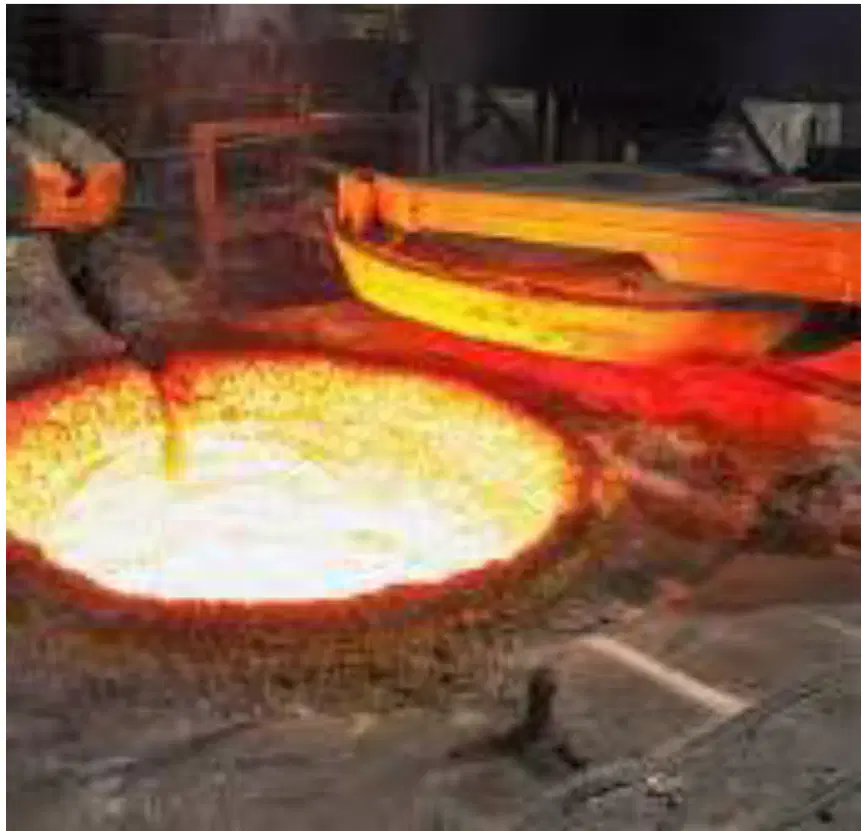
Aluminium melts at about 660°C. Which application benefits from this property, as suggested by the image?
Forging thick steel shafts
Casting complex aluminium parts
Sintering ceramic powders
Carburising low-carbon steel
The slide titled Tempering describes reheating quenched steel to a moderate temperature then cooling. What is the primary purpose?
Increase brittleness significantly
Reduce brittleness while keeping hardness
Lower density by heat treatment
Eliminate hardness entirely
Which component is a typical application for tempered steel shown on the tempering slide?
Electrical insulators
Tools and machinery parts
Concrete aggregates
Food packaging films

You compare samples by density to identify materials. Which simple procedure is most appropriate?
Measure mass and calculate volume
Measure color under sunlight
Record surface roughness values
Perform X-ray diffraction analysis
A quenched steel is too brittle for a spring. Which sequence improves toughness while maintaining useful hardness?
Anneal then quench steel
Normalize then cold roll
Quench then temper steel
Case harden then age
When selecting a supply form for manufacturing, which factor is most relevant to reduce waste for casting aluminium?
Order thick square bar stock
Buy oversized steel plate
Use extruded copper tubing
Choose near-net-shaped casting
Which best describes cold working in metals?
Rapid quenching from austenite phase
Heating above melting point for shaping
Plastic deformation below recrystallisation temperature
Diffusion-based alloying at high temperature
During cold working, how does hardness typically change?
Oscillates with cyclic loading
Remains unchanged with strain
Decreases due to grain growth
Increases due to work hardening
What is the primary microstructural reason for work hardening during cold working?
Increased dislocation density and interactions
Reduction in atomic mass of lattice
Formation of vacancies by annealing
Transformation to amorphous structure
A metal has been heavily cold worked and shows reduced ductility. Which process restores ductility most effectively?
Shot peening to induce compressive stress
Further cold rolling at room temperature
Annealing above recrystallisation temperature
Surface carburising for case hardening
Which statement about recrystallisation temperature is most accurate?
Exact value identical for all pure metals
Temperature that maximises thermal conductivity
Point where elastic limit becomes infinite
Temperature where new strain-free grains nucleate
Which statement best distinguishes mechanical modification from thermal modification in materials engineering?
Mechanical changes composition; thermal changes shape
Mechanical alters dislocation density; thermal alters microstructure
Mechanical improves conductivity; thermal increases magnetism
Mechanical increases melting point; thermal lowers density
Cold working typically produces which combined effect on a metal?
Higher ductility and toughness, lower strength and hardness
Higher strength and hardness, lower ductility and toughness
Higher conductivity and density, lower melting point
Higher magnetism and corrosion resistance, lower strength
During mechanical modification, what primary mechanism increases strength?
Phase transformation creates liquid phase
Dislocation multiplication hinders slip
Diffusion removes alloying elements
Grain growth reduces boundaries
Which processing route most likely restores ductility lost during cold work?
Quenching from ambient temperature
Solutionizing below recrystallization
Annealing above recrystallization
More cold rolling at room temperature
A designer needs high hardness for a formed steel bracket. Which sequence is most appropriate?
Cold work moderately then stress relieve
Cold work heavily then anneal fully
Anneal then cold work lightly
Hot forge then age harden
Which trade-off is most important when selecting mechanical versus thermal modification for cost efficiency?
Mechanical creates magnetism; thermal removes iron
Mechanical improves color; thermal enhances appearance
Mechanical raises melting point; thermal reduces density
Mechanical increases tooling wear; thermal increases energy use

Which property pair correctly categorizes physical vs mechanical properties for materials selection?
Toughness is physical; conductivity is mechanical
Melting point is mechanical; ductility is physical
Hardness and strength are mechanical; density is physical
Density and color are mechanical; hardness is physical
Which statement best describes the primary purpose of annealing in steels?
Refine grain size and increase yield strength
Create martensite and raise wear resistance
Increase hardness and reduce toughness
Reduce hardness and improve ductility
During normalising of steel, what is the typical sequence of steps?
Rapid quench from room temperature
Cold work then temper at low heat
Heat above critical, air cool freely
Heat below critical, furnace cool slowly
Compared to annealing, normalising most commonly results in which microstructural outcome?
Graphitic structure without pearlite
Fully martensitic structure
Coarser grains with residual stresses
Finer, more uniform pearlite
Which condition would most likely require annealing rather than normalising?
Improving cast steel’s uniform grain size
Relieving cold-work strains in sheet metal
Producing martensite for high wear parts
Increasing through-hardness in tool steel
A steel component is heated above the austenitising temperature and then allowed to cool in still air on a rack. What property change is most expected?
Extreme softness with large grains
Maximum hardness from martensite
No change because temperature is low
Improved strength with refined grains
Which pairing correctly matches process to cooling method?
Annealing—furnace cool slowly
Tempering—air cool from cold
Hardening—cool inside furnace
Normalising—quench in brine

Which property best matches the image of multiple thin metal strands being pulled apart into long filaments?
Hardness resisting surface indentation under load
Ductility enabling elongation into continuous wires
Toughness absorbing energy before fracturing
Malleability forming broad flat metal sheets
A manufacturer needs copper conductors for electrical wiring. Which heat treatment is most appropriate before drawing to balance softness and formability?
Tempering to slightly reduce brittleness
Quenching to increase martensitic hardness
Annealing to reduce hardness and improve ductility
Normalizing to refine grain without softening

Which statement correctly distinguishes malleability from ductility when shaping metals?
Malleability relates to forming sheets; ductility to forming wires
Both describe energy absorption during impact
Malleability relates to forming wires; ductility to forming sheets
Both describe hardness increase during quench

For producing thin aluminum foil from an ingot, which process-property combination is most suitable?
Cold quench increasing hardness for rolling
Surface hardening improving wear during forging
Austempering improving toughness for wire drawing
Full anneal increasing malleability for sheet forming
Which step immediately follows heating steel to its austenitizing temperature during hardening?
Quenching in water or oil
Tempering at low temperature
Normalizing in still air
Air cooling to room temperature
What is the primary purpose of quenching in the hardening process?
Increase ductility of the steel
Form hard martensitic structure
Remove residual stresses only
Improve corrosion resistance
Tempering is performed after quenching mainly to achieve which outcome?
Reduce hardness dramatically
Increase brittleness significantly
Eliminate grain boundaries completely
Balance hardness with toughness
For a thin, high-carbon steel blade, which quenching medium is most likely to reduce the risk of cracking while still achieving hardening?
Forced air with a fan
Warm oil with slower cooling
Ice water at near freezing
Brine solution with high salinity
Which statement best describes the hardness–toughness relationship after tempering?
Toughness increases with some hardness reduction
Both hardness and toughness sharply increase
Neither hardness nor toughness changes
Hardness increases while toughness decreases
A gear is quenched too rapidly and becomes very brittle. What adjustment most directly improves its service performance?
Skip tempering completely
Reheat and temper appropriately
Polish the surface finish
Anneal then leave unquenched
Which process sequence correctly represents hardening and tempering of steel?
Heat, temper, quench, normalize
Heat, quench, temper, cool
Quench, heat, temper, forge
Normalize, temper, quench, heat

Looking at the racing car image of impact-prone components, which property is most important for parts like bumpers after heat treatment?
Extreme surface roughness
Maximized corrosion resistance
High electrical conductivity
Adequate toughness with hardness

