
Font size
 Worksheets
Unit 2 SS Assessment Items (Grade 5)
Total questions: 14
Worksheet time: 7mins
Which of the following did NOT take place in South Carolina during the 1920s? (5.2.CO)
The boll weevil destroyed much of the cotton crop.
Farming in South Carolina boomed as farmer’s crops were needed to feed war-torn Europe.
Many thousands of African Americans went north looking for job opportunities.
Many banks and stores failed.
Which of the following BEST describes a factor that led to the crash of the stock market? (5.2.CO)
Many Americans began buying more stocks.
Value of stocks increased due to mass production.
Factories were not able to produce goods for consumers.
Factories were overproducing and began to lay off workers.
How did life in the U.S. and South Carolina change after the Stock Market Crash of 1929? (5.2.CO)
All Americans had appliances and televisions in their homes.
Millions of people became unemployed, and many lived in shantytowns.
Farmers did well as more crops were produced for European countries.
More people were able to enjoy the new technologies that were developed.
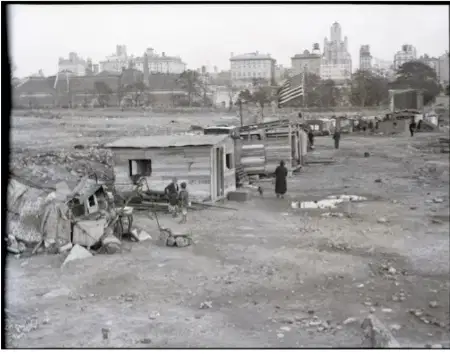
Study the photograph. What is one of the cultural and economic impacts of the Stock Market Crash of 1929? (5.2.CO)
People were forced to live in Hoovervilles.
People were forced to work in factories.
Many people were forced to build houses for immigrants.
Many people were forced to migrate to the North.
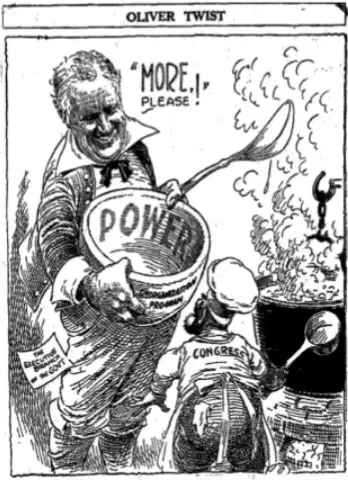
Study the political cartoon which states, "To get America out of the Depression, Roosevelt moves away from laissez-faire and uses more presidential power than previous presidents had before." Why did Roosevelt feel the need to increase federal power during the Great Depression? (5.2.P)
Roosevelt believed that the president should be more like a king.
Roosevelt believed that the federal government needed to pass New Deal policies to protect citizens and boost the economy.
Roosevelt believed that state governments needed to pass New Deal policies.
Roosevelt believed that Hoover’s Great Depression policies were working, and he needed to continue them.
Which of the following resulted from New Deal programs? Select all that apply. (5.2.P.)
Workers were hired to build roads, dams, and parks.
Millions of customers in some Southern states received electrical power.
People were able to receive unemployment and disability insurance.
Bank deposits and customers’ money were now protected.
Which statement about the “Harlem Renaissance” is TRUE? (5.2.CX)
It was caused by the great poverty and starvation present in New York City.
People in the New York neighborhood were not affected by the Great Depression.
It was made famous by such authors and musicians as F. Scott Fitzgerald and Glenn Miller.
Langston Hughes, Louis Armstrong, and other African Americans shared their art and culture with the nation.
What statement BEST summarizes the “Roaring Twenties” in the United States? (5.2.CX)
Most Americans lost jobs, lost interest in art and music, and were angry with the government.
All women were happy to work in the home and take care of their families.
Many Americans enjoyed an economic boost and a new interest in leisure and cultural activities.
African Americans were not allowed to express themselves as writers, artists, or musicians.
What was the lasting impact of the Harlem Renaissance of the 1920s and 1930s? (5.2.CX)
Hospitals began conducting medical research to find new cures.
Music, literature, and theater began to reflect African American culture.
Public education became regulated by the state and federal governments.
Roads and bridges were improved through better planning and construction.
Why did African Americans migrate north from South Carolina? Select all that apply. (5.2.CX)
To escape Jim Crow Laws
To own their own plantations
To continue going to separate schools
To escape the limitations of sharecropping
To have the opportunity to work in factories
Civilian Conservation Corps, Work Progress Administration, and the Tennessee Valley Authority are associated with what period of U.S. history? (5.2.CC)
The New Deal
The Great Society
The Prohibition Era
The Reagan Revolution
Why was the “New Deal” such a new concept for the United States government? (5.2.CC)
It was the first time a Democrat had been President.
It was the first time a Republican had been President.
The Federal government became very active in the national economy.
The states refused to take part in Roosevelt’s attempts to end the Great Depression.
Which New Deal program was created to give benefits to older, retired workers? (5.2.CC)
Social Security
Welfare Administration
Civilian Conservation Corps
National Recovery Administration
The Federal Deposit Insurance Corporation was a New Deal program that was created during the Great Depressions. It had the MOST impact on which industry? (5.2.CC)
Automobile
Banking
Cattle
stocks

