
Font size
 Worksheets
APUSH Unit 5 (1844–1877) —review
Total questions: 67
Worksheet time: 34mins
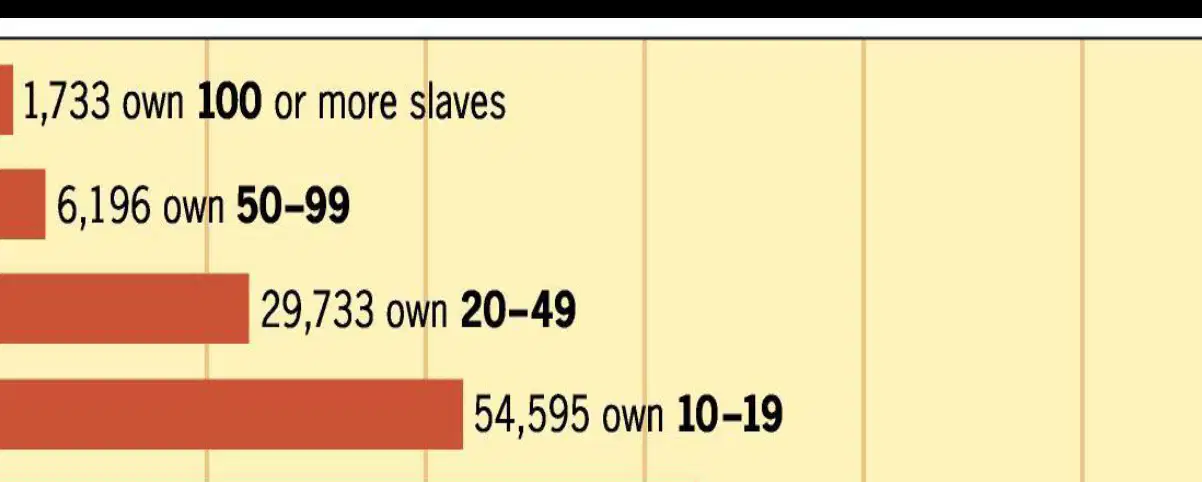
Refer to the bar chart titled Slave-owning Families, 1850. Which ownership range includes the largest number of slave-owning families?
100 or more slaves
50–99 slaves
20–49 slaves
10–19 slaves
2–4 slaves
Using the bar chart titled Slave-owning Families, 1850, which ownership range has the fewest slave-owning families?
1 each
5–9 slaves
20–49 slaves
50–99 slaves
100 or more slaves
Based on the bar chart titled Slave-owning Families, 1850, which pair correctly orders two categories from more families to fewer families?
5–9 slaves then 10–19 slaves
2–4 slaves then 5–9 slaves
20–49 slaves then 10–19 slaves
50–99 slaves then 100 or more slaves

Refer to the pie charts titled Value of Cotton Exports as a Percentage of All U.S. Exports, 1800–1860. In which year did cotton exports account for the highest share of all U.S. exports?
1800
1820
1840
1860

Using the pie chart labeled 1800 in Value of Cotton Exports as a Percentage of All U.S. Exports, 1800–1860, approximately what percent of U.S. exports were cotton?
7.1%
32.0%
51.6%
57.5%
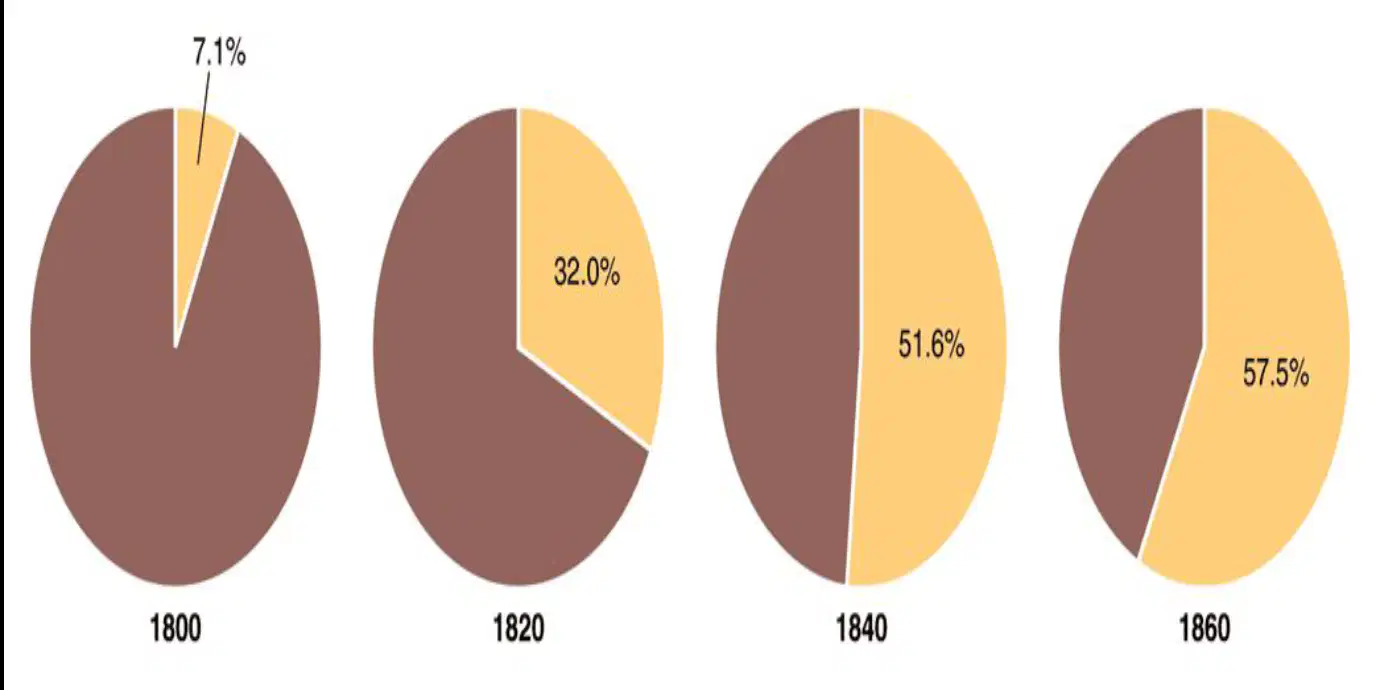
Across the pie charts titled Value of Cotton Exports as a Percentage of All U.S. Exports, 1800–1860, which statement best describes the trend in cotton’s share?
It declined steadily from 1800 to 1860.
It remained about the same across all years.
It increased overall, reaching its highest share by 1860.
It peaked in 1820 and fell afterward.
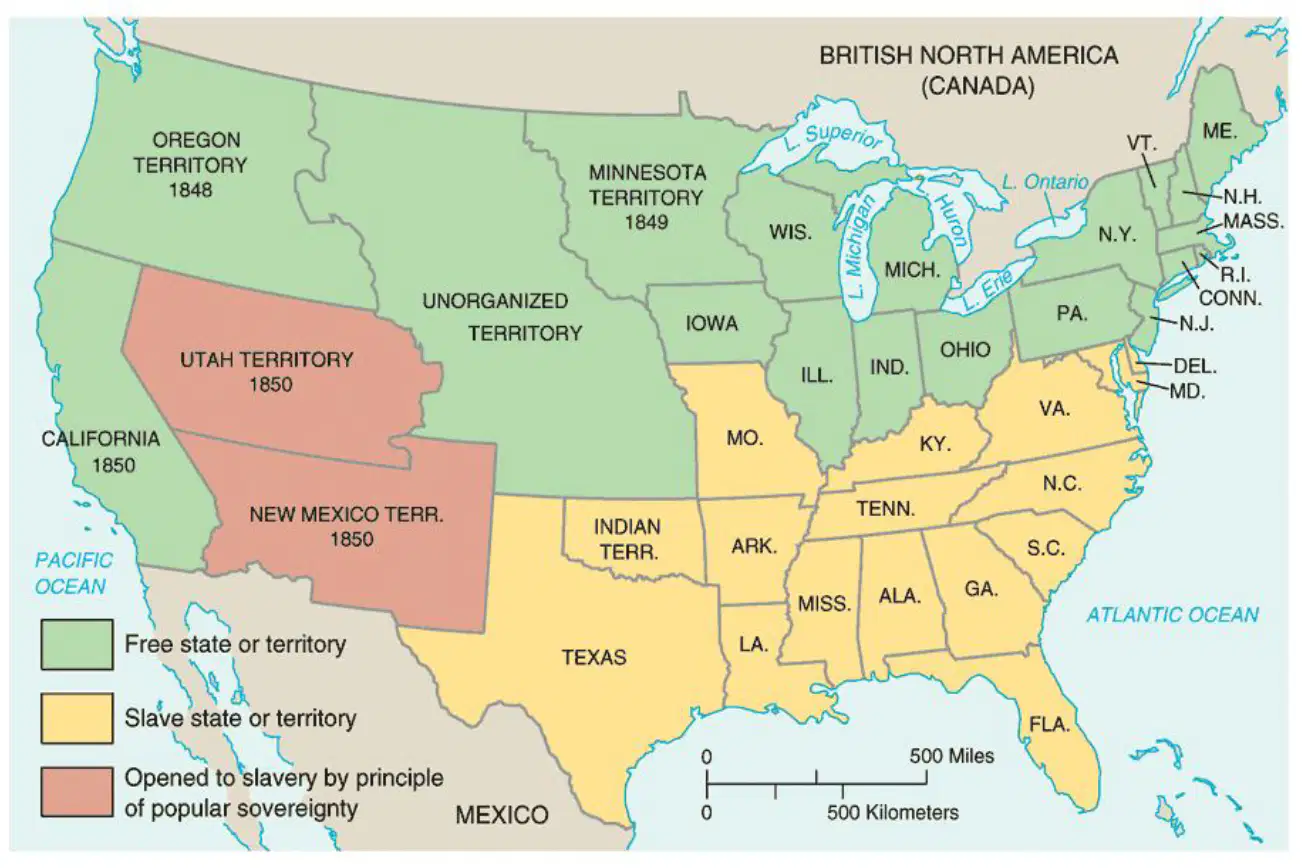
Refer to the map titled The Compromise of 1850. Which region(s) were opened to slavery by the principle of popular sovereignty in 1850? Select all that apply.
Utah Territory
New Mexico Territory
California
Oregon Territory

Using the map titled The Compromise of 1850, which state entered the Union as a free state in 1850?
Texas
California
Utah
New Mexico
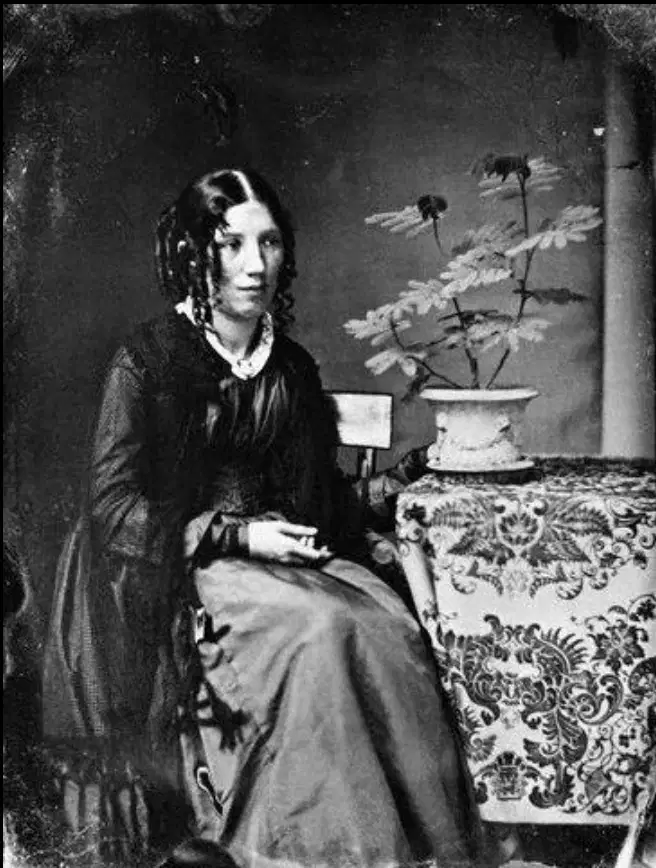
According to the text shown, who is credited as the author of Uncle Tom’s Cabin?
Harriet Beecher Stowe
Frederick Douglass
Sojourner Truth
William Lloyd Garrison
Based on the text displayed, in what year was the book Uncle Tom’s Cabin published?
1848
1850
1852
1854

Refer to the map titled Gadsden Purchase 1853. From which country did the United States acquire the Gadsden Purchase?
Canada
Great Britain
Mexico
Spain

Using the map titled Gadsden Purchase 1853, which future railroad route is marked across the purchased area?
Union Pacific Railroad
Southern Pacific Railroad
Transcontinental Northern Line
Atlantic Coast Line

Read the quotation: "I, John Brown, am now quite certain that the crimes of this guilty land will never be purged away but with blood. I had, as I now think, vainly flattered myself that without very much bloodshed it might be done." According to the speaker, how will the nation's "crimes" be removed?
Through violent struggle involving bloodshed
By peaceful reform and dialogue
Through decisions of the courts alone
By economic change without conflict
Which event is named in the slide title as connected to the year 1859?
The raid on Harpers Ferry
The Battle of Gettysburg
The Missouri Compromise
The Emancipation Proclamation
Based on the slide, what year is associated with Harpers Ferry?
1859
1861
1863
1877
Consider the lower-left illustration showing troops advancing on a smoking building with arched doors. What location is depicted?
The armory at Harpers Ferry
The U.S. Capitol building
Fort Sumter in Charleston Harbor
Independence Hall in Philadelphia
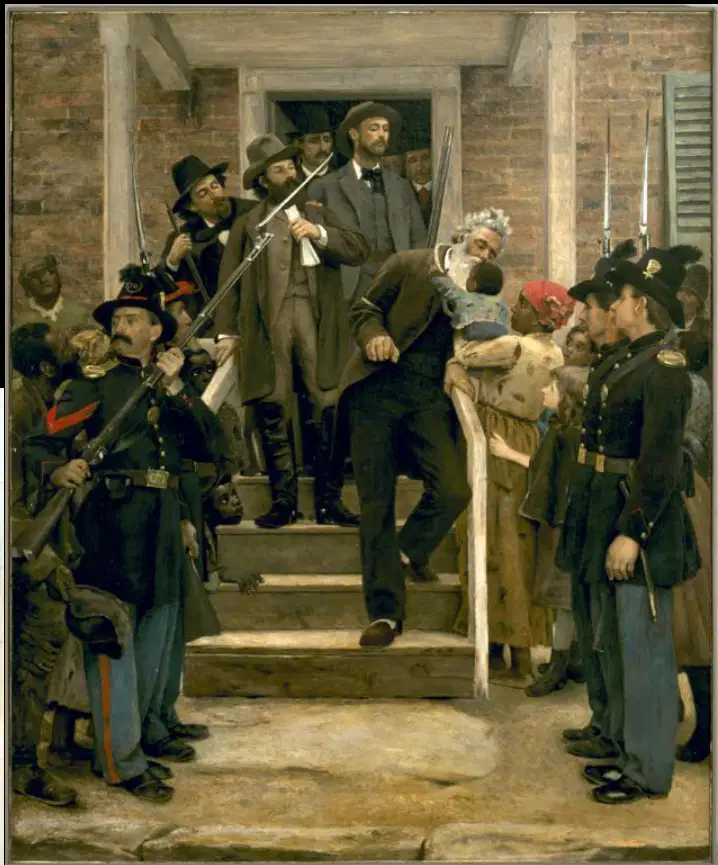
Which statements accurately reflect the change in belief expressed in the quotation on the slide? Select all that apply.
The speaker concludes that only bloodshed can purge the land's crimes
The speaker maintains that no bloodshed will be required
The speaker admits he once hoped minimal bloodshed might suffice
The speaker rejects violence as completely unnecessary
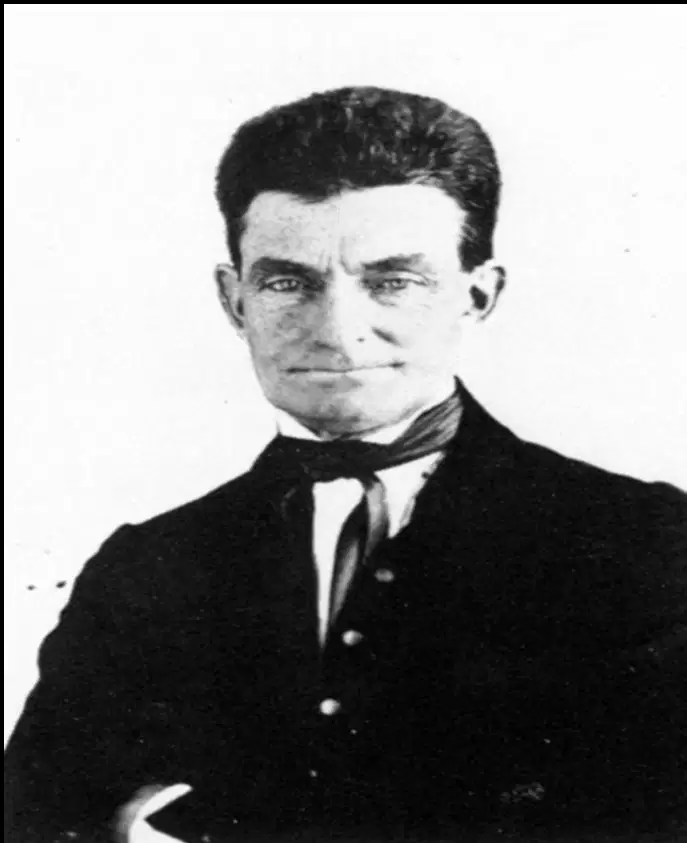
What name appears as the sole label next to the black-and-white portrait and URL on the second slide?
John Brown
Frederick Douglass
Ulysses S. Grant
Abraham Lincoln

Under the prompt "What is the Meaning of John Brown?", analyze the mural and choose the interpretation that best matches the imagery of a towering figure with outstretched arms, a raised weapon, a paper in one hand, swirling smoke, United States and Confederate flags, close combat, fire, and fallen bodies.
The artwork portrays the violent moral urgency of the antislavery struggle, casting the central figure as a prophetic, uncompromising force.
It celebrates reconciliation and peace achieved through diplomatic negotiation and compromise.
It commemorates a Confederate victory and endorses secession as a noble cause.
It critiques industrialization and factory labor as the primary source of social conflict.

Which visual element in the mural most strongly supports an interpretation of righteous fury and confrontation rather than calm deliberation?
The central figure’s outstretched arms holding a weapon and a paper amid smoke and chaos.
A tranquil landscape with clear skies and still water.
A group seated at a table in quiet discussion.
A symbol of harvest abundance in a peaceful field.

Political cartoon titled “1856 ATTACK IN CONGRESS ON SUMNER by Brooks,” captioned “SOUTHERN CHIVALRY — ARGUMENT VERSUS CLUB'S.” Based on the scene showing one congressman striking another in a legislative chamber, which event is depicted?
A violent caning on the Senate floor
A formal courtroom debate
A campaign rally speech
A peace treaty signing

In the cartoon titled “1856 ATTACK IN CONGRESS ON SUMNER by Brooks,” the caption “ARGUMENT VERSUS CLUB'S” most clearly suggests which message about politics shown in the image?
Violence is being used in place of reasoned debate
Legal reasoning triumphs over force
Diplomacy resolves political disagreements
Economic compromise settles legislative disputes
In the image labeled “1856 ATTACK IN CONGRESS ON SUMNER by Brooks,” where does the confrontation take place, as indicated by desks, spectators, and the chamber setting?
Inside a legislative chamber
On a battlefield
On a city street
Inside a church
According to the Dred Scott decision, as stated on the slide, what was ruled about a slave’s ability to sue in Federal Court?
A slave could not sue in Federal Court
A slave could sue only in state courts
A slave could sue in Federal Court if manumitted
A slave could sue in Federal Court with owner’s consent
The slide on the Dred Scott decision states that because a slave was private property, he could be taken anywhere and held in slavery. Which constitutional provision was cited as barring Congress from depriving anyone of property without due process?
5th Amendment
1st Amendment
10th Amendment
13th Amendment
The Dred Scott decision ruled the Missouri Compromise was unconstitutional. According to the slide, what did this mean for Congress’s power in the territories?
Congress had no power to ban slavery in territories
Congress gained full power to regulate slavery in territories
Congress could ban slavery only in newly acquired territories
Congress could ban slavery if a territory opposed it
Reaction to the Dred Scott decision: Which region is described on the slide as extremely happy with the decision?
The South
Northern Democrats
Republicans
Abolitionist societies
Reaction to the Dred Scott decision: Northern Democrats, who favored popular sovereignty, were opposed to which outcome, according to the slide?
Thwarting of popular will
Expansion of federal tariffs
Increased railroad subsidies
Use of judicial review in state courts
Reaction to the Dred Scott decision: How did Republicans characterize the ruling, as stated on the slide?
Not a decision, just an opinion
Binding precedent for all states
A compromise acceptable to all parties
A victory for popular sovereignty
Reaction to the Dred Scott decision: According to the slide, how did the South view the Union if the North would not obey the Supreme Court decision?
Questionable
Stronger
Unified
Indifferent
Lincoln Versus Douglas 1858: Who is identified on the slide as the Republican nominee for senate?
Abraham Lincoln
Stephen Douglas
James Buchanan
Salmon P. Chase
Lincoln Versus Douglas 1858: According to the slide, how many debates did Lincoln challenge Douglas to, and during which months?
Seven debates from August to October 1858
Five debates in spring 1857
Nine debates in winter 1859
Two debates in summer 1858
Lincoln Versus Douglas 1858: The slide states that the only issue discussed in the debates was which topic?
Slavery
Tariffs
Immigration
Banking policy
Lincoln Versus Douglas 1858: What position did Douglas argue would work, according to the slide?
Popular sovereignty
A federal ban on slavery
State nullification of federal law
Judicial enforcement without legislation
Lincoln Versus Douglas 1858: What position did Lincoln argue, as summarized on the slide?
Free soil—block slavery in the territories, legal where it already was
Immediate nationwide abolition of slavery
Allow slavery to expand with new states
Federal protection of slavery in all territories
Freeport, Illinois was site of key debate: According to the slide, which location hosted the key debate in the Lincoln–Douglas series?
Freeport, Illinois
Springfield, Illinois
Chicago, Illinois
Peoria, Illinois
Freeport, Illinois was site of key debate: The slide says Lincoln asked Douglas what would happen if people in a territory voted down slavery since the Supreme Court had said slavery could not be restricted in the territories. Which conflict does this question highlight?
Popular sovereignty versus Supreme Court ruling
Taxation versus representation
Foreign policy versus domestic policy
States’ rights versus federal tariffs
Douglas’ Freeport Doctrine: According to the slide, what did Douglas claim about slavery in a territory if the people voted it down, regardless of the Supreme Court decision?
It could not be allowed
It must be enforced by federal law
It would be permitted temporarily
It required a constitutional amendment
Douglas’ Freeport Doctrine: What political effect of the doctrine is listed on the slide?
It made him very unpopular with Southern Democrats
It united Southern and Northern Democrats
It secured immediate presidential nomination
It ended the debates early
Douglas’ Freeport Doctrine: According to the slide, what were the outcomes for Douglas after the debates?
He won the Senate seat but this cost him the presidency in 1860
He lost the Senate seat but won the presidency in 1860
He won both the Senate seat and the presidency in 1860
He lost both the Senate seat and the presidency in 1860
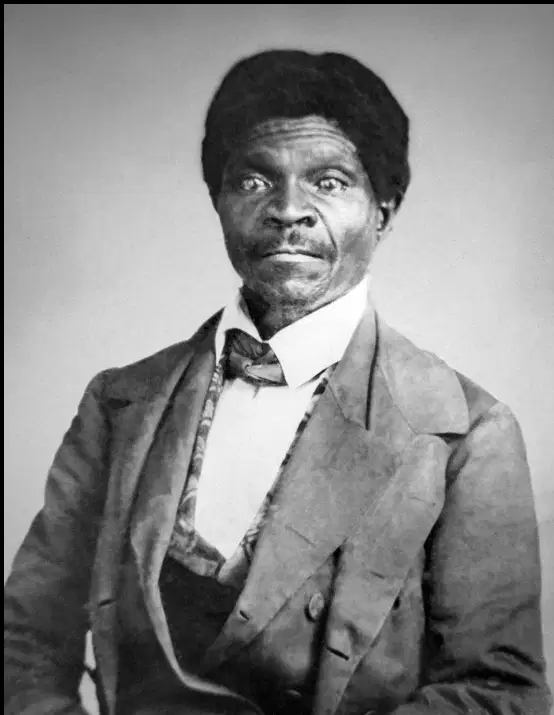
The slide shows the name Dred Scott. Which historical topic is most directly associated with this name, as presented on the slide title.
An abolitionist newspaper editor
A landmark Supreme Court case on slavery
A Union general during the Civil War
A compromise proposal in Congress

According to the 1860 election map showing party colors and vote shares, which party carried most of the Southern states.
Republican (Lincoln)
Southern Democratic (Breckinridge)
Constitutional Union (Bell)
Northern Democratic (Douglas)
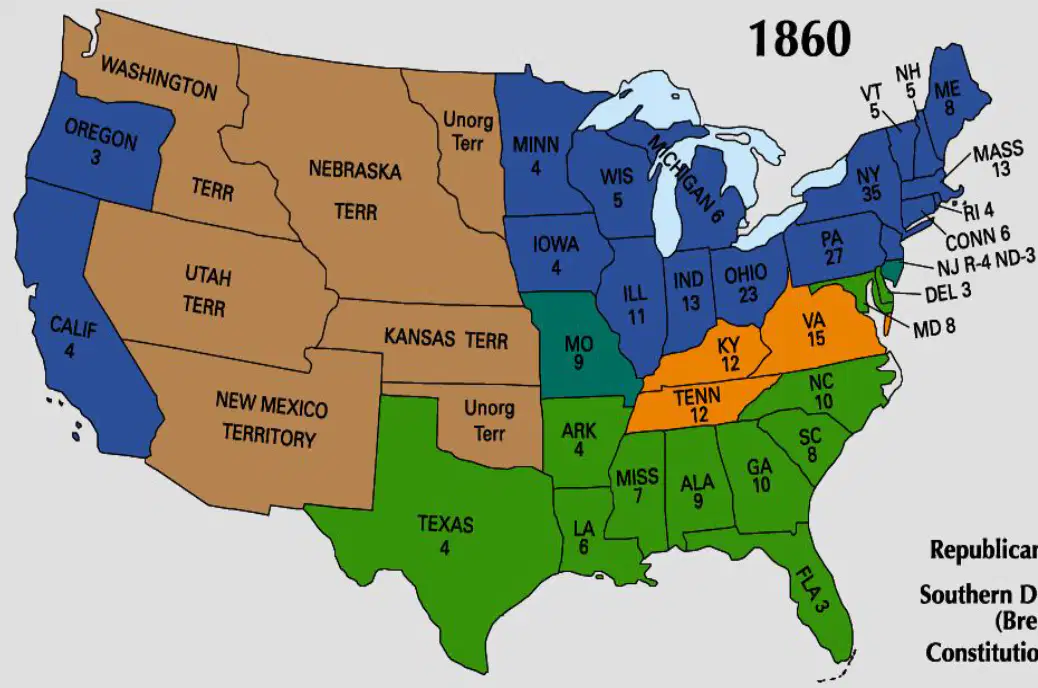
On the 1860 election map, which color represents states won by the Republican (Lincoln) ticket.
Blue
Green
Orange
Teal
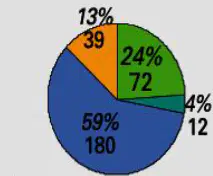
The 1860 election slide notes that Lincoln received less than 40% of the popular vote in a four-way race. What does this statement imply about the national political landscape that year.
The election was a two-party contest dominated by Republicans
Support was consolidated around a single Southern candidate
The vote was split among multiple parties across regions
Lincoln won a majority of the popular vote nationwide

In the secession map titled “The Course of Secession,” which state is marked with the number 1 in the order of secession.
Virginia
South Carolina
Georgia
Texas

Based on the secession map legend, which color indicates slave states that remained loyal to the Union.
Green
Orange
Yellow
Purple

According to the secession map, which category describes states that seceded after the fall of Fort Sumter.
Green-shaded states
Yellow-shaded states
Orange-shaded states
Purple-shaded states

Which senator proposed the Crittenden amendment, as stated on the slide.
Stephen A. Douglas
Henry Clay
James Henry Crittenden
John C. Calhoun

What policy regarding slavery did the Crittenden amendment propose for U.S. territories relative to the 36∘30′ line.
Abolish slavery everywhere in the territories
Allow slavery north of the line, prohibit it south
Allow slavery south of the line, prohibit it north
Leave slavery entirely to territorial courts without guidelines

How did Abraham Lincoln respond to the Crittenden compromise, according to the slide.
He endorsed it to preserve the Union
He rejected it fearing the extension of slavery
He postponed action until after inauguration
He referred it to the Supreme Court
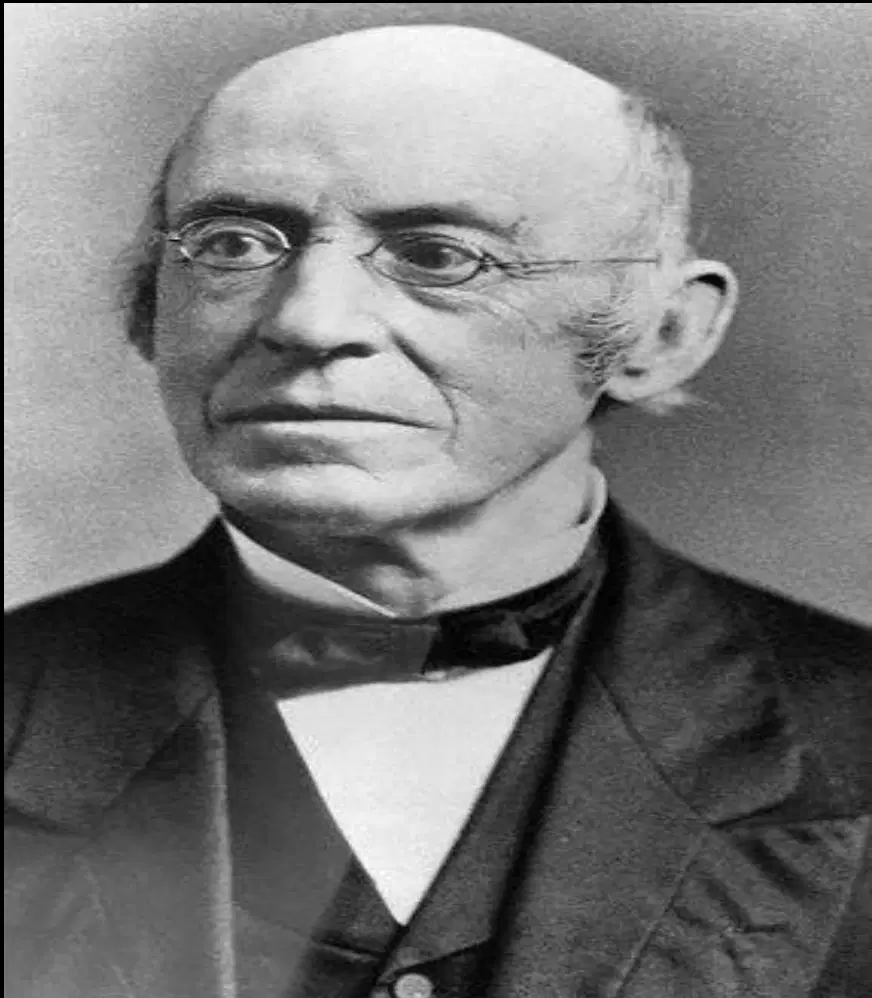
The slide displays the name of a prominent abolitionist alongside the title of his newspaper. Which newspaper title appears on the slide.
The North Star
The Liberator
Harper’s Weekly
The Emancipator
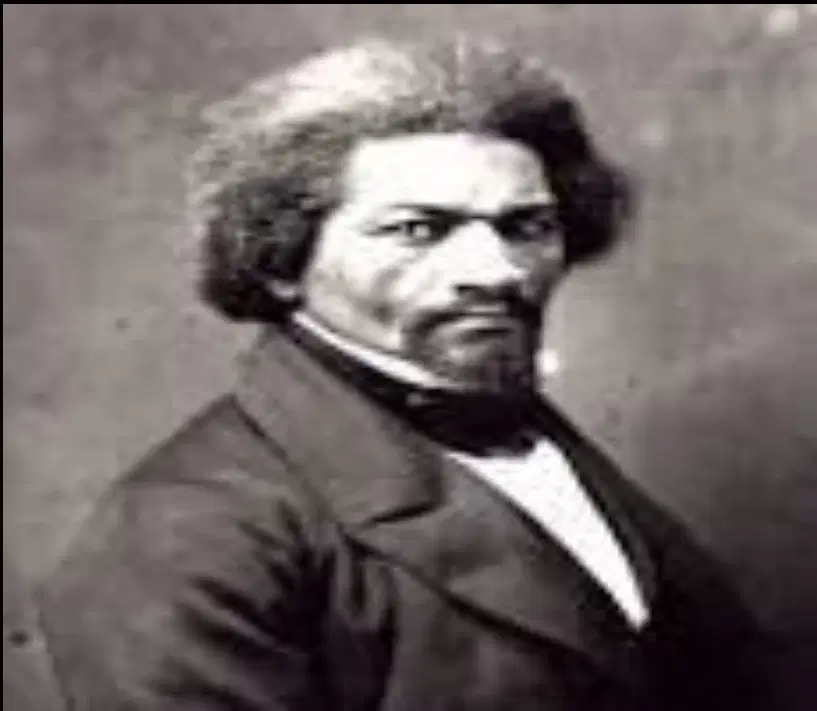
According to the slide title text, what is linked with Frederick Douglas?
The North Star
The South Star
The Evening Star
The Western Star

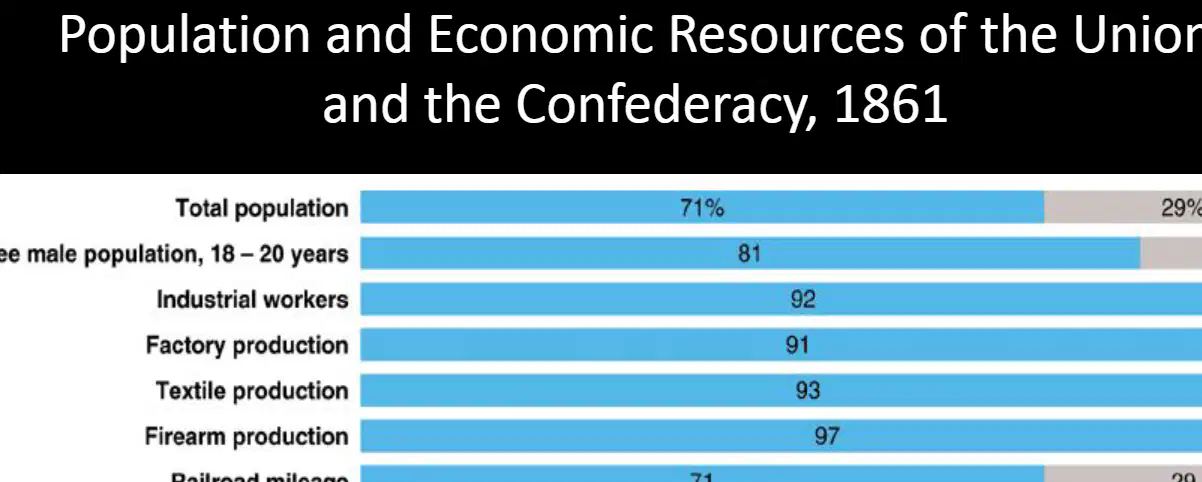
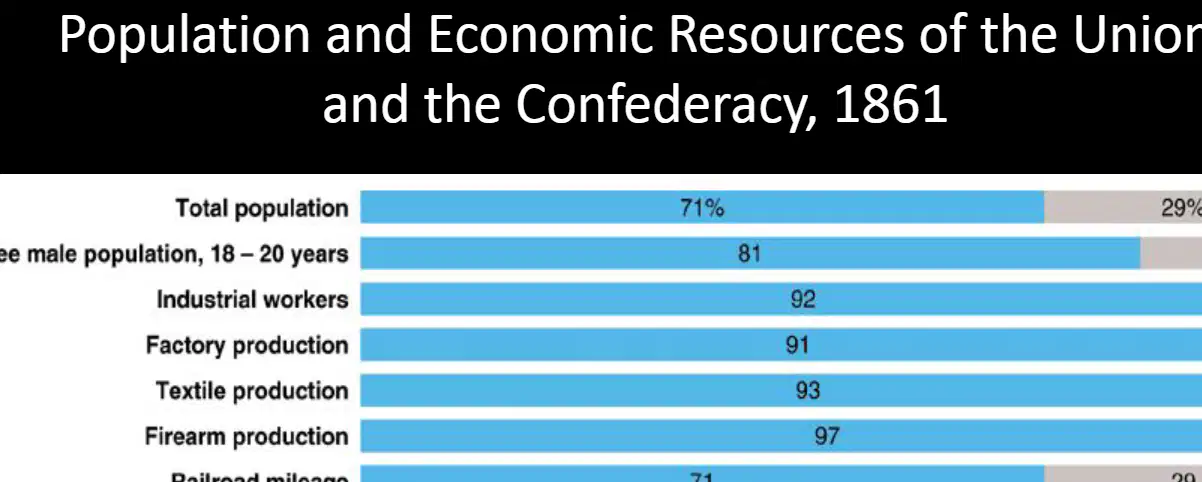
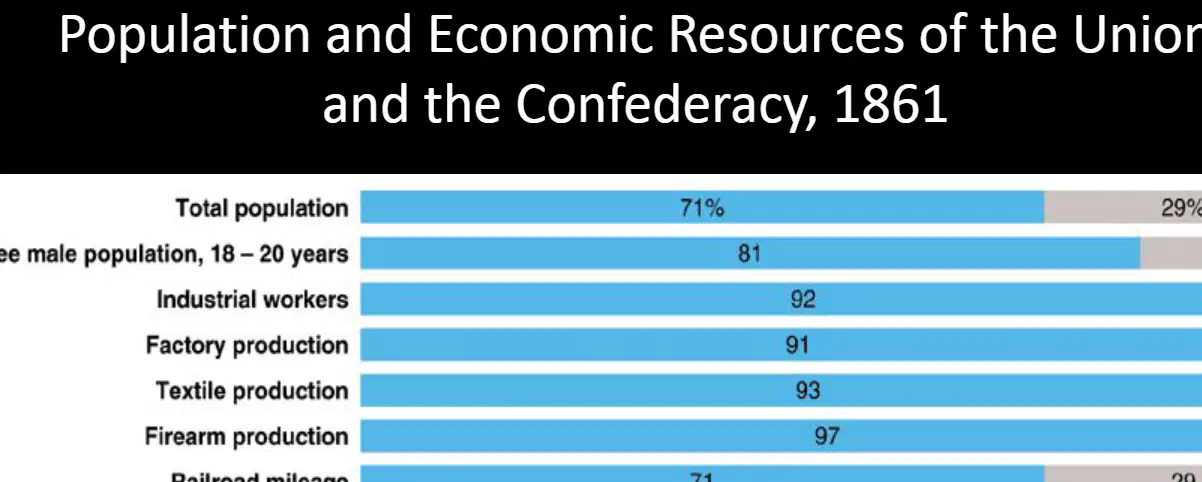
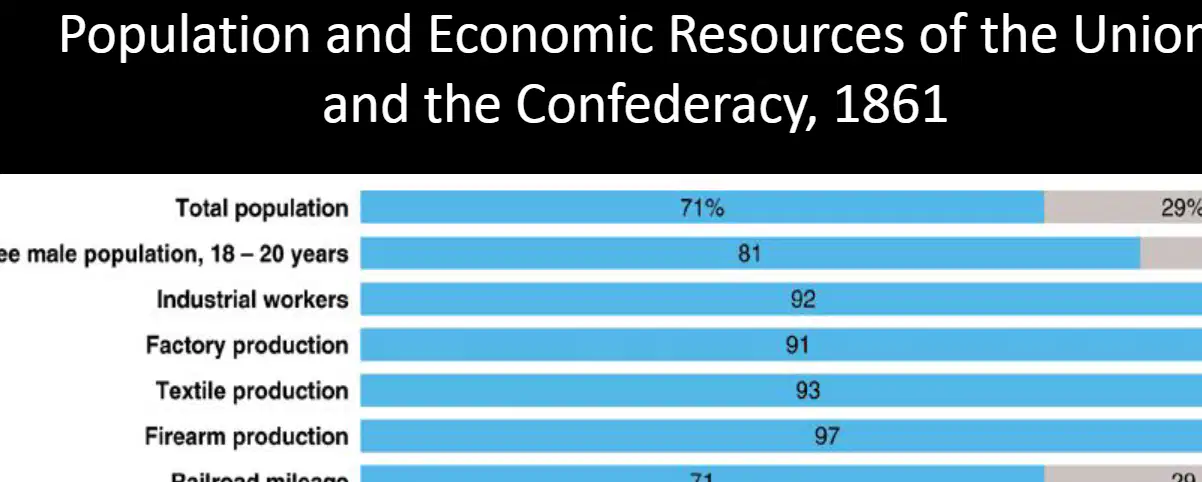
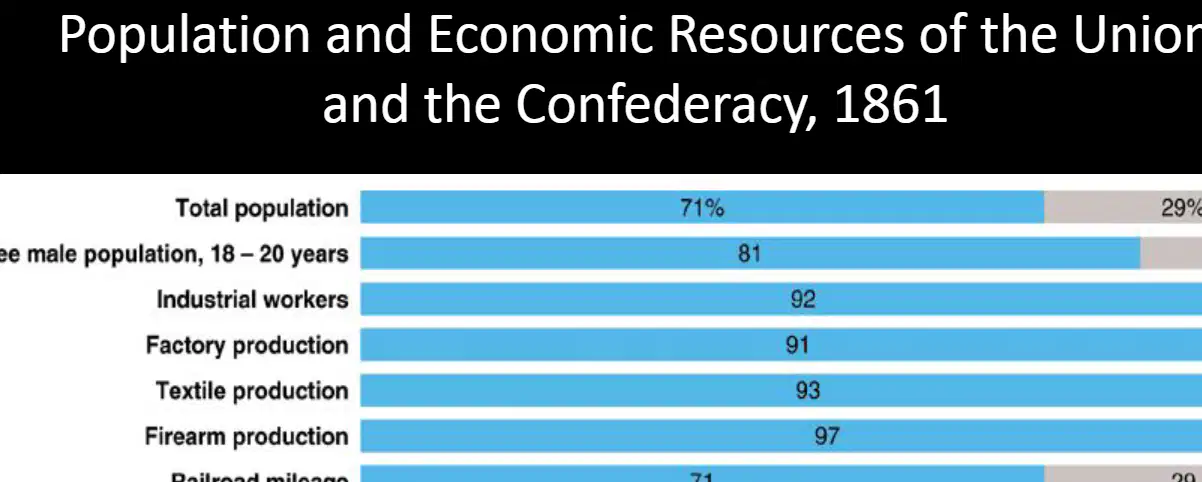
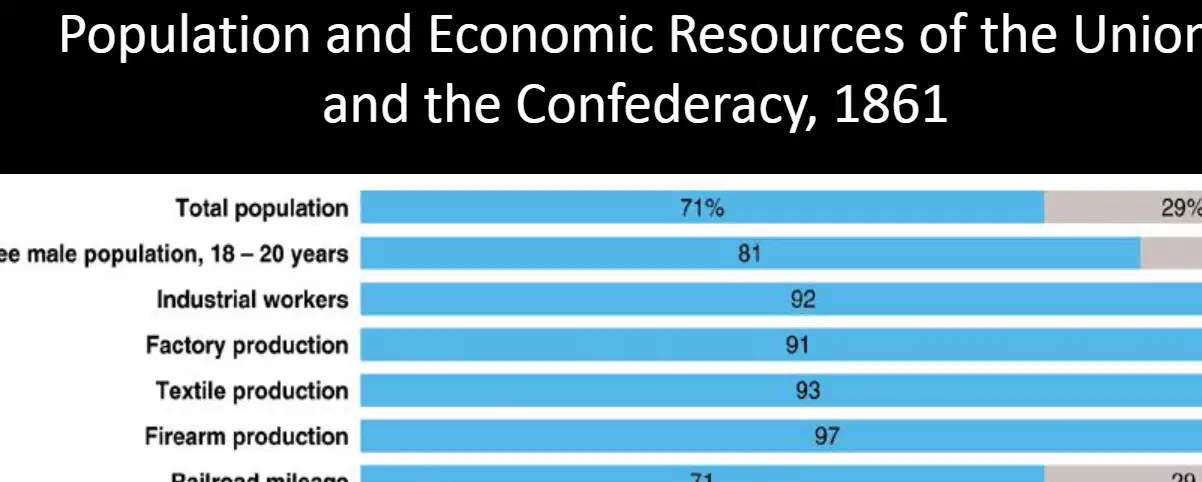
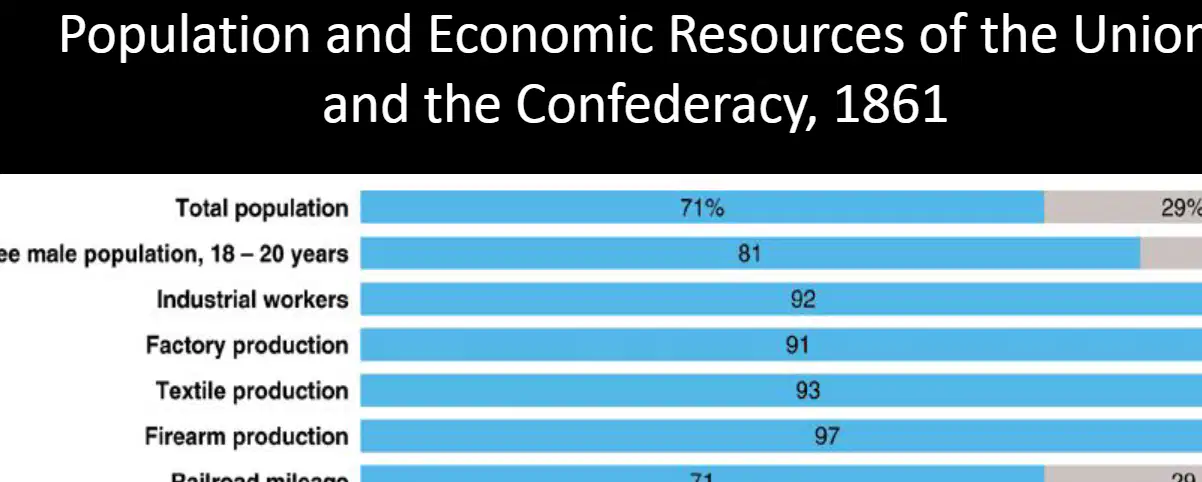
Based on the chart "Population and Economic Resources of the Union and the Confederacy, 1861," which side held 71% of the total population?
Union
Confederacy
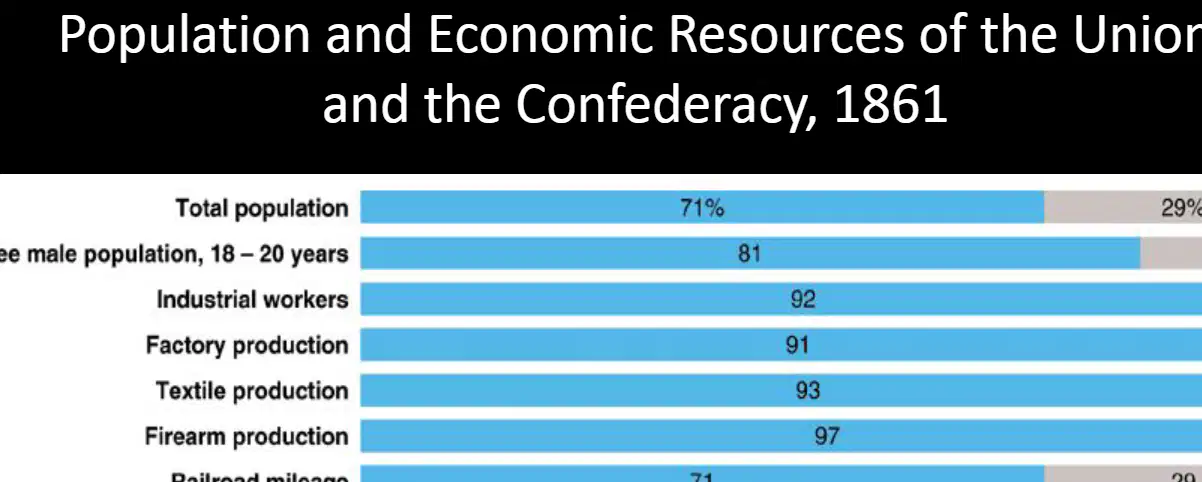
In the category "Free male population, 18–20 years," what share is attributed to the Union?
81%
71%
60%
75%
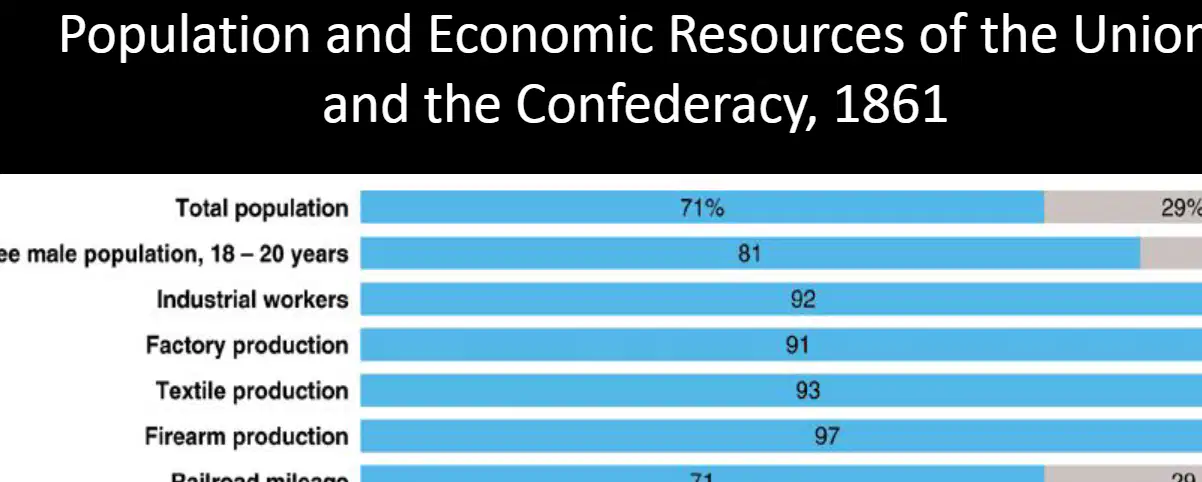
Which side accounted for 92% of industrial workers in 1861?
Union
Confederacy
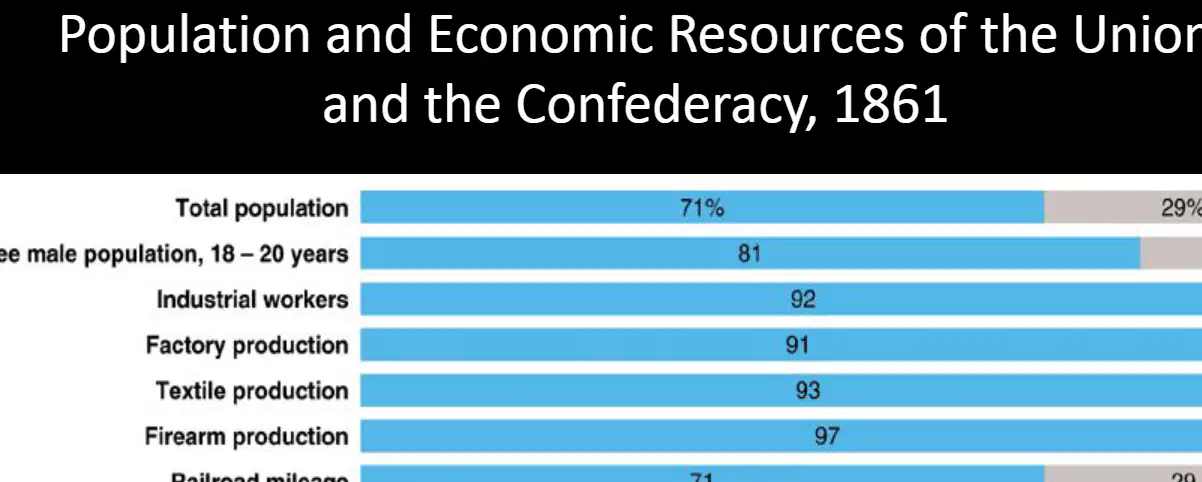
Factory production in 1861 was predominantly on which side, with 91%?
Union
Confederacy

Textile production was concentrated where, with 93% of output?
Union
Confederacy
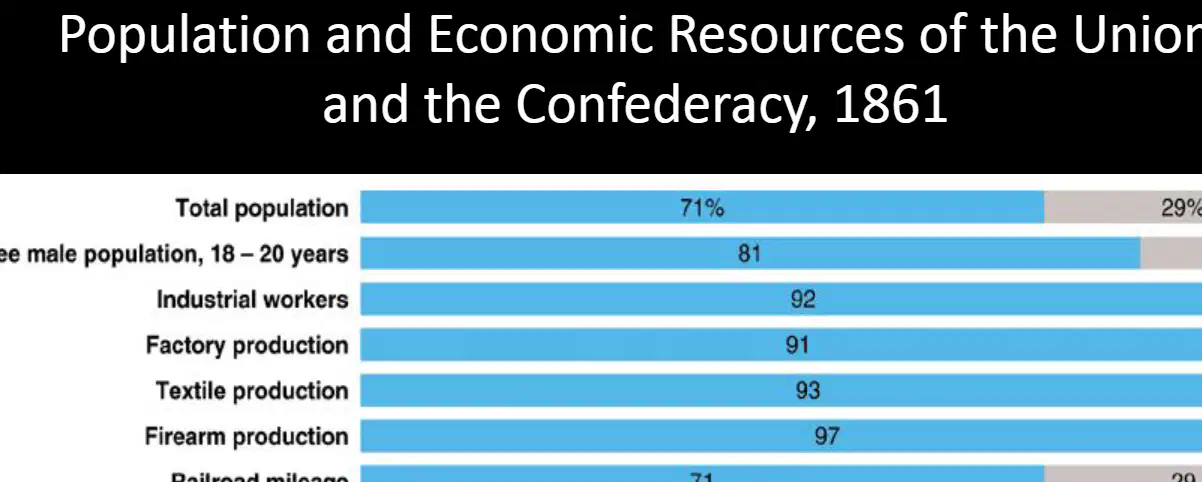
Firearm production shows a 97% share on which side?
Union
Confederacy
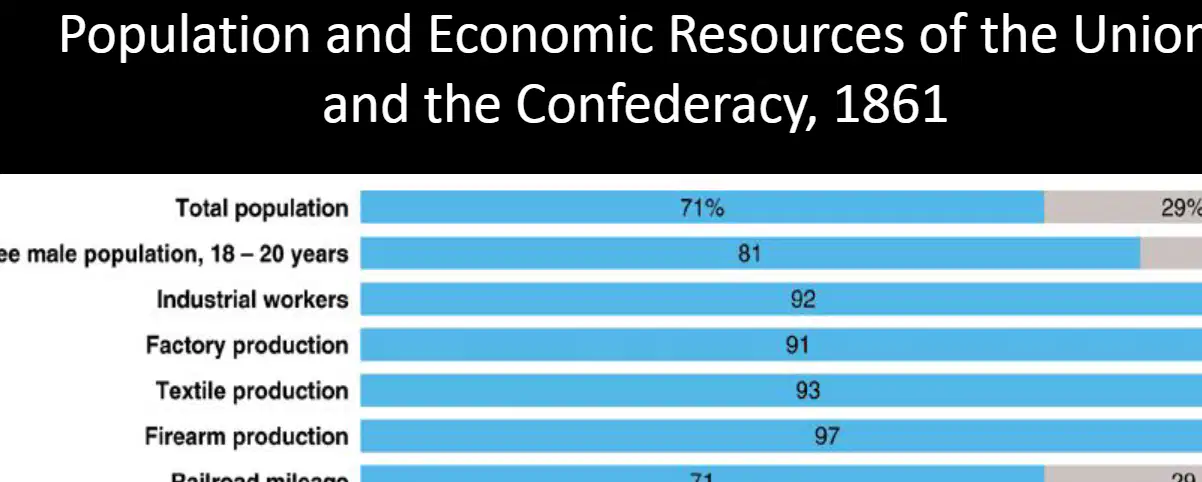
Which side controlled 71% of railroad mileage in 1861?
Union
Confederacy
Iron production was overwhelmingly on which side, with 94%?
Union
Confederacy
Coal production in 1861 shows a 97% share for which side?
Union
Confederacy
Livestock ownership is split with 60% on one side and 40% on the other. Which side holds 60%?
Union
Confederacy
Farm acreage shows a 75% share on which side?
Union
Confederacy
Wheat production is shown at 81% for which side?
Union
Confederacy
Corn production is split 67% to 33%. Which side holds 67%?
Union
Confederacy
Cotton production shows a 96% share on which side?
Confederacy
Union
Wealth produced is shown as 75% on one side and 25% on the other. Which side produced 75%?
Union
Confederacy

