
 Worksheets
Fundamentals of Fluid Power
Total questions: 83
Worksheet time: 1hrs 28mins
Which field of engineering focuses on transmitting power through pressurized fluids?
Structural load analysis
Thermal circuit design
Optical signal processing
Fluid power engineering
Which statement best distinguishes hydraulics from pneumatics?
Both use gases at high temperature
Hydraulics use gases; pneumatics use liquids
Hydraulics use liquids; pneumatics use gases
Both use liquids at low pressure
Which component converts fluid energy into mechanical linear motion?
Hydraulic cylinder
Pressure gauge
Gear pump
Reservoir tank
Which statement best defines fluid power in engineering systems?
Use of electrical signals for motion
Use of solid gears to transmit force
Use of thermal energy for rotation
Use of pumped fluids to transmit force
Which characteristic describes well‑adapted fluid power systems under proper use?
Frequent breakdown under overload
Smooth uniform action without vibration
High random motion with oscillations
Constant manual control requirement
Which guideline is suggested when choosing hydraulics versus pneumatics for an application requiring speed and medium pressure?
Prefer a hydraulic system
Prefer a mechanical linkage
Prefer a pneumatic system
Prefer an electrical system
What automotive component commonly uses hydraulic power to assist driver control?
Windshield wiper motor assembly
Power steering in passenger vehicles
Radiator fan on gasoline engines
Alternator drive belt tensioner
Which factor makes expressing effects of liquids in motion more difficult than at rest?
Evaporation causing mass loss
Frictional and other complex actions
Constant density simplifying equations
Absence of surface tension effects
Which formula correctly relates force, pressure, and area in fluid power?
F = P × A
F = P ÷ A
P = F × A
A = P × F
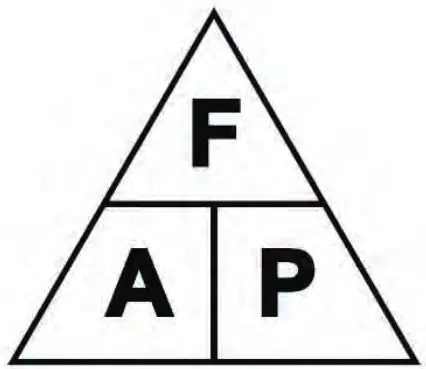
In the memory triangle showing F, P, and A, how are the variables related?
Bottom equals square of top term
Left equals difference of right term
Any letter equals product or quotient of two
Top equals sum of bottom terms
For a circular surface, which formula is used to find area?
A = πd
A = d²/4
A = 2πr
A = πr²
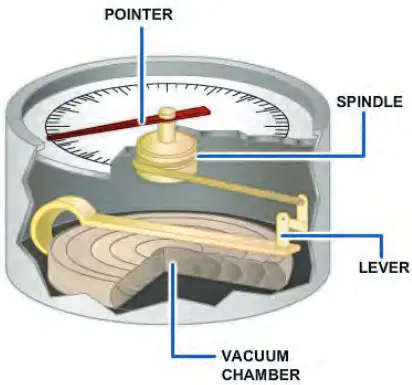
In an aneroid barometer, what component’s movement is transmitted to the pointer to indicate pressure?
Liquid-filled Bourdon tube
Calibrated spring mechanism
Thin metal evacuated cell
Elastic rubber diaphragm sheet
What effect partially counteracts compression of lower air layers by mass above them?
Expansion of lower layers due to heating
Contraction of upper layers due to cooling
Heating of upper layers aloft
Decrease in gravity with altitude
Which principle explains that pressure applied to a confined liquid is transmitted equally in all directions?
Bernoulli’s principle for streamline flow
Pascal’s law for confined liquids
Archimedes’ principle of buoyancy
Newton’s second law of motion
In a rigid solid bar struck at one end, how is the force primarily transmitted?
Equally outward in all directions
Straight through along the bar’s length
Randomly dispersing through the bar
Only perpendicular to the blow direction
When force is applied to the end of a column of liquid, what happens inside the container?
Pressure transfers only upward due to gravity
Pressure distributes equally in every direction
Pressure diminishes as distance increases
Pressure increases only near the applied end
Density in the English system is expressed as weight per unit volume. Which unit of volume is stated?
One gallon of volume
One cubic foot of volume
One cubic inch of volume
One quart of volume
In metric terms, density is commonly expressed in which units?
Newtons per cubic foot
Grams per cubic centimeter
Pascals per liter
Kilograms per square meter
Why does the direction of a blow on a solid bar largely determine the direction of transmitted force?
Liquids resist shear more than solids
Atmospheric pressure pushes in one direction
Rigid solids constrain force along their axis
Density differences cause lateral dispersion
Which equation correctly expresses density as a relationship of weight and volume?
D equals W divided by V
D equals V divided by W
D equals W times V
D equals W minus V
If 24 cubic feet of a liquid weighs 1,497.6 pounds, what is the weight per cubic foot?
62.4 pounds per cubic foot
68.64 pounds per cubic foot
64.2 pounds per cubic foot
61.4 pounds per cubic foot
In metric terms, what is the density of water at 4 °C?
0.997 gram per cubic centimeter
1000 grams per liter
1 kilogram per liter
1 gram per cubic centimeter
Moving a pressure gauge closer to the liquid surface will cause the indicated pressure to do what?
Oscillate
Remain unchanged
Increase
Decrease
Setting area A equal to 1, which expression gives pressure due to a liquid column?
P equals hD
P equals D over h
P equals h over D
P equals D minus h
To express pressure in psi when D is in lb/ft³ and h in feet, which adjustment is necessary?
Divide hD by 12
Multiply hD by 144
Multiply hD by 12
Divide hD by 144
Why is resistance necessary to create fluid pressure in a hydraulic system?
It reduces flow turbulence
It prevents cavitation in the pump
It provides a force to act against
It keeps the fluid temperature low
Which statement best describes energy transfer when an object is slowed without friction?
Energy disappears completely
Energy increases with atmospheric pressure
Energy converts to internal heat
Energy equals that used to speed up
What is the role of static pressure relative to velocity and friction heads along a flow path?
Static pressure increases as friction head is consumed
Static pressure decreases only when velocity increases
Static pressure plus velocity and friction heads equals original static head
Static pressure equals the original static pressure everywhere
What is the principle/Law that helps us apply greater hydraulic force to the calipers?
Lemon's
Ohm's
Pascal's
Newton's
Pneumatic systems use compressed _________ to transfer force.
Air
Liquid
Solid
Gas
Pneumatic actuators require valves to control compressed air.
True
False
What type of cylinder is supplied with compressed air at both ends?
Single-acting cylinder
Double-acting cylinder
Triple-acting cylinder
Quadruple-acting cylinder
At sea level and 0°C, what mercury column height corresponds to approximately 14.7 psi of atmospheric pressure?
28 inches, about 71 centimeters
30 inches, about 76 centimeters
24 inches, about 61 centimeters
32 inches, about 81 centimeters
Which component in an aneroid barometer transmits the metal cell’s motion to the indicator?
Vacuum chamber connecting tube
Lever system and spindle
Calibrated mercury reservoir
Weighted pointer spring
A flat hose becomes round when filled because liquid pressure in a confined fluid does what?
Acts mainly downward with gravity
Distributes equally in all directions
Transmits straight in one direction only
Concentrates near the inlet opening
A pair of pistons connected by a liquid are exposed to the same atmospheric pressure on both sides. What is the net effect of atmospheric pressure on the pistons?
Net force cancels, pressures are balanced
Net downward force increases on left piston
Force shifts with piston area difference
Net upward force acts on right piston
A liquid fills a 4 ft × 3 ft × 2 ft container and weighs 1,497.6 lb. What is its density in pounds per cubic foot?
62.4 lb per cubic foot
68.6 lb per cubic foot
49.9 lb per cubic foot
64.0 lb per cubic foot
Which expression correctly defines specific gravity for liquids when water is the standard?
Weight of substance divided by equal volume of water
Weight of water divided by equal volume of substance
Density of water divided by density of substance
Volume of substance divided by volume of water
Water at 4 °C has a density of 62.4 lb/ft³. A hydraulic liquid has specific gravity 0.8. What is the density of the hydraulic liquid in lb/ft³?
68.6 lb per cubic foot
49.9 lb per cubic foot
62.4 lb per cubic foot
43.3 lb per cubic foot
Which instrument is used to measure the specific gravity of liquids?
Dynamometer
Hydrometer
Manometer
Barometer
Which statement best describes Pascal's law in a confined fluid system?
Pressure acts equally at right angles in all directions
Pressure depends on container shape and volume
Pressure decreases across bends and fittings
Pressure transmits only along the line of applied force
A column of water 1 ft high over 1 square inch produces approximately what pressure at the bottom?
1.299 psi at the bottom surface
0.433 psi at the bottom surface
8.0 psi at the bottom surface
62.4 psi at the bottom surface
Two pistons, each 10 square inches, are connected by a fluid passage. An input force of 100 lb is applied on piston 1. What is the upward force on piston 2 if the passage is unobstructed?
100 lb upward on piston two
10 lb upward on piston two
0 lb upward on piston two
200 lb upward on piston two
A tank with varied shapes is filled to the same vertical level H across connected sections. Which factor determines the pressure at level H at any point in the system?
Fluid density multiplied by depth h
Container cross-sectional area at level
Total volume of connected vessels
Length of the connecting tube
In a hydraulic system, pressure is 10 psi throughout. If the output piston has an area of 20 square inches, what upward force is produced on that piston?
100 pounds of upward force
150 pounds of upward force
250 pounds of upward force
200 pounds of upward force
Two pistons are connected by small-diameter piping. The input piston area is 2 square inches and the output piston area is 20 square inches. If 20 pounds is applied downward on the input piston, which statement best describes the resulting forces?
Both pistons see 10 pounds of force
Output experiences 200 pounds of force
Output experiences 20 pounds of force
Input experiences 200 pounds of force
A single piston has fluid acting on both faces; one face has 6 square inches, the other effectively 4 square inches due to a rod. With 20 psi applied to both faces, what is the net unbalanced force direction and magnitude?
40 pounds to the right
20 pounds to the left
40 pounds to the left
80 pounds to the right
In a closed hydraulic system with equal cross-sectional areas on both pistons, if the left piston is pushed down 1 inch displacing 10 cubic inches of fluid, how far will the right piston move and why?
2 inches due to area mismatch
No movement due to incompressibility
1 inch due to equal volume exchange
0.5 inch due to pressure drop
Which equation correctly relates flow rate to velocity and cross-sectional area in a pipe?
Q equals v divided by A
Q equals A divided by v
Q equals v times A
Q equals A minus v
A pipe narrows from 16 square inches to 4 square inches while carrying an incompressible fluid at constant flow rate. What happens to velocity in the narrower section?
It becomes one-fourth as large
It stays the same value
It becomes four times larger
It becomes half as large
Two hydraulic cylinders have equal volumes. One cylinder is twice as long as the other. If both are filled at the same flow rate, how must piston speeds compare for equal fill times?
Longer cylinder piston moves twice as fast
Speed depends only on viscosity
Shorter cylinder piston moves twice as fast
Both pistons move at equal speed
Which statement best describes streamlined (laminar) flow in small-diameter tubes at low velocities?
Particles cross paths frequently
Flow rate changes unpredictably
Particles move in parallel layers
Velocity fluctuates randomly
Which description best characterizes laminar (streamline) flow in a pipe?
Particles move in parallel layers with orderly paths
Centerline velocity is lower than near the pipe walls
Fluid paths cross randomly with frequent eddies
Velocity fluctuates widely near bends and obstructions
A fluid in a narrowing pipe speeds up and becomes turbulent when velocity exceeds a certain threshold. What is this threshold called?
Static head limit
Atmospheric pressure point
Terminal acceleration
Critical velocity
A body of fluid moving at constant speed continues in that state unless acted on by an unbalanced force. Which principle explains this behavior?
Archimedes’ buoyancy principle
Pascal’s transmission law
Newton’s first law of motion
Bernoulli’s continuity law
Which expression best represents kinetic energy in foot-pounds for a moving object?
Weight times velocity squared divided by sixty-four
Force times distance divided by sixty-four
Mass times acceleration divided by sixty-four
Pressure times area divided by sixty-four
In fluid systems, which statement correctly distinguishes gravity head from friction head?
Gravity head is energy from temperature; friction head is energy lost to leakage
Gravity head is energy from velocity; friction head is energy added by turbulence
Gravity head is energy from pressure; friction head is energy gained by viscosity
Gravity head is energy from elevation; friction head is energy lost to resistance
A hydraulic pump starts fluid flow through a line to an actuator at rest. Which reasoning best explains the initial energy transfer?
Pump work overcomes fluid inertia and actuator inertia
Pump work reduces friction and increases fluid viscosity
Pump work raises temperature and creates gravity head
Pump work decreases pressure and releases stored head
In a horizontal flow where friction is negligible, which statement best describes how static pressure and velocity head are related according to Bernoulli’s principle?
Static pressure and velocity head both increase together
Static pressure remains constant regardless of velocity
An increase in velocity head reduces static pressure equally
Velocity head converts into friction head at constant rate
Which set lists the five basic components of a hydraulic fluid power system?
Reservoir, pump, lines, directional valve, actuator
Reservoir, compressor, nozzle, venturi, governor
Accumulator, filter, regulator, manifold, transducer
Tank, turbine, hoses, relief valve, indicator
In the hydraulic jack shown, the input piston has 5 sq in area and the output piston has 250 sq in area. If 25 lb is applied on the input piston, which statement best describes the resulting effect on the output piston?
It experiences 1250 lb due to equal pressure
It receives 5 lb per sq in but no motion
It moves fifty times farther than the input piston
It sees 25 lb because areas do not matter
Refer to the brake system diagram. What is the primary role of the master cylinder relative to the wheel cylinders during pedal application?
Vent fluid to keep pressure constant
Creates pressure and distributes it equally
Stores fluid without changing pressure
Converts wheel motion into pedal force
Two equal-area pistons in a closed hydraulic system each have 10 square inches area. If one piston is pushed down 1 inch, what happens to the other piston?
Moves up 0.1 inch slightly
Moves up 1 inch oppositely
Does not move at all
Moves down 1 inch with it
Which description best matches streamline (laminar) flow in a tube?
Particles follow swirling, random paths with frequent mixing
Particles move in parallel layers with minimal cross-motion
Particles accelerate only near the walls and slow at center
Particles stop at bends and then resume straight paths
A system maintains the same flow rate while velocity increases beyond the critical value in a narrowed pipe. Which outcome is most likely?
Pressure becomes zero along the pipe walls
Flow becomes turbulent with eddies and cross-motions
Flow rate instantly drops to prevent turbulence
Flow remains orderly and layered throughout
A particle of fluid rises to level P1 in the diagram when moving through a system. Which factor primarily causes the drop from the applied force head to P1?
Atmospheric pressure increase
Inertia head cancellation
Friction losses in the lines
Gravity head reduction
Which formula correctly captures the rule for kinetic energy described for engineering applications?
Weight times velocity squared divided by 64
Force times distance divided by 32
Mass times acceleration divided by 32
Pressure times area divided by 64
A hydraulic pump accelerates fluid from rest to move an actuator. Which sequence of effects is most accurate?
Atmospheric pressure removes energy, inertia assists, velocity decreases
Gravity adds energy, inertia cancels, velocity stops
Applied force adds energy, inertia resists, velocity increases
Friction creates energy, inertia adds, velocity constant
In a horizontal flow through a smooth tube, which statement best captures Bernoulli’s principle for fluids?
Friction head and velocity head always increase
Static pressure plus velocity head stays constant
Static pressure alone remains constant everywhere
Velocity head increases without affecting pressure
A system shows chamber A at 100 psi static pressure and a connecting tube where the fluid has 10 psi as velocity head. What is the remaining static pressure available in the tube at point X (ignoring friction)?
90 psi static pressure remains
100 psi static pressure remains
80 psi static pressure remains
10 psi static pressure remains
In the same jack, for every inch the input piston moves, how far does the output piston move when the system multiplies force by 50?
One inch of output movement
One half inch of output movement
One tenth inch of output movement
One fiftieth inch of output movement
Which component prevents fluid from returning and holds the lift platform at its new level when the input piston is raised again in the hydraulic jack?
Valve 1 closes to hold position
Valve 2 closes to hold position
Valve 3 opens to hold position
Reservoir pressurizes to hold position
A multiple piston system transmits equal pressure to all connected pistons. If the master cylinder generates 10 psi, what force acts on a 300-square-inch output piston?
3,000 pounds of force applied
1,000 pounds of force applied
300 pounds of force applied
30,000 pounds of force applied
Which statement best defines viscosity in hydraulic fluids?
Measure of heat content at constant pressure
Measure of fluid compressibility under load
Measure of resistance to flow in a liquid
Measure of amount of dissolved gases present
How does increasing temperature generally affect a liquid’s viscosity?
Viscosity increases as temperature rises
Viscosity fluctuates randomly with heat
Viscosity remains unchanged with heat
Viscosity decreases as temperature rises
How does increasing pressure generally affect a liquid’s viscosity?
Viscosity increases as pressure rises
Viscosity decreases as pressure rises
Viscosity first drops then increases
Viscosity is unaffected by pressure
Why must hydraulic fluid not be too thin for system clearances?
To prevent oxidation at high speeds
To increase compressibility during shock
To allow easier pumping at startup
To reduce leakage losses past close fits
Which outcome is a likely result of using fluid that is too low in viscosity?
Loss of pressure and pump efficiency
Excessive foaming during operation
Rapid oxidation under cold starts
Cavitation due to vapor pressure
What is the immediate effect of thin fluid on pump performance?
Lower temperature sensitivity overall
Greater resistance to internal motion
Improved volumetric efficiency at heat
Reduced ability to maintain pressure
If a fluid is too viscous for a given pump, what is a likely system symptom?
Zero pressure buildup at all speeds
Air ingestion through seals only
Excess internal heating during operation
Immediate external leaks at fittings
Which selection criterion is commonly considered alongside viscosity in hydraulic fluids?
Operating temperature range of the system
Radioactivity shielding capability
Electrical conductivity of the reservoir
Magnetic susceptibility of the fluid
Why are hydraulic systems sensitive to the match between viscosity and component clearances?
Contamination levels set clearance size
Sealing and efficiency rely on close fits
Cavitation depends only on density
Color and odor depend on clearances

