
 Worksheets
MA.912.GR.1.1 Review Geometry Part 1,2,3
Total questions: 165
Worksheet time: 4hrs 12mins
What is a postulate?
A type of angle
A rule accepted as true without proof
A statement proven to be true
A logical argument
What is a theorem?
A rule accepted as true without proof
A statement proven to be true
A type of angle
A line that intersects two others
What is a proof?
A type of angle
A rule accepted as true without proof
A line that intersects two others
A logical argument showing a statement is true
What is the converse of a conditional statement?
A type of angle
A rule accepted as true without proof
Proving a statement is true
Switching the 'if' and 'then' parts
What are parallel lines?
Lines that never intersect
Angles that add up to 180°
Lines that intersect at a right angle
A line that intersects two others
What are perpendicular lines?
Angles that add up to 180°
A line that intersects two others
Lines that never intersect
Lines that intersect at a 90° angle
What is a transversal?
A pair of adjacent angles
A line that intersects two or more coplanar lines
A line that never intersects
A line that intersects at a right angle
What is a linear pair?
A pair of adjacent angles that are supplementary
Angles that are congruent
Angles that are opposite each other
A line that intersects two others
What are vertical angles?
Angles that are adjacent
Angles that are supplementary
Angles opposite each other when two lines cross
Angles that are formed by a transversal
What is the relationship between alternate interior angles when parallel lines are cut by a transversal?
They are adjacent
They are supplementary
They are proportional
They are congruent
What is the relationship between alternate exterior angles when parallel lines are cut by a transversal?
They are congruent
They are supplementary
They are adjacent
They are proportional
What is the relationship between corresponding angles when parallel lines are cut by a transversal?
They are congruent
They are proportional
They are supplementary
They are adjacent
What is the relationship between consecutive interior angles when parallel lines are cut by a transversal?
They are supplementary
They are proportional
They are congruent
They are adjacent
What does it mean for two polygons to be congruent?
All corresponding angles and sides are congruent
All corresponding sides are proportional
All corresponding angles are proportional
They have the same shape but different sizes
What is an included angle?
The angle formed by two adjacent sides of a polygon
The side between two angles of a polygon
An angle that is supplementary
An angle that is congruent
What is an included side?
The side located between two consecutive angles of a polygon
The side that is congruent
The side opposite an angle
The side that is proportional
What does CPCTC stand for?
Congruent Polygons are Proportional
Corresponding Parts of Congruent Triangles are Proportional
Congruent Polygons are Congruent
Corresponding Parts of Congruent Triangles are Congruent
What does the SSS Congruence Theorem state?
If two angles and a non-included side of one triangle are congruent to the corresponding parts of another, the triangles are congruent
If two angles and the included side of one triangle are congruent to two angles and the included side of another, the triangles are congruent
If two sides and the included angle of one triangle are congruent to two sides and the included angle of another, the triangles are congruent
If three sides of one triangle are congruent to three sides of another, the triangles are congruent
What does the SAS Congruence Theorem state?
If three sides of one triangle are congruent to three sides of another, the triangles are congruent
If two sides and the included angle of one triangle are congruent to two sides and the included angle of another, the triangles are congruent
If two angles and a non-included side of one triangle are congruent to the corresponding parts of another, the triangles are congruent
If two angles and the included side of one triangle are congruent to two angles and the included side of another, the triangles are congruent
What does the ASA Congruence Theorem state?
If two angles and a non-included side of one triangle are congruent to the corresponding parts of another, the triangles are congruent
If three sides of one triangle are congruent to three sides of another, the triangles are congruent
If two angles and the included side of one triangle are congruent to two angles and the included side of another, the triangles are congruent
If two sides and the included angle of one triangle are congruent to two sides and the included angle of another, the triangles are congruent
What does the AAS Congruence Theorem state?
If three sides of one triangle are congruent to three sides of another, the triangles are congruent
If two angles and the included side of one triangle are congruent to two angles and the included side of another, the triangles are congruent
If two angles and a non-included side of one triangle are congruent to the corresponding parts of another, the triangles are congruent
If two sides and the included angle of one triangle are congruent to two sides and the included angle of another, the triangles are congruent
What does the HL Congruence Theorem apply to?
Right triangles
Equilateral triangles
All triangles
Isosceles triangles
What does it mean for two polygons to be similar?
All corresponding angles and sides are congruent
All corresponding sides are proportional
They have the same shape but different sizes
They have the same size but different shapes
What is a scale factor?
The ratio of the lengths of two corresponding sides of similar polygons
The sum of the sides of a polygon
The ratio of the angles of two polygons
The difference between two angles
What does the AA Similarity Theorem state?
If two angles and a non-included side of one triangle are congruent to the corresponding parts of another, the triangles are similar
If two angles of one triangle are congruent to two angles of another triangle, the triangles are similar
If three sides of one triangle are proportional to three sides of another, the triangles are similar
If two sides of one triangle are proportional to two sides of another and their included angles are congruent, the triangles are similar
What does the SAS Similarity Theorem state?
If two angles of one triangle are congruent to two angles of another triangle, the triangles are similar
If two sides of one triangle are proportional to two sides of another and their included angles are congruent, the triangles are similar
If two angles and a non-included side of one triangle are congruent to the corresponding parts of another, the triangles are similar
If three sides of one triangle are proportional to three sides of another, the triangles are similar
What does the SSS Similarity Theorem state?
If two angles and a non-included side of one triangle are congruent to the corresponding parts of another, the triangles are similar
If two sides of one triangle are proportional to two sides of another and their included angles are congruent, the triangles are similar
If two angles of one triangle are congruent to two angles of another triangle, the triangles are similar
If the corresponding sides of two triangles are proportional, the triangles are similar
What is a proportion?
An equation stating that two ratios are equal
A pair of adjacent angles
A rule accepted as true without proof
A line that intersects two others
What is the first step when solving a problem involving congruence or similarity?
Prove the angles are supplementary
Identify the transversal
Find the scale factor
Determine if it is congruence or similarity
Which of the following best describes corresponding angles?
Angles that are in the same relative position at each intersection where a straight line crosses two others
Angles that are opposite each other when two lines cross
Angles that are adjacent
Angles that are supplementary
What does the ASA Congruence Theorem state?
If two angles and a non-included side of one triangle are congruent to the corresponding parts of another, the triangles are congruent
If two angles and the included side of one triangle are congruent to two angles and the included side of another triangle, the triangles are congruent
If three sides of one triangle are congruent to three sides of another, the triangles are congruent
If two sides and the included angle of one triangle are congruent to two sides and the included angle of another, the triangles are congruent
What is the relationship between corresponding angles when parallel lines are cut by a transversal?
They are supplementary
They are proportional
They are congruent
They are adjacent
Which theorem states that if two angles of one triangle are congruent to two angles of another triangle, the triangles are similar?
AA Similarity Theorem
HL Congruence Theorem
SSS Congruence Theorem
SAS Congruence Theorem
What is the relationship between alternate interior angles when parallel lines are cut by a transversal?
They are congruent
They are supplementary
They are adjacent
They are proportional
Which of the following is true about vertical angles?
They are always proportional
They are always adjacent
They are always supplementary
They are always congruent
Which of the following statements is true about supplementary angles?
They are always vertical angles
They are always adjacent
Their measures add up to 180°
They are always congruent
What does the SAS Similarity Theorem state?
If two angles of one triangle are congruent to two angles of another triangle, the triangles are similar
If two angles and a non-included side of one triangle are congruent to the corresponding parts of another, the triangles are similar
If three sides of one triangle are congruent to three sides of another, the triangles are similar
If two sides of one triangle are proportional to two sides of another and their included angles are congruent, the triangles are similar
Which of the following best describes alternate exterior angles?
Angles that are congruent and supplementary
Angles that are on the same side of the transversal and inside the two lines
Angles that are adjacent to each other
Angles that are on opposite sides of the transversal and outside the two lines

What angle pair is formed by ∠2 and ∠6
Corresponding
Alternate Interior
Alternate Exterior
Same Side Interior
What angle pair is formed by ∠1 and ∠8
Corresponding
Alternate Interior
Alternate Exterior
Same Side Interior
What angle pair is formed by ∠3 and ∠5
Corresponding
Alternate Interior
Alternate Exterior
Same Side Interior
If m∠3 = 65°, what is m∠5?
(a)

A glazier is setting supports in parallel segments to prevent glass breakage during storms. What is the value of y?
(a)

Complete the proof by filling in the blanks.
Given: ∠1 ≅ ∠7
Prove: m∠6 + m∠2 = 180°
Linear Pairs Theorem
Transitive Property of Congruence
Substitution Property of Equality

Find m<2
123°
57°
90°
180°

For what value of x is f || g?
(a)
Which property justifies the statement: If ∠2≅∠6 and ∠6≅∠8 , then ∠2≅∠8 ?
Transitive Property of Congruence
Linear Pairs Theorem
Reflexive Property

What angle corresponds to ∠1 ?
∠4
∠5
∠3
∠2
What is a line segment?
A part of a line that has two endpoints
A line that goes on forever in both directions
A line that has only one endpoint
A line that curves
Which of the following is a quadrilateral?
Triangle
Circle
Rectangle
Pentagon
Which shape has only one line of symmetry?
Circle
Square
Rectangle
Trapezoid
What do you call lines that never meet and are always the same distance apart?
Intersecting lines
Perpendicular lines
Parallel lines
Curved lines
Which of the following is a defining attribute of a rhombus?
Four right angles
Four equal sides
Two pairs of parallel sides
One pair of parallel sides
Which of the following figures is line-symmetric?
Scalene triangle
Isosceles triangle
Parallelogram
Trapezoid
What is a ray?
A line with two endpoints
A line that goes on forever in one direction
A line that goes on forever in both directions
A line that curves
Which quadrilateral has only one pair of parallel sides?
Square
Rectangle
Trapezoid
Rhombus
How many lines of symmetry does a square have?
1
2
3
4
What do you call lines that cross each other?
Parallel lines
Perpendicular lines
Intersecting lines
Curved lines
Which of the following is a defining attribute of a rectangle?
Four equal sides
Four right angles
One pair of parallel sides
No parallel sides
Which shape is not line-symmetric?
Circle
Equilateral triangle
Scalene triangle
Square
What is a point?
A location with no size or dimension
A line with two endpoints
A line that goes on forever in one direction
A line that curves
Which quadrilateral has all sides equal and all angles equal?
Rectangle
Rhombus
Square
Trapezoid
How many lines of symmetry does an equilateral triangle have?
1
2
3
4
What do you call lines that meet at a right angle?
Parallel lines
Perpendicular lines
Intersecting lines
Curved lines
Which of the following is a defining attribute of a parallelogram?
Four right angles
Two pairs of parallel sides
One pair of parallel sides
No parallel sides
Which shape has two lines of symmetry?
Rectangle
Circle
Trapezoid
Rhombus
What is the term for a flat surface that extends infinitely in all directions?
Line
Plane
Ray
Line segment
Which quadrilateral has opposite sides that are equal and parallel, but not all sides are equal?
Square
Rectangle
Rhombus
Trapezoid

11) Given the two parallel lines cut by a transversal,
What is the measure of ∠4 if m∠8=76° ?
(a)
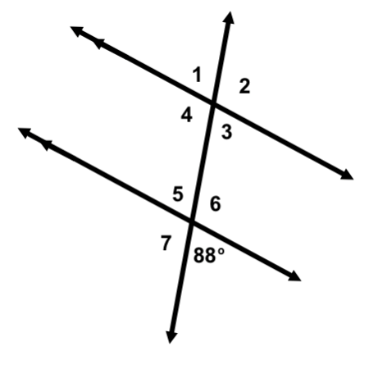
10)Given the two parallel lines cute by a transversal,
What is the measure of ∠5 ?
(a)

9) Given the following two parallel lines that have been cut by a transversal.
Choose all the options that represent corresponding angles.
∠3 and ∠8
∠2 and ∠7
∠6 and ∠4

8) Given the following two parallel lines that have been cut by a transversal.
∠1 and which angle make up Alternate Interior angles?
∠6
∠5
∠3
7) Given the following two parallel lines that have been cut by a transversal.
True or False, ∠6 and ∠4 are vertical angles?
False
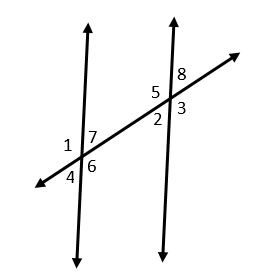
2) Given the following two parallel lines cut by a transversal.
Which pair of angles represents corresponding angles?
∠1 and ∠6
∠6 and ∠5
∠7 and ∠8
∠4 and ∠8
3) Given the following two parallel lines cut by a transversal.
Which pair of angles represents alternate interior angles?
∠3 and ∠8
∠7 and ∠2
∠7 and ∠8
∠4 and ∠8
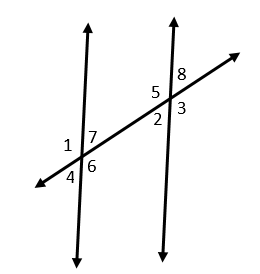
1) Given the two parallel lines cut by a transversal.
What is the vertical angle to angle 4?
Angle 2
Angle 6
Angle 8
Angle 7
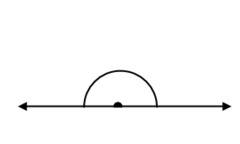
What type of angle is shown?
acute
obtuse
right
straight
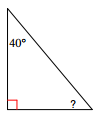
Find the measure of the missing angle.
90o
100
130o
50o

What angle corresponds to ∠3 ?
∠4
∠5
∠8
∠7
What angle corresponds to ∠7 ?
∠4
∠5
∠8
∠7
What angle corresponds to ∠6 ?
∠7
∠8
∠3
∠2
What angle is vertical to ∠1 ?
∠7
∠4
∠6
∠2
What angle is vertical to ∠5 ?
∠3
∠1
∠6
∠2
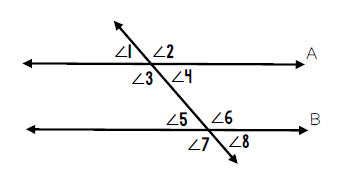
Angle 1 and Angle 5 are examples of which type of angle pair?
Alternate exterior angles
Alternate interior angles
Vertical angles
Corresponding angles
If the m∠7 = 115°, find the measure of ∠2.
115°
65°
180°
Cannot be determined
If the m∠5 = 63°, find the measure of ∠3.
63°
117°
180°
Cannot be determined

∠1 and ∠3 can best be described as -
complementary angles
supplementary angles
vertical angles
adjacent angles
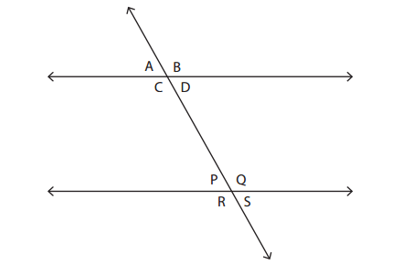
If angle P measures 60 degrees, what is the measure of angle C?
60 degrees
30 degrees
120 degrees
Which of the following angles would NOT be congruent to the measure of ∠7 ?
∠2
∠3
∠6
∠8
Which of the following is NOT an example of supplementary angles?
∠7 and ∠8
∠2 and ∠3
∠1 and ∠7
∠6 and ∠4
If the m∠1 = 57°, find the measure of ∠6.
123°
57°
180°
Cannot be determined

The angle relationship shown is -
complementary angles
supplementary angles
vertical angles
angle bisector
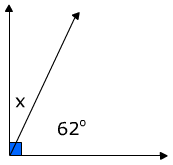
Find the value of x.
18°
28°
38°
118°
Two lines going the exact same way and will never intersect
Alternate exterior angles
Parallel lines
Alternate interior angles
Vertical lines

Identify the correct statement.
∠J=105°
∠J=75°
∠J=15°
∠J=90°
Find the value of x if the m∠1 = 11x − 9° and the m∠5 = 7x +9° .
-4.5
4.5
1
0

Find the measure of angle 1.
28o
136o
44o
6o

Solve for x.
41
-41
-9
-21
11) Given the two parallel lines cut by a transversal,
What is the measure of ∠4 if m∠8=76° ?
(a)
10)Given the two parallel lines cute by a transversal,
What is the measure of ∠5 ?
(a)
11) Given the two parallel lines cut by a transversal,
What is the measure of ∠4 if m∠8=76° ?
(a)
3) Given the following two parallel lines cut by a transversal.
Which pair of angles represents alternate interior angles?
∠3 and ∠8
∠7 and ∠2
∠7 and ∠8
∠4 and ∠8

∠2 & ∠6 are...
Supplementary angles
Vertical angles
Corresponding angles
Alternate interior angles
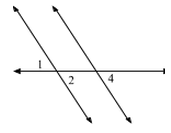
Angle 1 = 27o
Find the measure of angle 4
27o
153o
63o
90o

∠1 and ∠4
Vertical Angles
Linear Pair
Corresponding Angles
Transversal

What is it called when points lie on the same line.
Midpoint
Coplanear
Segment Bisector
Collinear
Given the following two parallel lines cut by a transversal.
Which pair of angles represents alternate exterior angles?
∠3 and ∠8
∠7 and ∠2
∠7 and ∠8
∠4 and ∠8
4) Given the following two parallel lines cut by a transversal.
Which pair of angles represents alternate exterior angles?
∠4 and ∠8
∠7 and ∠5
∠1 and ∠2
∠6 and ∠5
Choose the correct term described: A connected straight path that has no thickness and extends in opposite directions.
Point
Segment
Line
Plane

Find the m∠1
67
113
180
23
Which of the following angles would NOT be congruent to the measure of ∠7 ?
∠2
∠3
∠6
∠8

∠1 and ∠2 are ___.
Alternate Interior Angles
Alternate Exterior Angles
Same-side Interior Angles
Corresponding Angles
None of these
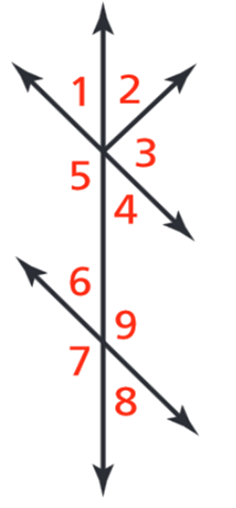
Which angle is a vertical angle to with ∠7 ?
∠1
∠5
∠3
∠6
∠9
Supplementary angles always add up to
(a)

Find the value of x.
x = 10
x = 20
x = 720
x = 5
A pair of angles that add up to 90º
Complementary
Complimentary
Supplementary

Find D
∠D=116°
∠D=64°
∠D=180°
∠D=26°
Same Side Interior angles...
Add to be 180
Are congruent
Add to be 90
Are equal
Angle 3 and Angle 6 are examples of which type of angle pair?
Alternate exterior angles
Alternate interior angles
Vertical angles
Corresponding angles
Angle 1 and Angle 5 are examples of which type of angle pair?
Alternate exterior angles
Alternate interior angles
Vertical angles
Corresponding angles
If the m∠7 = 115°, find the measure of ∠2.
115°
65°
180°
Cannot be determined
The angle relationship shown is -
complementary angles
supplementary angles
vertical angles
angle bisector
∠1 and ∠3 can best be described as -
complementary angles
supplementary angles
vertical angles
adjacent angles
Find the value of x.
18°
28°
38°
118°

What is the Angle Relationship
Alternate Interior
Alternate Exterior
Corresponding
Same Side-Interior

Solve for y.
y = 20
y = 120
y = 60
y = 10
Given the following two parallel lines cut by a transversal.
Which pair of angles represents corresponding angles?
∠1 and ∠6
∠6 and ∠5
∠7 and ∠8
∠4 and ∠8

If m∠1 = 30°, then m∠3 =
30°
60°
150°
undetermined

Angle C and P are...
Alternate Interior Angles
Consecutive Interior Angles
Corresponding Angles
Alternate Exterior Angles

Angle S and A are...
Alternate Interior Angles
Consecutive Interior Angles
Corresponding Angles
Alternate Exterior Angles

What is the value of x?
60
26
14
10

Lines r and s are cut by a transversal. What value of x proves r ∥ s?
43
37
143
37
Solve for x.
41
-41
-9
-21

What is the relationship of the angles?
Corresponding angles
Same Side Interior
Alternate Interior
Alternate Exterior

∠2 & ∠6 are...
Supplementary angles
Vertical angles
Corresponding angles
Alternate interior angles

Identify the angle relationship between angles 4 & 6
Corresponding
Alternate Interior
Alternate Exterior
Same-Side Interior
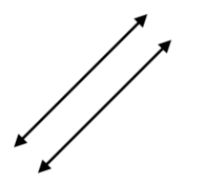
Parallel
Not Parallel
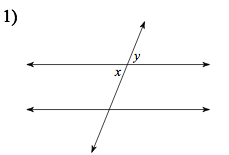
What is the relationship of the angles
Alternate Interior
Alternate Exterior
Corresponding
Vertical

What is the relationship of the Angles
Alternate Interior
Alternate Exterior
Corresponding
Same Side Interior
Two angles whose sum equals 180° are called...
supplementary angles.
obtuse angles.
complementary angles
a straight line.

x = _________
146° - supplementary angles.
34° - alternating exterior angles.
146° - same-side interior angles.
34° - supplementary angles.

x = ________
77° - alternating exterior angles.
103° - alternating interior angles.
77° - vertical angles.
103° - vertical angles.
Which of the following is NOT an example of supplementary angles?
∠7 and ∠8
∠2 and ∠3
∠1 and ∠7
∠6 and ∠4
If the ∠ find the measure of
∠7 and ∠8
∠2 and ∠3
∠1 and ∠7
Cannot be determined
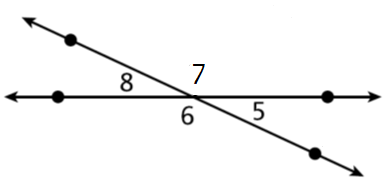
Which angles are vertical angles?
∠8 and ∠7
∠8 and ∠6
∠8 and ∠5
Which angle is a vertical angle to with ∠7 ?
∠1
∠5
∠3
∠6
∠9
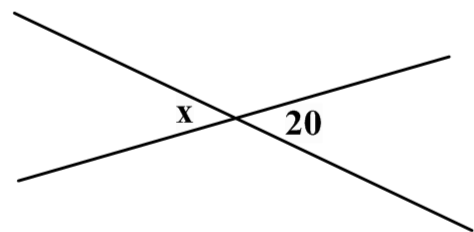
Find the missing angle. Find x.
20o
70o
160o
180o
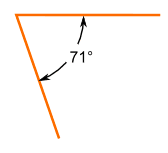
This is what kind of angle?
obtuse
right
straight
acute
Vertical angles are always
acute
total 180 degrees
congruent (equal measures)
adjacent angles
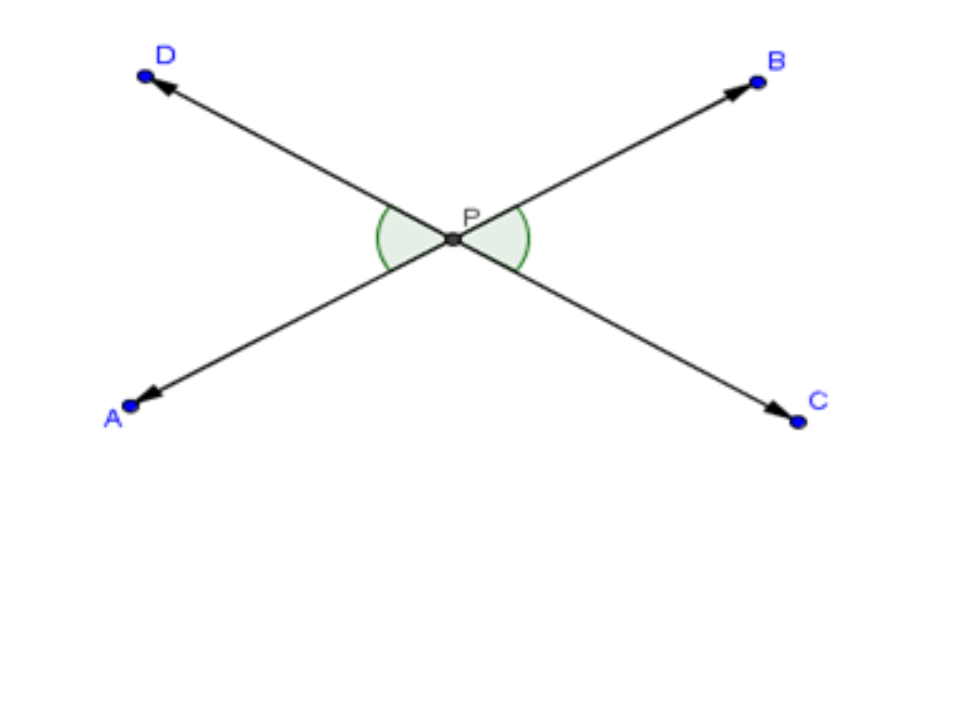
What angle pair is pictured?
Alternate Interior Angles
Supplementary Angles
Vertical Angles
Corresponding Angles
Angle 3 and Angle 6 are examples of which type of angle pair?
Alternate exterior angles
Alternate interior angles
Vertical angles
Corresponding angles
Angle 6 and Angle 7 are examples of which type of angle pair?
Alternate exterior angles
Alternate interior angles
Vertical angles
Corresponding angles
Which of the following angles would NOT be congruent to the measure of ∠7 ?
∠2
∠3
∠6
∠8
Which of the following is NOT an example of supplementary angles?
∠7 and ∠8
∠2 and ∠3
∠1 and ∠7
∠6 and ∠4
If the m∠7 = 115°, find the measure of ∠2.
115°
65°
180°
Cannot be determined
If the m∠5 = 63°, find the measure of ∠3.
63°
117°
180°
Cannot be determined
If the m∠1 = 57°, find the measure of ∠6.
123°
57°
180°
Cannot be determined
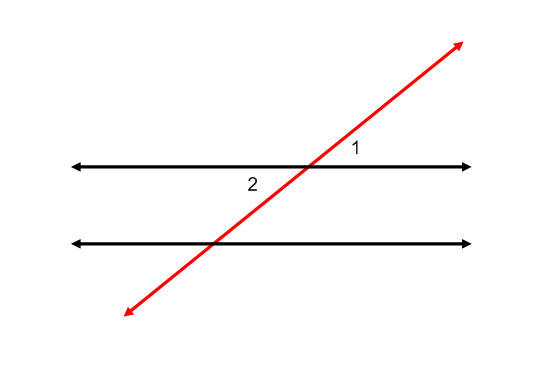
Name the angle relationship.
Alternate Interior
Alternate Exterior
Corresponding
Vertical Angles
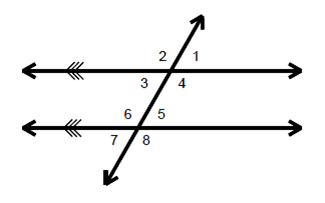
Name the alternate interior angle to angle 3.
4
5
6
8
1) Given the two parallel lines cut by a transversal.
What is the vertical angle to angle 4?
Angle 2
Angle 6
Angle 8
Angle 7
3) Given the following two parallel lines cut by a transversal.
Which pair of angles represents alternate interior angles?
∠3 and ∠8
∠7 and ∠2
∠7 and ∠8
∠4 and ∠8
If m∠1 = 30°, then m∠3 =
30°
60°
150°
undetermined

What is the value of x?
15
16
18
19

What is the measure of the missing angle?
39°
129°
119°
129°
Find the m∠1
67
113
180
23

