
 Worksheets
WH7 Mid
Total questions: 15
Worksheet time: 8mins
Name
Class
Date
1.
Archaeologists learn about prehistoric people by studying
a)
cave paintings.
b)
artifacts such as pottery.
c)
fossils and bones.
d)
modern hunter-gatherers.
2.
Important developments during the Paleolithic Age included
a)
control of fire.
b)
invention of the plow.
c)
development of spoken language.
d)
formation of governments.
3.
In what ways did humans adapt to the harsh conditions of the Ice Age?
a)
They migrated to warmer climates.
b)
They built sturdier shelters.
c)
They built permanent communities.
d)
They added more fat to their diet.
4.
Cave paintings from the Paleolithic Age show
a)
Animals
b)
Hunting
c)
Farming
d)
Handprints
5.
Governments developed in early human societies primarily to
a)
expand territory for farming.
b)
maintain law and order.
c)
protect people and resources.
d)
manage food surpluses and other resources.
6.
What did the Neolithic communities of Jericho and Çatalhüyük have in common?
a)
They both had a few thousand people.
b)
They both had houses that were built side by side.
c)
They both used the same writing system.
d)
They both used an irrigation system.
7.
Evidence found at different Neolithic sites shows that
a)
warriors guarded religious sites.
b)
people were often buried with their valuables.
c)
sacrifices were part of some Neolithic religious rituals.
d)
religion was important to both Paleolithic and Neolithic people.
8.
In the first civilizations, how was social status determined?
a)
type of work
b)
wealth
c)
artistic skill
d)
ability to write
9.
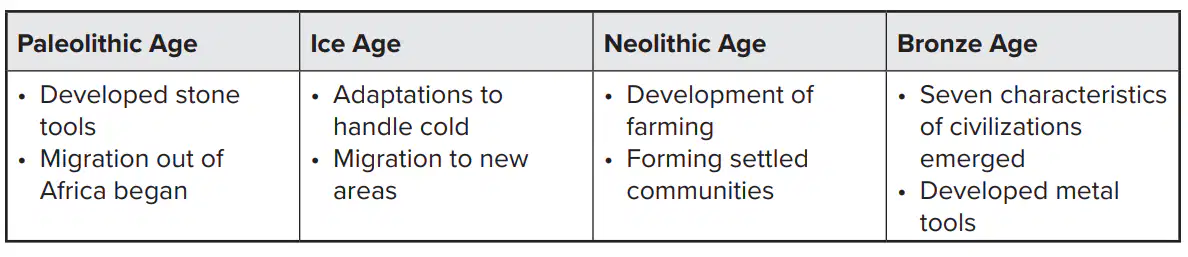
In which period shown in the chart did humans migrate to North America and Australia?
a)
Paleolithic Age
b)
Ice Age
c)
Neolithic Age
d)
Bronze Age
10.
Based on the map, what geographical feature did all four early civilizations have in common?
a)
coastal location
b)
location in river valleys
c)
closeness to the Equator
d)
location in Asia
11.
Based on the map, which two civilizations would most likely trade with each other using shipping along the Persian Gulf?
a)
Egypt and Mesopotamia
b)
Egypt and the Indus Valley
c)
Mesopotamia and the Indus Valley
d)
the Indus Valley and China
12.

What does the chart tell us about these recent hunter-gatherer societies? Choose all that apply.
a)
There are probably more sources of fruit in the Amazon than in northern coastal Australia.
b)
“Other animals” are more plentiful in northern coastal Australia than in the Amazon.
c)
There are more rivers and lakes in the Amazon than in northern coastal Australia.
d)
Animals are the biggest part of both groups’ diets.
13.
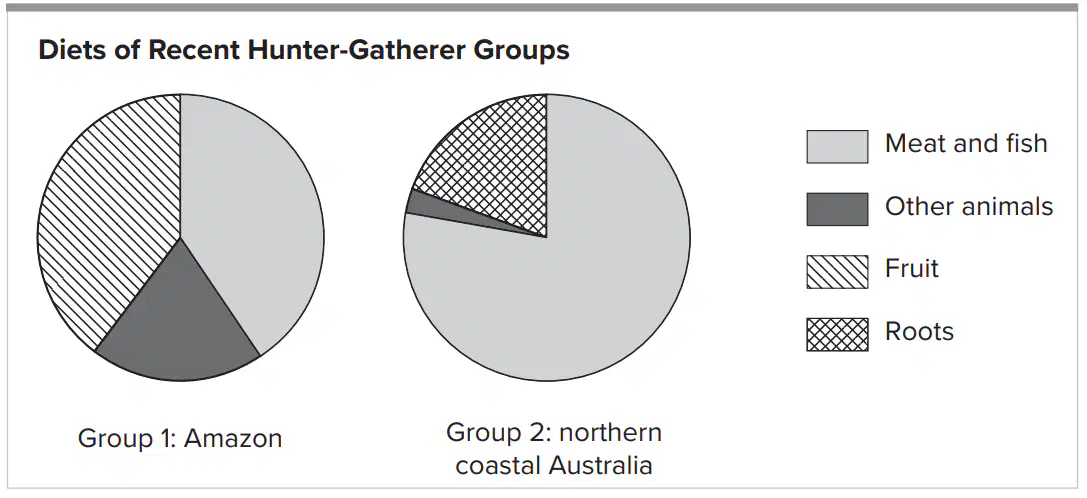
What assumption about prehistoric hunter-gatherers can be made based on this chart? Choose all that apply.
a)
Prehistoric humans did not need vegetables to be part of their diet.
b)
Prehistoric hunter-gatherer groups in different areas probably had different diets.
c)
Prehistoric hunter-gathers probably had meat as the main part of their diets.
d)
Prehistoric hunter-gathers did not trade foods with other nomadic groups.
14.
T or F? Bronze is an alloy made of a mixture of copper and tin.
a)
True
b)
False
15.
T or F? Seminomads hunt their food source, constantly on the move.
a)
True
b)
False
100 %

