
 Worksheets
WH9 Midterm Review
Total questions: 70
Worksheet time: 47mins
In a (a) , the leader is not a king and certain citizens have the right to vote.
A (a) is a type of government led by three people with equal power.
The Roman Republic, at times, could be led by a (a) , or absolute ruler
The Latin word emperor comes from (a) , the title for commander in the Roman Empire.
Rome fought Carthage in a series of conflicts known as the (a) Wars.
The Eastern Roman Empire, later known as the Byzantine Empire, was centered in the city of (a) .
Lepidus


What was the Pax Romana?
A Roman Goddess
A famous battle
A period of peace and prosperity
A legal code

The highest land owning social class in Rome, the men were allowed to vote and could serve in political positions
Macedonians
Helots
Plebeians
Patricians

Lower class of Romans, majority of the people, couldn't run for office most of the Republic
Plebeians
Patricians
Slaves
Helots
What was the most important social institution in Germanic custom?
the state
the village
the parish
the family
What caused Clovis to convert to Christianity?
the persistent appeals from his wife
a promise he made to Jesus Christ if he won a battle
a compromise with the pope in exchange for political support
the appearance of Jesus Christ in a dream
Pepin’s assumption of the kingship was significant because his actions
unified the Franks as one people
resulted in the defeat of Clovis
weakened the Roman Catholic Church
made the Carolingian Empire possible
The disintegration of the Carolingian Empire following Charlemagne’s death supports the conclusion that his
descendants were ineffective rulers
religious devotion was short-lived
army was unprepared to fight invaders
conquests were too difficult to hold
How did the Ostrogoths and Visigoths manage the territory they conquered in Italy and Spain?
They implemented a strict hierarchy dominated by local warrior-kings.
They empowered the Roman Catholic Church to administer local government operations.
They kept the Roman structure of government but excluded Romans from holding power.
They enforced traditional Germanic customs upon the native populations.
How did monks contribute to the Carolingian Renaissance?
by reproducing the works of classical authors
by extending their mission work to the Franks
by founding monasteries in Ireland and England
by teaching the emperor how to read and write
The primary purpose of the manorial system was to provide an economic structure that allowed lords to
uphold the local traditions
raise armies & fight wars
grow their own food
enslave landless laborers
Which statement supports the conclusion that peasants had little control over their daily lives?
They required permission to leave the lord’s estate.
They lived in small cottages made with timber and straw.
They worked on their lord’s estate three days a week.
They relied on the late summer harvest for survival.
In exchange for swearing an oath of loyalty, the nobles
held tournaments for entertainment
trained their knights’ sons
took care of their warriors’ needs
gave large sums of money to the church
The lord-vassal relationship
required military service
implied a sense of servitude
was governed by strict authoritarian rules
was between knights who served the king
Why was feudalism developed?
Lords reformed society by establishing a new code of behavior.
The church competed with local rulers for influence.
There was a need for a clear successor to the crown.
Rulers struggled to guarantee the safety of their subjects.
Two problems facing Western Europe following the death of Charlemagne include
disagreements over the roles of women and issues with succession
invasions from southern peoples and food shortages
religious divisions and the need to document the laws of feudalism
internal division and invasions from northern peoples
The agricultural practice known as the (a) allowed medieval farmers to rotate crops and leave less land fallow, which helped increase food production and contributed to population growth during the Middle Ages.
The Hanseatic League was instrumental in
forming a union between Belgium and France
protecting trade and promoting the economy in northern Europe
encouraging the production and the sale of silk and woolen cloth
devising the system of capitalism
What was one contribution of Thomas Aquinas to medieval thought?
He established the University of Naples.
He disputed the existence of God’s eternal law.
He reconciled Greek philosophy and Christian doctrine.
He translated Latin texts into German.
What was the economic consequence of the Black Death?
Increased demand for luxury goods caused trade to grow.
Decreased incomes and rents for feudal lords caused serfdom to expand.
Widespread crop shortages caused peasants to pay taxes with money.
Widespread labor shortages caused prices for workers to rise.
Arabia is a land best known for what type of climate?
cool, dry climate
hot, humid climate
harshness of its hot, dry desert landscape
Which of the 5 pillars deals with giving to the poor
Fasting
Prayer
Charity
Pilgrimage
Why did Muhammad move from Mecca to Medina?
He faced persecution in Mecca
He like Medina better
His army was defeated
He wanted to worship in Medina
Muhammad's flight from Mecca to Medina is called...
THe Quran
The Hajj
a pilgrimage
The Hijra
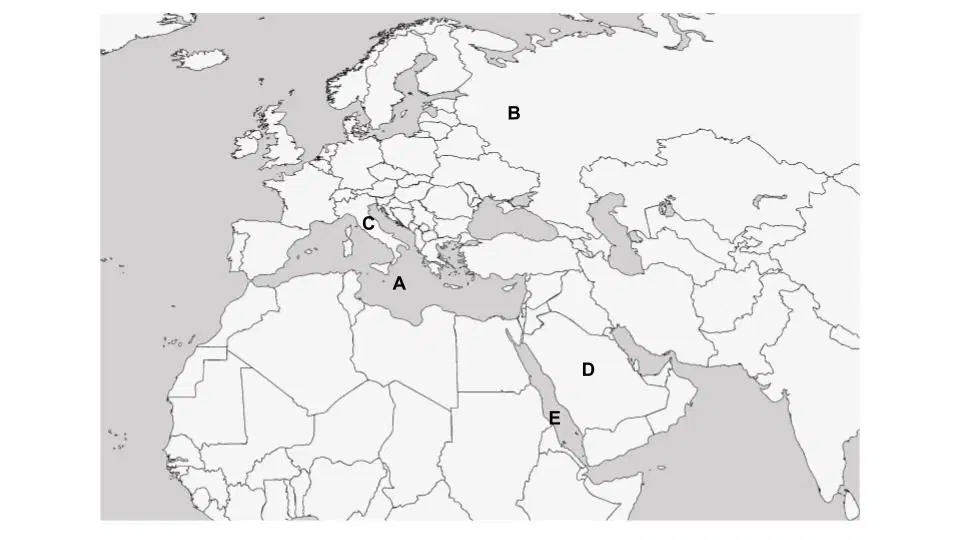
The letter E represents what body of water?
Black Sea
Red Sea
Caspian Sea
Mediterranean sea
What is the Quran?
The law of Islam
A religious community
The sacred book of Islam
The religious leader of Islam
What are the basic acts of worship, or duties, that Muslims must follow?
Four Noble Truths
The Five Pillars
The Eightfold path
Three Wise Sayings
What type of environment describes the Arabian Peninsula?
Rain Forest
Snowy mountains
Mild farm land
Dry desert
The building used for Muslim worship is called a
Mosque
Medina
Sunnah
Islam split into two branches known as
Sunni and Shi'ite
Sonny and Cher
Safavid and Ottoman
Muhammad and Allah
Why did Islam split into 2 branches?
Issue over who could succeed Muhammad
Issue over how to conquer new territories
Issues over Five Pillars of Islam
Issue over the teachings of the Qur'an
Where did Islam begin?
Arabian Peninsula
Iberian Peninsula
Australia
Europe
Which of the following is NOT considered part of the 5 pillars?
Fasting
Daily Prayer
Pilgrimage
Confession
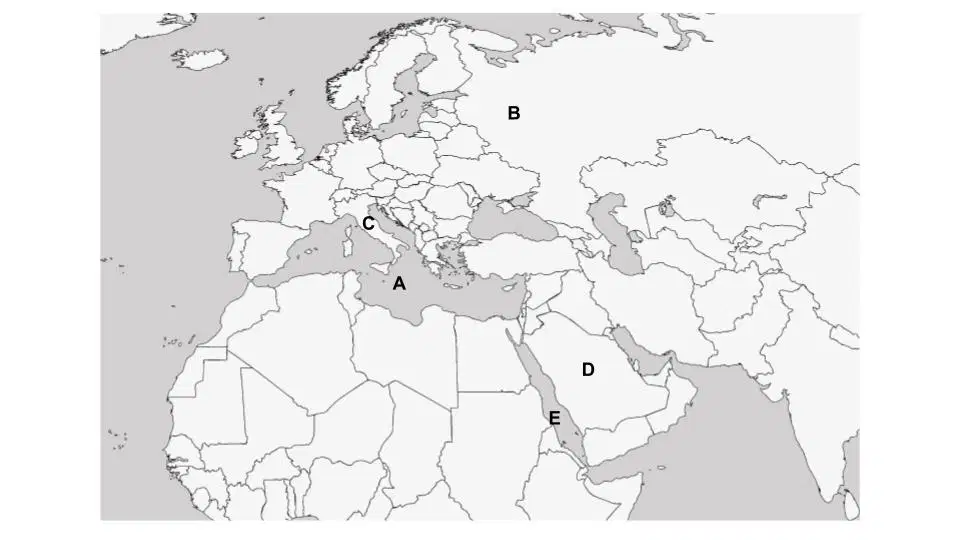
The Arabian Peninsula is located with the Letter
A
B
C
D
Which of the following is the Holy City of Islam?
Cairo
Makkah(Mecca)
Baghdad
Amritsar
Which of the following is considered the most important mosque in Makkah ( Mecca)?
Temple at the Wall
Ka'bah (kaaba)
St. Peters Cathedral
The Golden Temple at Amritsar
Which of the following is considered an important cultural and scholastic contributions of Islam?
Paper
Glass
Arabic numerals
The Alphabet

