
 Worksheets
3G4 MUSARTS
Total questions: 43
Worksheet time: 22mins
Who is Maria Makiling in the story?
A mountain guard who is a soldier
A traveling merchant from another city
A greedy witch who steals crops
A kind fairy who helps townspeople
Where did Maria Makiling visit to sell fruits?
A village in Cavite pier
A farm in Batangas fields
A city in Manila harbor
A town in Laguna marketplace
What did Maria do with the money she earned from selling fruit?
She saved it for a large house
She paid guards to protect her
She shared it among the poor
She bought jewelry for herself
Which detail shows why people thought Maria was different?
Her red cloak and silver sword
Her pet bird on her shoulder
Her loud voice and big shoes
Her beauty and flowing black hair
A young farmer followed Maria into the woods. What happened next?
He guided her safely to town
He found her and became rich
He married her the next market day
He lost her and never came back
What do old folks believe about Maria Makiling and the mountain today?
She sleeps under the sea forever
She turned the mountain into a city
She moved away and forgot the place
She still haunts and protects the mountain
If you go to the mountain, how can you show respect to the good fairy?
Wear bright colors to scare animals away
Sing loudly to call guides to help
Turn clothes inside out to show no fruits
Carry a map and compass for hiking
What warning is given about taking fruit from the mountain?
Dry fruit to make it last longer
Eat fruit there but do not bring it home
Trade fruit for directions and maps
Collect fruit and sell it in town

Which statement best describes folklore?
Scientific laws tested in a laboratory by experts
Beliefs, customs, and stories kept by a community
Modern news reports broadcast on television channels
Personal diaries written by one person about daily life

Which is NOT usually part of folklore?
Community beliefs and traditional practices
Tales, myths, legends, and fables shared widely
Rituals and ceremonies passed down in families
Computer codes used to run new video games

Why do communities preserve folklore?
To prove that every myth is scientifically correct
To replace all modern celebrations with ancient ones
To earn money from selling old story books
To keep cultural identity strong across generations
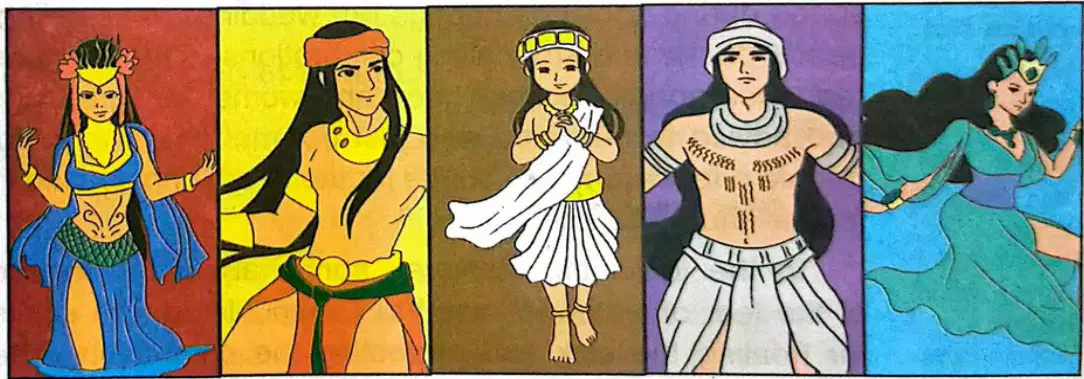
Look at the panel of Philippine folklore characters. What shared feature suggests they belong to the same cultural tradition?
All wearing school uniforms with badges
Identical hairstyles and face paint
Carrying the same modern electronic gadget
Similar traditional clothing and adornments
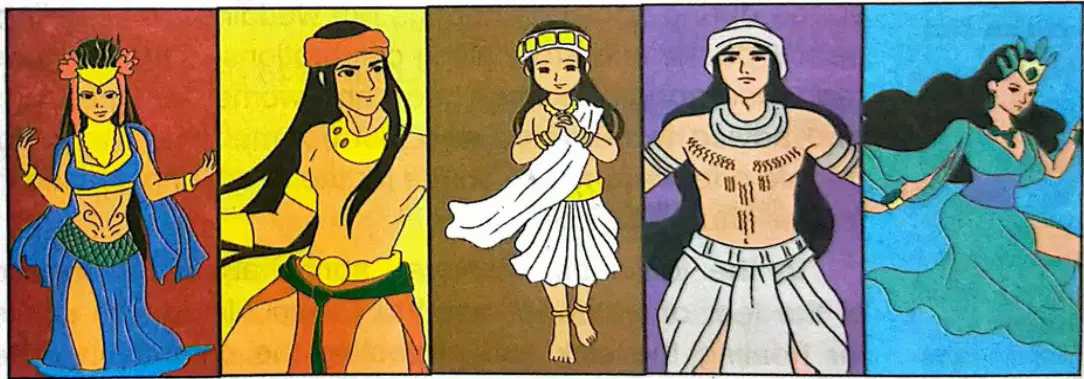
A class wants to create a mini-exhibit on Philippine folklore. Which plan would best show respect and accuracy?
Use illustrations with brief myths and cultural notes
Invent random characters with no background
Replace myths with unrelated superhero plots
Display only modern fashion photos from magazines
Which purpose best describes why indigenous groups use healing songs during rituals?
To help the sick recover health
To entertain during celebrations
To teach children new words
To keep time for work tasks
What is ceremonial chanting mainly used for by many tribes in the Philippines?
To mark special community events
To practice speaking faster
To scare away wild animals
To sell goods at the market
Which example shows music used to ward off spirits in a ritual?
Singing protective songs at night
Playing lullabies for babies
Humming softly while reading
Clapping hands during games
A ceremony is an activity performed by a person or people at a special time. Which activity best fits this description?
Doing homework quietly
Chanting together at a harvest
Walking alone to the store
Eating lunch after school
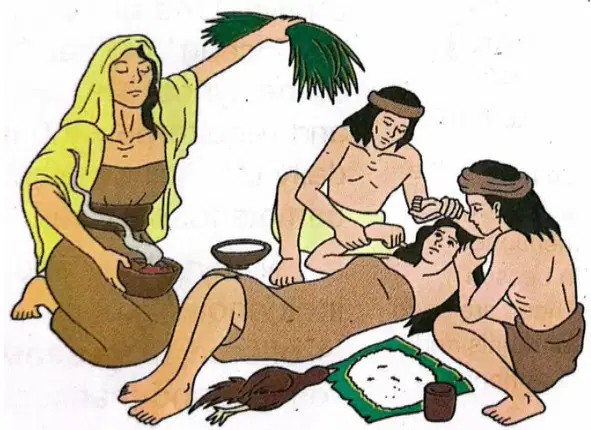
Look at the scene of people gathered around someone lying down with tools and leaves. What musical purpose is most likely shown?
Learning a new instrument
Performing a healing ritual
Preparing a dance class
Practicing for a concert
If a tribe wants success in hunting, which musical choice would they most likely make?
Sing a hunting ritual song
Play a birthday party tune
Chant a math lesson rhyme
Listen to travel music playlists
Which group in the highlands of Luzon is known for singing social songs during gatherings?
Ifugao of Visayas
Tagalog of Manila
Kalinga of Luzon
Maranao of Mindanao
During which events do Kalinga people commonly sing social songs?
Trading voyages and hunting
Harvest rituals and fishing
Weddings and counselling
Market days and farming
What is the main idea of Maranao neutrality songs?
Choosing sides in disputes
Encouraging revenge in conflicts
Staying neutral during conflicts
Calling elders to punish rivals
If two relatives are quarreling, what action matches the Maranao tradition taught in neutrality songs?
Join one relative’s side
Move the dispute to court
Avoid involvement in parties
Sing to shame both sides
How do musical rituals help with peace pacts and conflict resolution in these communities?
They start new arguments loudly
They celebrate hunting victories
They ban all singing in public
They guide behavior toward harmony
Which best describes how songs and chants help folkloric storytelling for children?
They connect us with past generations
They stop dancers from moving
They replace all spoken narration
They make stories only about music
What is sound imitation most useful for in myths and legends?
Teaching music theory to students
Showing how to read musical notes
Creating voices for mythical creatures
Making instruments louder than normal
A scene showing good and evil needs musical accompaniment. Which choice fits this purpose best?
Use contrasting tunes to show differences
Use only one gentle melody throughout
Play the same steady beat for all parts
Keep silence to avoid any feeling
You are telling a fable with animals. Which plan uses sound imitation effectively?
Play only drum patterns for minutes
Speak quietly with no sound effects
Sing one long song without changes
Imitate different animals you know

During a legend about a giant and a dwarf, which choice shows thoughtful planning with sound?
Same footsteps for both characters
Random loud noises without pattern
Deep heavy steps for giant, light quick steps for dwarf
High squeaky sounds for both characters
Which Philippine epic tells of Lam-ang avenging a water monster and later living happily with his love?
Biag ni Lam-ang from Ilocos
Hinilawod from Panay
Kandagoong from Mindanao
Ethno-epics from Luzon
Hinilawod is an epic from Panay Island. What does this suggest about Philippine folklore and music?
All epics share one melody
Music is not used in stories
Only Ilocos has musical epics
Epics come from different regions
Kandagoong, meaning “rain sounds,” shows a young man’s intention to ask for a lady’s hand even without the royal family’s gifts. What theme best fits this story?
Love and courage despite obstacles
Traveling across many islands
Battle and defeating sea beasts
Magic and returning from death
Which statement describes how music connects to these epics?
Music replaces all dialogue
Music stops the plot entirely
Music helps tell long stories
Music makes heroes invisible

A class wants to perform a short scene from Biag ni Lam-ang with music. Which plan uses music effectively?
Keep silence during exciting parts
Avoid music to save time
Play strong drums during the battle
Use random songs without meaning
You hear soft “rain” rhythms during a stage proposal scene inspired by Kandagoong. Why might the performers choose this sound?
To symbolize gentle hope in love
To show the hero fighting monsters
To hide the actors’ voices
To copy ocean waves exactly
Which statement best describes a melody in music?
A single drum hit repeated many times
Only the steady beat heard underneath
Random noises without any pattern
A group of sounds forming the main tune
Melody is made from two main elements. What are they?
Harmony and timbre mixed
Tempo and dynamics combined
Pitch and rhythm working together
Beat and silence alternating
What does pitch mean in a melody?
How long a note is held
How fast or slow the beat goes
How loud or soft the music is
How high or low a note sounds
Which example shows ascending melodic direction?
Notes change randomly without order
Notes jump down to lower tones
Notes stay on the same pitch
Notes move higher step by step
Which example shows descending melodic direction?
Notes move lower step by step
Notes repeat the exact same tone
Notes climb higher and higher
Notes get louder but stay level
When a melody repeats the same pitch several times, what is the direction called?
Repeated melodic direction
Mixed melodic direction
Descending melodic direction
Ascending melodic direction

You clap Ta a long, then Ta short, then Ta a long. What rhythm pattern are you making?
Long–long–long sequence
Short–long–short sequence
Short–short–short sequence
Long–short–long sequence

In the song Bahay Kubo, which action helps you feel the melody’s rhythm?
Clapping long and short syllables
Only listening without moving
Singing quietly with no beat
Playing one very loud note

